
2.4 Solve Mixture and Uniform Motion Applications
Solve Coin Word Problems
Using algebra to find the number of nickels and pennies in a piggy bank may seem silly. You may wonder why we just don’t open the bank and count them. But this type of problem introduces us to some techniques that will be useful as we move forward in our study of mathematics.
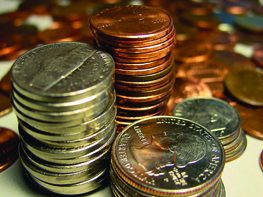
If we have a pile of dimes, how would we determine its value? If we count the number of dimes, we’ll know how many we have—the number of dimes. But this does not tell us the value of all the dimes. Say we counted 23 dimes, how much are they worth? Each dime is worth $0.10—that is the value of one dime. To find the total value of the pile of 23 dimes, multiply 23 by $0.10 to get $2.30.
The number of dimes times the value of each dime equals the total value of the dimes.
This method leads to the following model.
If we had several types of coins, we could continue this process for each type of coin, and then we would know the total value of each type of coin. To get the total value of all the coins, add the total value of each type of coin.
The steps for solving a coin word problem are summarized below.
Solve Ticket and Stamp Word Problems
Problems involving tickets or stamps are very much like coin problems. Each type of ticket and stamp has a value, just like each type of coin does. So to solve these problems, we will follow the same steps we used to solve coin problems.
In most of our examples so far, we have been told that one quantity is four more than twice the other, or something similar. In our next example, we have to relate the quantities in a different way.
Suppose Aniket sold a total of 100 tickets. Each ticket was either an adult ticket or a child ticket. If he sold 20 child tickets, how many adult tickets did he sell?
Did you say “80”? How did you figure that out? Did you subtract 20 from 100?
If he sold 45 child tickets, how many adult tickets did he sell?
Did you say “55”? How did you find it? By subtracting 45 from 100?
Now, suppose Aniket sold x child tickets. Then how many adult tickets did he sell? To find out, we would follow the same logic we used above. In each case, we subtracted the number of child tickets from 100 to get the number of adult tickets. We now do the same with x.
We have summarized this in the table.
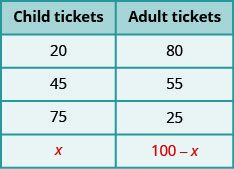
We will apply this technique in the next example.
Solve Mixture Word Problems
Now we’ll solve some more general applications of the mixture model. In mixture problems, we are often mixing two quantities, such as raisins and nuts, to create a mixture, such as trail mix. In our tables we will have a row for each item to be mixed as well as one for the final mixture.
Solve Uniform Motion Applications
When you are driving down the interstate using your cruise control, the speed of your car stays the same—it is uniform. We call a problem in which the speed of an object is constant a uniform motion application. We will use the distance, rate, and time formula, to compare two scenarios, such as two vehicles travelling at different rates or in opposite directions.
Our problem solving strategies will still apply here, but we will add to the first step. The first step will include drawing a diagram that shows what is happening in the example. Drawing the diagram helps us understand what is happening so that we will write an appropriate equation. Then we will make a table to organize the information, like we did for the coin, ticket, and stamp applications.
The steps are listed here for easy reference:
In Example 5, we had two bikers traveling the same distance. In the next example, two people drive toward each other until they meet.
As you read the next example, think about the relationship of the distances traveled. Which of the previous two examples is more similar to this situation?
It is important to make sure that the units match when we use the distance rate and time formula. For instance, if the rate is in miles per hour, then the time must be in hours.
In the distance, rate and time formula, time represents the actual amount of elapsed time (in hours, minutes, etc.). If a problem gives us starting and ending times as clock times, we must find the elapsed time in order to use the formula.
Key Concepts
- Total Value of Coins
For the same type of coin, the total value of a number of coins is found by using the model
- number is the number of coins
- value is the value of each coin
- total value is the total value of all the coins
- How to solve coin word problems.
- Read the problem. Make sure all the words and ideas are understood.
Determine the types of coins involved.
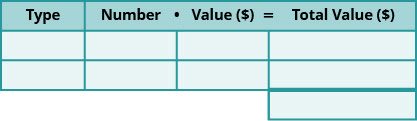
Create a table to organize the information.
Label the columns “type,” “number,” “value,” “total value.”
List the types of coins.
Write in the value of each type of coin.
Write in the total value of all the coins.
- Identify what you are looking for.
- Name what you are looking for. Choose a variable to represent that quantity.
Use variable expressions to represent the number of each type of coin and write them in the table.
Multiply the number times the value to get the total value of each type of coin. - Translate into an equation.
It may be helpful to restate the problem in one sentence with all the important information. Then, translate the sentence into an equation.
Write the equation by adding the total values of all the types of coins. - Solve the equation using good algebra techniques.
- Check the answer in the problem and make sure it makes sense.
- Answer the question with a complete sentence.
- Read the problem. Make sure all the words and ideas are understood.
- How To Solve a Uniform Motion Application
- Read the problem. Make sure all the words and ideas are understood.
Draw a diagram to illustrate what it happening.
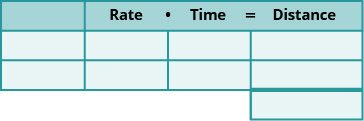
Create a table to organize the information.
Label the columns rate, time, distance.
List the two scenarios.
Write in the information you know.
- Identify what you are looking for.
- Name what you are looking for. Choose a variable to represent that quantity.
Complete the chart.
Use variable expressions to represent that quantity in each row.
Multiply the rate times the time to get the distance. - Translate into an equation.
Restate the problem in one sentence with all the important information.
Then, translate the sentence into an equation. - Solve the equation using good algebra techniques.
- Check the answer in the problem and make sure it makes sense.
- Answer the question with a complete sentence.
- Read the problem. Make sure all the words and ideas are understood.
Practice Makes Perfect
Solve Coin Word Problems
In the following exercises, solve each coin word problem.
Michaela has $2.05 in dimes and nickels in her change purse. She has seven more dimes than nickels. How many coins of each type does she have?
nine nickels, 16 dimes
Liliana has $2.10 in nickels and quarters in her backpack. She has 12 more nickels than quarters. How many coins of each type does she have?
In a cash drawer there is $125 in $5 and $10 bills. The number of $10 bills is twice the number of $5 bills. How many of each type of bill is in the drawer?
ten $10 bills, five $5 bills
Sumanta has $175 in $5 and $10 bills in his drawer. The number of $5 bills is three times the number of $10 bills. How many of each are in the drawer?
Chi has $11.30 in dimes and quarters. The number of dimes is three more than three times the number of quarters. How many of each are there?
63 dimes, 20 quarters
Alison has $9.70 in dimes and quarters. The number of quarters is eight more than four times the number of dimes. How many of each coin does she have?
Mukul has $3.75 in quarters, dimes and nickels in his pocket. He has five more dimes than quarters and nine more nickels than quarters. How many of each coin are in his pocket?
16 nickels, 12 dimes, seven quarters
Vina has $4.70 in quarters, dimes and nickels in her purse. She has eight more dimes than quarters and six more nickels than quarters. How many of each coin are in her purse?
Solve Ticket and Stamp Word Problems
In the following exercises, solve each ticket or stamp word problem.
The first day of a water polo tournament the total value of tickets sold was $17,610. One-day passes sold for $20 and tournament passes sold for $30. The number of tournament passes sold was 37 more than the number of day passes sold. How many day passes and how many tournament passes were sold?
330 day passes, 367 tournament passes
At the movie theater, the total value of tickets sold was $2,612.50. Adult tickets sold for $10 each and senior/child tickets sold for $7.50 each. The number of senior/child tickets sold was 25 less than twice the number of adult tickets sold. How many senior/child tickets and how many adult tickets were sold?
Julie went to the post office and bought both $0.41 stamps and $0.26 postcards. She spent $51.40. The number of stamps was 20 more than twice the number of postcards. How many of each did she buy?
40 postcards, 100 stamps
Jason went to the post office and bought both $0.41 stamps and $0.26 postcards and spent $10.28 The number of stamps was four more than twice the number of postcards. How many of each did he buy?
Hilda has $210 worth of $10 and $12 stock shares. The number of $10 shares is five more than twice the number of $12 shares. How many of each type of share does she have?
15 $10 shares, five $12 shares
Mario invested $475 in $45 and $25 stock shares. The number of $25 shares was five less than three times the number of $45 shares. How many of each type of share did he buy?
The ice rink sold 95 tickets for the afternoon skating session, for a total of $828. General admission tickets cost $10 each and youth tickets cost $8 each. How many general admission tickets and how many youth tickets were sold?
34 general, 61 youth
For the 7:30 show time, 140 movie tickets were sold. Receipts from the $13 adult tickets and the $10 senior tickets totaled $1,664. How many adult tickets and how many senior tickets were sold?
The box office sold 360 tickets to a concert at the college. The total receipts were $4,170. General admission tickets cost $15 and student tickets cost $10. How many of each kind of ticket was sold?
114 general, 246 student
Last Saturday, the museum box office sold 281 tickets for a total of $3,954. Adult tickets cost $15 and student tickets cost $12. How many of each kind of ticket was sold?
Solve Mixture Word Problems
In the following exercises, solve each mixture word problem.
Macario is making 12 pounds of nut mixture with macadamia nuts and almonds. Macadamia nuts cost $9 per pound and almonds cost $5.25 per pound. How many pounds of macadamia nuts and how many pounds of almonds should Macario use for the mixture to cost $6.50 per pound to make?
Four pounds of macadamia nuts, eight pounds almonds
Carmen wants to tile the floor of his house. He will need 1,000 square feet of tile. He will do most of the floor with a tile that costs $1.50 per square foot, but also wants to use an accent tile that costs $9.00 per square foot. How many square feet of each tile should he plan to use if he wants the overall cost to be $3 per square foot?
Riley is planning to plant a lawn in his yard. He will need nine pounds of grass seed. He wants to mix Bermuda seed that costs $4.80 per pound with Fescue seed that costs $3.50 per pound. How much of each seed should he buy so that the overall cost will be $4.02 per pound?
lbs Bermuda seed, lbs Fescue seed
Vartan was paid $25,000 for a cell phone app that he wrote and wants to invest it to save for his son’s education. He wants to put some of the money into a bond that pays 4% annual interest and the rest into stocks that pay 9% annual interest. If he wants to earn 7.4% annual interest on the total amount, how much money should he invest in each account?
Vern sold his 1964 Ford Mustang for $55,000 and wants to invest the money to earn him 5.8% interest per year. He will put some of the money into Fund A that earns 3% per year and the rest in Fund B that earns 10% per year. How much should he invest into each fund if he wants to earn 5.8% interest per year on the total amount?
$33,000 in Fund A, $22,000 in Fund B
Dominic pays 7% interest on his $15,000 college loan and 12% interest on his $11,000 car loan. What average interest rate does he pay on the total $26,000 he owes? (Round your answer to the nearest tenth of a percent.)
Liam borrowed a total of $35,000 to pay for college. He pays his parents 3% interest on the $8,000 he borrowed from them and pays the bank 6.8% on the rest. What average interest rate does he pay on the total $35,000? (Round your answer to the nearest tenth of a percent.)
Solve Uniform Motion Applications
In the following exercises, solve.
Lilah is moving from Portland to Seattle. It takes her three hours to go by train. Mason leaves the train station in Portland and drives to the train station in Seattle with all Lilah’s boxes in his car. It takes him 2.4 hours to get to Seattle, driving at 15 miles per hour faster than the speed of the train. Find Mason’s speed and the speed of the train.
Kathy and Cheryl are walking in a fundraiser. Kathy completes the course in 4.8 hours and Cheryl completes the course in eight hours. Kathy walks two miles per hour faster than Cheryl. Find Kathy’s speed and Cheryl’s speed.
Kathy 5 mph, Cheryl 3 mph
Two busses go from Sacramento to San Diego. The express bus makes the trip in 6.8 hours and the local bus takes 10.2 hours for the trip. The speed of the express bus is 25 mph faster than the speed of the local bus. Find the speed of both busses.
A commercial jet and a private airplane fly from Denver to Phoenix. It takes the commercial jet 1.6 hours for the flight, and it takes the private airplane 2.6 hours. The speed of the commercial jet is 210 miles per hour faster than the speed of the private airplane. Find the speed of both airplanes to the nearest 10 mph.
commercial 550 mph, private plane 340 mph
Saul drove his truck three hours from Dallas towards Kansas City and stopped at a truck stop to get dinner. At the truck stop he met Erwin, who had driven four hours from Kansas City towards Dallas. The distance between Dallas and Kansas City is 542 miles, and Erwin’s speed was eight miles per hour slower than Saul’s speed. Find the speed of the two truckers.
Charlie and Violet met for lunch at a restaurant between Memphis and New Orleans. Charlie had left Memphis and drove 4.8 hours towards New Orleans. Violet had left New Orleans and drove two hours towards Memphis, at a speed 10 miles per hour faster than Charlie’s speed. The distance between Memphis and New Orleans is 394 miles. Find the speed of the two drivers.
Violet 65 mph, Charlie 55 mph
Sisters Helen and Anne live 332 miles apart. For Thanksgiving, they met at their other sister’s house partway between their homes. Helen drove 3.2 hours and Anne drove 2.8 hours. Helen’s average speed was four miles per hour faster than Anne’s. Find Helen’s average speed and Anne’s average speed.
Ethan and Leo start riding their bikes at the opposite ends of a 65-mile bike path. After Ethan has ridden 1.5 hours and Leo has ridden two hours, they meet on the path. Ethan’s speed is six miles per hour faster than Leo’s speed. Find the speed of the two bikers.
Ethan 22 mph, Leo 16 mph
Elvira and Aletheia live 3.1 miles apart on the same street. They are in a study group that meets at a coffee shop between their houses. It took Elvira half an hour and Aletheia two-thirds of an hour to walk to the coffee shop. Aletheia’s speed is 0.6 miles per hour slower than Elvira’s speed. Find both women’s walking speeds.
DaMarcus and Fabian live 23 miles apart and play soccer at a park between their homes. DaMarcus rode his bike for three-quarters of an hour and Fabian rode his bike for half an hour to get to the park. Fabian’s speed was six miles per hour faster than DaMarcus’ speed. Find the speed of both soccer players.
DaMarcus 16 mph, Fabian 22 mph
Cindy and Richard leave their dorm in Charleston at the same time. Cindy rides her bicycle north at a speed of 18 miles per hour. Richard rides his bicycle south at a speed of 14 miles per hour. How long will it take them to be 96 miles apart?
Matt and Chris leave their uncle’s house in Phoenix at the same time. Matt drives west on I-60 at a speed of 76 miles per hour. Chris drives east on I-60 at a speed of 82 miles per hour. How many hours will it take them to be 632 miles apart?
four hours
Two busses leave Billings at the same time. The Seattle bus heads west on I-90 at a speed of 73 miles per hour while the Chicago bus heads east at a speed of 79 miles an hour. How many hours will it take them to be 532 miles apart?
Two boats leave the same dock in Cairo at the same time. One heads north on the Mississippi River while the other heads south. The northbound boat travels four miles per hour. The southbound boat goes eight miles per hour. How long will it take them to be 54 miles apart?
4.5 hours
Lorena walks the path around the park in 30 minutes. If she jogs, it takes her 20 minutes. Her jogging speed is 1.5 miles per hour faster than her walking speed. Find Lorena’s walking speed and jogging speed.
Julian rides his bike uphill for 45 minutes, then turns around and rides back downhill. It takes him 15 minutes to get back to where he started. His uphill speed is 3.2 miles per hour slower than his downhill speed. Find Julian’s uphill and downhill speed.
uphill mph, downhill mph
Cassius drives his boat upstream for 45 minutes. It takes him 30 minutes to return downstream. His speed going upstream is three miles per hour slower than his speed going downstream. Find his upstream and downstream speeds.
It takes Darline 20 minutes to drive to work in light traffic. To come home, when there is heavy traffic, it takes her 36 minutes. Her speed in light traffic is 24 miles per hour faster than her speed in heavy traffic. Find her speed in light traffic and in heavy traffic.
light traffic 54 mph, heavy traffic 30 mph
At 1:30, Marlon left his house to go to the beach, a distance of 7.6 miles. He rode his skateboard until 2:15, and then walked the rest of the way. He arrived at the beach at 3:00. Marlon’s speed on his skateboard is 2.5 times his walking speed. Find his speed when skateboarding and when walking.
Aaron left at 9:15 to drive to his mountain cabin 108 miles away. He drove on the freeway until 10:45 and then drove on a mountain road. He arrived at 11:05. His speed on the freeway was three times his speed on the mountain road. Find Aaron’s speed on the freeway and on the mountain road.
freeway 67 mph, mountain road 22.3 mph
Marisol left Los Angeles at 2:30 to drive to Santa Barbara, a distance of 95 miles. The traffic was heavy until 3:20. She drove the rest of the way in very light traffic and arrived at 4:20. Her speed in heavy traffic was 40 miles per hour slower than her speed in light traffic. Find her speed in heavy traffic and in light traffic.
Lizette is training for a marathon. At 7:00 she left her house and ran until 8:15 then she walked until 11:15. She covered a total distance of 19 miles. Her running speed was five miles per hour faster than her walking speed. Find her running and walking speeds.
running eight mph, walking three mph
Everyday Math
John left his house in Irvine at 8:35 a.m. to drive to a meeting in Los Angeles, 45 miles away. He arrived at the meeting at 9:50 a.m.. At 5:30 p.m. he left the meeting and drove home. He arrived home at 7:18 p.m.
ⓐ What was his average speed on the drive from Irvine to Los Angeles?
ⓑ What was his average speed on the drive from Los Angeles to Irvine?
ⓒ What was the total time he spent driving to and from this meeting?
Sarah wants to arrive at her friend’s wedding at 3:00. The distance from Sarah’s house to the wedding is 95 miles. Based on usual traffic patterns, Sarah predicts she can drive the first 15 miles at 60 miles per hour, the next 10 miles at 30 miles per hour, and the remainder of the drive at 70 miles per hour.
ⓐ How long will it take Sarah to drive the first 15 miles?
ⓑ How long will it take Sarah to drive the next 10 miles?
ⓒ How long will it take Sarah to drive the rest of the trip?
ⓓ What time should Sarah leave her house?
ⓐ 15 minutes ⓑ 20 minutes ⓒ one hour (d) 1:25
Writing Exercises
Suppose you have six quarters, nine dimes, and four pennies. Explain how you find the total value of all the coins.
Do you find it helpful to use a table when solving coin problems? Why or why not?
Answers will vary.
In the table used to solve coin problems, one column is labeled “number” and another column is labeled “value.” What is the difference between the “number” and the “value”?
When solving a uniform motion problem, how does drawing a diagram of the situation help you?
Answers will vary.
Self Check
ⓐ After completing the exercises, use this checklist to evaluate your mastery of the objectives of this section.
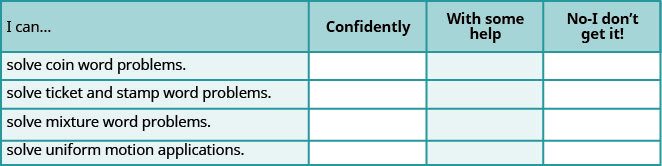
ⓑ On a scale of 1-10, how would you rate your mastery of this section in light of your responses on the checklist? How can you improve this?
Adapted from Intermediate Algebra 2e by OpenStax (openstax.org), licensed under CC BY-NC-SA 4.0. Changes were made. License: CC-BY-NC-SA-4.0.