
8.4 Add and Subtract Rational Expressions with Unlike Denominators
Find the Least Common Denominator of Rational Expressions
When we add or subtract rational expressions with unlike denominators we will need to get common denominators. If we review the procedure we used with numerical fractions, we will know what to do with rational expressions.
Let’s look at the example from Foundations. Since the denominators are not the same, the first step was to find the least common denominator (LCD). Remember, the LCD is the least common multiple of the denominators. It is the smallest number we can use as a common denominator.
To find the LCD of 12 and 18, we factored each number into primes, lining up any common primes in columns. Then we “brought down” one prime from each column. Finally, we multiplied the factors to find the LCD.
We do the same thing for rational expressions. However, we leave the LCD in factored form.
Find Equivalent Rational Expressions
When we add numerical fractions, once we find the LCD, we rewrite each fraction as an equivalent fraction with the LCD.
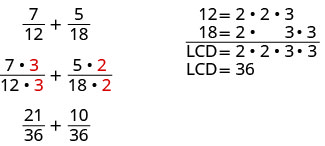
We will do the same thing for rational expressions.
Add Rational Expressions with Different Denominators
Now we have all the steps we need to add rational expressions with different denominators. As we have done previously, we will do one example of adding numerical fractions first.
Now we will add rational expressions whose denominators are monomials.
Now we are ready to tackle polynomial denominators.
The steps to use to add rational expressions are summarized in the following procedure box.
Avoid the temptation to simplify too soon! In the example above, we must leave the first rational expression as to be able to add it to . Simplify only after you have combined the numerators.
Subtract Rational Expressions with Different Denominators
The process we use to subtract rational expressions with different denominators is the same as for addition. We just have to be very careful of the signs when subtracting the numerators.
The steps to take to subtract rational expressions are listed below.
There are lots of negative signs in the next example. Be extra careful!
When one expression is not in fraction form, we can write it as a fraction with denominator 1.
We follow the same steps as before to find the LCD when we have more than two rational expressions. In the next example we will start by factoring all three denominators to find their LCD.
Key Concepts
- Find the Least Common Denominator of Rational Expressions
- Factor each expression completely.
- List the factors of each expression. Match factors vertically when possible.
- Bring down the columns.
- Multiply the factors.
- Add or Subtract Rational Expressions
- Determine if the expressions have a common denominator.
Yes – go to step 2.
No – Rewrite each rational expression with the LCD.- Find the LCD.
- Rewrite each rational expression as an equivalent rational expression with the LCD.
- Add or subtract the rational expressions.
- Simplify, if possible.
- Determine if the expressions have a common denominator.
Practice Makes Perfect
In the following exercises, find the LCD.
In the following exercises, write as equivalent rational expressions with the given LCD.
LCD
LCD
LCD
LCD
LCD
LCD
LCD
LCD
In the following exercises, add.
In the following exercises, subtract.
In the following exercises, add and subtract.
In the following exercises, simplify.
Everyday Math
Decorating cupcakes Victoria can decorate an order of cupcakes for a wedding in hours, so in 1 hour she can decorate of the cupcakes. It would take her sister 3 hours longer to decorate the same order of cupcakes, so in 1 hour she can decorate of the cupcakes.
- ⓐ Find the fraction of the decorating job that Victoria and her sister, working together, would complete in one hour by adding the rational expressions
- ⓑ Evaluate your answer to part (a) when
ⓐ ⓑ
Kayaking When Trina kayaks upriver, it takes her hours to go 5 miles, where is the speed of the river current. It takes her hours to kayak 5 miles down the river.
- ⓐ Find an expression for the number of hours it would take Trina to kayak 5 miles up the river and then return by adding
- ⓑ Evaluate your answer to part (a) when to find the number of hours it would take Trina if the speed of the river current is 1 mile per hour.
Writing Exercises
Felipe thinks is
- ⓐ Choose numerical values for x and y and evaluate
- ⓑ Evaluate for the same values of x and y you used in part (a).
- ⓒ Explain why Felipe is wrong.
- ⓓ Find the correct expression for
Answers may vary.
Simplify the expression and explain all your steps.
Self Check
ⓐ After completing the exercises, use this checklist to evaluate your mastery of the objectives of this section.
ⓑ On a scale of 1-10, how would you rate your mastery of this section in light of your responses on the checklist? How can you improve this?