
8.1 Simplify Rational Expressions
In Chapter 1, we reviewed the properties of fractions and their operations. We introduced rational numbers, which are just fractions where the numerators and denominators are integers, and the denominator is not zero.
In this chapter, we will work with fractions whose numerators and denominators are polynomials. We call these rational expressions.
Remember, division by 0 is undefined.
Here are some examples of rational expressions:
Notice that the first rational expression listed above, is just a fraction. Since a constant is a polynomial with degree zero, the ratio of two constants is a rational expression, provided the denominator is not zero.
We will perform the same operations with rational expressions that we do with fractions. We will simplify, add, subtract, multiply, divide, and use them in applications.
Determine the Values for Which a Rational Expression is Undefined
When we work with a numerical fraction, it is easy to avoid dividing by zero, because we can see the number in the denominator. In order to avoid dividing by zero in a rational expression, we must not allow values of the variable that will make the denominator be zero.
If the denominator is zero, the rational expression is undefined. The numerator of a rational expression may be 0—but not the denominator.
So before we begin any operation with a rational expression, we examine it first to find the values that would make the denominator zero. That way, when we solve a rational equation for example, we will know whether the algebraic solutions we find are allowed or not.
Evaluate Rational Expressions
To evaluate a rational expression, we substitute values of the variables into the expression and simplify, just as we have for many other expressions in this book.
Remember that a fraction is simplified when it has no common factors, other than 1, in its numerator and denominator. When we evaluate a rational expression, we make sure to simplify the resulting fraction.
Simplify Rational Expressions
Just like a fraction is considered simplified if there are no common factors, other than 1, in its numerator and denominator, a rational expression is simplified if it has no common factors, other than 1, in its numerator and denominator.
For example:
- is simplified because there are no common factors of 2 and 3.
- is not simplified because x is a common factor of 2x and 3x.
We use the Equivalent Fractions Property to simplify numerical fractions. We restate it here as we will also use it to simplify rational expressions.
Notice that in the Equivalent Fractions Property, the values that would make the denominators zero are specifically disallowed. We see clearly stated. Every time we write a rational expression, we should make a similar statement disallowing values that would make a denominator zero. However, to let us focus on the work at hand, we will omit writing it in the examples.
Let’s start by reviewing how we simplify numerical fractions.
Throughout this chapter, we will assume that all numerical values that would make the denominator be zero are excluded. We will not write the restrictions for each rational expression, but keep in mind that the denominator can never be zero. So in this next example, and .
To simplify rational expressions we first write the numerator and denominator in factored form. Then we remove the common factors using the Equivalent Fractions Property.
Be very careful as you remove common factors. Factors are multiplied to make a product. You can remove a factor from a product. You cannot remove a term from a sum.
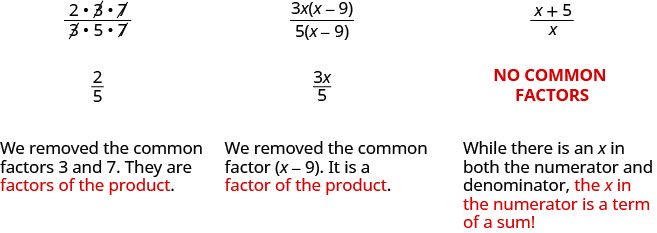
Note that removing the x’s from would be like cancelling the 2’s in the fraction !
We now summarize the steps you should follow to simplify rational expressions.
Usually, we leave the simplified rational expression in factored form. This way it is easy to check that we have removed all the common factors!
We’ll use the methods we covered in Factoring to factor the polynomials in the numerators and denominators in the following examples.
Simplify Rational Expressions with Opposite Factors
Now we will see how to simplify a rational expression whose numerator and denominator have opposite factors. Let’s start with a numerical fraction, say . We know this fraction simplifies to . We also recognize that the numerator and denominator are opposites.
In Foundations, we introduced opposite notation: the opposite of is . We remember, too, that .
We simplify the fraction , whose numerator and denominator are opposites, in this way:
So, in the same way, we can simplify the fraction :
But the opposite of could be written differently:
This means the fraction simplifies to .
In general, we could write the opposite of as . So the rational expression simplifies to .
We will use this property to simplify rational expressions that contain opposites in their numerators and denominators.
Remember, the first step in simplifying a rational expression is to factor the numerator and denominator completely.
Key Concepts
- Determine the Values for Which a Rational Expression is Undefined
- Set the denominator equal to zero.
- Solve the equation, if possible.
- Simplified Rational Expression
- A rational expression is considered simplified if there are no common factors in its numerator and denominator.
- Simplify a Rational Expression
- Factor the numerator and denominator completely.
- Simplify by dividing out common factors.
- Opposites in a Rational Expression
- The opposite of is .
- The opposite of is .
Practice Makes Perfect
In the following exercises, determine the values for which the rational expression is undefined.
ⓐ ⓑ ⓒ
ⓐ ⓑ ⓒ
ⓐ ⓑ ⓒ
ⓐ ⓑ ⓒ
ⓐ ⓑ ⓒ
ⓐ ⓑ ⓒ
Evaluate Rational Expressions
In the following exercises, evaluate the rational expression for the given values.
ⓐ ⓑ ⓒ
ⓐ ⓑ ⓒ
ⓐ ⓑ ⓒ
ⓐ ⓑ ⓒ
ⓐ ⓑ ⓒ
ⓐ ⓑ ⓒ
ⓐ ⓑ ⓒ
ⓐ ⓑ ⓒ
ⓐ ⓑ ⓒ
ⓐ ⓑ ⓒ
ⓐ ⓑ ⓒ
ⓐ ⓑ ⓒ
- ⓐ
- ⓑ
- ⓒ
ⓐ ⓑ ⓒ
- ⓐ
- ⓑ
- ⓒ
- ⓐ
- ⓑ
- ⓒ
ⓐ ⓑ ⓒ
- ⓐ
- ⓑ
- ⓒ
Simplify Rational Expressions
In the following exercises, simplify.
Simplify Rational Expressions with Opposite Factors
In the following exercises, simplify each rational expression.
Everyday Math
Tax Rates For the tax year 2015, the amount of tax owed by a single person earning between $37,450 and $90,750, can be found by evaluating the formula where x is income. The average tax rate for this income can be found by evaluating the formula What would be the average tax rate for a single person earning $50,000?
16.6%
Work The length of time it takes for two people to perform the same task if they work together can be found by evaluating the formula If Tom can paint the den in 45 minutes and his brother Bobby can paint it in 60 minutes, how many minutes will it take them if they work together?
Writing Exercises
Explain how you find the values of x for which the rational expression is undefined.
Answers will vary, but all should reference setting the denominator function to zero.
Explain all the steps you take to simplify the rational expression
Self Check
ⓐ After completing the exercises, use this checklist to evaluate your mastery of the objectives of this section.
ⓑ If most of your checks were:
…confidently. Congratulations! You have achieved your goals in this section! Reflect on the study skills you used so that you can continue to use them. What did you do to become confident of your ability to do these things? Be specific!
…with some help. This must be addressed quickly as topics you do not master become potholes in your road to success. Math is sequential - every topic builds upon previous work. It is important to make sure you have a strong foundation before you move on. Whom can you ask for help? Your fellow classmates and instructor are good resources. Is there a place on campus where math tutors are available? Can your study skills be improved?
…no - I don’t get it! This is critical and you must not ignore it. You need to get help immediately or you will quickly be overwhelmed. See your instructor as soon as possible to discuss your situation. Together you can come up with a plan to get you the help you need.
Adapted from Elementary Algebra 2e by OpenStax (openstax.org), licensed under CC BY-NC-SA 4.0. Changes were made. License: CC-BY-NC-SA-4.0.