
8.2 Multiply and Divide Rational Expressions
Multiply Rational Expressions
To multiply rational expressions, we do just what we did with numerical fractions. We multiply the numerators and multiply the denominators. Then, if there are any common factors, we remove them to simplify the result.
We’ll do the first example with numerical fractions to remind us of how we multiplied fractions without variables.
Remember, throughout this chapter, we will assume that all numerical values that would make the denominator be zero are excluded. We will not write the restrictions for each rational expression, but keep in mind that the denominator can never be zero. So in this next example, and .
Divide Rational Expressions
To divide rational expressions we multiply the first fraction by the reciprocal of the second, just like we did for numerical fractions.
Remember, the reciprocal of is . To find the reciprocal we simply put the numerator in the denominator and the denominator in the numerator. We “flip” the fraction.
Remember, first rewrite the division as multiplication of the first expression by the reciprocal of the second. Then factor everything and look for common factors.
Before doing the next example, let’s look at how we divide a fraction by a whole number. When we divide , we first write 4 as a fraction so that we can find its reciprocal.
We do the same thing when we divide rational expressions.
Remember a fraction bar means division. A complex fraction is another way of writing division of two fractions.
If we have more than two rational expressions to work with, we still follow the same procedure. The first step will be to rewrite any division as multiplication by the reciprocal. Then we factor and multiply.
Key Concepts
- Multiplication of Rational Expressions
- If are polynomials where , then .
- To multiply rational expressions, multiply the numerators and multiply the denominators
- Multiply a Rational Expression
- Factor each numerator and denominator completely.
- Multiply the numerators and denominators.
- Simplify by dividing out common factors.
- Division of Rational Expressions
- If are polynomials where , then .
- To divide rational expressions multiply the first fraction by the reciprocal of the second.
- Divide Rational Expressions
- Rewrite the division as the product of the first rational expression and the reciprocal of the second.
- Factor the numerators and denominators completely.
- Multiply the numerators and denominators together.
- Simplify by dividing out common factors.
Practice Makes Perfect
Multiply Rational Expressions
In the following exercises, multiply.
Divide Rational Expressions
In the following exercises, divide.
Everyday Math
Probability The director of large company is interviewing applicants for two identical jobs. If the number of women applicants and the number of men applicants, then the probability that two women are selected for the jobs is
- ⓐ Simplify the probability by multiplying the two rational expressions.
- ⓑ Find the probability that two women are selected when and .
ⓐ
ⓑ
Area of a triangle The area of a triangle with base b and height h is If the triangle is stretched to make a new triangle with base and height three times as much as in the original triangle, the area is Calculate how the area of the new triangle compares to the area of the original triangle by dividing by .
Writing Exercises
- ⓐ Multiply and explain all your steps.
- ⓑ Multiply and explain all your steps.
- ⓒ Evaluate your answer to part (b) when Did you get the same answer you got in part (a)? Why or why not?
Answers will vary.
- ⓐ Divide and explain all your steps.
- ⓑ Divide and explain all your steps.
- ⓒ Evaluate your answer to part (b) when Did you get the same answer you got in part (a)? Why or why not?
Self Check
ⓐ After completing the exercises, use this checklist to evaluate your mastery of the objectives of this section.
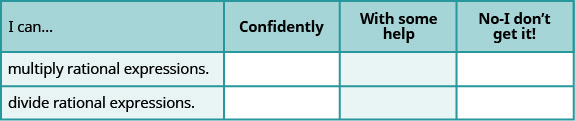
ⓑ After reviewing this checklist, what will you do to become confident for all objectives?
Adapted from Elementary Algebra 2e by OpenStax (openstax.org), licensed under CC BY-NC-SA 4.0. Changes were made. License: CC-BY-NC-SA-4.0.