
6.6 Divide Polynomials
Divide a Polynomial by a Monomial
In the last section, you learned how to divide a monomial by a monomial. As you continue to build up your knowledge of polynomials the next procedure is to divide a polynomial of two or more terms by a monomial.
The method we’ll use to divide a polynomial by a monomial is based on the properties of fraction addition. So we’ll start with an example to review fraction addition.
| The sum, | |
|---|---|
| simplifies to |
Now we will do this in reverse to split a single fraction into separate fractions.
We’ll state the fraction addition property here just as you learned it and in reverse.
We use the form on the left to add fractions and we use the form on the right to divide a polynomial by a monomial.
| For example, | |
|---|---|
| can be written |
We use this form of fraction addition to divide polynomials by monomials.
Remember that division can be represented as a fraction. When you are asked to divide a polynomial by a monomial and it is not already in fraction form, write a fraction with the polynomial in the numerator and the monomial in the denominator.
When we divide by a negative, we must be extra careful with the signs.
Divide a Polynomial by a Binomial
To divide a polynomial by a binomial, we follow a procedure very similar to long division of numbers. So let’s look carefully at the steps we take when we divide a 3-digit number, 875, by a 2-digit number, 25.
| We write the long division |  |
|---|---|
| We divide the first two digits, 87, by 25. |  |
| We multiply 3 times 25 and write the product under the 87. |  |
| Now we subtract 75 from 87. |  |
| Then we bring down the third digit of the dividend, 5. |  |
| Repeat the process, dividing 25 into 125. | 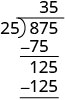 |
We check division by multiplying the quotient by the divisor.
If we did the division correctly, the product should equal the dividend.
Now we will divide a trinomial by a binomial. As you read through the example, notice how similar the steps are to the numerical example above.
When the divisor has a subtraction sign, we must be extra careful when we multiply the partial quotient and then subtract. It may be safer to show that we change the signs and then add.
When we divided 875 by 25, we had no remainder. But sometimes division of numbers does leave a remainder. The same is true when we divide polynomials. In Example 10, we’ll have a division that leaves a remainder. We write the remainder as a fraction with the divisor as the denominator.
Look back at the dividends in Example 8, Example 9, and Example 10. The terms were written in descending order of degrees, and there were no missing degrees. The dividend in Example 11 will be . It is missing an term. We will add in as a placeholder.
In Example 12, we will divide by . As we divide we will have to consider the constants as well as the variables.
Key Concepts
- Fraction Addition
- If are numbers where , then
- If are numbers where , then
- Division of a Polynomial by a Monomial
- To divide a polynomial by a monomial, divide each term of the polynomial by the monomial.
Practice Makes Perfect
In the following exercises, divide each polynomial by the monomial.
Divide a Polynomial by a Binomial
In the following exercises, divide each polynomial by the binomial.
Everyday Math
Average cost Pictures Plus produces digital albums. The company’s average cost (in dollars) to make albums is given by the expression .
- ⓐ Find the quotient by dividing the numerator by the denominator.
- ⓑ What will the average cost (in dollars) be to produce 20 albums?
Handshakes At a company meeting, every employee shakes hands with every other employee. The number of handshakes is given by the expression , where represents the number of employees. How many handshakes will there be if there are 10 employees at the meeting?
45
Writing Exercises
James divides by 6 this way: . What is wrong with his reasoning?
Divide and explain with words how you get each term of the quotient.
Answers will vary.
Self Check
ⓐ After completing the exercises, use this checklist to evaluate your mastery of the objectives of this section.

ⓑ After reviewing this checklist, what will you do to become confident for all goals?
Adapted from Elementary Algebra 2e by OpenStax (openstax.org), licensed under CC BY-NC-SA 4.0. Changes were made. License: CC-BY-NC-SA-4.0.