
6.5 Divide Monomials
Simplify Expressions Using the Quotient Property for Exponents
Earlier in this chapter, we developed the properties of exponents for multiplication. We summarize these properties below.
Now we will look at the exponent properties for division. A quick memory refresher may help before we get started. You have learned to simplify fractions by dividing out common factors from the numerator and denominator using the Equivalent Fractions Property. This property will also help you work with algebraic fractions—which are also quotients.
As before, we’ll try to discover a property by looking at some examples.
| Consider | and | ||
|---|---|---|---|
| What do they mean? | |||
| Use the Equivalent Fractions Property. | |||
| Simplify. |
Notice, in each case the bases were the same and we subtracted exponents.
When the larger exponent was in the numerator, we were left with factors in the numerator.
When the larger exponent was in the denominator, we were left with factors in the denominator—notice the numerator of 1.
We write:
This leads to the Quotient Property for Exponents.
A couple of examples with numbers may help to verify this property.
Notice the difference in the two previous examples:
- If we start with more factors in the numerator, we will end up with factors in the numerator.
- If we start with more factors in the denominator, we will end up with factors in the denominator.
The first step in simplifying an expression using the Quotient Property for Exponents is to determine whether the exponent is larger in the numerator or the denominator.
Simplify Expressions with an Exponent of Zero
A special case of the Quotient Property is when the exponents of the numerator and denominator are equal, such as an expression like . From your earlier work with fractions, you know that:
In words, a number divided by itself is 1. So, , for any , since any number divided by itself is 1.
The Quotient Property for Exponents shows us how to simplify when and when by subtracting exponents. What if ?
Consider , which we know is 1.
| Write as . | |
| Subtract exponents. | |
| Simplify. |
Now we will simplify in two ways to lead us to the definition of the zero exponent. In general, for :
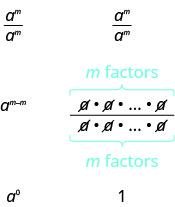
We see simplifies to and to 1. So .
In this text, we assume any variable that we raise to the zero power is not zero.
Now that we have defined the zero exponent, we can expand all the Properties of Exponents to include whole number exponents.
What about raising an expression to the zero power? Let’s look at . We can use the product to a power rule to rewrite this expression.
| Use the product to a power rule. | |
| Use the zero exponent property. | |
| Simplify. |
This tells us that any nonzero expression raised to the zero power is one.
Simplify Expressions Using the Quotient to a Power Property
Now we will look at an example that will lead us to the Quotient to a Power Property.
| This means: | |
| Multiply the fractions. | |
| Write with exponents. |
Notice that the exponent applies to both the numerator and the denominator.
| We write: | |
|---|---|
This leads to the Quotient to a Power Property for Exponents.
An example with numbers may help you understand this property:
Simplify Expressions by Applying Several Properties
We’ll now summarize all the properties of exponents so they are all together to refer to as we simplify expressions using several properties. Notice that they are now defined for whole number exponents.
Divide Monomials
You have now been introduced to all the properties of exponents and used them to simplify expressions. Next, you’ll see how to use these properties to divide monomials. Later, you’ll use them to divide polynomials.
Once you become familiar with the process and have practiced it step by step several times, you may be able to simplify a fraction in one step.
In all examples so far, there was no work to do in the numerator or denominator before simplifying the fraction. In the next example, we’ll first find the product of two monomials in the numerator before we simplify the fraction. This follows the order of operations. Remember, a fraction bar is a grouping symbol.
Key Concepts
- Quotient Property for Exponents:
- If is a real number, , and are whole numbers, then:
- If is a real number, , and are whole numbers, then:
- Zero Exponent
- If is a non-zero number, then .
- If is a non-zero number, then .
- Quotient to a Power Property for Exponents:
- If and are real numbers, and is a counting number, then:
- To raise a fraction to a power, raise the numerator and denominator to that power.
- If and are real numbers, and is a counting number, then:
- Summary of Exponent Properties
- If are real numbers and are whole numbers, then
- If are real numbers and are whole numbers, then
Practice Makes Perfect
Simplify Expressions Using the Quotient Property for Exponents
In the following exercises, simplify.
ⓐ ⓑ
ⓐ ⓑ
ⓐ ⓑ
ⓐ ⓑ
ⓐ ⓑ
ⓐ ⓑ
ⓐ ⓑ
ⓐ ⓑ
ⓐ ⓑ
ⓐ ⓑ
ⓐ ⓑ
ⓐ ⓑ
Simplify Expressions with Zero Exponents
In the following exercises, simplify.
ⓐ ⓑ
ⓐ ⓑ
ⓐ 1 ⓑ 1
ⓐ ⓑ
ⓐ ⓑ
ⓐ ⓑ
ⓐ ⓑ
ⓐ ⓑ
ⓐ 1 ⓑ 6
ⓐ ⓑ
ⓐ ⓑ
ⓐ 7 ⓑ 1
ⓐ ⓑ
ⓐ ⓑ
ⓐ ⓑ 0
Simplify Expressions Using the Quotient to a Power Property
In the following exercises, simplify.
ⓐ ⓑ ⓒ
ⓐ ⓑ ⓒ
ⓐ ⓑ ⓒ
ⓐ ⓑ
ⓐ ⓑ
ⓐ ⓑ
Simplify Expressions by Applying Several Properties
In the following exercises, simplify.
1
Divide Monomials
In the following exercises, divide the monomials.
Mixed Practice
ⓐ ⓑ ⓒ ⓓ
ⓐ ⓑ ⓒ ⓓ
ⓐ ⓑ ⓒ ⓓ 5
ⓐ ⓑ
ⓐ ⓑ
ⓐ ⓑ
ⓐ ⓑ
ⓐ ⓑ
ⓐ ⓑ
Everyday Math
Memory One megabyte is approximately bytes. One gigabyte is approximately bytes. How many megabytes are in one gigabyte?
Memory One gigabyte is approximately bytes. One terabyte is approximately bytes. How many gigabytes are in one terabyte?
Writing Exercises
Jennifer thinks the quotient simplifies to . What is wrong with her reasoning?
Maurice simplifies the quotient by writing . What is wrong with his reasoning?
Answers will vary.
When Drake simplified and he got the same answer. Explain how using the Order of Operations correctly gives different answers.
Robert thinks simplifies to 0. What would you say to convince Robert he is wrong?
Answers will vary.
Self Check
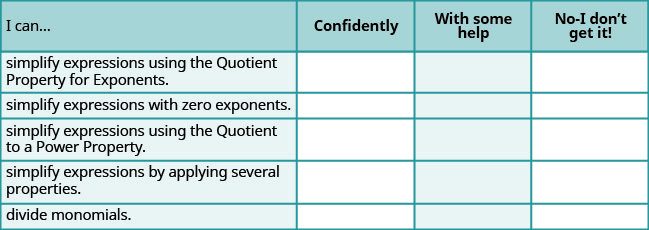
ⓐ After completing the exercises, use this checklist to evaluate your mastery of the objectives of this section.
ⓑ On a scale of 1-10, how would you rate your mastery of this section in light of your responses on the checklist? How can you improve this?
Adapted from Elementary Algebra 2e by OpenStax (openstax.org), licensed under CC BY-NC-SA 4.0. Changes were made. License: CC-BY-NC-SA-4.0.