
4.6 Find the Equation of a Line
How do online retailers know that ‘you may also like’ a particular item based on something you just ordered? How can economists know how a rise in the minimum wage will affect the unemployment rate? How do medical researchers create drugs to target cancer cells? How can traffic engineers predict the effect on your commuting time of an increase or decrease in gas prices? It’s all mathematics.
You are at an exciting point in your mathematical journey as the mathematics you are studying has interesting applications in the real world.
The physical sciences, social sciences, and the business world are full of situations that can be modeled with linear equations relating two variables. Data is collected and graphed. If the data points appear to form a straight line, an equation of that line can be used to predict the value of one variable based on the value of the other variable.
To create a mathematical model of a linear relation between two variables, we must be able to find the equation of the line. In this section we will look at several ways to write the equation of a line. The specific method we use will be determined by what information we are given.
Find an Equation of the Line Given the Slope and y-Intercept
We can easily determine the slope and intercept of a line if the equation was written in slope–intercept form, Now, we will do the reverse—we will start with the slope and y-intercept and use them to find the equation of the line.
Sometimes, the slope and intercept need to be determined from the graph.
Find an Equation of the Line Given the Slope and a Point
Finding an equation of a line using the slope–intercept form of the equation works well when you are given the slope and y-intercept or when you read them off a graph. But what happens when you have another point instead of the y-intercept?
We are going to use the slope formula to derive another form of an equation of the line. Suppose we have a line that has slope and that contains some specific point and some other point, which we will just call . We can write the slope of this line and then change it to a different form.
| Multiply both sides of the equation by . | |
| Simplify. | |
| Rewrite the equation with the terms on the left. |
This format is called the point–slope form of an equation of a line.
We can use the point–slope form of an equation to find an equation of a line when we are given the slope and one point. Then we will rewrite the equation in slope–intercept form. Most applications of linear equations use the the slope–intercept form.
Find an Equation of the Line Given Two Points
When real-world data is collected, a linear model can be created from two data points. In the next example we’ll see how to find an equation of a line when just two points are given.
We have two options so far for finding an equation of a line: slope–intercept or point–slope. Since we will know two points, it will make more sense to use the point–slope form.
But then we need the slope. Can we find the slope with just two points? Yes. Then, once we have the slope, we can use it and one of the given points to find the equation.
We have seen that we can use either the slope–intercept form or the point–slope form to find an equation of a line. Which form we use will depend on the information we are given. This is summarized in Table 4.48.
| To Write an Equation of a Line | ||
| If given: | Use: | Form: |
| Slope and y-intercept | slope–intercept | |
| Slope and a point | point–slope | |
| Two points | point–slope |
Find an Equation of a Line Parallel to a Given Line
Suppose we need to find an equation of a line that passes through a specific point and is parallel to a given line. We can use the fact that parallel lines have the same slope. So we will have a point and the slope—just what we need to use the point–slope equation.
First let’s look at this graphically.
The graph shows the graph of . We want to graph a line parallel to this line and passing through the point .
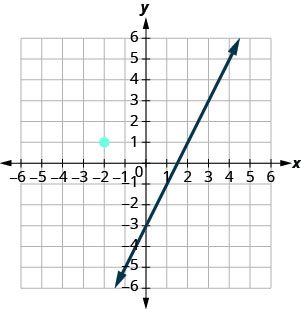
We know that parallel lines have the same slope. So the second line will have the same slope as. That slope is. We’ll use the notation to represent the slope of a line parallel to a line with slope . (Notice that the subscript looks like two parallel lines.)
The second line will pass through and have . To graph the line, we start at and count out the rise and run. With (or ), we count out the rise 2 and the run 1. We draw the line.
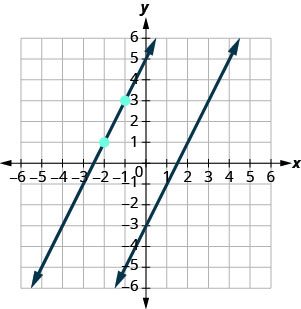
Do the lines appear parallel? Does the second line pass through ?
Now, let’s see how to do this algebraically.
We can use either the slope–intercept form or the point–slope form to find an equation of a line. Here we know one point and can find the slope. So we will use the point–slope form.
Find an Equation of a Line Perpendicular to a Given Line
Now, let’s consider perpendicular lines. Suppose we need to find a line passing through a specific point and which is perpendicular to a given line. We can use the fact that perpendicular lines have slopes that are negative reciprocals. We will again use the point–slope equation, like we did with parallel lines.
The graph shows the graph of . Now, we want to graph a line perpendicular to this line and passing through .
We know that perpendicular lines have slopes that are negative reciprocals. We’ll use the notation to represent the slope of a line perpendicular to a line with slope . (Notice that the subscript ⊥ looks like the right angles made by two perpendicular lines.)
We now know the perpendicular line will pass through with .
To graph the line, we will start at and count out the rise and the run 2. Then we draw the line.
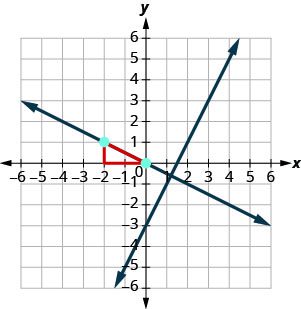
Do the lines appear perpendicular? Does the second line pass through ?
Now, let’s see how to do this algebraically. We can use either the slope–intercept form or the point–slope form to find an equation of a line. In this example we know one point, and can find the slope, so we will use the point–slope form.
In Example 11, we used the point–slope form to find the equation. We could have looked at this in a different way.
We want to find a line that is perpendicular to that contains the point . The graph shows us the line and the point .
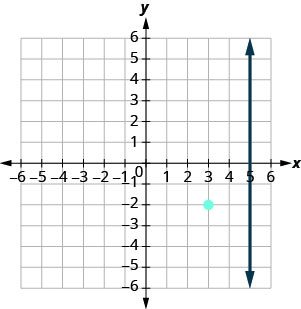
We know every line perpendicular to a vertical line is horizontal, so we will sketch the horizontal line through .
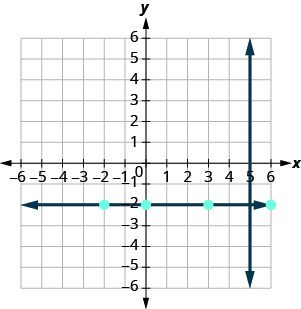
Do the lines appear perpendicular?
If we look at a few points on this horizontal line, we notice they all have y-coordinates of . So, the equation of the line perpendicular to the vertical line is .
Key Concepts
- To Find an Equation of a Line Given the Slope and a Point
- Identify the slope.
- Identify the point.
- Substitute the values into the point-slope form, .
- Write the equation in slope-intercept form.
- To Find an Equation of a Line Given Two Points
- Find the slope using the given points.
- Choose one point.
- Substitute the values into the point-slope form, .
- Write the equation in slope-intercept form.
- To Write and Equation of a Line
- If given slope and y-intercept, use slope–intercept form .
- If given slope and a point, use point–slope form .
- If given two points, use point–slope form .
- To Find an Equation of a Line Parallel to a Given Line
- Find the slope of the given line.
- Find the slope of the parallel line.
- Identify the point.
- Substitute the values into the point-slope form, .
- Write the equation in slope-intercept form.
- To Find an Equation of a Line Perpendicular to a Given Line
- Find the slope of the given line.
- Find the slope of the perpendicular line.
- Identify the point.
- Substitute the values into the point-slope form, .
- Write the equation in slope-intercept form.
Practice Makes Perfect
Find an Equation of the Line Given the Slope and y-Intercept
In the following exercises, find the equation of a line with given slope and y-intercept. Write the equation in slope–intercept form.
slope 3 and y-intercept
slope 4 and y-intercept
slope 6 and y-intercept
slope 8 and y-intercept
slope and y-intercept
slope and y-intercept
slope and y-intercept
slope and y-intercept
slope and y-intercept
slope and y-intercept
slope and y-intercept
slope and y-intercept
slope 0 and y-intercept
slope 0 and y-intercept
slope and y-intercept
slope and y-intercept
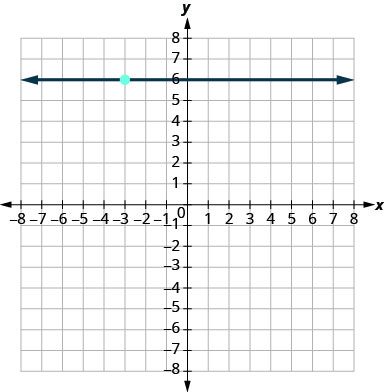
In the following exercises, find the equation of the line shown in each graph. Write the equation in slope–intercept form.
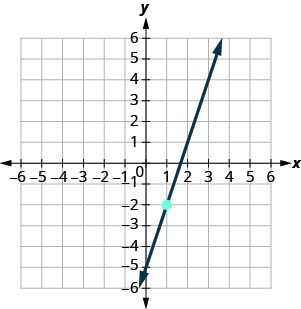
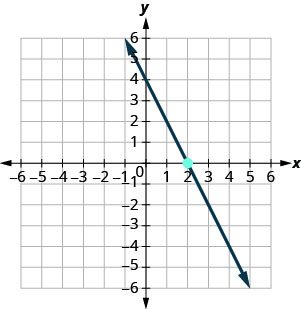
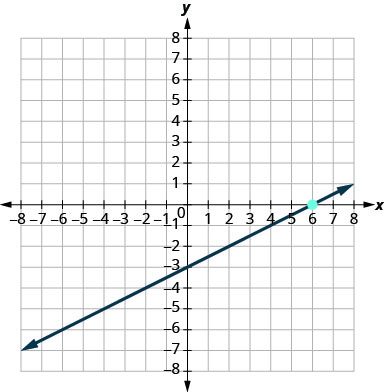
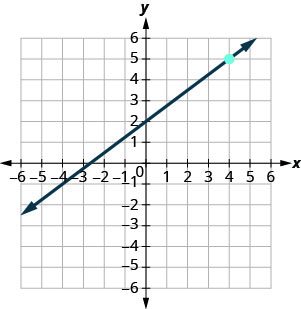
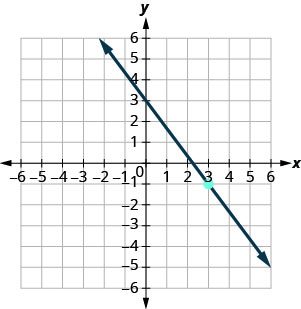
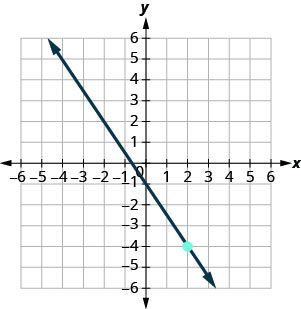
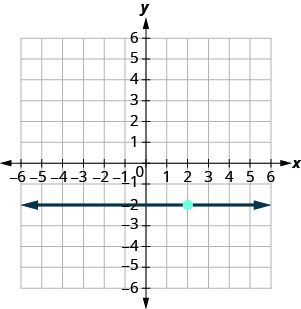
Find an Equation of the Line Given the Slope and a Point
In the following exercises, find the equation of a line with given slope and containing the given point. Write the equation in slope–intercept form.
, point
, point
, point
, point
, point
, point
, point
, point
Horizontal line containing
Horizontal line containing
Horizontal line containing
Horizontal line containing
, point
, point
, point
, point
Horizontal line containing
Horizontal line containing
Find an Equation of the Line Given Two Points
In the following exercises, find the equation of a line containing the given points. Write the equation in slope–intercept form.
and
and
and
and
and
and
and
and
and
and
and
and
and
and
and
and
and
and
and
and
and
and
and
and
and
and
Find an Equation of a Line Parallel to a Given Line
In the following exercises, find an equation of a line parallel to the given line and contains the given point. Write the equation in slope–intercept form.
line , point
line , point
line , point
line , point
line , point
line , point
line , point
line , point
line , point
line , point
line , point
line , point
line , point
line , point
line , point
line , point
Find an Equation of a Line Perpendicular to a Given Line
In the following exercises, find an equation of a line perpendicular to the given line and contains the given point. Write the equation in slope–intercept form.
line , point
line , point
line , point
line , point
line , point
line , point
line , point
line , point
line , point
line , point
line y-axis, point
line y-axis, point
Mixed Practice
In the following exercises, find the equation of each line. Write the equation in slope–intercept form.
Containing the points and
Containing the points and
, containing point
, containing point
Parallel to the line , containing point
Parallel to the line , containing point
, containing point
, containing point
Perpendicular to the line , point
Perpendicular to the line y-axis, point
Containing the points and
Containing the points and
Parallel to the line , containing point
Parallel to the line , containing point
Containing the points and
Containing the points and
Perpendicular to the line , containing point
Perpendicular to the line , containing point
Everyday Math
Cholesterol. The age, , and LDL cholesterol level, , of two men are given by the points and . Find a linear equation that models the relationship between age and LDL cholesterol level.
Fuel consumption. The city mpg, , and highway mpg, , of two cars are given by the points and. Find a linear equation that models the relationship between city mpg and highway mpg.
Writing Exercises
Why are all horizontal lines parallel?
Explain in your own words why the slopes of two perpendicular lines must have opposite signs.
Answers will vary.
Self Check
ⓐ After completing the exercises, use this checklist to evaluate your mastery of the objectives of this section.
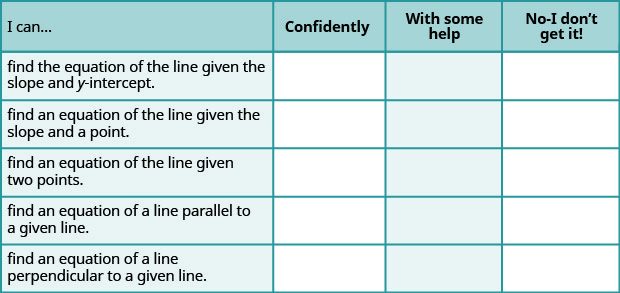
ⓑ On a scale of 1-10, how would you rate your mastery of this section in light of your responses on the checklist? How can you improve this?
Adapted from Elementary Algebra 2e by OpenStax (openstax.org), licensed under CC BY-NC-SA 4.0. Changes were made. License: CC-BY-NC-SA-4.0.