
2.1 Solve Equations Using the Subtraction and Addition Properties of Equality
Verify a Solution of an Equation
Solving an equation is like discovering the answer to a puzzle. The purpose in solving an equation is to find the value or values of the variable that make each side of the equation the same – so that we end up with a true statement. Any value of the variable that makes the equation true is called a solution to the equation. It is the answer to the puzzle!
Solve Equations Using the Subtraction and Addition Properties of Equality
We are going to use a model to clarify the process of solving an equation. An envelope represents the variable – since its contents are unknown – and each counter represents one. We will set out one envelope and some counters on our workspace, as shown in Figure 2.2. Both sides of the workspace have the same number of counters, but some counters are “hidden” in the envelope. Can you tell how many counters are in the envelope?
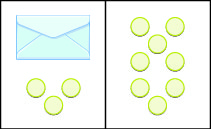
What are you thinking? What steps are you taking in your mind to figure out how many counters are in the envelope?
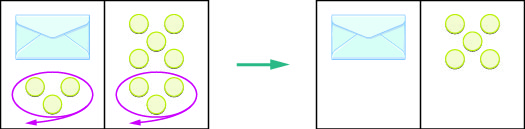
Perhaps you are thinking: “I need to remove the 3 counters at the bottom left to get the envelope by itself. The 3 counters on the left can be matched with 3 on the right and so I can take them away from both sides. That leaves five on the right—so there must be 5 counters in the envelope.” See Figure 2.3 for an illustration of this process.
What algebraic equation would match this situation? In Figure 2.4 each side of the workspace represents an expression and the center line takes the place of the equal sign. We will call the contents of the envelope .
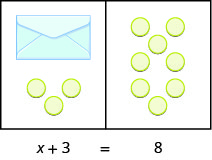
Let’s write algebraically the steps we took to discover how many counters were in the envelope:
 | |
|---|---|
| First, we took away three from each side. |  |
| Then we were left with five. |  |
Check:
Five in the envelope plus three more does equal eight!
Our model has given us an idea of what we need to do to solve one kind of equation. The goal is to isolate the variable by itself on one side of the equation. To solve equations such as these mathematically, we use the Subtraction Property of Equality.
Let’s see how to use this property to solve an equation. Remember, the goal is to isolate the variable on one side of the equation. And we check our solutions by substituting the value into the equation to make sure we have a true statement.
What happens when an equation has a number subtracted from the variable, as in the equation ? We use another property of equations to solve equations where a number is subtracted from the variable. We want to isolate the variable, so to ‘undo’ the subtraction we will add the number to both sides. We use the Addition Property of Equality.
In Example 2, 37 was added to the y and so we subtracted 37 to ‘undo’ the addition. In Example 3, we will need to ‘undo’ subtraction by using the Addition Property of Equality.
The next example will be an equation with decimals.
Solve Equations That Require Simplification
In the previous examples, we were able to isolate the variable with just one operation. Most of the equations we encounter in algebra will take more steps to solve. Usually, we will need to simplify one or both sides of an equation before using the Subtraction or Addition Properties of Equality.
You should always simplify as much as possible before you try to isolate the variable. Remember that to simplify an expression means to do all the operations in the expression. Simplify one side of the equation at a time. Note that simplification is different from the process used to solve an equation in which we apply an operation to both sides.
Translate to an Equation and Solve
To solve applications algebraically, we will begin by translating from English sentences into equations. Our first step is to look for the word (or words) that would translate to the equals sign. Table 2.1 shows us some of the words that are commonly used.
| Equals = |
|---|
| is is equal to is the same as the result is gives was will be |
The steps we use to translate a sentence into an equation are listed below.
Translate and Solve Applications
Most of the time a question that requires an algebraic solution comes out of a real life question. To begin with that question is asked in English (or the language of the person asking) and not in math symbols. Because of this, it is an important skill to be able to translate an everyday situation into algebraic language.
We will start by restating the problem in just one sentence, assign a variable, and then translate the sentence into an equation to solve. When assigning a variable, choose a letter that reminds you of what you are looking for. For example, you might use q for the number of quarters if you were solving a problem about coins.
Key Concepts
- To Determine Whether a Number is a Solution to an Equation
- Substitute the number in for the variable in the equation.
- Simplify the expressions on both sides of the equation.
- Determine whether the resulting statement is true.
- If it is true, the number is a solution.
- If it is not true, the number is not a solution.
- Addition Property of Equality
- For any numbers a, b, and c, if , then .
- Subtraction Property of Equality
- For any numbers a, b, and c, if , then .
- To Translate a Sentence to an Equation
- Locate the “equals” word(s). Translate to an equal sign (=).
- Translate the words to the left of the “equals” word(s) into an algebraic expression.
- Translate the words to the right of the “equals” word(s) into an algebraic expression.
- To Solve an Application
- Read the problem. Make sure all the words and ideas are understood.
- Identify what we are looking for.
- Name what we are looking for. Choose a variable to represent that quantity.
- Translate into an equation. It may be helpful to restate the problem in one sentence with the important information.
- Solve the equation using good algebra techniques.
- Check the answer in the problem and make sure it makes sense.
- Answer the question with a complete sentence.
Practice Makes Perfect
Verify a Solution of an Equation
In the following exercises, determine whether the given value is a solution to the equation.
Is a solution of
?
yes
Is a solution of
?
Is a solution of
?
no
Is a solution of
?
Solve Equations using the Subtraction and Addition Properties of Equality
In the following exercises, solve each equation using the Subtraction and Addition Properties of Equality.
Solve Equations that Require Simplification
In the following exercises, solve each equation.
Translate to an Equation and Solve
In the following exercises, translate to an equation and then solve it.
Nine more than is equal to 52.
The sum of x and is 23.
Ten less than m is .
Three less than y is .
The sum of y and is 40.
Twelve more than p is equal to 67.
The difference of is 107.
The difference of is 602.
The difference of and is .
The difference of and is .
The sum of and is .
The sum of and is .
Translate and Solve Applications
In the following exercises, translate into an equation and solve.
Distance Avril rode her bike a total of 18 miles, from home to the library and then to the beach. The distance from Avril’s house to the library is 7 miles. What is the distance from the library to the beach?
11 miles
Reading Jeff read a total of 54 pages in his History and Sociology textbooks. He read 41 pages in his History textbook. How many pages did he read in his Sociology textbook?
Age Eva’s daughter is 15 years younger than her son. Eva’s son is 22 years old. How old is her daughter?
7 years old
Age Pablo’s father is 3 years older than his mother. Pablo’s mother is 42 years old. How old is his father?
Groceries For a family birthday dinner, Celeste bought a turkey that weighed 5 pounds less than the one she bought for Thanksgiving. The birthday turkey weighed 16 pounds. How much did the Thanksgiving turkey weigh?
21 pounds
Weight Allie weighs 8 pounds less than her twin sister Lorrie. Allie weighs 124 pounds. How much does Lorrie weigh?
Health Connor’s temperature was 0.7 degrees higher this morning than it had been last night. His temperature this morning was 101.2 degrees. What was his temperature last night?
100.5 degrees
Health The nurse reported that Tricia’s daughter had gained 4.2 pounds since her last checkup and now weighs 31.6 pounds. How much did Tricia’s daughter weigh at her last checkup?
Salary Ron’s paycheck this week was $17.43 less than his paycheck last week. His paycheck this week was $103.76. How much was Ron’s paycheck last week?
$121.19
Textbooks Melissa’s math book cost $22.85 less than her art book cost. Her math book cost $93.75. How much did her art book cost?
Everyday Math
Construction Miguel wants to drill a hole for a inch screw. The hole should be inch smaller than the screw. Let equal the size of the hole he should drill. Solve the equation to see what size the hole should be.
Baking Kelsey needs cup of sugar for the cookie recipe she wants to make. She only has cup of sugar and will borrow the rest from her neighbor. Let equal the amount of sugar she will borrow. Solve the equation to find the amount of sugar she should ask to borrow.
Writing Exercises
Is a solution to the equation ? How do you know?
No. Justifications will vary.
What is the first step in your solution to the equation ?
Self Check
ⓐ After completing the exercises, use this checklist to evaluate your mastery of the objectives of this section.
ⓑ If most of your checks were:
…confidently. Congratulations! You have achieved your goals in this section! Reflect on the study skills you used so that you can continue to use them. What did you do to become confident of your ability to do these things? Be specific!
…with some help. This must be addressed quickly as topics you do not master become potholes in your road to success. Math is sequential - every topic builds upon previous work. It is important to make sure you have a strong foundation before you move on. Whom can you ask for help? Your fellow classmates and instructor are good resources. Is there a place on campus where math tutors are available? Can your study skills be improved?
…no - I don’t get it! This is critical and you must not ignore it. You need to get help immediately or you will quickly be overwhelmed. See your instructor as soon as possible to discuss your situation. Together you can come up with a plan to get you the help you need.