Login
📚 Elementary Algebra 2e
Chapters ▾
⇩ Download ▾

2.7 Solve Linear Inequalities

Graph Inequalities on the Number Line

Do you remember what it means for a number to be a solution to an equation? A solution of an equation is a value of a variable that makes a true statement when substituted into the equation.

What about the solution of an inequality? What number would make the inequality x>3 true? Are you thinking, ‘x could be 4’? That’s correct, but x could be 5 too, or 20, or even 3.001. Any number greater than 3 is a solution to the inequality x>3.

We show the solutions to the inequality x>3 on the number line by shading in all the numbers to the right of 3, to show that all numbers greater than 3 are solutions. Because the number 3 itself is not a solution, we put an open parenthesis at 3. The graph of x>3 is shown in Figure 2.7. Please note that the following convention is used: thick arrows point in the positive direction and thin arrows point in the negative direction.

This figure is a number line ranging from negative 5 to 5 with tick marks for each integer. The inequality x is greater than 3 is graphed on the number line, with an open parenthesis at x equals 3, and a red line extending to the right of the parenthesis.
Figure 2.7 The inequality x>3 is graphed on this number line.

The graph of the inequality x3 is very much like the graph of x>3, but now we need to show that 3 is a solution, too. We do that by putting a bracket at x=3, as shown in Figure 2.8.

This figure is a number line ranging from negative 5 to 5 with tick marks for each integer. The inequality x is greater than or equal to 3 is graphed on the number line, with an open bracket at x equals 3, and a red line extending to the right of the bracket.
Figure 2.8 The inequality x3 is graphed on this number line.

Notice that the open parentheses symbol, (, shows that the endpoint of the inequality is not included. The open bracket symbol, [, shows that the endpoint is included.

We can also represent inequalities using interval notation. As we saw above, the inequality x>3 means all numbers greater than 3. There is no upper end to the solution to this inequality. In interval notation, we express x>3 as (3,). The symbol is read as ‘infinity’. It is not an actual number. Figure 2.9 shows both the number line and the interval notation.

This figure is a number line ranging from negative 5 to 5 with tick marks for each integer. The inequality x is greater than 3 is graphed on the number line, with an open parenthesis at x equals 3, and a red line extending to the right of the parenthesis. The inequality is also written in interval notation as parenthesis, 3 comma infinity, parenthesis.
Figure 2.9 The inequality x>3 is graphed on this number line and written in interval notation.

The inequality x1 means all numbers less than or equal to 1. There is no lower end to those numbers. We write x1 in interval notation as (,1]. The symbol is read as ‘negative infinity’. Figure 2.10 shows both the number line and interval notation.

This figure is a number line ranging from negative 5 to 5 with tick marks for each integer. The inequality x is less than or equal to 1 is graphed on the number line, with an open bracket at x equals 1, and a red line extending to the left of the bracket. The inequality is also written in interval notation as parenthesis, negative infinity comma 1, bracket.
Figure 2.10 The inequality x1 is graphed on this number line and written in interval notation.

Did you notice how the parenthesis or bracket in the interval notation matches the symbol at the endpoint of the arrow? These relationships are shown in Figure 2.11.

This figure shows the same four number lines as above, with the same interval notation labels. Below the interval notation for each number line, there is text indicating how the notation on the number lines is similar to the interval notation. The first number line is a graph of x is greater than a, and the interval notation is parenthesis, a comma infinity, parenthesis. The text below reads: “Both have a left parenthesis.” The second number line is a graph of x is greater than or equal to a, and the interval notation is bracket, a comma infinity, parenthesis. The text below reads: “Both have a left bracket.” The third number line is a graph of x is less than a, and the interval notation is parenthesis, negative infinity comma a, parenthesis. The text below reads: “Both have a right parenthesis.” The last number line is a graph of x is less than or equal to a, and the interval notation is parenthesis, negative infinity comma a, bracket. The text below reads: “Both have a right bracket.”
Figure 2.11 The notation for inequalities on a number line and in interval notation use similar symbols to express the endpoints of intervals.

Solve Inequalities using the Subtraction and Addition Properties of Inequality

The Subtraction and Addition Properties of Equality state that if two quantities are equal, when we add or subtract the same amount from both quantities, the results will be equal.

Similar properties hold true for inequalities.

For example, we know that −4 is less than 2.
A mathematical inequality displays the expression '-4 < 2' against a white background, signifying that negative four is less than two.
If we subtract 5 from both quantities, is the
left side still less than the right side?
A mathematical sequence showing '-4 - 5 ? 2 - 5', with a red question mark in the middle.
We get −9 on the left and −3 on the right.
The inequality -9 ? -3 asks what operator goes between the two negative numbers. The answer is < (less than).
And we know −9 is less than −3.
The image displays a mathematical inequality, -9 < -3, which correctly states that negative nine is less than negative three.
The inequality sign stayed the same.

Similarly we could show that the inequality also stays the same for addition.

This leads us to the Subtraction and Addition Properties of Inequality.

We use these properties to solve inequalities, taking the same steps we used to solve equations. Solving the inequality x+5>9, the steps would look like this:

Table 2.6
x+5>9
Subtract 5 from both sides to isolate x.x+55>95
Simplify.x>4

Any number greater than 4 is a solution to this inequality.

Solve Inequalities using the Division and Multiplication Properties of Inequality

The Division and Multiplication Properties of Equality state that if two quantities are equal, when we divide or multiply both quantities by the same amount, the results will also be equal (provided we don’t divide by 0).

Are there similar properties for inequalities? What happens to an inequality when we divide or multiply both sides by a constant?

Consider some numerical examples.

The image displays a simple mathematical inequality: 10 is less than 15, written as '10 < 15' in a clear, digital font against a white background.
The image displays a mathematical inequality '10 < 15', indicating that the number 10 is less than the number 15. The text is in a clear, dark gray font against a white background.
Divide both sides by 5.
A math problem showing two fractions, 10/5 and 15/5, with a red question mark between them, implying a comparison or operation needs to be determined.
Multiply both sides by 5.
A mathematical equation shows 10(5) ? 15(5), questioning the relationship between 50 and 75.
Simplify.
The image displays the numbers '2' and '3' with a red question mark between them, suggesting an unknown operation or value in a numerical sequence or problem.
A question about the relationship between 50 and 75, with a red question mark emphasizing the query.
Fill in the inequality signs.
The numbers 2 and 3 are displayed on a white background, with a red less-than symbol (<) between them, visually representing the inequality 2 < 3.
The image displays the mathematical inequality '50 < 75' in black font against a white background, with the less-than symbol appearing in a slightly reddish hue.

The inequality signs stayed the same.

Does the inequality stay the same when we divide or multiply by a negative number?

The image displays the mathematical inequality '10 < 15' in black font against a white background, indicating that ten is less than fifteen.
A mathematical expression '10 < 15' (ten is less than fifteen) is displayed in black text against a white background.
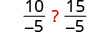
Divide both sides by −5.
A mathematical problem comparing two fractions, 10/-5 and 15/-5, with a red question mark positioned between them, indicating the need for a relational operator.
Multiply both sides by −5.
A math problem comparing 10 multiplied by -5 with 15 multiplied by -5, featuring a red question mark between them. The correct comparison is 10(-5) > 15(-5) because -50 is greater than -75.
Simplify.
A math problem asking to compare -2 and -3, with a red question mark between them. The correct comparison is -2 > -3.
The image displays the numbers -50 and -75 separated by a red question mark, indicating a comparison needs to be made. The correct operator to place in the question mark's position is '>' (greater than).
Fill in the inequality signs.
A mathematical inequality displays '-2 > -3' in black text with a red greater-than sign, against a white background, demonstrating that negative two is greater than negative three.
A mathematical inequality is shown, stating that -50 is greater than -75. The numbers -50 and -75 are in gray, and the greater than symbol (>) is in red, all against a white background.

The inequality signs reversed their direction.

When we divide or multiply an inequality by a positive number, the inequality sign stays the same. When we divide or multiply an inequality by a negative number, the inequality sign reverses.

Here are the Division and Multiplication Properties of Inequality for easy reference.

When we divide or multiply an inequality by a:

  • positive number, the inequality stays the same.
  • negative number, the inequality reverses.

Solve Inequalities That Require Simplification

Most inequalities will take more than one step to solve. We follow the same steps we used in the general strategy for solving linear equations, but be sure to pay close attention during multiplication or division.

Just like some equations are identities and some are contradictions, inequalities may be identities or contradictions, too. We recognize these forms when we are left with only constants as we solve the inequality. If the result is a true statement, we have an identity. If the result is a false statement, we have a contradiction.

Translate to an Inequality and Solve

To translate English sentences into inequalities, we need to recognize the phrases that indicate the inequality. Some words are easy, like ‘more than’ and ‘less than’. But others are not as obvious.

Think about the phrase ‘at least’ – what does it mean to be ‘at least 21 years old’? It means 21 or more. The phrase ‘at least’ is the same as ‘greater than or equal to’.

Table 2.7 shows some common phrases that indicate inequalities.

Table 2.7
><
is greater thanis greater than or equal tois less thanis less than or equal to
is more thanis at leastis smaller thanis at most
is larger thanis no less thanhas fewer thanis no more than
exceedsis the minimumis lower thanis the maximum

Key Concepts

  • Subtraction Property of Inequality
    For any numbers a, b, and c,
    if a<b then ac<bc and
    if a>b then ac>bc.
  • Addition Property of Inequality
    For any numbers a, b, and c,
    if a<b then a+c<b+c and
    if a>b then a+c>b+c.
  • Division and Multiplication Properties of Inequality
    For any numbers a, b, and c,
    if a<b and c>0, then ac<bc and ac>bc.
    if a>b and c>0, then ac>bc and ac>bc.
    if a<b and c<0, then ac>bc and ac>bc.
    if a>b and c<0, then ac<bc and ac<bc.
  • When we divide or multiply an inequality by a:
    • positive number, the inequality stays the same.
    • negative number, the inequality reverses.

Section Exercises

Practice Makes Perfect

Graph Inequalities on the Number Line

In the following exercises, graph each inequality on the number line.

x2
x>1x<0

x>1x<2
x−3


  1. This figure is a number line ranging from negative 5 to 5 with tick marks for each integer. The inequality x is greater than 1 is graphed on the number line, with an open parenthesis at x equals 1, and a dark line extending to the right of the parenthesis.

  2. This figure is a number line ranging from negative 5 to 5 with tick marks for each integer. The inequality x is less than negative 2 is graphed on the number line, with an open parenthesis at x equals negative 2, and a dark line extending to the left of the parenthesis.

  3. This figure is a number line ranging from negative 5 to 5 with tick marks for each integer. The inequality x is greater than or equal to negative 3 is graphed on the number line, with an open bracket at x equals negative 3, and a dark line extending to the right of the bracket.

x−3x<4x2

x0x>4x−1


  1. This figure is a number line ranging from negative 5 to 5 with tick marks for each integer. The inequality x is less than or equal to 0 is graphed on the number line, with an open bracket at x equals 0, and a dark line extending to the left of the bracket.

  2. This figure is a number line ranging from negative 5 to 5 with tick marks for each integer. The inequality x is greater than negative 4 is graphed on the number line, with an open parenthesis at x equals negative 4, and a dark line extending to the right of the parenthesis.

  3. This figure is a number line ranging from negative 5 to 5 with tick marks for each integer. The inequality x is greater than or equal to negative 1 is graphed on the number line, with an open bracket at x equals negative 1, and a dark line extending to the right of the bracket.

In the following exercises, graph each inequality on the number line and write in interval notation.

x<2x−3.5x23

x>3x0.5x13


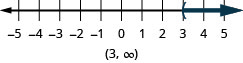
  1. This figure is a number line ranging from negative 5 to 5 with tick marks for each integer. The inequality x is greater than 3 is graphed on the number line, with an open parenthesis at x equals 3, and a dark line extending to the right of the parenthsis. Below the number line is the solution written in interval notation: parenthesis, 3 comma infinity, parenthesis.

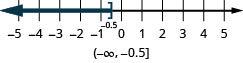
  2. This figure is a number line ranging from negative 5 to 5 with tick marks for each integer. The inequality x is less than or equal to negative 0.5 is graphed on the number line, with an open bracket at x equals negative 0.5, and a dark line extending to the left of the bracket. Below the number line is the solution written in interval notation: parenthesis, negative infinity comma negative 0.5, bracket.

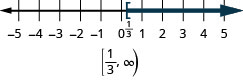
  3. This figure is a number line ranging from negative 5 to 5 with tick marks for each integer. The inequality x is greater than or equal to 1/3 is graphed on the number line, with an open bracket at x equals 1/3 (written in), and a dark line extending to the right of the bracket. Below the number line is the solution written in interval notation: bracket, 1/3 comma infinity, parenthesis.

x−4x<2.5x>32

x5x−1.5x<73


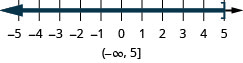
  1. This figure is a number line with tick marks. The inequality x is less than or equal to 5 is graphed on the number line, with an open bracket at x equals 5, and a dark line extending to the left of the bracket. Below the number line is the solution written in interval notation: parenthesis, negative infinity comma 5, bracket.

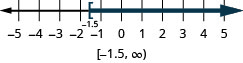
  2. This figure is a number line ranging from negative 5 to 5 with tick marks for each integer. The inequality x is greater than or equal to negative 1.5 is graphed on the number line, with an open bracket at x equals negative 1.5, and a dark line extending to the right of the bracket. Below the number line is the solution written in interval notation: bracket, negative 1.5 comma infinity, parenthesis.

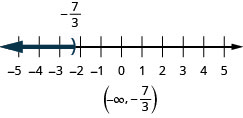
  3. This figure is a number line ranging from negative 5 to 5 with tick marks for each integer. The inequality x is less than negative 7/3 is graphed on the number line, with an open parenthesis at x equals negative 7/3 (written in), and a dark line extending to the left of the parenthsis. Below the number line is the solution written in interval notation: parenthesis, negative infinity comma negative 7/3, parenthesis.

Solve Inequalities using the Subtraction and Addition Properties of Inequality

In the following exercises, solve each inequality, graph the solution on the number line, and write the solution in interval notation.
n11<33

m4562

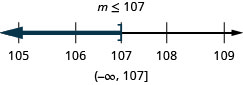
At the top of this figure is the solution to the inequality: m is less than or equal to 107. Below this is a number line ranging from 105 to 109 with tick marks for each integer. The inequality x is less than or equal to 107 is graphed on the number line, with an open bracket at x equals 107, and a dark line extending to the left of the bracket. Below the number line is the solution written in interval notation: parenthesis, negative infinity comma 107, bracket.

u+25>21

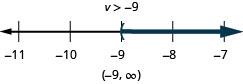
v+12>3

At the top of this figure is the solution to the inequality: v is greater than negative 9. Below this is a number line ranging from negative 11 to negative 7 with tick marks for each integer. The inequality x is greater than negative 9 is graphed on the number line, with an open parenthesis at x equals negative 9, and a dark line extending to the right of the parenthesis. Below the number line is the solution written in interval notation: parenthesis, negative 9 comma infinity, parenthesis.

a+34710

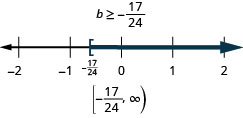
b+7816

At the top of this figure is the solution to the inequality: b is greater than or equal to negative 17/24. Below this is a number line ranging from negative 2 to 2 with tick marks for each integer. The inequality b is greater than or equal to negative 17/24 is graphed on the number line, with an open bracket at b equals negative 17/24 (written in), and a dark line extending to the right of the bracket. Below the number line is the solution written in interval notation: bracket, negative 17/24 comma infinity, parenthesis.

f1320<512

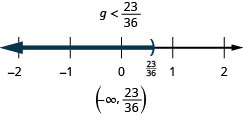
g1112<518

At the top of this figure is the solution to the inequality: g is less than 23/26. Below this is a number line ranging from negative 2 to 2 with tick marks for each integer. The inequality g is less than 23/26 is graphed on the number line, with an open parenthesis at g equals 23/26 (written in), and a dark line extending to the left of the parenthesis. Below the number line is the solution written in interval notation: parenthesis, negative infinity comma 23/26, parenthesis.

Solve Inequalities using the Division and Multiplication Properties of Inequality

In the following exercises, solve each inequality, graph the solution on the number line, and write the solution in interval notation.
8x>72

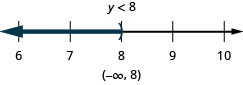
6y<48

At the top of this figure is the solution to the inequality: y is less than 8. Below this is a number line ranging from 6 to 10 with tick marks for each integer. The inequality y is less than 8 is graphed on the number line, with an open parenthesis at y equals 8, and a dark line extending to the left of the parenthesis. Below the number line is the solution written in interval notation: parenthesis, negative infinity comma 8, parenthesis.

7r56

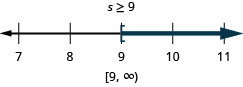
9s81

At the top of this figure is the solution to the inequality: s is greater than or equal to 9. Below this is a number line ranging from 7 to 11 with tick marks for each integer. The inequality s is greater than or equal to 9 is graphed on the number line, with an open bracket at s equals 9, and a dark line extending to the right of the bracket. Below the number line is the solution written in interval notation: bracket, 9 comma infinity, parenthesis.

−5u65

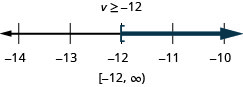
−8v96

At the top of this figure is the solution to the inequality: v is greater than or equal to negative 12. Below this is a number line ranging from negative 14 to negative 10 with tick marks for each integer. The inequality v is greater than or equal to negative 12 is graphed on the number line, with an open bracket at v equals negative 12, and a dark line extending to the right of the bracket. Below the number line is the solution written in interval notation: bracket, negative 12 comma infinity, parenthesis.

−9c<126

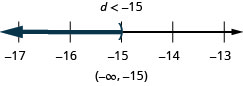
−7d>105

At the top of this figure is the solution to the inequality: d is less than negative 15. Below this is a number line ranging from negative 17 to negative 13 with tick marks for each integer. The inequality d is less than negative 15 is graphed on the number line, with an open parenthesis at d equals negative 15, and a dark line extending to the left of the parenthesis. Below the number line is the solution written in interval notation: parenthesis, negative infinity comma negative 15, parenthesis.

20>25h

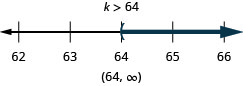
40<58k

At the top of this figure is the solution to the inequality: k is greater than 64. Below this is a number line ranging from 62 to 66 with tick marks for each integer. The inequality k is greater than 64 is graphed on the number line, with an open parenthesis at k equals 64, and a dark line extending to the right of the parenthesis. Below the number line is the solution written in interval notation: parenthesis, negative infinity comma 64, parenthesis.

76j42

94g36

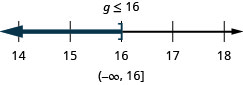
At the top of this figure is the solution to the inequality: g is less than or equal to 16. Below this is a number line ranging from 14 to 18 with tick marks for each integer. The inequality g is less than or equal to 16 is graphed on the number line, with an open bracket at g equals 16, and a dark line extending to the left of the bracket. Below the number line is the solution written in interval notation: parenthesis, negative infinity comma 16, bracket.

a−39

b−1030

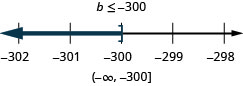
At the top of this figure is the solution to the inequality: b is less than or equal to negative 300. Below this is a number line ranging from negative 302 to negative 298 with tick marks for each integer. The inequality b is less than or equal to negative 300 is graphed on the number line, with an open bracket at b equals negative 300, and a dark line extending to the left of the bracket. Below the number line is the solution written in interval notation: parenthesis, negative infinity comma negative 300, bracket.

−25<p−5

−18>q−6

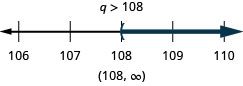
At the top of this figure is the solution to the inequality: q is greater than 108. Below this is a number line ranging from 106 to 110 with tick marks for each integer. The inequality q is greater than 108 is graphed on the number line, with an open parenthesis at q equals 108, and a dark line extending to the right of the parenthesis. Below the number line is the solution written in interval notation: parenthesis, 108 comma infinity, parenthesis.

9t−27

7s<28

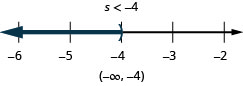
At the top of this figure is the solution to the inequality: s is less than negative 4. Below this is a number line ranging from negative 6 to negative 2 with tick marks for each integer. The inequality s is less than negative 4 is graphed on the number line, with an open parenthesis at s equals negative 4, and a dark line extending to the left of the parenthesis. Below the number line is the solution written in interval notation: parenthesis, negative infinity comma negative 4, parenthesis.

23y>36

35x45

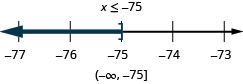
At the top of this figure is the solution to the inequality: x is less than or equal to negative 75. Below this is a number line ranging from negative 77 to negative 73 with tick marks for each integer. The inequality x is less than or equal to negative 75 is graphed on the number line, with an open bracket at x equals negative 75, and a dark line extending to the left of the bracket. Below the number line is the solution written in interval notation: parenthesis, negative infinity comma negative 75, bracket.

Solve Inequalities That Require Simplification

In the following exercises, solve each inequality, graph the solution on the number line, and write the solution in interval notation.
4v9v40

5u8u21

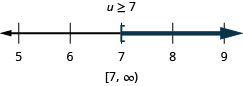
At the top of this figure is the solution to the inequality: au is greater than or equal to 7. Below this is a number line ranging from 5 to 9 with tick marks for each integer. The inequality u is greater than or equal to 7 is graphed on the number line, with an open bracket at u equals 7, and a dark line extending to the right of the bracket. Below the number line is the solution written in interval notation: bracket, 7 comma infinity, parenthesis.

13q<7q29

9p>14p18

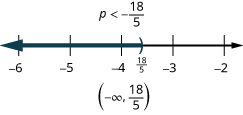
At the top of this figure is the solution to the inequality: p is less than 18/5. Below this is a number line ranging from 2 to 6 with tick marks for each integer. The inequality p is less than 18/5 is graphed on the number line, with an open parenthesis at p equals 18/5 (written in), and a dark line extending to the left of the parenthesis. Below the number line is the solution written in interval notation: parenthesis, negative infinity comma 18/5, parenthesis.

12x+3(x+7)>10x24

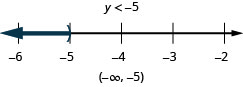
9y+5(y+3)<4y35

At the top of this figure is the solution to the inequality: y is less than negative 5. Below this is a number line ranging from negative 6 to negative 2 with tick marks for each integer. The inequality y is less than negative 5 is graphed on the number line, with an open parenthesis at y equals negative 5, and a dark line extending to the left of the parenthesis. Below the number line is the solution written in interval notation: parenthesis, negative infinity comma negative 5, parenthesis.

6h4(h1)7h11

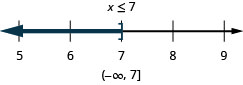
4k(k2)7k26

At the top of this figure is the solution to the inequality: x is less than or equal to 7. Below this is a number line ranging from 5 to 9 with tick marks for each integer. The inequality x is less than or equal to 7 is graphed on the number line, with an open bracket at x equals 7, and a dark line extending to the left of the bracket. Below the number line is the solution written in interval notation: parenthesis, negative infinity comma 7, bracket.

8m2(14m)7(m4)+3m

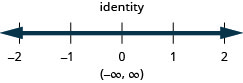
6n12(3n)9(n4)+9n

At the top of this figure is the solution to the inequality: the inequality is an identity. Below this is a number line ranging from negative 2 to 2 with tick marks for each integer. The identity is graphed on the number line, with a dark line extending in both directions. Below the number line is the solution written in interval notation: parenthesis, negative infinity comma infinity, parenthesis.

34b13b<512b12

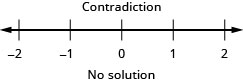
9u+5(2u5)12(u1)+7u

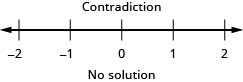
At the top of this figure is the result of the inequality: the inequality is a contradiction. Below this is a number line ranging from negative 2 to 2 with tick marks for each integer. Because this is a contradiction, no inequality is graphed on the number line. Below the number line is the statement: “No solution”.

23g12(g14)16(g+42)

56a14a>712a+23

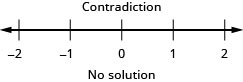
At the top of this figure is the result of the inequality: the inequality is a contradiction. Below this is a number line ranging from negative 2 to 2 with tick marks for each integer. Because this is a contradiction, no inequality is graphed on the number line. Below the number line is the statement: “No solution”.

45h23(h9)115(2h+90)

12v+3(4v1)19(v2)+5v

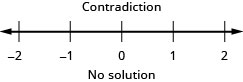
At the top of this figure is the result of the inequality: the inequality is a contradiction. Below this is a number line ranging from negative 2 to 2 with tick marks for each integer. Because this is a contradiction, no inequality is graphed on the number line. Below the number line is the statement: “No solution”.

Mixed practice

In the following exercises, solve each inequality, graph the solution on the number line, and write the solution in interval notation.
15k40

35k−77

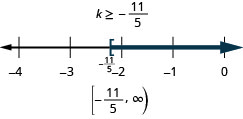
At the top of this figure is the solution to the inequality: k is greater than or equal to negative 11/5. Below this is a number line ranging from negative 4 to 0 with tick marks for each integer. The inequality k is greater than or equal to negative 11/5 is graphed on the number line, with an open bracket at k equals negative 11/5 (written in), and a dark line extending to the right of the bracket. Below the number line is the solution written in interval notation: bracket, negative 11/5 comma infinity, parenthesis.

23p2(65p)>3(11p4)

18q4(103q)<5(6q8)

At the top of this figure is the result of the inequality: the inequality is a contradiction. Below this is a number line ranging from negative 2 to 2 with tick marks for each integer. Because this is a contradiction, no inequality is graphed on the number line. Below the number line is the statement: “No solution”.

94x512

218y1528

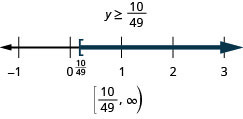
At the top of this figure is the solution to the inequality: y is greater than or equal to 10/49. Below this is a number line ranging from negative 1 to 3 with tick marks for each integer. The inequality y is greater than or equal to 10/49 is graphed on the number line, with an open bracket at y equals 10/49 (written in), and a dark line extending to the right of the bracket. Below the number line is the solution written in interval notation: bracket, 10/49 comma infinity, parenthesis.

c+34<99

d+29>61

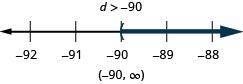
At the top of this figure is the solution to the inequality: d is greater than negative 90. Below this is a number line ranging from negative 92 to negative 88 with tick marks for each integer. The inequality d is greater than negative 90 is graphed on the number line, with an open parenthesis at d equals negative 90, and a dark line extending to the right of the parenthesis. Below the number line is the solution written in interval notation: parenthesis, negative 90 comma infinity, parenthesis.

m18−4

n136

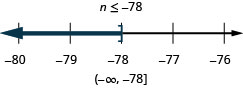
At the top of this figure is the solution to the inequality: n is less than or equal to negative 78. Below this is a number line ranging from negative 80 to negative 76 with tick marks for each integer. The inequality n is less than or equal to negative 78 is graphed on the number line, with an open bracket at n equals negative 78, and a dark line extending to the left of the bracket. Below the number line is the solution written in interval notation: parenthesis, negative infinity comma negative 78, bracket.

Translate to an Inequality and Solve

In the following exercises, translate and solve.Then write the solution in interval notation and graph on the number line.

Fourteen times d is greater than 56.

Ninety times c is less than 450.

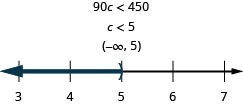
At the top of this figure is the the inequality 90c is less than 450. Below this is the solution to the inequality: c is less than 5. Below the solution is the solution written in interval notation: parenthesis, negative infinity comma 5, parenthesis. Below the interval notation is a number line ranging from 3 to 7 with tick marks for each integer. The inequality c is less than 5 is graphed on the number line, with an open parenthesis at c equals 5, and a dark line extending to the left of the parenthesis.

Eight times z is smaller than −40.

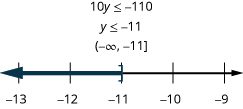
Ten times y is at most −110.

At the top of this figure is the the inequality 10y is less than or equal to negative 110. Below this is the solution to the inequality: y is less than or equal to negative 11. Below the solution is the solution written in interval notation: parenthesis, negative infinity comma negative 11, bracket. Below the interval notation is a number line ranging from negative 13 to negative 9 with tick marks for each integer. The inequality y is less than or equal to negative 11 is graphed on the number line, with an open bracket at y equals negative 11, and a dark line extending to the left of the bracket.

Three more than h is no less than 25.

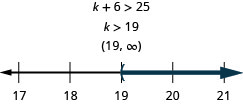
Six more than k exceeds 25.

At the top of this figure is the the inequality k plus 6 is greater than 25. Below this is the solution to the inequality: k is greater than 19. Below the the solution written in interval notation: parenthesis, 19 comma infinity, parenthesis. Below the interval notation is a number line ranging from 17 to 21 with tick marks for each integer. The inequality k is greater than 19 is graphed on the number line, with an open parenthesis at k equals 19, and a dark line extending to the right of the parenthesis.

Ten less than w is at least 39.

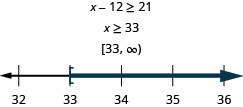
Twelve less than x is no less than 21.

At the top of this figure is the the inequality x minus 12 is greater than or equal to 21. Below this is the solution to the inequality: x is greater than or equal to 33. Below the solution is the solution written in interval notation: bracket, 33 comma infinity, parenthesis. Below the interval notation is a number line ranging from 32 to 36 with tick marks for each integer. The inequality x is greater than or equal to 33 is graphed on the number line, with an open bracket at x equals 33, and a dark line extending to the right of the bracket.

Negative five times r is no more than 95.

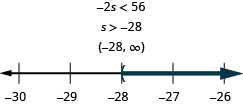
Negative two times s is lower than 56.

At the top of this figure is the the inequality negative 2s is less than 56. Below this is the solution to the inequality: s is greater than negative 28. Below the solution is the solution written in interval notation: parenthesis, negative 28 comma infinity, parenthesis. Below the interval notation is a number line ranging from negative 30 to negative 26 with tick marks for each integer. The inequality s is greater than negative 28 is graphed on the number line, with an open parenthesis at s equals negative 28, and a dark line extending to the right of the parenthesis.

Nineteen less than b is at most −22.

Fifteen less than a is at least −7.

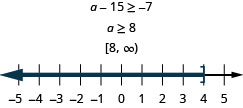
At the top of this figure is the the inequality a minus 15 is greater than or equal to negative 7. Below this is the solution to the inequality: a is greater than or equal to 8. Below the solution is the solution written in interval notation: bracket, 8 comma infinity, parenthesis. Below the interval notation is a number line ranging from 0 to 10 with tick marks for each integer. The inequality a is greater than or equal to 8 is graphed on the number line, with an open bracket at a equals 8, and a dark line extending to the right of the bracket.

Everyday Math

Safety A child’s height, h, must be at least 57 inches for the child to safely ride in the front seat of a car. Write this as an inequality.

Fighter pilots The maximum height, h, of a fighter pilot is 77 inches. Write this as an inequality.

h77

Elevators The total weight, w, of an elevator’s passengers can be no more than 1,200 pounds. Write this as an inequality.

Shopping The number of items, n, a shopper can have in the express check-out lane is at most 8. Write this as an inequality.

n8

Writing Exercises

Give an example from your life using the phrase ‘at least’.

Give an example from your life using the phrase ‘at most’.

Answers will vary.

Explain why it is necessary to reverse the inequality when solving −5x>10.

Explain why it is necessary to reverse the inequality when solving n−3<12.

Answers will vary.

Self Check

ⓐ After completing the exercises, use this checklist to evaluate your mastery of the objectives of this section.

This is a table that has six rows and four columns. In the first row, which is a header row, the cells read from left to right: “I can…,” “confidently,” “with some help,” and “no-I don’t get it!” The first column below “I can…” reads “graph inequalities on the number line,” “solve inequalitites using the Subtraction and Addition Properties of Inequality,” “solve inequalitites using the Division and Multiplication Properties of Inequality,” “solve inequalities that require simplification,” and “translate to an inequality and solve.” The rest of the cells are blank.

ⓑ What does this checklist tell you about your mastery of this section? What steps will you take to improve?

Chapter 2 Review Exercises

Solve Equations using the Subtraction and Addition Properties of Equality

Verify a Solution of an Equation

In the following exercises, determine whether each number is a solution to the equation.

10x1=5x;x=15

w+2=58;w=38

no

−12n+5=8n;n=54

6a3=−7a,a=313

yes

Solve Equations using the Subtraction and Addition Properties of Equality

In the following exercises, solve each equation using the Subtraction Property of Equality.

x+7=19

y+2=−6

y=−8

a+13=53

n+3.6=5.1

n=1.5

In the following exercises, solve each equation using the Addition Property of Equality.

u7=10

x9=−4

x=5

c311=911

p4.8=14

p=18.8

In the following exercises, solve each equation.

n12=32

y+16=−9

y=−25

f+23=4

d3.9=8.2

d=12.1

Solve Equations That Require Simplification

In the following exercises, solve each equation.

y+815=−3

7x+106x+3=5

x=−8

6(n1)5n=−14

8(3p+5)23(p1)=35

p=−28

Translate to an Equation and Solve

In the following exercises, translate each English sentence into an algebraic equation and then solve it.

The sum of −6 and m is 25.

Four less than n is 13.

n4=13;n=17

Translate and Solve Applications

In the following exercises, translate into an algebraic equation and solve.

Rochelle’s daughter is 11 years old. Her son is 3 years younger. How old is her son?

Tan weighs 146 pounds. Minh weighs 15 pounds more than Tan. How much does Minh weigh?

161 pounds

Peter paid $9.75 to go to the movies, which was $46.25 less than he paid to go to a concert. How much did he pay for the concert?

Elissa earned $152.84 this week, which was $21.65 more than she earned last week. How much did she earn last week?

$131.19

Solve Equations using the Division and Multiplication Properties of Equality

Solve Equations Using the Division and Multiplication Properties of Equality

In the following exercises, solve each equation using the division and multiplication properties of equality and check the solution.

8x=72

13a=−65

a=−5

0.25p=5.25

y=4

y=−4

n6=18

y−10=30

y=−300

36=34x

58u=1516

u=32

−18m=−72

c9=36

c=324

0.45x=6.75

1112=23y

y=118

Solve Equations That Require Simplification

In the following exercises, solve each equation requiring simplification.

5r3r+9r=352

24x+8x11x=−714

x=−1

1112n56n=95

−9(d2)15=−24

d=3

Translate to an Equation and Solve

In the following exercises, translate to an equation and then solve.

143 is the product of −11 and y.

The quotient of b and 9 is −27.

b9=−27;b=−243

The sum of q and one-fourth is one.

The difference of s and one-twelfth is one fourth.

s112=14;s=13

Translate and Solve Applications

In the following exercises, translate into an equation and solve.

Ray paid $21 for 12 tickets at the county fair. What was the price of each ticket?

Janet gets paid $24 per hour. She heard that this is 34 of what Adam is paid. How much is Adam paid per hour?

$32

Solve Equations with Variables and Constants on Both Sides

Solve an Equation with Constants on Both Sides

In the following exercises, solve the following equations with constants on both sides.

8p+7=47

10w5=65

w=7

3x+19=−47

32=−49n

n=−4

Solve an Equation with Variables on Both Sides

In the following exercises, solve the following equations with variables on both sides.

7y=6y13

5a+21=2a

a=−7

k=−6k35

4x38=3x

x=38

Solve an Equation with Variables and Constants on Both Sides

In the following exercises, solve the following equations with variables and constants on both sides.

12x9=3x+45

5n20=−7n80

n=−5

4u+16=−19u

58c4=38c+4

c=32

Use a General Strategy for Solving Linear Equations

Solve Equations Using the General Strategy for Solving Linear Equations

In the following exercises, solve each linear equation.

6(x+6)=24

9(2p5)=72

p=132

(s+4)=18

8+3(n9)=17

n=12

233(y7)=8

13(6m+21)=m7

m=−14

4(3.5y+0.25)=365

0.25(q8)=0.1(q+7)

q=18

8(r2)=6(r+10)

5+7(25x)=2(9x+1)
(13x57)

x=−1

(9n+5)(3n7)
=20(4n2)

2[−16+5(8k6)]
=8(34k)32

k=34

Classify Equations

In the following exercises, classify each equation as a conditional equation, an identity, or a contradiction and then state the solution.

17y3(42y)=11(y1)
+12y1

9u+32=15(u4)
3(2u+21)

contradiction; no solution

−8(7m+4)=−6(8m+9)

21(c1)19(c+1)
=2(c20)

identity; all real numbers

Solve Equations with Fractions and Decimals

Solve Equations with Fraction Coefficients

In the following exercises, solve each equation with fraction coefficients.

25n110=710

13x+15x=8

x=15

34a13=12a56

12(k3)=13(k+16)

k=41

3x25=3x+48

5y13+4=−8y+46

y=−1

Solve Equations with Decimal Coefficients

In the following exercises, solve each equation with decimal coefficients.

0.8x0.3=0.7x+0.2

0.36u+2.55=0.41u+6.8

u=−85

0.6p1.9=0.78p+1.7

0.7y+2.5=0.95y9.25

y=47

Solve a Formula for a Specific Variable

Use the Distance, Rate, and Time Formula

In the following exercises, solve.

Natalie drove for 712 hours at 60 miles per hour. How much distance did she travel?

Mallory is taking the bus from St. Louis to Chicago. The distance is 300 miles and the bus travels at a steady rate of 60 miles per hour. How long will the bus ride be?

5 hours

Aaron’s friend drove him from Buffalo to Cleveland. The distance is 187 miles and the trip took 2.75 hours. How fast was Aaron’s friend driving?

Link rode his bike at a steady rate of 15 miles per hour for 212 hours. How much distance did he travel?

37.5 miles

Solve a Formula for a Specific Variable

In the following exercises, solve.

Use the formula. d=rt to solve for t
ⓐ when d=510 and r=60
ⓑ in general

Use the formula. d=rt to solve for r
ⓐ when when d=451 and t=5.5
ⓑ in general

r=82mph; ⓑ r=Dt

Use the formula A=12bh to solve for b
ⓐ when A=390 and h=26
ⓑ in general

Use the formula A=12bh to solve for h
ⓐ when A=153 and b=18
ⓑ in general

h=17h=2Ab

Use the formula I=Prt to solve for the principal, P for
I=$2,501,r=4.1%,
t=5years
ⓑ in general

Solve the formula 4x+3y=6 for y
ⓐ when x=−2
ⓑ in general

y=143y=64x3

Solve 180=a+b+c for c.

Solve the formula V=LWH for H.

H=VLW

Solve Linear Inequalities

Graph Inequalities on the Number Line

In the following exercises, graph each inequality on the number line.

x4
x>2
x<1

x>0
x<3
x−1


  1. This figure is a number line ranging from negative 5 to 5 with tick marks for each integer. The inequality x is greater than 0 is graphed on the number line, with an open parenthesis at x equals 0, and a dark line extending to the right of the parenthesis.

  2. This figure is a number line ranging from negative 5 to 5 with tick marks for each integer. The inequality x is less than negative 3 is graphed on the number line, with an open parenthesis at x equals negative 3, and a dark line extending to the left of the parenthesis.

  3. This figure is a number line ranging from negative 5 to 5 with tick marks for each integer. The inequality x is greater than or equal to 1 is graphed on the number line, with an open bracket at x equals 1, and a dark line extending to the right of the bracket.

In the following exercises, graph each inequality on the number line and write in interval notation.

x<1
x−2.5
x54

x>2
x1.5
x53


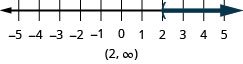
  1. This figure is a number line ranging from negative 5 to 5 with tick marks for each integer. The inequality x is greater than 2 is graphed on the number line, with an open parenthesis at x equals 2, and a dark line extending to the right of the parenthesis. Below the number line is the solution written in interval notation: parenthesis, 2 comma infinity, parenthesis.

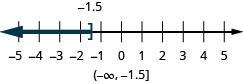
  2. This figure is a number line ranging from negative 5 to 5 with tick marks for each integer. The inequality x is less than or equal to negative 1.5 is graphed on the number line, with an open bracket at x equals negative 1.5, and a dark line extending to the left of the bracket. Below the number line is the solution written in interval notation: parenthesis, negative infinity comma negative 1.5, bracket.

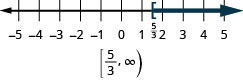
  3. This figure is a number line ranging from negative 5 to 5 with tick marks for each integer. The inequality x is greater than or equal to 5/3 is graphed on the number line, with an open bracket at x equals 5/3, and a dark line extending to the right of the bracket. Below the number line is the solution written in interval notation: bracket, 5/3 comma infinity, parenthesis.

Solve Inequalities using the Subtraction and Addition Properties of Inequality

In the following exercises, solve each inequality, graph the solution on the number line, and write the solution in interval notation.
n1223

m+1456

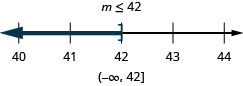
At the top of this figure is the solution to the inequality: m is less than or equal to 42. Below this is a number line ranging from 40 to 44 with tick marks for each integer. The inequality m is less than or equal to 42 is graphed on the number line, with an open bracket at m equals 42, and a dark line extending to the left of the bracket. Below the number line is the solution written in interval notation: parenthesis, negative infinity comma 42, bracket

a+23712

b7812

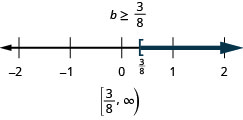
At the top of this figure is the solution to the inequality: b is greater than or equal to 3/8. Below this is a number line ranging from negative 2 to 2 with tick marks for each integer. The inequality b is greater than or equal to 3/8 is graphed on the number line, with an open bracket at b equals 3/8 (written in), and a dark line extending to the right of the bracket. Below the number line is the solution written in interval notation: bracket, 3/8 comma infinity, bracket

Solve Inequalities using the Division and Multiplication Properties of Inequality

In the following exercises, solve each inequality, graph the solution on the number line, and write the solution in interval notation.
9x>54

−12d108

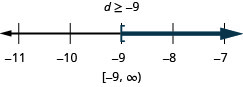
At the top of this figure is the solution to the inequality: d is greater than or equal to negative 9. Below this is a number line ranging from negative 11 to negative 7 with tick marks for each integer. The inequality d is greater than or equal to negative 9 is graphed on the number line, with an open bracket at d equals negative 9, and a dark line extending to the right of the bracket. Below the number line is the solution written in interval notation: bracket, negative 9 comma infinity, parenthesis.

56j<60

q224

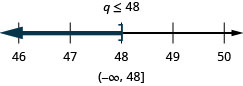
At the top of this figure is the solution to the inequality: q is less than or equal to 48. Below this is a number line ranging from 46 to 50 with tick marks for each integer. The inequality q is less than or equal to 48 is graphed on the number line, with an open bracket at q equals 48, and a dark line extending to the left of the bracket. Below the number line is the solution written in interval notation: parenthesis, negative infinity comma 48, bracket.

Solve Inequalities That Require Simplification

In the following exercises, solve each inequality, graph the solution on the number line, and write the solution in interval notation.
6p>15p30

9h7(h1)4h23

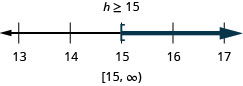
At the top of this figure is the solution to the inequality: h is greater than or equal to 15. Below this is a number line ranging from 13 to 17 with tick marks for each integer. The inequality h is greater than or equal to 15 is graphed on the number line, with an open bracket at h equals 15, and a dark line extending to the right of the bracket. Below the number line is the solution written in interval notation: bracket, 15 comma infinity, parenthesis.

5n15(4n)<10(n6)+10n

38a112a>512a+34

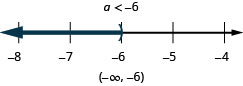
At the top of this figure is the solution to the inequality: a is less than negative 6. Below this is a number line ranging from negative 8 to negative 4 with tick marks for each integer. The inequality a is less than negative 6 is graphed on the number line, with an open parenthesis at a equals negative 6, and a dark line extending to the left of the parenthesis. Below the number line is the solution written in interval notation: parenthesis, negative infinity comma negative 6, parenthesis.

Translate to an Inequality and Solve

In the following exercises, translate and solve. Then write the solution in interval notation and graph on the number line.

Five more than z is at most 19.

Three less than c is at least 360.

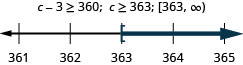
At the top of this figure is the inequality c minus 3 is greater than or equal to 360. To the right of this is the solution to the inequality: c is greater than or equal to 363. To the right of the solution is the solution written in interval notation: bracket, 363 comma infinity, parenthesis. Below all of this is a number line ranging from 361 to 365 with tick marks for each integer. The inequality c is greater than or equal to 363 is graphed on the number line, with an open bracket at c equals 363, and a dark line extending to the right of the bracket.

Nine times n exceeds 42.

Negative two times a is no more than 8.

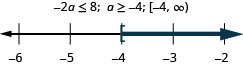
At the top of this figure is the inequality negative 2a is less than or equal to 8. To the right of this is the solution to the inequality: a is greater than or equal to negative 4. To the right of the solution is the solution written in interval notation: bracket, negative 4 comma infinity, parenthesis. Below all of this is a number line ranging from negative 6 to negative 2 with tick marks for each integer. The inequality a is greater than or equal to negative 4 is graphed on the number line, with an open bracket at a equals negative 4, and a dark line extending to the right of the bracket.

Everyday Math

Describe how you have used two topics from this chapter in your life outside of your math class during the past month.

Chapter 2 Practice Test

Determine whether each number is a solution to the equation 6x3=x+20.

ⓐ 5ⓑ 235

ⓐ no ⓑ yes

In the following exercises, solve each equation.

n23=14

92c=144

c=32

4y8=16

−8x15+9x1=−21

x=−5

−15a=120

23x=6

x=9

x3.8=8.2

10y=−5y60

y=−4

8n2=6n12

9m24mm=428

m=9

−5(2x1)=45

(d9)=23

d=−14

14(12m28)=62(3m1)

2(6x5)8=−22

x=13

8(3a5)7(4a3)=203a

14p13=12

p=103

0.1d+0.25(d+8)=4.1

14n3(4n+5)=−9+2(n8)

contradiction; no solution

9(3u2)4[68(u1)] =3(u2)

Solve the formula x2y=5 for y
ⓐ when x=−3
ⓑ in general

y=4y=5x2

In the following exercises, graph on the number line and write in interval notation.

x−3.5

x<114

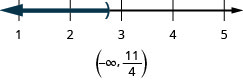
This figure is a number line ranging from 1 to 5 with tick marks for each integer. The inequality x is less than 11/4 is graphed on the number line, with an open parenthesis at x equals 11/4, and a dark line extending to the left of the parenthesis. Below the number line is the solution written in interval notation: parenthesis, negative infinity comma 11/4, parenthesis.

In the following exercises,, solve each inequality, graph the solution on the number line, and write the solution in interval notation.
8k5k120

3c10(c2)<5c+16

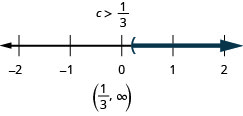
This figure is a number line ranging from negative 2 to 3 with tick marks for each integer. The inequality c is greater than 1/3 is graphed on the number line, with an open parenthesis at c equals 1/3, and a dark line extending to the right of the parenthesis. Below the number line is the solution: c is greater than 1/3. To the right of the solution is the solution written in interval notation: parenthesis, 1/3 comma infinity, parenthesis

In the following exercises, translate to an equation or inequality and solve.

4 less than twice x is 16.

Fifteen more than n is at least 48.

n+1548;n33

Samuel paid $25.82 for gas this week, which was $3.47 less than he paid last week. How much had he paid last week?

Jenna bought a coat on sale for $120, which was 23 of the original price. What was the original price of the coat?

120=23p; The original price was $180.

Sean took the bus from Seattle to Boise, a distance of 506 miles. If the trip took 723 hours, what was the speed of the bus?