
2.5 Solve Equations with Fractions or Decimals
Solve Equations with Fraction Coefficients
Let’s use the general strategy for solving linear equations introduced earlier to solve the equation, .
 | |
|---|---|
| To isolate the term, subtract from both sides. |  |
| Simplify the left side. |  |
| Change the constants to equivalent fractions with the LCD. |  |
| Subtract. |  |
| Multiply both sides by the reciprocal of . | 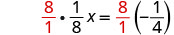 |
| Simplify. |  |
This method worked fine, but many students do not feel very confident when they see all those fractions. So, we are going to show an alternate method to solve equations with fractions. This alternate method eliminates the fractions.
We will apply the Multiplication Property of Equality and multiply both sides of an equation by the least common denominator of all the fractions in the equation. The result of this operation will be a new equation, equivalent to the first, but without fractions. This process is called “clearing” the equation of fractions.
Let’s solve a similar equation, but this time use the method that eliminates the fractions.
Notice in Example 1, once we cleared the equation of fractions, the equation was like those we solved earlier in this chapter. We changed the problem to one we already knew how to solve! We then used the General Strategy for Solving Linear Equations.
In the next example, we again have variables on both sides of the equation.
In the next example, we start by using the Distributive Property. This step clears the fractions right away.
In the next example, even after distributing, we still have fractions to clear.
Solve Equations with Decimal Coefficients
Some equations have decimals in them. This kind of equation will occur when we solve problems dealing with money or percentages. But decimals can also be expressed as fractions. For example, and . So, with an equation with decimals, we can use the same method we used to clear fractions—multiply both sides of the equation by the least common denominator.
The next example uses an equation that is typical of the money applications in the next chapter. Notice that we distribute the decimal before we clear all the decimals.
Key Concepts
- Strategy to Solve an Equation with Fraction Coefficients
- Find the least common denominator of all the fractions in the equation.
- Multiply both sides of the equation by that LCD. This clears the fractions.
- Solve using the General Strategy for Solving Linear Equations.
Practice Makes Perfect
Solve Equations with Fraction Coefficients
In the following exercises, solve each equation with fraction coefficients.
Solve Equations with Decimal Coefficients
In the following exercises, solve each equation with decimal coefficients.
Everyday Math
Coins Taylor has $2.00 in dimes and pennies. The number of pennies is 2 more than the number of dimes. Solve the equation for , the number of dimes.
Stamps Paula bought $22.82 worth of 49-cent stamps and 21-cent stamps. The number of 21-cent stamps was 8 less than the number of 49-cent stamps. Solve the equation for s, to find the number of 49-cent stamps Paula bought.
Writing Exercises
Explain how you find the least common denominator of , , and .
If an equation has several fractions, how does multiplying both sides by the LCD make it easier to solve?
Answers will vary.
If an equation has fractions only on one side, why do you have to multiply both sides of the equation by the LCD?
In the equation what is the LCD? How do you know?
100. Justifications will vary.
Self Check
ⓐ After completing the exercises, use this checklist to evaluate your mastery of the objectives of this section.

ⓑ Overall, after looking at the checklist, do you think you are well-prepared for the next section? Why or why not?
Adapted from Elementary Algebra 2e by OpenStax (openstax.org), licensed under CC BY-NC-SA 4.0. Changes were made. License: CC-BY-NC-SA-4.0.