
1.7 Decimals
Name and Write Decimals
Decimals are another way of writing fractions whose denominators are powers of 10.
Notice that “ten thousand” is a number larger than one, but “one ten-thousandth” is a number smaller than one. The “th” at the end of the name tells you that the number is smaller than one.
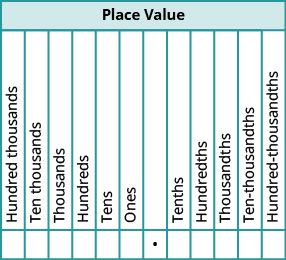
When we name a whole number, the name corresponds to the place value based on the powers of ten. We read 10,000 as “ten thousand” and 10,000,000 as “ten million.” Likewise, the names of the decimal places correspond to their fraction values. Figure 1.14 shows the names of the place values to the left and right of the decimal point.
We summarize the steps needed to name a decimal below.
When we write a check we write both the numerals and the name of the number. Let’s see how to write the decimal from the name.
We summarize the steps to writing a decimal.
Round Decimals
Rounding decimals is very much like rounding whole numbers. We will round decimals with a method based on the one we used to round whole numbers.
We summarize the steps for rounding a decimal here.
Add and Subtract Decimals
To add or subtract decimals, we line up the decimal points. By lining up the decimal points this way, we can add or subtract the corresponding place values. We then add or subtract the numbers as if they were whole numbers and then place the decimal point in the sum.
Multiply and Divide Decimals
Multiplying decimals is very much like multiplying whole numbers—we just have to determine where to place the decimal point. The procedure for multiplying decimals will make sense if we first convert them to fractions and then multiply.
So let’s see what we would get as the product of decimals by converting them to fractions first. We will do two examples side-by-side. Look for a pattern!
 | |
|---|---|
| Convert to fractions. |  |
| Multiply. |  |
| Convert to decimals. |  |
Notice, in the first example, we multiplied two numbers that each had one digit after the decimal point and the product had two decimal places. In the second example, we multiplied a number with one decimal place by a number with two decimal places and the product had three decimal places.
We multiply the numbers just as we do whole numbers, temporarily ignoring the decimal point. We then count the number of decimal places in the factors and that sum tells us the number of decimal places in the product.
The rules for multiplying positive and negative numbers apply to decimals, too, of course!
When multiplying two numbers,
- if their signs are the same the product is positive.
- if their signs are different the product is negative.
When we multiply signed decimals, first we determine the sign of the product and then multiply as if the numbers were both positive. Finally, we write the product with the appropriate sign.
In many of your other classes, especially in the sciences, you will multiply decimals by powers of 10 (10, 100, 1000, etc.). If you multiply a few products on paper, you may notice a pattern relating the number of zeros in the power of 10 to number of decimal places we move the decimal point to the right to get the product.
Just as with multiplication, division of decimals is very much like dividing whole numbers. We just have to figure out where the decimal point must be placed.
To divide decimals, determine what power of 10 to multiply the denominator by to make it a whole number. Then multiply the numerator by that same power of Because of the equivalent fractions property, we haven’t changed the value of the fraction! The effect is to move the decimal points in the numerator and denominator the same number of places to the right. For example:
We use the rules for dividing positive and negative numbers with decimals, too. When dividing signed decimals, first determine the sign of the quotient and then divide as if the numbers were both positive. Finally, write the quotient with the appropriate sign.
We review the notation and vocabulary for division:
We’ll write the steps to take when dividing decimals, for easy reference.
A common application of dividing whole numbers into decimals is when we want to find the price of one item that is sold as part of a multi-pack. For example, suppose a case of 24 water bottles costs $3.99. To find the price of one water bottle, we would divide $3.99 by 24. We show this division in Example 11. In calculations with money, we will round the answer to the nearest cent (hundredth).
Convert Decimals, Fractions, and Percents
We convert decimals into fractions by identifying the place value of the last (farthest right) digit. In the decimal 0.03 the 3 is in the hundredths place, so 100 is the denominator of the fraction equivalent to 0.03.
Notice, when the number to the left of the decimal is zero, we get a fraction whose numerator is less than its denominator. Fractions like this are called proper fractions.
The steps to take to convert a decimal to a fraction are summarized in the procedure box.
We’ve learned to convert decimals to fractions. Now we will do the reverse—convert fractions to decimals. Remember that the fraction bar means division. So can be written or This leads to the following method for converting a fraction to a decimal.
When we divide, we will not always get a zero remainder. Sometimes the quotient ends up with a decimal that repeats. A repeating decimal is a decimal in which the last digit or group of digits repeats endlessly. A bar is placed over the repeating block of digits to indicate it repeats.
A bar is placed over the repeating block of digits to indicate it repeats.
Sometimes we may have to simplify expressions with fractions and decimals together.
A percent is a ratio whose denominator is 100. Percent means per hundred. We use the percent symbol, %, to show percent.
Since a percent is a ratio, it can easily be expressed as a fraction. Percent means per 100, so the denominator of the fraction is 100. We then change the fraction to a decimal by dividing the numerator by the denominator.
| Write as a ratio with denominator 100. | |||
| Change the fraction to a decimal by dividing the numerator by the denominator. |
Do you see the pattern? To convert a percent number to a decimal number, we move the decimal point two places to the left.
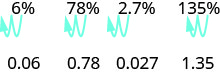
Converting a decimal to a percent makes sense if we remember the definition of percent and keep place value in mind.
To convert a decimal to a percent, remember that percent means per hundred. If we change the decimal to a fraction whose denominator is 100, it is easy to change that fraction to a percent.
| Write as a fraction. | |||
| The denominator is 100. | |||
| Write the ratio as a percent. |
Recognize the pattern? To convert a decimal to a percent, we move the decimal point two places to the right and then add the percent sign.
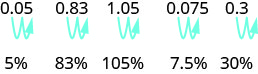
Key Concepts
- Name a Decimal
- Name the number to the left of the decimal point.
- Write ”and” for the decimal point.
- Name the “number” part to the right of the decimal point as if it were a whole number.
- Name the decimal place of the last digit.
- Write a Decimal
- Look for the word ‘and’—it locates the decimal point. Place a decimal point under the word ‘and.’ Translate the words before ‘and’ into the whole number and place it to the left of the decimal point. If there is no “and,” write a “0” with a decimal point to its right.
- Mark the number of decimal places needed to the right of the decimal point by noting the place value indicated by the last word.
- Translate the words after ‘and’ into the number to the right of the decimal point. Write the number in the spaces—putting the final digit in the last place.
- Fill in zeros for place holders as needed.
- Round a Decimal
- Locate the given place value and mark it with an arrow.
- Underline the digit to the right of the place value.
- Is this digit greater than or equal to 5? Yes—add 1 to the digit in the given place value. No—do not change the digit in the given place value.
- Rewrite the number, deleting all digits to the right of the rounding digit.
- Add or Subtract Decimals
- Write the numbers so the decimal points line up vertically.
- Use zeros as place holders, as needed.
- Add or subtract the numbers as if they were whole numbers. Then place the decimal in the answer under the decimal points in the given numbers.
- Multiply Decimals
- Determine the sign of the product.
- Write in vertical format, lining up the numbers on the right. Multiply the numbers as if they were whole numbers, temporarily ignoring the decimal points.
- Place the decimal point. The number of decimal places in the product is the sum of the decimal places in the factors.
- Write the product with the appropriate sign.
- Multiply a Decimal by a Power of Ten
- Move the decimal point to the right the same number of places as the number of zeros in the power of 10.
- Add zeros at the end of the number as needed.
- Divide Decimals
- Determine the sign of the quotient.
- Make the divisor a whole number by “moving” the decimal point all the way to the right. “Move” the decimal point in the dividend the same number of places - adding zeros as needed.
- Divide. Place the decimal point in the quotient above the decimal point in the dividend.
- Write the quotient with the appropriate sign.
- Convert a Decimal to a Proper Fraction
- Determine the place value of the final digit.
- Write the fraction: numerator—the ‘numbers’ to the right of the decimal point; denominator—the place value corresponding to the final digit.
- Convert a Fraction to a Decimal Divide the numerator of the fraction by the denominator.
Practice Makes Perfect
Name and Write Decimals
In the following exercises, write as a decimal.
Twenty-nine and eighty-one hundredths
29.81
Sixty-one and seventy-four hundredths
Seven tenths
0.7
Six tenths
Twenty-nine thousandth
0.029
Thirty-five thousandths
Negative eleven and nine ten-thousandths
Negative fifty-nine and two ten-thousandths
In the following exercises, name each decimal.
5.5
five and five tenths
14.02
8.71
eight and seventy-one hundredths
2.64
0.002
two thousandths
0.479
negative seventeen and nine tenths
Round Decimals
In the following exercises, round each number to the nearest tenth.
0.67
0.7
0.49
2.84
2.8
4.63
In the following exercises, round each number to the nearest hundredth.
0.845
0.85
0.761
0.299
0.30
0.697
4.098
4.10
7.096
In the following exercises, round each number to the nearest ⓐ hundredth ⓑ tenth ⓒ whole number.
5.781
ⓐ 5.78 ⓑ 5.8 ⓒ 6
1.6381
63.479
ⓐ 63.48 ⓑ 63.5 ⓒ 63
Add and Subtract Decimals
In the following exercises, add or subtract.
24.48
15.73
102.412
51.31
Multiply and Divide Decimals
In the following exercises, multiply.
0.144
42.008
337.8914
1.305
92.4
55,200
In the following exercises, divide.
0.19
$2.44
3
35
2.08
20
Convert Decimals, Fractions and Percents
In the following exercises, write each decimal as a fraction.
0.04
0.19
0.52
0.78
1.25
1.35
0.375
0.464
0.095
0.085
In the following exercises, convert each fraction to a decimal.
0.85
2.75
3.025
In the following exercises, convert each percent to a decimal.
1%
0.01
2%
63%
0.63
71%
150%
1.5
250%
21.4%
0.214
39.3%
7.8%
0.078
6.4%
In the following exercises, convert each decimal to a percent.
0.01
1%
0.03
1.35
135%
1.56
3
300%
4
0.0875
8.75%
0.0625
2.254
225.4%
2.317
Everyday Math
Salary Increase Danny got a raise and now makes $58,965.95 a year. Round this number to the nearest ⓐ dollar ⓑ thousand dollars ⓒ ten thousand dollars.
ⓐ $58,966 ⓑ $59,000 ⓒ $60,000
New Car Purchase Selena’s new car cost $23,795.95. Round this number to the nearest ⓐ dollar ⓑ thousand dollars ⓒ ten thousand dollars.
Sales Tax Hyo Jin lives in San Diego. She bought a refrigerator for $1,624.99 and when the clerk calculated the sales tax it came out to exactly $142.186625. Round the sales tax to the nearest ⓐ penny and ⓑ dollar.
ⓐ $142.19; ⓑ $142
Sales Tax Jennifer bought a $1,038.99 dining room set for her home in Cincinnati. She calculated the sales tax to be exactly $67.53435. Round the sales tax to the nearest ⓐ penny and ⓑ dollar.
Paycheck Annie has two jobs. She gets paid $14.04 per hour for tutoring at City College and $8.75 per hour at a coffee shop. Last week she tutored for 8 hours and worked at the coffee shop for 15 hours. ⓐ How much did she earn? ⓑ If she had worked all 23 hours as a tutor instead of working both jobs, how much more would she have earned?
ⓐ $243.57 ⓑ $79.35
Paycheck Jake has two jobs. He gets paid $7.95 per hour at the college cafeteria and $20.25 at the art gallery. Last week he worked 12 hours at the cafeteria and 5 hours at the art gallery. ⓐ How much did he earn? ⓑ If he had worked all 17 hours at the art gallery instead of working both jobs, how much more would he have earned?
Writing Exercises
How does knowing about US money help you learn about decimals?
Answers may vary
Explain how you write “three and nine hundredths” as a decimal.
Without solving the problem “44 is 80% of what number” think about what the solution might be. Should it be a number that is greater than 44 or less than 44? Explain your reasoning.
Answers may vary
When the Szetos sold their home, the selling price was 500% of what they had paid for the house 30 years ago. Explain what 500% means in this context.
Self Check
ⓐ After completing the exercises, use this checklist to evaluate your mastery of the objectives of this section.
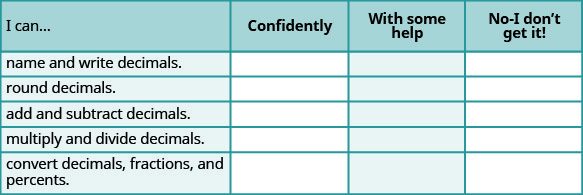
ⓑ What does this checklist tell you about your mastery of this section? What steps will you take to improve?
Adapted from Elementary Algebra 2e by OpenStax (openstax.org), licensed under CC BY-NC-SA 4.0. Changes were made. License: CC-BY-NC-SA-4.0.