
1.1 Introduction to Whole Numbers
As we begin our study of elementary algebra, we need to refresh some of our skills and vocabulary. This chapter will focus on whole numbers, integers, fractions, decimals, and real numbers. We will also begin our use of algebraic notation and vocabulary.
Use Place Value with Whole Numbers
The most basic numbers used in algebra are the numbers we use to count objects in our world: 1, 2, 3, 4, and so on. These are called the counting numbers. Counting numbers are also called natural numbers. If we add zero to the counting numbers, we get the set of whole numbers.
Counting Numbers: 1, 2, 3, …
Whole Numbers: 0, 1, 2, 3, …
The notation “…” is called ellipsis and means “and so on,” or that the pattern continues endlessly.
We can visualize counting numbers and whole numbers on a number line (see Figure 1.2).

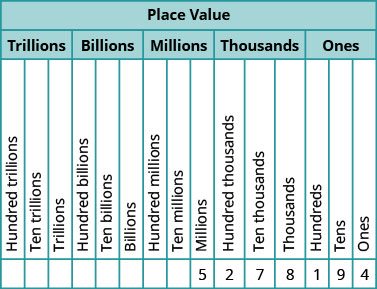
Our number system is called a place value system, because the value of a digit depends on its position in a number. Figure 1.3 shows the place values. The place values are separated into groups of three, which are called periods. The periods are ones, thousands, millions, billions, trillions, and so on. In a written number, commas separate the periods.
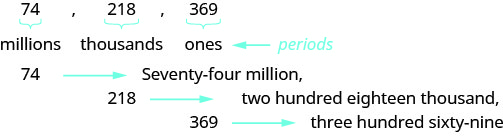
When you write a check, you write out the number in words as well as in digits. To write a number in words, write the number in each period, followed by the name of the period, without the s at the end. Start at the left, where the periods have the largest value. The ones period is not named. The commas separate the periods, so wherever there is a comma in the number, put a comma between the words (see Figure 1.4). The number 74,218,369 is written as seventy-four million, two hundred eighteen thousand, three hundred sixty-nine.
We are now going to reverse the process by writing the digits from the name of the number. To write the number in digits, we first look for the clue words that indicate the periods. It is helpful to draw three blanks for the needed periods and then fill in the blanks with the numbers, separating the periods with commas.
In 2013, the U.S. Census Bureau estimated the population of the state of New York as 19,651,127. We could say the population of New York was approximately 20 million. In many cases, you don’t need the exact value; an approximate number is good enough.
The process of approximating a number is called rounding. Numbers are rounded to a specific place value, depending on how much accuracy is needed. Saying that the population of New York is approximately 20 million means that we rounded to the millions place.
In algebra, we use a letter of the alphabet to represent a number whose value may change or is unknown. Commonly used symbols are a, b, c, m, n, x, and y. Further discussion of constants and variables appears later in this section.
Identify Multiples and Apply Divisibility Tests
The numbers 2, 4, 6, 8, 10, and 12 are called multiples of 2. A multiple of 2 can be written as the product of 2 and a counting number.

Similarly, a multiple of 3 would be the product of a counting number and 3.

We could find the multiples of any number by continuing this process.
Table 1.1 shows the multiples of 2 through 10 for the first 12 counting numbers.
| Counting Number | 1 | 2 | 3 | 4 | 5 | 6 | 7 | 8 | 9 | 10 | 11 | 12 |
|---|---|---|---|---|---|---|---|---|---|---|---|---|
| Multiples of 2 | 2 | 4 | 6 | 8 | 10 | 12 | 14 | 16 | 18 | 20 | 22 | 24 |
| Multiples of 3 | 3 | 6 | 9 | 12 | 15 | 18 | 21 | 24 | 27 | 30 | 33 | 36 |
| Multiples of 4 | 4 | 8 | 12 | 16 | 20 | 24 | 28 | 32 | 36 | 40 | 44 | 48 |
| Multiples of 5 | 5 | 10 | 15 | 20 | 25 | 30 | 35 | 40 | 45 | 50 | 55 | 60 |
| Multiples of 6 | 6 | 12 | 18 | 24 | 30 | 36 | 42 | 48 | 54 | 60 | 66 | 72 |
| Multiples of 7 | 7 | 14 | 21 | 28 | 35 | 42 | 49 | 56 | 63 | 70 | 77 | 84 |
| Multiples of 8 | 8 | 16 | 24 | 32 | 40 | 48 | 56 | 64 | 72 | 80 | 88 | 96 |
| Multiples of 9 | 9 | 18 | 27 | 36 | 45 | 54 | 63 | 72 | 81 | 90 | 99 | 108 |
| Multiples of 10 | 10 | 20 | 30 | 40 | 50 | 60 | 70 | 80 | 90 | 100 | 110 | 120 |
Another way to say that 15 is a multiple of 3 is to say that 15 is divisible by 3. That means that when we divide 15 by 3, we get a counting number. In fact, is 5, so 15 is
Look at the multiples of 5 in Table 1.1. They all end in 5 or 0. Numbers with last digit of 5 or 0 are divisible by 5. Looking for other patterns in Table 1.1 that shows multiples of the numbers 2 through 9, we can discover the following divisibility tests:
Find Prime Factorizations and Least Common Multiples
In mathematics, there are often several ways to talk about the same ideas. So far, we’ve seen that if m is a multiple of n, we can say that m is divisible by n. For example, since 72 is a multiple of 8, we say 72 is divisible by 8. Since 72 is a multiple of 9, we say 72 is divisible by 9. We can express this still another way.
Since we say that 8 and 9 are factors of 72. When we write we say we have factored 72.
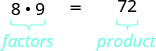
Other ways to factor 72 are Seventy-two has many factors: 1, 2, 3, 4, 6, 8, 9, 12, 18, 36, and 72.
Some numbers, like 72, have many factors. Other numbers have only two factors.
The counting numbers from 2 to 19 are listed in Figure 1.5, with their factors. Make sure to agree with the “prime” or “composite” label for each!
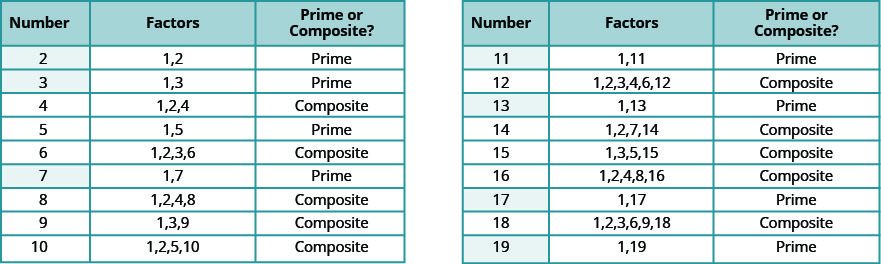
The prime numbers less than 20 are 2, 3, 5, 7, 11, 13, 17, and 19. Notice that the only even prime number is 2.
A composite number can be written as a unique product of primes. This is called the prime factorization of the number. Finding the prime factorization of a composite number will be useful later in this course.
To find the prime factorization of a composite number, find any two factors of the number and use them to create two branches. If a factor is prime, that branch is complete. Circle that prime!
If the factor is not prime, find two factors of the number and continue the process. Once all the branches have circled primes at the end, the factorization is complete. The composite number can now be written as a product of prime numbers.
One of the reasons we look at multiples and primes is to use these techniques to find the least common multiple of two numbers. This will be useful when we add and subtract fractions with different denominators. Two methods are used most often to find the least common multiple and we will look at both of them.
The first method is the Listing Multiples Method. To find the least common multiple of 12 and 18, we list the first few multiples of 12 and 18:
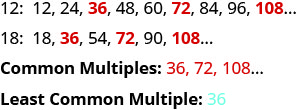
Notice that some numbers appear in both lists. They are the common multiples of 12 and 18.
We see that the first few common multiples of 12 and 18 are 36, 72, and 108. Since 36 is the smallest of the common multiples, we call it the least common multiple. We often use the abbreviation LCM.
The procedure box lists the steps to take to find the LCM using the Listing Multiples Method we used above for 12 and 18.
Our second method to find the least common multiple of two numbers is to use The Prime Factors Method. Let’s find the LCM of 12 and 18 again, this time using their prime factors.
Notice that the prime factors of 12 and the prime factors of 18 are included in the LCM So 36 is the least common multiple of 12 and 18.
By matching up the common primes, each common prime factor is used only once. This way you are sure that 36 is the least common multiple.
Key Concepts
- Place Value as in Figure 1.3.
- Name a Whole Number in Words
- Start at the left and name the number in each period, followed by the period name.
- Put commas in the number to separate the periods.
- Do not name the ones period.
- Write a Whole Number Using Digits
- Identify the words that indicate periods. (Remember the ones period is never named.)
- Draw 3 blanks to indicate the number of places needed in each period. Separate the periods by commas.
- Name the number in each period and place the digits in the correct place value position.
- Round Whole Numbers
- Locate the given place value and mark it with an arrow. All digits to the left of the arrow do not change.
- Underline the digit to the right of the given place value.
- Is this digit greater than or equal to 5?
- Yes—add 1 to the digit in the given place value.
- No—do not change the digit in the given place value.
- Replace all digits to the right of the given place value with zeros.
- Divisibility Tests: A number is divisible by:
- 2 if the last digit is 0, 2, 4, 6, or 8.
- 3 if the sum of the digits is divisible by 3.
- 5 if the last digit is 5 or 0.
- 6 if it is divisible by both 2 and 3.
- 10 if it ends with 0.
- Find the Prime Factorization of a Composite Number
- Find two factors whose product is the given number, and use these numbers to create two branches.
- If a factor is prime, that branch is complete. Circle the prime, like a bud on the tree.
- If a factor is not prime, write it as the product of two factors and continue the process.
- Write the composite number as the product of all the circled primes.
- Find the Least Common Multiple by Listing Multiples
- List several multiples of each number.
- Look for the smallest number that appears on both lists.
- This number is the LCM.
- Find the Least Common Multiple Using the Prime Factors Method
- Write each number as a product of primes.
- List the primes of each number. Match primes vertically when possible.
- Bring down the columns.
- Multiply the factors.
Practice Makes Perfect
Use Place Value with Whole Numbers
In the following exercises, find the place value of each digit in the given numbers.
51,493 ⓐ 1, ⓑ 4, ⓒ 9, ⓓ 5, ⓔ 3
ⓐ thousands ⓑ hundreds ⓒ tens ⓓ ten thousands ⓔ ones
87,210 ⓐ 2 ⓑ 8 ⓒ 0 ⓓ 7 ⓔ 1
164,285 ⓐ 5, ⓑ 6, ⓒ 1, ⓓ 8, ⓔ 2
ⓐ ones ⓑ ten thousands ⓒ hundred thousands ⓓ tens ⓔ hundreds
395,076 ⓐ 5 ⓑ 3 ⓒ 7 ⓓ 0 ⓔ 9
93,285,170 ⓐ 9 ⓑ 8 ⓒ 7 ⓓ 5 ⓔ 3
ⓐ ten millions ⓑ ten thousands ⓒ tens ⓓ thousands ⓔ millions
36,084,215 ⓐ 8 ⓑ 6 ⓒ 5 ⓓ 4 ⓔ 3
7,284,915,860,132 ⓐ 7 ⓑ 4 ⓒ 5 ⓓ 3 ⓔ 0
ⓐ trillions ⓑ billions ⓒ millions ⓓ tens ⓔ thousands
2,850,361,159,433
ⓐ 9
ⓑ 8
ⓒ 6
ⓓ 4
ⓔ 2
In the following exercises, name each number using words.
1,078
one thousand, seventy-eight
5,902
364,510
three hundred sixty-four thousand, five hundred ten
146,023
5,846,103
five million, eight hundred forty-six thousand, one hundred three
1,458,398
37,889,005
thirty-seven million, eight hundred eighty-nine thousand, five
62,008,465
In the following exercises, write each number as a whole number using digits.
four hundred twelve
412
two hundred fifty-three
thirty-five thousand, nine hundred seventy-five
35,975
sixty-one thousand, four hundred fifteen
eleven million, forty-four thousand, one hundred sixty-seven
11,044,167
eighteen million, one hundred two thousand, seven hundred eighty-three
three billion, two hundred twenty-six million, five hundred twelve thousand, seventeen
3,226,512,017
eleven billion, four hundred seventy-one million, thirty-six thousand, one hundred six
In the following, round to the indicated place value.
Round to the nearest ten.
ⓐ 386 ⓑ 2,931
ⓐ 390 ⓑ 2,930
Round to the nearest ten.
ⓐ 792 ⓑ 5,647
Round to the nearest hundred.
ⓐ 13,748 ⓑ 391,794
ⓐ 13,700 ⓑ 391,800
Round to the nearest hundred.
ⓐ 28,166 ⓑ 481,628
Round to the nearest ten.
ⓐ 1,492 ⓑ 1,497
ⓐ 1,490 ⓑ 1,500
Round to the nearest ten.
ⓐ 2,791 ⓑ 2,795
Round to the nearest hundred.
ⓐ 63,994 ⓑ 63,940
ⓐ 64,000 ⓑ 63,900
Round to the nearest hundred.
ⓐ 49,584 ⓑ 49,548
In the following exercises, round each number to the nearest ⓐ hundred, ⓑ thousand, ⓒ ten thousand.
392,546
ⓐ 392,500 ⓑ 393,000 ⓒ 390,000
619,348
2,586,991
ⓐ 2,587,000 ⓑ 2,587,000 ⓒ 2,590,000
4,287,965
Identify Multiples and Factors
In the following exercises, use the divisibility tests to determine whether each number is divisible by 2, 3, 5, 6, and 10.
84
divisible by 2, 3, and 6
9,696
75
divisible by 3 and 5
78
900
divisible by 2, 3, 5, 6, and 10
800
986
divisible by 2
942
350
divisible by 2, 5, and 10
550
22,335
divisible by 3 and 5
39,075
Find Prime Factorizations and Least Common Multiples
In the following exercises, find the prime factorization.
86
78
132
455
693
400
432
627
2,160
2,520
In the following exercises, find the least common multiple of the each pair of numbers using the multiples method.
8, 12
24
4, 3
12, 16
48
30, 40
20, 30
60
44, 55
In the following exercises, find the least common multiple of each pair of numbers using the prime factors method.
8, 12
24
12, 16
28, 40
280
84, 90
55, 88
440
60, 72
Everyday Math
Writing a Check Jorge bought a car for $24,493. He paid for the car with a check. Write the purchase price in words.
twenty-four thousand, four hundred ninety-three dollars
Writing a Check Marissa’s kitchen remodeling cost $18,549. She wrote a check to the contractor. Write the amount paid in words.
Buying a Car Jorge bought a car for $24,493. Round the price to the nearest ⓐ ten ⓑ hundred ⓒ thousand; and ⓓ ten-thousand.
ⓐ $24,490 ⓑ $24,500 ⓒ $24,000 ⓓ $20,000
Remodeling a Kitchen Marissa’s kitchen remodeling cost $18,549, Round the cost to the nearest ⓐ ten ⓑ hundred ⓒ thousand and ⓓ ten-thousand.
Population The population of China was 1,339,724,852 on November 1, 2010. Round the population to the nearest ⓐ billion ⓑ hundred-million; and ⓒ million.
ⓐ 1,000,000,000 ⓑ 1,300,000,000 ⓒ 1,340,000,000
Astronomy The average distance between Earth and the sun is 149,597,888 kilometers. Round the distance to the nearest ⓐ hundred-million ⓑ ten-million; and ⓒ million.
Grocery Shopping Hot dogs are sold in packages of 10, but hot dog buns come in packs of eight. What is the smallest number that makes the hot dogs and buns come out even?
40
Grocery Shopping Paper plates are sold in packages of 12 and party cups come in packs of eight. What is the smallest number that makes the plates and cups come out even?
Writing Exercises
Give an everyday example where it helps to round numbers.
Answers may vary.
If a number is divisible by 2 and by 3 why is it also divisible by 6?
What is the difference between prime numbers and composite numbers?
Answers may vary.
Explain in your own words how to find the prime factorization of a composite number, using any method you prefer.
Self Check
ⓐ After completing the exercises, use this checklist to evaluate your mastery of the objectives of this section.
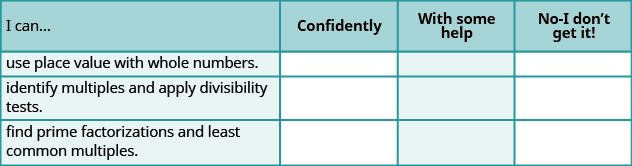
ⓑ If most of your checks were:
…confidently. Congratulations! You have achieved the objectives in this section. Reflect on the study skills you used so that you can continue to use them. What did you do to become confident of your ability to do these things? Be specific.
…with some help. This must be addressed quickly because topics you do not master become potholes in your road to success. In math, every topic builds upon previous work. It is important to make sure you have a strong foundation before you move on. Whom can you ask for help? Your fellow classmates and instructor are good resources. Is there a place on campus where math tutors are available? Can your study skills be improved?
…no—I don’t get it! This is a warning sign and you must not ignore it. You should get help right away or you will quickly be overwhelmed. See your instructor as soon as you can to discuss your situation. Together you can come up with a plan to get you the help you need.
Adapted from Elementary Algebra 2e by OpenStax (openstax.org), licensed under CC BY-NC-SA 4.0. Changes were made. License: CC-BY-NC-SA-4.0.