
1.6 Add and Subtract Fractions
Add or Subtract Fractions with a Common Denominator
When we multiplied fractions, we just multiplied the numerators and multiplied the denominators right straight across. To add or subtract fractions, they must have a common denominator.
Now we will do an example that has both addition and subtraction.
Add or Subtract Fractions with Different Denominators
As we have seen, to add or subtract fractions, their denominators must be the same. The least common denominator (LCD) of two fractions is the smallest number that can be used as a common denominator of the fractions. The LCD of the two fractions is the least common multiple (LCM) of their denominators.
After we find the least common denominator of two fractions, we convert the fractions to equivalent fractions with the LCD. Putting these steps together allows us to add and subtract fractions because their denominators will be the same!
When finding the equivalent fractions needed to create the common denominators, there is a quick way to find the number we need to multiply both the numerator and denominator. This method works if we found the LCD by factoring into primes.
Look at the factors of the LCD and then at each column above those factors. The “missing” factors of each denominator are the numbers we need.
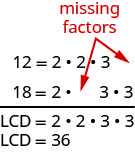
In Example 5, the LCD, 36, has two factors of 2 and two factors of
The denominator 12 has two factors of 2 but only one of 3—so it is “missing” one 3—we multiply the numerator and denominator by 3.
The denominator 18 is missing one factor of 2—so we multiply the numerator and denominator by 2.
We will apply this method as we subtract the fractions in Example 6.
In the next example, one of the fractions has a variable in its numerator. Notice that we do the same steps as when both numerators are numbers.
We now have all four operations for fractions. Table 1.26 summarizes fraction operations.
| Fraction Multiplication | Fraction Division |
Multiply the numerators and multiply the denominators | Multiply the first fraction by the reciprocal of the second. |
| Fraction Addition | Fraction Subtraction |
Add the numerators and place the sum over the common denominator. | Subtract the numerators and place the difference over the common denominator. |
| To multiply or divide fractions, an LCD is NOT needed. To add or subtract fractions, an LCD is needed. |
Use the Order of Operations to Simplify Complex Fractions
We have seen that a complex fraction is a fraction in which the numerator or denominator contains a fraction. The fraction bar indicates division. We simplified the complex fraction by dividing by
Now we’ll look at complex fractions where the numerator or denominator contains an expression that can be simplified. So we first must completely simplify the numerator and denominator separately using the order of operations. Then we divide the numerator by the denominator.
Evaluate Variable Expressions with Fractions
We have evaluated expressions before, but now we can evaluate expressions with fractions. Remember, to evaluate an expression, we substitute the value of the variable into the expression and then simplify.
The next example will have only variables, no constants.
Key Concepts
- Fraction Addition and Subtraction: If are numbers where then
and
To add or subtract fractions, add or subtract the numerators and place the result over the common denominator. - Strategy for Adding or Subtracting Fractions
- Do they have a common denominator?
Yes—go to step 2.
No—Rewrite each fraction with the LCD (Least Common Denominator). Find the LCD. Change each fraction into an equivalent fraction with the LCD as its denominator. - Add or subtract the fractions.
- Simplify, if possible. To multiply or divide fractions, an LCD IS NOT needed. To add or subtract fractions, an LCD IS needed.
- Do they have a common denominator?
- Simplify Complex Fractions
- Simplify the numerator.
- Simplify the denominator.
- Divide the numerator by the denominator. Simplify if possible.
Practice Makes Perfect
Add and Subtract Fractions with a Common Denominator
In the following exercises, add.
In the following exercises, subtract.
Mixed Practice
In the following exercises, simplify.
Add or Subtract Fractions with Different Denominators
In the following exercises, add or subtract.
Mixed Practice
In the following exercises, simplify.
ⓐ ⓑ
ⓐ ⓑ 4
ⓐ ⓑ
ⓐ ⓑ
ⓐ ⓑ
ⓐ ⓑ
Use the Order of Operations to Simplify Complex Fractions
In the following exercises, simplify.
54
1
Evaluate Variable Expressions with Fractions
In the following exercises, evaluate.
when
ⓐ
ⓑ
ⓐ ⓑ
when
ⓐ ⓑ
when ⓐ ⓑ
ⓐ ⓑ
when ⓐ ⓑ
when ⓐ ⓑ
ⓐ ⓑ
when ⓐ ⓑ
when and
when and
when
when
Everyday Math
Decorating Laronda is making covers for the throw pillows on her sofa. For each pillow cover, she needs yard of print fabric and yard of solid fabric. What is the total amount of fabric Laronda needs for each pillow cover?
yard
Baking Vanessa is baking chocolate chip cookies and oatmeal cookies. She needs cup of sugar for the chocolate chip cookies and cup of sugar for the oatmeal cookies. How much sugar does she need altogether?
Writing Exercises
Why do you need a common denominator to add or subtract fractions? Explain.
Answers may vary
How do you find the LCD of 2 fractions?
Self Check
ⓐ After completing the exercises, use this checklist to evaluate your mastery of the objectives of this section.
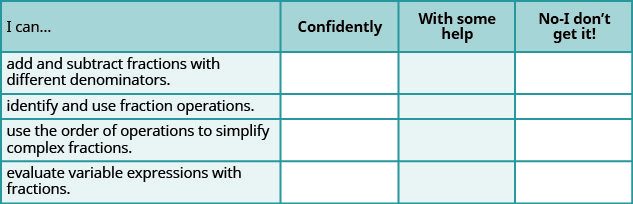
ⓑ After looking at the checklist, do you think you are well-prepared for the next chapter? Why or why not?
Adapted from Elementary Algebra 2e by OpenStax (openstax.org), licensed under CC BY-NC-SA 4.0. Changes were made. License: CC-BY-NC-SA-4.0.