
28.6 Relativistic Energy
Learning Objectives
By the end of this section, you will be able to:
- Compute total energy of a relativistic object.
- Compute the kinetic energy of a relativistic object.
- Describe rest energy, and explain how it can be converted to other forms.
- Explain why massive particles cannot reach C.
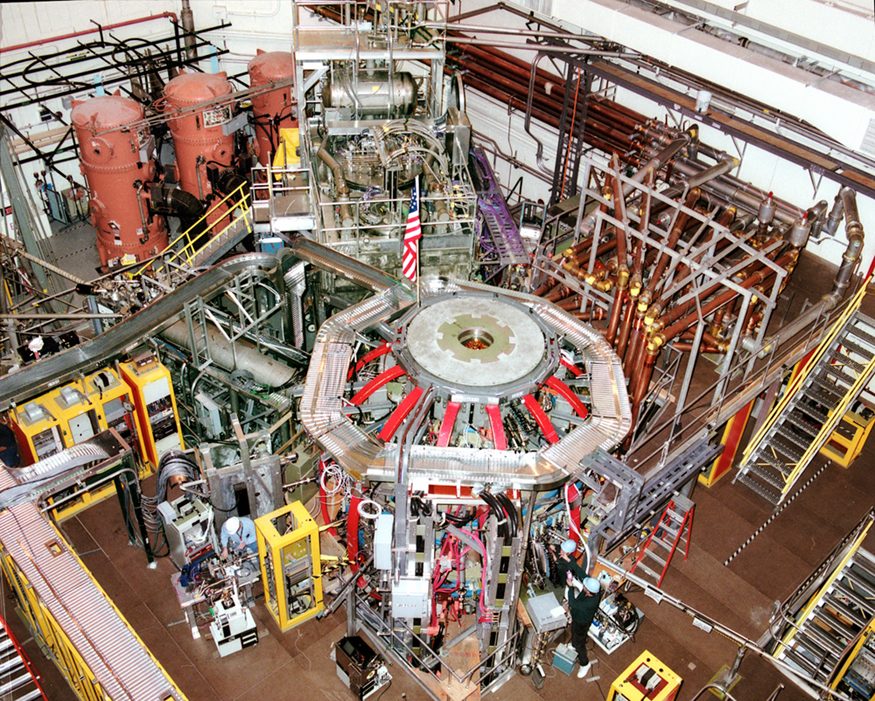
A tokamak is a form of experimental fusion reactor, which can change mass to energy. Accomplishing this requires an understanding of relativistic energy. Nuclear reactors are proof of the conservation of relativistic energy.
Conservation of energy is one of the most important laws in physics. Not only does energy have many important forms, but each form can be converted to any other. We know that classically the total amount of energy in a system remains constant. Relativistically, energy is still conserved, provided its definition is altered to include the possibility of mass changing to energy, as in the reactions that occur within a nuclear reactor. Relativistic energy is intentionally defined so that it will be conserved in all inertial frames, just as is the case for relativistic momentum. As a consequence, we learn that several fundamental quantities are related in ways not known in classical physics. All of these relationships are verified by experiment and have fundamental consequences. The altered definition of energy contains some of the most fundamental and spectacular new insights into nature found in recent history.
Total Energy and Rest Energy
The first postulate of relativity states that the laws of physics are the same in all inertial frames. Einstein showed that the law of conservation of energy is valid relativistically, if we define energy to include a relativistic factor.
This is the correct form of Einstein’s most famous equation, which for the first time showed that energy is related to the mass of an object at rest. For example, if energy is stored in the object, its rest mass increases. This also implies that mass can be destroyed to release energy. The implications of these first two equations regarding relativistic energy are so broad that they were not completely recognized for some years after Einstein published them in 1907, nor was the experimental proof that they are correct widely recognized at first. Einstein, it should be noted, did understand and describe the meanings and implications of his theory.
Today, the practical applications of the conversion of mass into another form of energy, such as in nuclear weapons and nuclear power plants, are well known. But examples also existed when Einstein first proposed the correct form of relativistic energy, and he did describe some of them. Nuclear radiation had been discovered in the previous decade, and it had been a mystery as to where its energy originated. The explanation was that, in certain nuclear processes, a small amount of mass is destroyed and energy is released and carried by nuclear radiation. But the amount of mass destroyed is so small that it is difficult to detect that any is missing. Although Einstein proposed this as the source of energy in the radioactive salts then being studied, it was many years before there was broad recognition that mass could be and, in fact, commonly is converted to energy. (See Figure 28.21.)
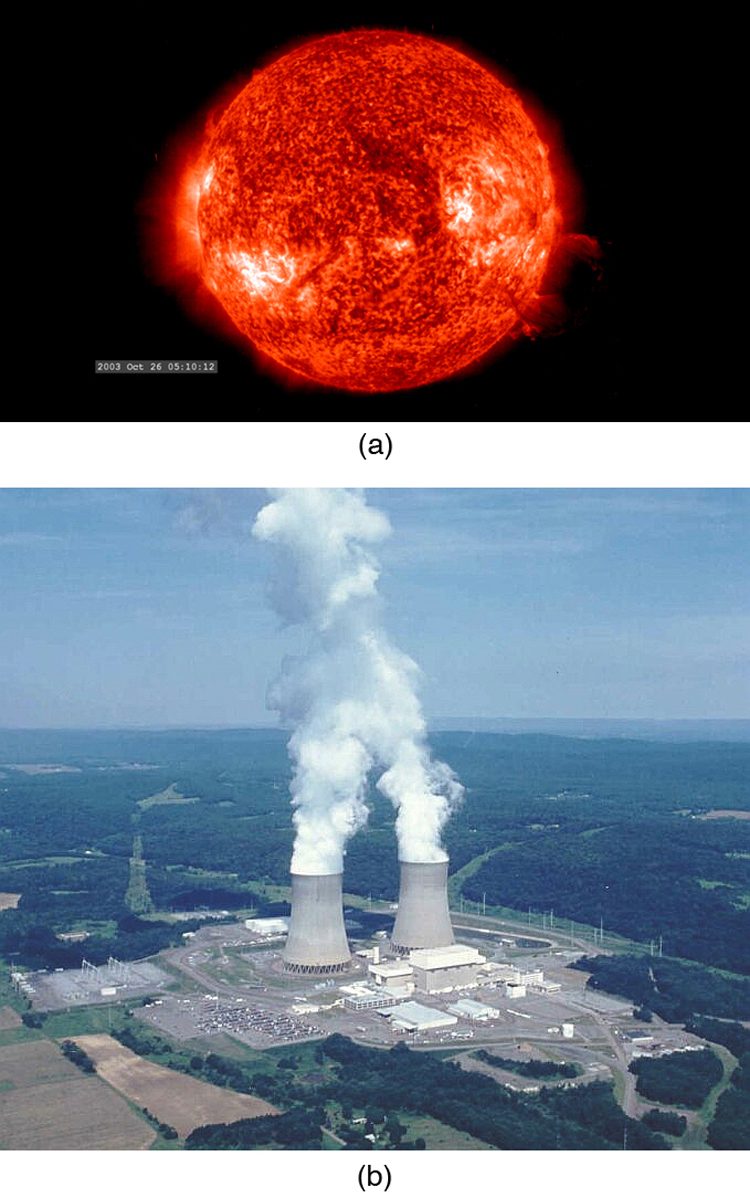
Because of the relationship of rest energy to mass, we now consider mass to be a form of energy rather than something separate. There had not even been a hint of this prior to Einstein’s work. Such conversion is now known to be the source of the Sun’s energy, the energy of nuclear decay, and even the source of energy keeping Earth’s interior hot.
Stored Energy and Potential Energy
What happens to energy stored in an object at rest, such as the energy put into a battery by charging it, or the energy stored in a toy gun’s compressed spring? The energy input becomes part of the total energy of the object and, thus, increases its rest mass. All stored and potential energy becomes mass in a system. Why is it we don’t ordinarily notice this? In fact, conservation of mass (meaning total mass is constant) was one of the great laws verified by 19th-century science. Why was it not noticed to be incorrect? The following example helps answer these questions.
Kinetic Energy and the Ultimate Speed Limit
Kinetic energy is energy of motion. Classically, kinetic energy has the familiar expression . The relativistic expression for kinetic energy is obtained from the work-energy theorem. This theorem states that the net work on a system goes into kinetic energy. If our system starts from rest, then the work-energy theorem is
Relativistically, at rest we have rest energy . The work increases this to the total energy . Thus,
Relativistically, we have .
When motionless, we have and
so that at rest, as expected. But the expression for relativistic kinetic energy (such as total energy and rest energy) does not look much like the classical . To show that the classical expression for kinetic energy is obtained at low velocities, we note that the binomial expansion for at low velocities gives
A binomial expansion is a way of expressing an algebraic quantity as a sum of an infinite series of terms. In some cases, as in the limit of small velocity here, most terms are very small. Thus the expression derived for here is not exact, but it is a very accurate approximation. Thus, at low velocities,
Entering this into the expression for relativistic kinetic energy gives
So, in fact, relativistic kinetic energy does become the same as classical kinetic energy when .
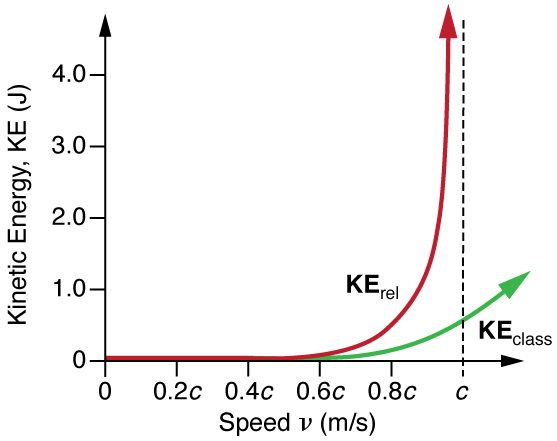
It is even more interesting to investigate what happens to kinetic energy when the velocity of an object approaches the speed of light. We know that becomes infinite as approaches , so that KErel also becomes infinite as the velocity approaches the speed of light. (See Figure 28.22.) An infinite amount of work (and, hence, an infinite amount of energy input) is required to accelerate a mass to the speed of light.
So the speed of light is the ultimate speed limit for any particle having mass. All of this is consistent with the fact that velocities less than always add to less than . Both the relativistic form for kinetic energy and the ultimate speed limit being have been confirmed in detail in numerous experiments. No matter how much energy is put into accelerating a mass, its velocity can only approach—not reach—the speed of light.
Relativistic Energy and Momentum
We know classically that kinetic energy and momentum are related to each other, since
Relativistically, we can obtain a relationship between energy and momentum by algebraically manipulating their definitions. This produces
where is the relativistic total energy and is the relativistic momentum. This relationship between relativistic energy and relativistic momentum is more complicated than the classical, but we can gain some interesting new insights by examining it. First, total energy is related to momentum and rest mass. At rest, momentum is zero, and the equation gives the total energy to be the rest energy (so this equation is consistent with the discussion of rest energy above). However, as the mass is accelerated, its momentum increases, thus increasing the total energy. At sufficiently high velocities, the rest energy term becomes negligible compared with the momentum term ; thus, at extremely relativistic velocities.
If we consider momentum to be distinct from mass, we can determine the implications of the equation for a particle that has no mass. If we take to be zero in this equation, then , or . Massless particles have this momentum. There are several massless particles found in nature, including photons (these are quanta of electromagnetic radiation). Another implication is that a massless particle must travel at speed and only at speed . While it is beyond the scope of this text to examine the relationship in the equation in detail, we can see that the relationship has important implications in special relativity.
A photon decays into an electron-positron pair. What is the kinetic energy of the electron if its speed is ?
Test Prep for AP Courses
A mass of 50 g is completely converted into energy. What is the energy that will be obtained when such a conversion takes place?
Show that relativistic kinetic energy becomes the same as classical kinetic energy when .
Relativistic kinetic energy is given as
where
Classical kinetic energy is given as
At low velocities , a binomial expansion and subsequent approximation of gives:
or
Substituting in the expression for gives
Hence, relativistic kinetic energy becomes classical kinetic energy when .
The relativistic energy of a particle in terms of momentum is given by:
Section Summary
- Relativistic energy is conserved as long as we define it to include the possibility of mass changing to energy.
- Total Energy is defined as: , where .
- Rest energy is , meaning that mass is a form of energy. If energy is stored in an object, its mass increases. Mass can be destroyed to release energy.
- We do not ordinarily notice the increase or decrease in mass of an object because the change in mass is so small for a large increase in energy.
- The relativistic work-energy theorem is .
- Relativistically, , where is the relativistic kinetic energy.
- Relativistic kinetic energy is , where . At low velocities, relativistic kinetic energy reduces to classical kinetic energy.
- No object with mass can attain the speed of light because an infinite amount of work and an infinite amount of energy input is required to accelerate a mass to the speed of light.
- The equation relates the relativistic total energy and the relativistic momentum . At extremely high velocities, the rest energy becomes negligible, and .
Conceptual Questions
How are the classical laws of conservation of energy and conservation of mass modified by modern relativity?
What happens to the mass of water in a pot when it cools, assuming no molecules escape or are added? Is this observable in practice? Explain.
Consider a thought experiment. You place an expanded balloon of air on weighing scales outside in the early morning. The balloon stays on the scales and you are able to measure changes in its mass. Does the mass of the balloon change as the day progresses? Discuss the difficulties in carrying out this experiment.
The mass of the fuel in a nuclear reactor decreases by an observable amount as it puts out energy. Is the same true for the coal and oxygen combined in a conventional power plant? If so, is this observable in practice for the coal and oxygen? Explain.
We know that the velocity of an object with mass has an upper limit of . Is there an upper limit on its momentum? Its energy? Explain.
Given the fact that light travels at , can it have mass? Explain.
If you use an Earth-based telescope to project a laser beam onto the Moon, you can move the spot across the Moon’s surface at a velocity greater than the speed of light. Does this violate modern relativity? (Note that light is being sent from the Earth to the Moon, not across the surface of the Moon.)
Problems & Exercises
What is the rest energy of an electron, given its mass is ? Give your answer in joules and MeV.
0.512 MeV
Find the rest energy in joules and MeV of a proton, given its mass is .
If the rest energies of a proton and a neutron (the two constituents of nuclei) are 938.3 and 939.6 MeV respectively, what is the difference in their masses in kilograms?
The Big Bang that began the universe is estimated to have released of energy. How many stars could half this energy create, assuming the average star’s mass is ?
A supernova explosion of a star produces of energy. (a) How many kilograms of mass are converted to energy in the explosion? (b) What is the ratio of mass destroyed to the original mass of the star?
(a)
(b)
(a) Using data from Table 7.2, calculate the mass converted to energy by the fission of 1.00 kg of uranium. (b) What is the ratio of mass destroyed to the original mass, ?
(a) Using data from Table 7.2, calculate the amount of mass converted to energy by the fusion of 1.00 kg of hydrogen. (b) What is the ratio of mass destroyed to the original mass, ? (c) How does this compare with for the fission of 1.00 kg of uranium?
The ratio is greater for hydrogen.
There is approximately of energy available from fusion of hydrogen in the world’s oceans. (a) If of this energy were utilized, what would be the decrease in mass of the oceans? Assume that 0.08% of the mass of a water molecule is converted to energy during the fusion of hydrogen. (b) How great a volume of water does this correspond to? (c) Comment on whether this is a significant fraction of the total mass of the oceans.
A muon has a rest mass energy of 105.7 MeV, and it decays into an electron and a massless particle. (a) If all the lost mass is converted into the electron’s kinetic energy, find for the electron. (b) What is the electron’s velocity?
208
A -meson is a particle that decays into a muon and a massless particle. The -meson has a rest mass energy of 139.6 MeV, and the muon has a rest mass energy of 105.7 MeV. Suppose the -meson is at rest and all of the missing mass goes into the muon’s kinetic energy. How fast will the muon move?
(a) Calculate the relativistic kinetic energy of a 1000-kg car moving at 30.0 m/s if the speed of light were only 45.0 m/s. (b) Find the ratio of the relativistic kinetic energy to classical.
1.54
Alpha decay is nuclear decay in which a helium nucleus is emitted. If the helium nucleus has a mass of and is given 5.00 MeV of kinetic energy, what is its velocity?
(a) Beta decay is nuclear decay in which an electron is emitted. If the electron is given 0.750 MeV of kinetic energy, what is its velocity? (b) Comment on how the high velocity is consistent with the kinetic energy as it compares to the rest mass energy of the electron.
(a)
(b) The rest mass energy of an electron is 0.511 MeV, so the kinetic energy is approximately 150% of the rest mass energy. The electron should be traveling close to the speed of light.
A positron is an antimatter version of the electron, having exactly the same mass. When a positron and an electron meet, they annihilate, converting all of their mass into energy. (a) Find the energy released, assuming negligible kinetic energy before the annihilation. (b) If this energy is given to a proton in the form of kinetic energy, what is its velocity? (c) If this energy is given to another electron in the form of kinetic energy, what is its velocity?
What is the kinetic energy in MeV of a -meson that lives as measured in the laboratory, and when at rest relative to an observer, given that its rest energy is 135 MeV?
90.0 MeV
Find the kinetic energy in MeV of a neutron with a measured life span of 2065 s, given its rest energy is 939.6 MeV, and rest life span is 900s.
(a) Show that . This means that at large velocities . (b) Is when , as for the astronaut discussed in the twin paradox?
(a)
(b) yes
One cosmic ray neutron has a velocity of relative to the Earth. (a) What is the neutron’s total energy in MeV? (b) Find its momentum. (c) Is in this situation? Discuss in terms of the equation given in part (a) of the previous problem.
What is for a proton having a mass energy of 938.3 MeV accelerated through an effective potential of 1.0 TV (teravolt) at Fermilab outside Chicago?
(a) What is the effective accelerating potential for electrons at the Stanford Linear Accelerator, if for them? (b) What is their total energy (nearly the same as kinetic in this case) in GeV?
(a) Using data from Table 7.2, find the mass destroyed when the energy in a barrel of crude oil is released. (b) Given these barrels contain 200 liters and assuming the density of crude oil is , what is the ratio of mass destroyed to original mass, ?
(a) Calculate the energy released by the destruction of 1.00 kg of mass. (b) How many kilograms could be lifted to a 10.0 km height by this amount of energy?
A Van de Graaff accelerator utilizes a 50.0 MV potential difference to accelerate charged particles such as protons. (a) What is the velocity of a proton accelerated by such a potential? (b) An electron?
Suppose you use an average of of electric energy per month in your home. (a) How long would 1.00 g of mass converted to electric energy with an efficiency of 38.0% last you? (b) How many homes could be supplied at the per month rate for one year by the energy from the described mass conversion?
(a) A nuclear power plant converts energy from nuclear fission into electricity with an efficiency of 35.0%. How much mass is destroyed in one year to produce a continuous 1000 MW of electric power? (b) Do you think it would be possible to observe this mass loss if the total mass of the fuel is ?
(a) 1.00 kg
(b) This much mass would be measurable, but probably not observable just by looking because it is 0.01% of the total mass.
Nuclear-powered rockets were researched for some years before safety concerns became paramount. (a) What fraction of a rocket’s mass would have to be destroyed to get it into a low Earth orbit, neglecting the decrease in gravity? (Assume an orbital altitude of 250 km, and calculate both the kinetic energy (classical) and the gravitational potential energy needed.) (b) If the ship has a mass of (100 tons), what total yield nuclear explosion in tons of TNT is needed?
The Sun produces energy at a rate of W by the fusion of hydrogen. (a) How many kilograms of hydrogen undergo fusion each second? (b) If the Sun is 90.0% hydrogen and half of this can undergo fusion before the Sun changes character, how long could it produce energy at its current rate? (c) How many kilograms of mass is the Sun losing per second? (d) What fraction of its mass will it have lost in the time found in part (b)?
(a)
(b)
(c)
(d) 0.32%
Unreasonable Results
A proton has a mass of . A physicist measures the proton’s total energy to be 50.0 MeV. (a) What is the proton’s kinetic energy? (b) What is unreasonable about this result? (c) Which assumptions are unreasonable or inconsistent?
Construct Your Own Problem
Consider a highly relativistic particle. Discuss what is meant by the term “highly relativistic.” (Note that, in part, it means that the particle cannot be massless.) Construct a problem in which you calculate the wavelength of such a particle and show that it is very nearly the same as the wavelength of a massless particle, such as a photon, with the same energy. Among the things to be considered are the rest energy of the particle (it should be a known particle) and its total energy, which should be large compared to its rest energy.
Construct Your Own Problem
Consider an astronaut traveling to another star at a relativistic velocity. Construct a problem in which you calculate the time for the trip as observed on the Earth and as observed by the astronaut. Also calculate the amount of mass that must be converted to energy to get the astronaut and ship to the velocity travelled. Among the things to be considered are the distance to the star, the velocity, and the mass of the astronaut and ship. Unless your instructor directs you otherwise, do not include any energy given to other masses, such as rocket propellants.
Critical Thinking A space rock with a length of 1,000.0 m is moving through space at exactly 0.6 c. (a) If the space rock is moving toward an observer, what is the contracted length observed? (b) If the space rock is moving away from the observer, what is the contracted length observed? (c) Can the object reach the speed of light? (d) If the object were to stop in the observer’s reference frame, would it be observed to have proper length?
(a)
(b)
(c) No.
(d) Yes.
Adapted from College Physics 2e by OpenStax (openstax.org), licensed under CC BY-NC-SA 4.0. Changes were made. License: CC-BY-NC-SA-4.0.