
28.4 Relativistic Addition of Velocities
Learning Objectives
By the end of this section, you will be able to:
- Calculate relativistic velocity addition.
- Explain when relativistic velocity addition should be used instead of classical addition of velocities.
- Calculate relativistic Doppler shift.

If you’ve ever seen a kayak move down a fast-moving river, you know that remaining in the same place would be hard. The river current pulls the kayak along. Pushing the oars back against the water can move the kayak forward in the water, but that only accounts for part of the velocity. The kayak’s motion is an example of classical addition of velocities. In classical physics, velocities add as vectors. The kayak’s velocity is the vector sum of its velocity relative to the water and the water’s velocity relative to the riverbank.
Classical Velocity Addition
For simplicity, we restrict our consideration of velocity addition to one-dimensional motion. Classically, velocities add like regular numbers in one-dimensional motion. (See Figure 28.14.) Suppose, for example, a girl is riding in a sled at a speed 1.0 m/s relative to an observer. She throws a snowball first forward, then backward at a speed of 1.5 m/s relative to the sled. We denote direction with plus and minus signs in one dimension; in this example, forward is positive. Let be the velocity of the sled relative to the Earth, the velocity of the snowball relative to the Earth-bound observer, and the velocity of the snowball relative to the sled.
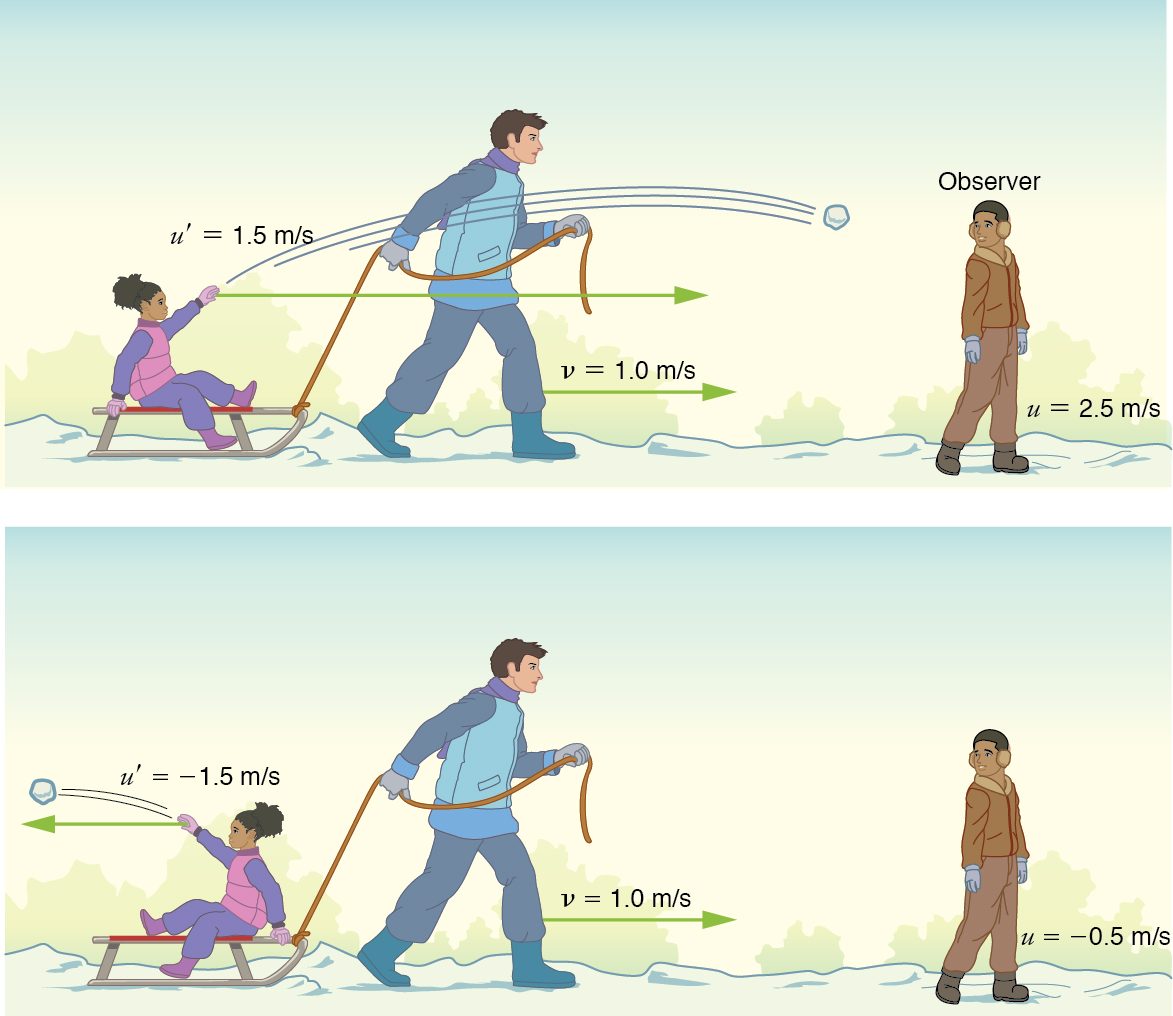
Thus, when the girl throws the snowball forward, . It makes good intuitive sense that the snowball will head towards the Earth-bound observer faster, because it is thrown forward from a moving vehicle. When the girl throws the snowball backward, . The minus sign means the snowball moves away from the Earth-bound observer.
Relativistic Velocity Addition
The second postulate of relativity (verified by extensive experimental observation) says that classical velocity addition does not apply to light. Imagine a car traveling at night along a straight road, as in Figure 28.15. If classical velocity addition applied to light, then the light from the car’s headlights would approach the observer on the sidewalk at a speed . But we know that light will move away from the car at speed relative to the driver of the car, and light will move towards the observer on the sidewalk at speed , too.
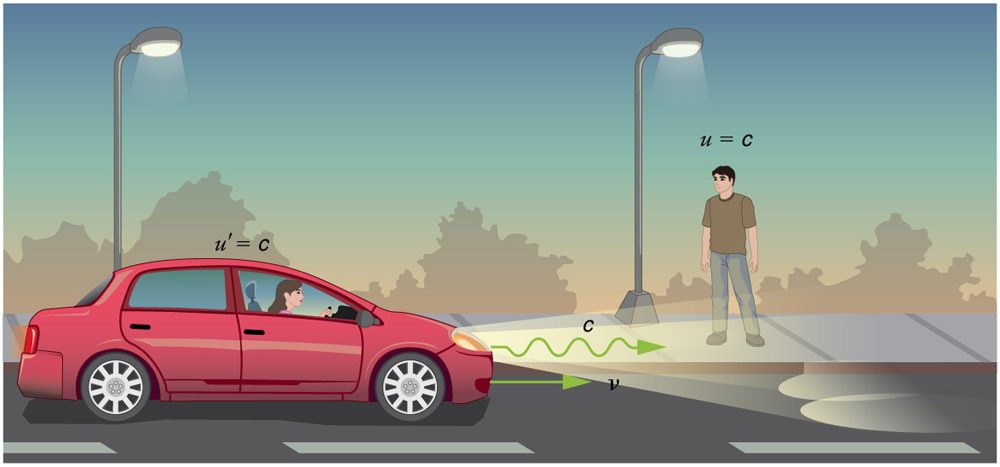
Velocities cannot add to greater than the speed of light, provided that is less than and does not exceed . The following example illustrates that relativistic velocity addition is not as symmetric as classical velocity addition.
Doppler Shift
Although the speed of light does not change with relative velocity, the frequencies and wavelengths of light do. First discussed for sound waves, a Doppler shift occurs in any wave when there is relative motion between source and observer.
In the Doppler equation, is the observed wavelength, is the source wavelength, and is the relative velocity of the source to the observer. The velocity is positive for motion away from an observer and negative for motion toward an observer. In terms of source frequency and observed frequency, this equation can be written
Notice that the – and + signs are different than in the wavelength equation.
The relativistic Doppler shift is easy to observe. This equation has everyday applications ranging from Doppler-shifted radar velocity measurements of transportation to Doppler-radar storm monitoring. In astronomical observations, the relativistic Doppler shift provides velocity information such as the motion and distance of stars.
Suppose a space probe moves away from the Earth at a speed . It sends a radio wave message back to the Earth at a frequency of 1.50 GHz. At what frequency is the message received on the Earth?
Test Prep for AP Courses
What happens when velocities comparable to the speed of light are involved in an observation?
- Newton’s second law of motion, , governs the motion of the object.
- Newton’s second law of motion, , no longer governs the dynamics of the object.
- Such velocities cannot be determined mathematically.
- None of the above
How is the relativistic Doppler effect different from the classical Doppler effect?
The relativistic Doppler effect takes into account the special relativity concept of time dilation and also does not require a medium of propagation to be used as a point of reference (light does not require a medium for propagation).
Section Summary
- With classical velocity addition, velocities add like regular numbers in one-dimensional motion: , where is the velocity between two observers, is the velocity of an object relative to one observer, and is the velocity relative to the other observer.
- Velocities cannot add to be greater than the speed of light. Relativistic velocity addition describes the velocities of an object moving at a relativistic speed:
- An observer of electromagnetic radiation sees relativistic Doppler effects if the source of the radiation is moving relative to the observer. The wavelength of the radiation is longer (called a red shift) than that emitted by the source when the source moves away from the observer and shorter (called a blue shift) when the source moves toward the observer. The shifted wavelength is described by the equation is the observed wavelength, is the source wavelength, and is the relative velocity of the source to the observer.
Conceptual Questions
Explain the meaning of the terms “red shift” and “blue shift” as they relate to the relativistic Doppler effect.
What happens to the relativistic Doppler effect when relative velocity is zero? Is this the expected result?
Is the relativistic Doppler effect consistent with the classical Doppler effect in the respect that is larger for motion away?
All galaxies farther away than about exhibit a red shift in their emitted light that is proportional to distance, with those farther and farther away having progressively greater red shifts. What does this imply, assuming that the only source of red shift is relative motion? (Hint: At these large distances, it is space itself that is expanding, but the effect on light is the same.)
Problems & Exercises
Suppose a spaceship heading straight towards the Earth at can shoot a canister at relative to the ship. (a) What is the velocity of the canister relative to the Earth, if it is shot directly at the Earth? (b) If it is shot directly away from the Earth?
(a)
(b)
Repeat the previous problem with the ship heading directly away from the Earth.
If a spaceship is approaching the Earth at and a message capsule is sent toward it at relative to the Earth, what is the speed of the capsule relative to the ship?
(a) Suppose the speed of light were only . A jet fighter moving toward a target on the ground at shoots bullets, each having a muzzle velocity of . What are the bullets’ velocity relative to the target? (b) If the speed of light was this small, would you observe relativistic effects in everyday life? Discuss.
If a galaxy moving away from the Earth has a speed of and emits light characteristic of hydrogen (the most common element in the universe). (a) What wavelength would we observe on the Earth? (b) What type of electromagnetic radiation is this? (c) Why is the speed of the Earth in its orbit negligible here?
a)
b) red
c) (negligible)
A space probe speeding towards the nearest star moves at and sends radio information at a broadcast frequency of 1.00 GHz. What frequency is received on the Earth?
If two spaceships are heading directly towards each other at , at what speed must a canister be shot from the first ship to approach the other at as seen by the second ship?
Two planets are on a collision course, heading directly towards each other at . A spaceship sent from one planet approaches the second at as seen by the second planet. What is the velocity of the ship relative to the first planet?
When a missile is shot from one spaceship towards another, it leaves the first at and approaches the other at . What is the relative velocity of the two ships?
What is the relative velocity of two spaceships if one fires a missile at the other at and the other observes it to approach at ?
Near the center of our galaxy, hydrogen gas is moving directly away from us in its orbit about a black hole. We receive 1900 nm electromagnetic radiation and know that it was 1875 nm when emitted by the hydrogen gas. What is the speed of the gas?
A highway patrol officer uses a device that measures the speed of vehicles by bouncing radar off them and measuring the Doppler shift. The outgoing radar has a frequency of 100 GHz and the returning echo has a frequency 15.0 kHz higher. What is the velocity of the vehicle? Note that there are two Doppler shifts in echoes. Be certain not to round off until the end of the problem, because the effect is small.
Prove that for any relative velocity between two observers, a beam of light sent from one to the other will approach at speed (provided that is less than , of course).
, so
Show that for any relative velocity between two observers, a beam of light projected by one directly away from the other will move away at the speed of light (provided that is less than , of course).
(a) All but the closest galaxies are receding from our own Milky Way Galaxy. If a galaxy ly away is receding from us at 0., at what velocity relative to us must we send an exploratory probe to approach the other galaxy at , as measured from that galaxy? (b) How long will it take the probe to reach the other galaxy as measured from the Earth? You may assume that the velocity of the other galaxy remains constant. (c) How long will it then take for a radio signal to be beamed back? (All of this is possible in principle, but not practical.)
a)
b)
c) (all to sufficient digits to show effects)
Adapted from College Physics 2e by OpenStax (openstax.org), licensed under CC BY-NC-SA 4.0. Changes were made. License: CC-BY-NC-SA-4.0.