
25.5 Dispersion: The Rainbow and Prisms
Learning Objectives
By the end of this section, you will be able to:
- Explain the phenomenon of dispersion and discuss its advantages and disadvantages.
Everyone enjoys the spectacle and surprise of rainbows. They’ve been hailed as symbols of hope and spirituality and are the subject of stories and myths across the world’s cultures. Just how does sunlight falling on water droplets cause the multicolored image we see, and what else does this phenomenon tell us about light, color, and radiation? Working in his native Persia (now Iran), Kamal al-Din Hasan ibn Ali ibn Hasan al-Farisi (1267–1319) designed a series of innovative experiments to answer this question and clarify the explanations of many earlier scientists. At that time, there were no microscopes to examine tiny drops of water similar to those in the atmosphere, so Farisi created an enormous drop of water. He filled a large glass vessel with water and placed it inside a camera obscura, in which he could carefully control the entry of light. Using a series of careful observations on the resulting multicolored spectra of light, he deduced and confirmed that the droplets split—or decompose—white light into the colors of the rainbow. Farisi’s contemporary, Theodoric of Freiberg (in Germany), performed similar experiments using other equipment. Both relied on the prior work of Ibn al-Haytham, often known as the founder of optics and among the first to formalize a scientific method.
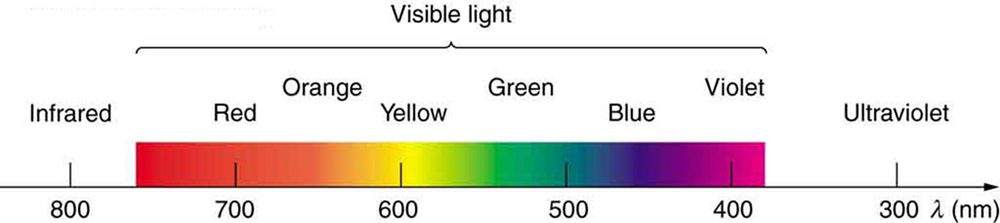
We see about six colors in a rainbow—red, orange, yellow, green, blue, and violet; sometimes indigo is listed, too. Those colors are associated with different wavelengths of light, as shown in Figure 25.31. When our eye receives pure-wavelength light, we tend to see only one of the six colors, depending on wavelength. The thousands of other hues we can sense in other situations are our eye’s response to various mixtures of wavelengths. White light, in particular, is a fairly uniform mixture of all visible wavelengths. Sunlight, considered to be white, actually appears to be a bit yellow because of its mixture of wavelengths, but it does contain all visible wavelengths. The sequence of colors in rainbows is the same sequence as the colors plotted versus wavelength in Figure 25.31. What this implies is that white light is spread out according to wavelength in a rainbow. Dispersion is defined as the spreading of white light into its full spectrum of wavelengths. More technically, dispersion occurs whenever there is a process that changes the direction of light in a manner that depends on wavelength. Dispersion, as a general phenomenon, can occur for any type of wave and always involves wavelength-dependent processes.
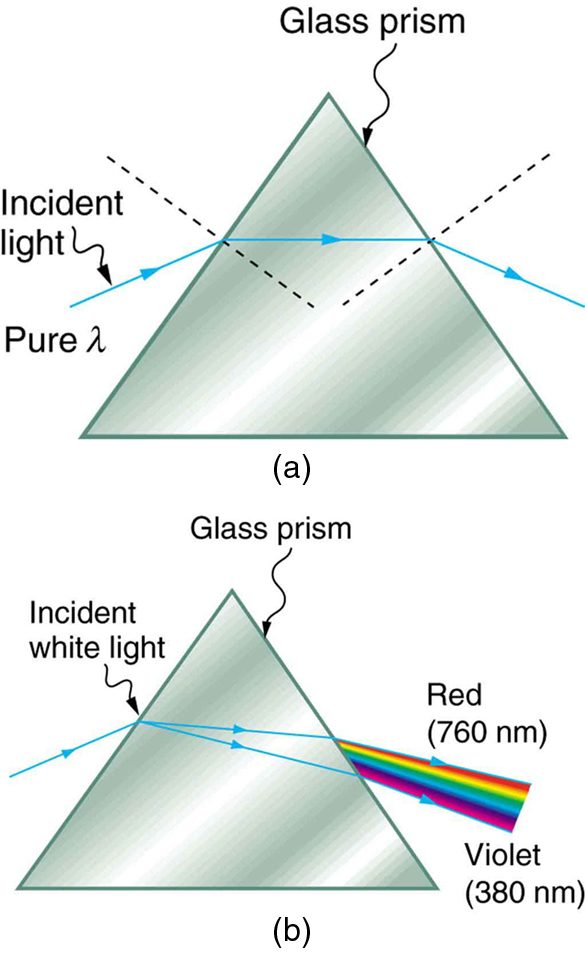
Refraction is responsible for dispersion in rainbows and many other situations. The angle of refraction depends on the index of refraction, as we saw in The Law of Refraction. We know that the index of refraction depends on the medium. But for a given medium, also depends on wavelength. (See Table 25.2. Note that, for a given medium, increases as wavelength decreases and is greatest for violet light. Thus violet light is bent more than red light, as shown for a prism in Figure 25.32(b), and the light is dispersed into the same sequence of wavelengths as seen in Figure 25.30 and Figure 25.31.
| Medium | Red (660 nm) | Orange (610 nm) | Yellow (580 nm) | Green (550 nm) | Blue (470 nm) | Violet (410 nm) |
|---|---|---|---|---|---|---|
| Water | 1.331 | 1.332 | 1.333 | 1.335 | 1.338 | 1.342 |
| Diamond | 2.410 | 2.415 | 2.417 | 2.426 | 2.444 | 2.458 |
| Glass, crown | 1.512 | 1.514 | 1.518 | 1.519 | 1.524 | 1.530 |
| Glass, flint | 1.662 | 1.665 | 1.667 | 1.674 | 1.684 | 1.698 |
| Polystyrene | 1.488 | 1.490 | 1.492 | 1.493 | 1.499 | 1.506 |
| Quartz, fused | 1.455 | 1.456 | 1.458 | 1.459 | 1.462 | 1.468 |
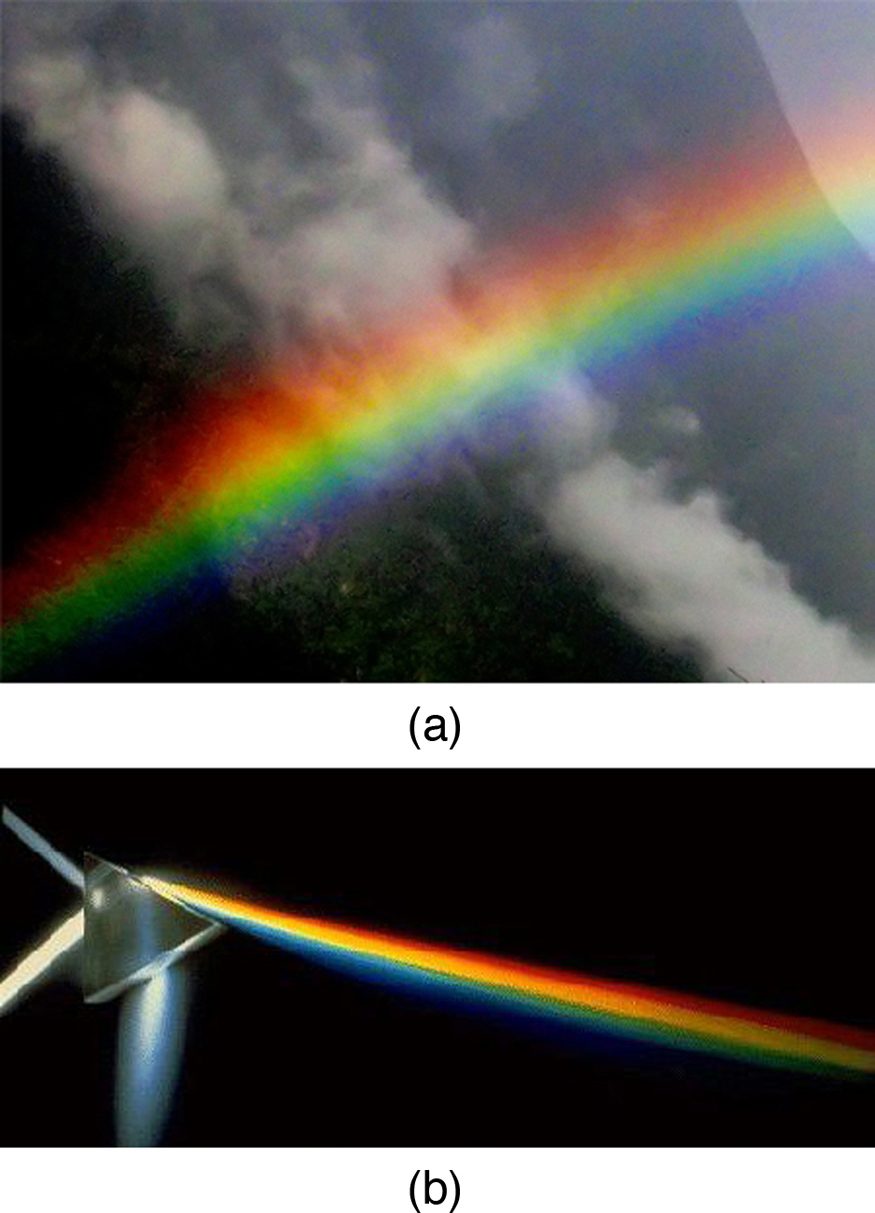
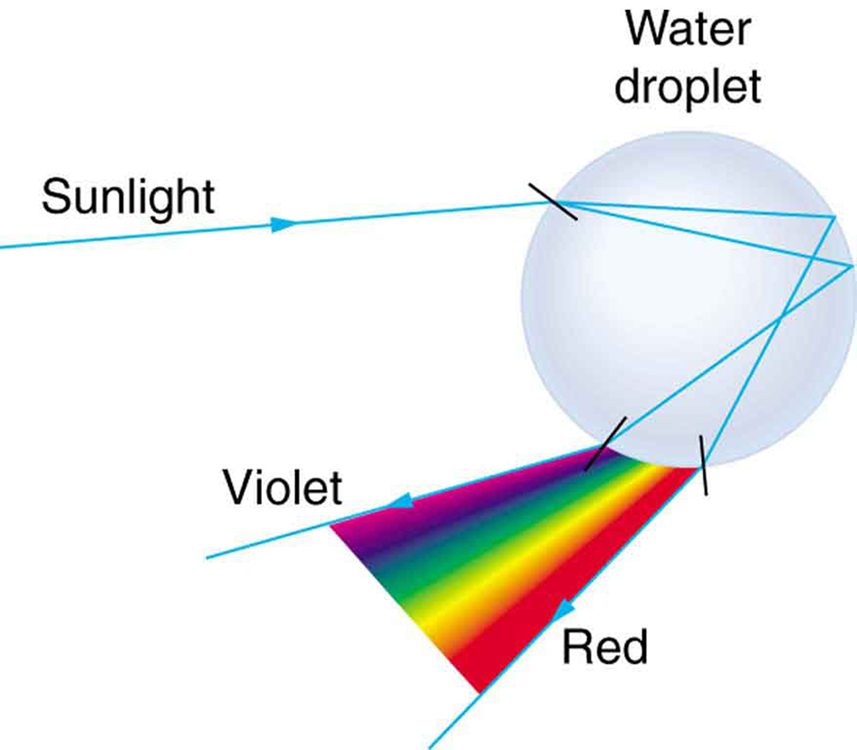
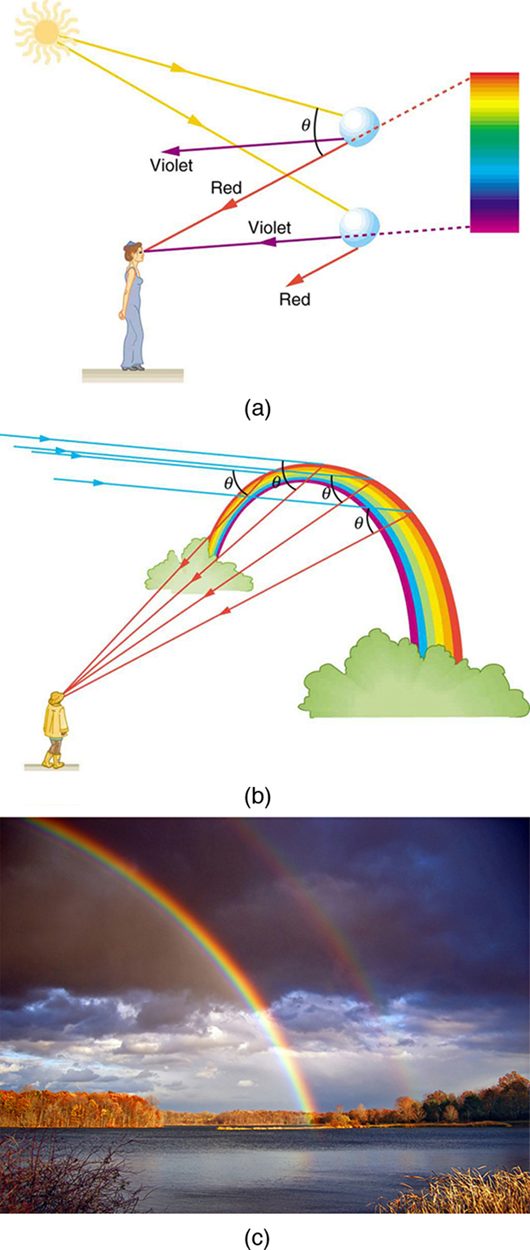
Rainbows are produced by a combination of refraction and reflection. You may have noticed that you see a rainbow only when you look away from the sun. Light enters a drop of water and is reflected from the back of the drop, as shown in Figure 25.33. The light is refracted both as it enters and as it leaves the drop. Since the index of refraction of water varies with wavelength, the light is dispersed, and a rainbow is observed, as shown in Figure 25.34 (a). (There is no dispersion caused by reflection at the back surface, since the law of reflection does not depend on wavelength.) The actual rainbow of colors seen by an observer depends on the myriad of rays being refracted and reflected toward the observer’s eyes from numerous drops of water. The effect is most spectacular when the background is dark, as in stormy weather, but can also be observed in waterfalls and lawn sprinklers. The arc of a rainbow comes from the need to be looking at a specific angle relative to the direction of the sun, as illustrated in Figure 25.34 (b). (If there are two reflections of light within the water drop, another “secondary” rainbow is produced. This rare event produces an arc that lies above the primary rainbow arc—see Figure 25.34 (c).)
Dispersion may produce beautiful rainbows, but it can cause problems in optical systems. White light used to transmit messages in a fiber is dispersed, spreading out in time and eventually overlapping with other messages. Since a laser produces a nearly pure wavelength, its light experiences little dispersion, an advantage over white light for transmission of information. In contrast, dispersion of electromagnetic waves coming to us from outer space can be used to determine the amount of matter they pass through. As with many phenomena, dispersion can be useful or a nuisance, depending on the situation and our human goals.
Section Summary
- The spreading of white light into its full spectrum of wavelengths is called dispersion.
- Rainbows are produced by a combination of refraction and reflection and involve the dispersion of sunlight into a continuous distribution of colors.
- Dispersion produces beautiful rainbows but also causes problems in certain optical systems.
Problems & Exercises
(a) What is the ratio of the speed of red light to violet light in diamond, based on Table 25.2? (b) What is this ratio in polystyrene? (c) Which is more dispersive?
A beam of white light goes from air into water at an incident angle of . At what angles are the red (660 nm) and violet (410 nm) parts of the light refracted?
By how much do the critical angles for red (660 nm) and violet (410 nm) light differ in a diamond surrounded by air?
(a) A narrow beam of light containing yellow (580 nm) and green (550 nm) wavelengths goes from polystyrene to air, striking the surface at a incident angle. What is the angle between the colors when they emerge? (b) How far would they have to travel to be separated by 1.00 mm?
(a)
(b)
A parallel beam of light containing orange (610 nm) and violet (410 nm) wavelengths goes from fused quartz to water, striking the surface between them at a incident angle. What is the angle between the two colors in water?
A ray of 610 nm light goes from air into fused quartz at an incident angle of . At what incident angle must 470 nm light enter flint glass to have the same angle of refraction?
A narrow beam of light containing red (660 nm) and blue (470 nm) wavelengths travels from air through a 1.00 cm thick flat piece of crown glass and back to air again. The beam strikes at a incident angle. (a) At what angles do the two colors emerge? (b) By what distance are the red and blue separated when they emerge?
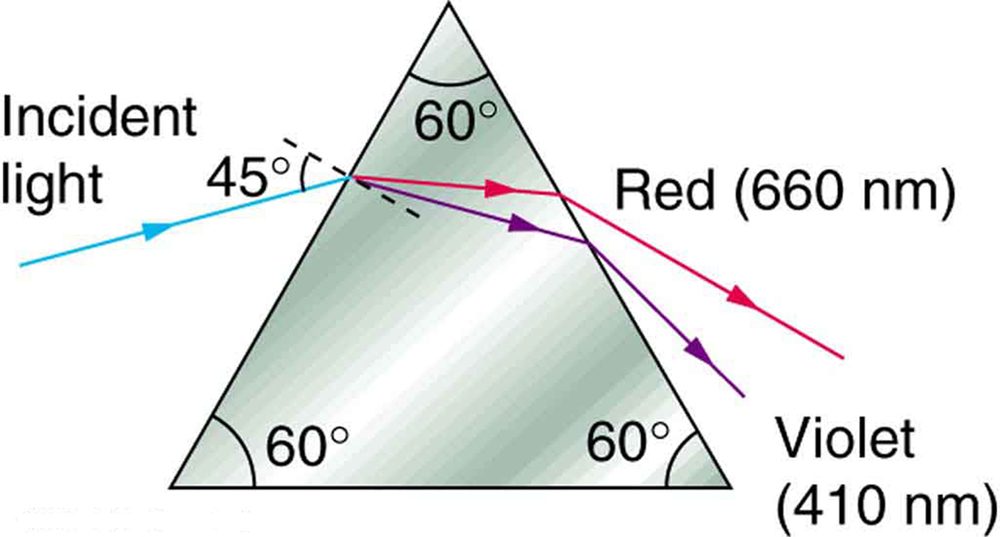
A narrow beam of white light enters a prism made of crown glass at a incident angle, as shown in Figure 25.35. At what angles, and , do the red (660 nm) and violet (410 nm) components of the light emerge from the prism?
Adapted from College Physics 2e by OpenStax (openstax.org), licensed under CC BY-NC-SA 4.0. Changes were made. License: CC-BY-NC-SA-4.0.