
25.3 The Law of Refraction
Learning Objectives
By the end of this section, you will be able to:
- Determine the index of refraction, given the speed of light in a medium.
It is easy to notice some odd things when looking into a fish tank. For example, you may see the same fish appearing to be in two different places. (See Figure 25.13.) This is because light coming from the fish to us changes direction when it leaves the tank, and in this case, it can travel two different paths to get to our eyes. The changing of a light ray’s direction (loosely called bending) when it passes through variations in matter is called refraction. Refraction is responsible for a tremendous range of optical phenomena, from the action of lenses to voice transmission through optical fibers.
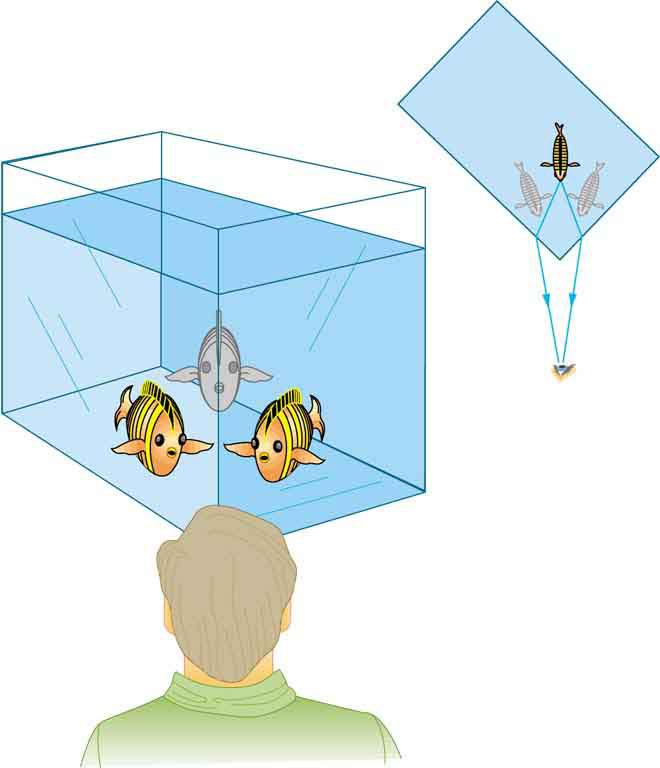
Why does light change direction when passing from one material (medium) to another? It is because light changes speed when going from one material to another. So before we study the law of refraction, it is useful to discuss the speed of light and how it varies in different media.
The Speed of Light
Early attempts to measure the speed of light, such as those made by Galileo, determined that light moved extremely fast, perhaps instantaneously. The first real evidence that light traveled at a finite speed came from the Danish astronomer Ole Roemer in the late 17th century. Roemer had noted that the average orbital period of one of Jupiter’s moons, as measured from Earth, varied depending on whether Earth was moving toward or away from Jupiter. He correctly concluded that the apparent change in period was due to the change in distance between Earth and Jupiter and the time it took light to travel this distance. From his 1676 data, a value of the speed of light was calculated to be (only 25% different from today’s accepted value). In more recent times, physicists have measured the speed of light in numerous ways and with increasing accuracy. One particularly direct method, used in 1887 by the American physicist Albert Michelson (1852–1931), is illustrated in Figure 25.14. Light reflected from a rotating set of mirrors was reflected from a stationary mirror 35 km away and returned to the rotating mirrors. The time for the light to travel can be determined by how fast the mirrors must rotate for the light to be returned to the observer’s eye.
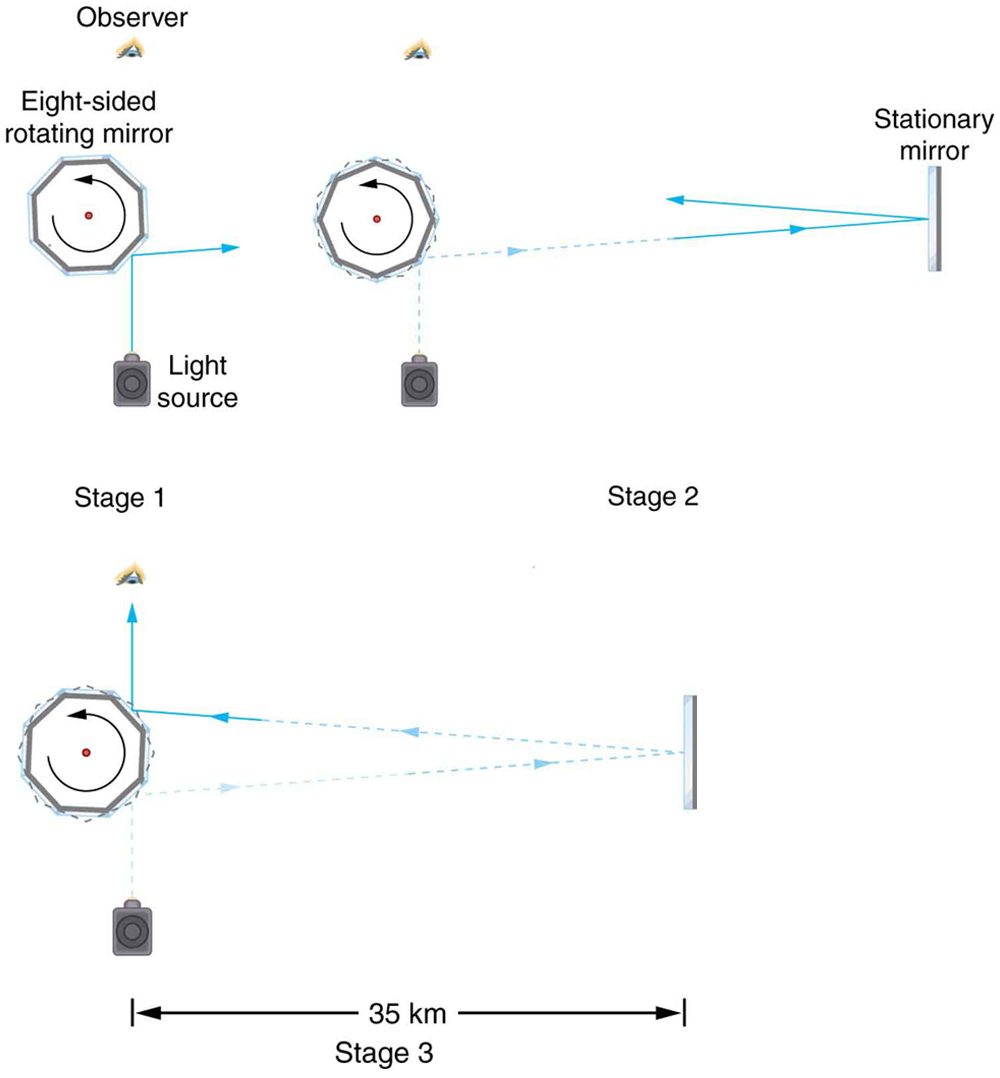
The speed of light is now known to great precision. In fact, the speed of light in a vacuum is so important that it is accepted as one of the basic physical quantities and has the fixed value
where the approximate value of is used whenever three-digit accuracy is sufficient. The speed of light through matter is less than it is in a vacuum, because light interacts with atoms in a material. The speed of light depends strongly on the type of material, since its interaction with different atoms, crystal lattices, and other substructures varies. We define the index of refraction of a material to be
where is the observed speed of light in the material. Since the speed of light is always less than in matter and equals only in a vacuum, the index of refraction is always greater than or equal to one.
That is, . Table 25.1 gives the indices of refraction for some representative substances. The values are listed for a particular wavelength of light, because they vary slightly with wavelength. (This can have important effects, such as colors produced by a prism.) Note that for gases, is close to 1.0. This seems reasonable, since atoms in gases are widely separated and light travels at in the vacuum between atoms. It is common to take for gases unless great precision is needed. Although the speed of light in a medium varies considerably from its value in a vacuum, it is still a large speed.
| Medium | n |
|---|---|
| Gases at , 1 atm | |
| Air | 1.000293 |
| Carbon dioxide | 1.00045 |
| Hydrogen | 1.000139 |
| Oxygen | 1.000271 |
| Liquids at | |
| Benzene | 1.501 |
| Carbon disulfide | 1.628 |
| Carbon tetrachloride | 1.461 |
| Ethanol | 1.361 |
| Glycerine | 1.473 |
| Water, fresh | 1.333 |
| Solids at | |
| Diamond | 2.419 |
| Fluorite | 1.434 |
| Glass, crown | 1.52 |
| Glass, flint | 1.66 |
| Ice at | 1.309 |
| Magnesium Fluoride | 1.38 |
| Polystyrene | 1.49 |
| Plexiglas | 1.51 |
| Quartz, crystalline | 1.544 |
| Quartz, fused | 1.458 |
| Sodium chloride | 1.544 |
| Zircon | 1.923 |
Law of Refraction
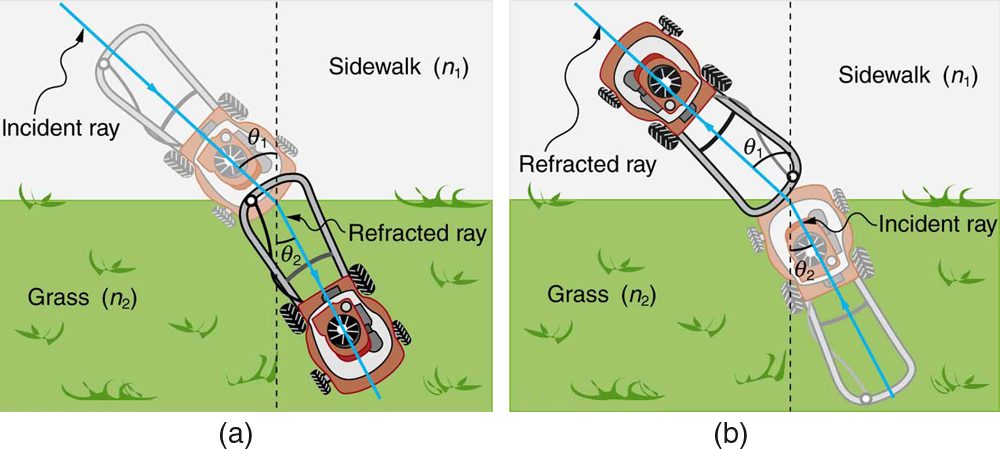
Figure 25.15 shows how a ray of light changes direction when it passes from one medium to another. As before, the angles are measured relative to a perpendicular to the surface at the point where the light ray crosses it. (Some of the incident light will be reflected from the surface, but for now we will concentrate on the light that is transmitted.) The change in direction of the light ray depends on how the speed of light changes. The change in the speed of light is related to the indices of refraction of the media involved. In the situations shown in Figure 25.15, medium 2 has a greater index of refraction than medium 1. This means that the speed of light is less in medium 2 than in medium 1. Note that as shown in Figure 25.15(a), the direction of the ray moves closer to the perpendicular when it slows down. Conversely, as shown in Figure 25.15(b), the direction of the ray moves away from the perpendicular when it speeds up. The path is exactly reversible. In both cases, you can imagine what happens by thinking about pushing a lawn mower from a footpath onto grass, and vice versa. Going from the footpath to grass, the front wheels are slowed and pulled to the side as shown. This is the same change in direction as for light when it goes from a fast medium to a slow one. When going from the grass to the footpath, the front wheels can move faster and the mower changes direction as shown. This, too, is the same change in direction as for light going from slow to fast.
The amount that a light ray changes its direction depends both on the incident angle and the amount that the speed changes. For a ray at a given incident angle, a large change in speed causes a large change in direction, and thus a large change in angle. The exact mathematical relationship is the law of refraction, or “Snell’s Law,” which is stated in equation form as
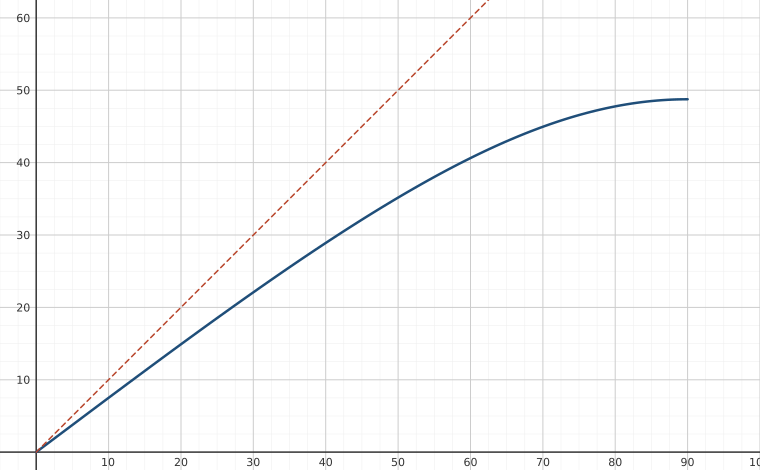
Here and are the indices of refraction for medium 1 and 2, and and are the angles between the rays and the perpendicular in medium 1 and 2, as shown in Figure 25.15. The incoming ray is called the incident ray and the outgoing ray the refracted ray, and the associated angles the incident angle and the refracted angle. The law of refraction is also called Snell’s law after the Dutch mathematician Willebrord Snell (1591–1626). While the law has been named after Snell, the Arabian physicist, Ibn Sahl, found the law of refraction in 984 and used it in his work On Burning Mirrors and Lenses. Snell’s experiments showed that the law of refraction was obeyed and that a characteristic index of refraction could be assigned to a given medium. Snell was not aware that the speed of light varied in different media, but through experiments he was able to determine indices of refraction from the way light rays changed direction.
Test Prep for AP Courses
When light travels from air into water, which of the following statements is accurate?
- The wavelength decreases, and the speed decreases.
- The wavelength decreases, and the speed increases.
- The wavelength increases, and the speed decreases.
- The wavelength increases, and the speed increases.
(a)
When a light ray travels from air into glass, which of the following statements is accurate after the light enters the glass?
- The ray bends away from the normal, and the speed decreases.
- The ray bends away from the normal, and the speed increases.
- The ray bends toward the normal, and the speed increases.
- The ray bends toward the normal, and the speed decreases.
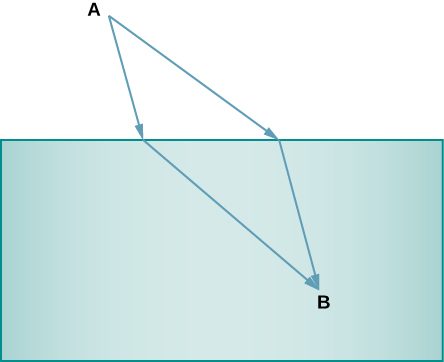
Two different potential paths from point A to point B are shown. Point A is in the air, and point B is in water. For which of these paths (upper or lower) would light travel from point A to point B faster? Which of the paths more accurately represents how a light ray would travel from point A to point B? Explain.
Since light bends toward the normal upon entering a medium with a higher index of refraction, the upper path is a more accurate representation of a light ray moving from A to B.
Students in a lab group are given a plastic cube with a hollow cube-shaped space in the middle that fills about half the volume of the cube. The index of refraction of the plastic is known. The hollow space is filled with a gas, and the students are asked to collect the data needed to find the index of refraction of the gas. The students take the following set of measurements:
Angle of incidence of the light in the air above the plastic block: 30°
Angle of refraction of the beam as it enters the plastic from the air: 45°
Angle of refraction of the beam as it enters the plastic from the gas: 45°
The three measurements are shared with a second lab group. Can the second group determine a value for the index of refraction of the gas from only this data?
- Yes, because they have information about the beam in air and in the plastic above the gas.
- Yes, because they have information about the beam on both sides of the gas.
- No, because they need additional information to determine the angle of the beam in the gas.
- No, because they do not have multiple data points to analyze.
Students in a lab group are given a plastic cube with a hollow cube-shaped space in the middle that fills about half the volume of the cube. The index of refraction of the plastic is known. The hollow space is filled with a gas, and the students are asked to collect the data needed to find the index of refraction of the gas. What information would you need to collect, and how would you use this information in order to deduce the index of refraction of the gas in the cube?
First, measure the angle of incidence and the angle of refraction for light entering the plastic from air. Since the two angles can be measured and the index of refraction of air is known, the student can solve for the index of refraction of the plastic.
Next, measure the angle of incidence and the angle of refraction for light entering the gas from the plastic. Since the two angles can be measured and the index of refraction of the plastic is known, the student can solve for the index of refraction of the gas.
Light travels through water and crosses a boundary at a non-normal angle into a different fluid with an unknown index of refraction. Which of the following is true about the path of the light after crossing the boundary?
- If the index of refraction of the fluid is higher than that of water, the light will speed up and turn toward the normal.
- If the index of refraction of the fluid is higher than that of water, the light will slow down and turn away from the normal.
- If the index of refraction of the fluid is lower than that of water, the light will speed up and turn away from the normal.
- If the index of refraction of the fluid is lower than that of water, the light will slow down and turn toward the normal.
A laser is fired from a submarine beneath the surface of a lake (n = 1.33). The laser emerges from the lake into air with an angle of refraction of 67°. How fast is the light moving through the water? What is the angle of incidence of the laser light when it crosses the boundary between the lake and the air?
The speed of light in a medium is simply c/n, so the speed of light in water is 2.25 × 10⁸ m/s. From Snell’s law, the angle of incidence is 44°.
Section Summary
- The changing of a light ray’s direction when it passes through variations in matter is called refraction.
- The speed of light in vacuum
- Index of refraction , where is the speed of light in the material, is the speed of light in vacuum, and is the index of refraction.
- Snell’s law, the law of refraction, is stated in equation form as .
Conceptual Questions
Diffusion by reflection from a rough surface is described in this chapter. Light can also be diffused by refraction. Describe how this occurs in a specific situation, such as light interacting with crushed ice.
Why is the index of refraction always greater than or equal to 1?
Does the fact that the light flash from lightning reaches you before its sound prove that the speed of light is extremely large or simply that it is greater than the speed of sound? Discuss how you could use this effect to get an estimate of the speed of light.
Will light change direction toward or away from the perpendicular when it goes from air to water? Water to glass? Glass to air?
Explain why an object in water always appears to be at a depth shallower than it actually is? Why do people sometimes sustain neck and spinal injuries when diving into unfamiliar ponds or waters?
Explain why a person’s legs appear very short when wading in a pool. Justify your explanation with a ray diagram showing the path of rays from the feet to the eye of an observer who is out of the water.
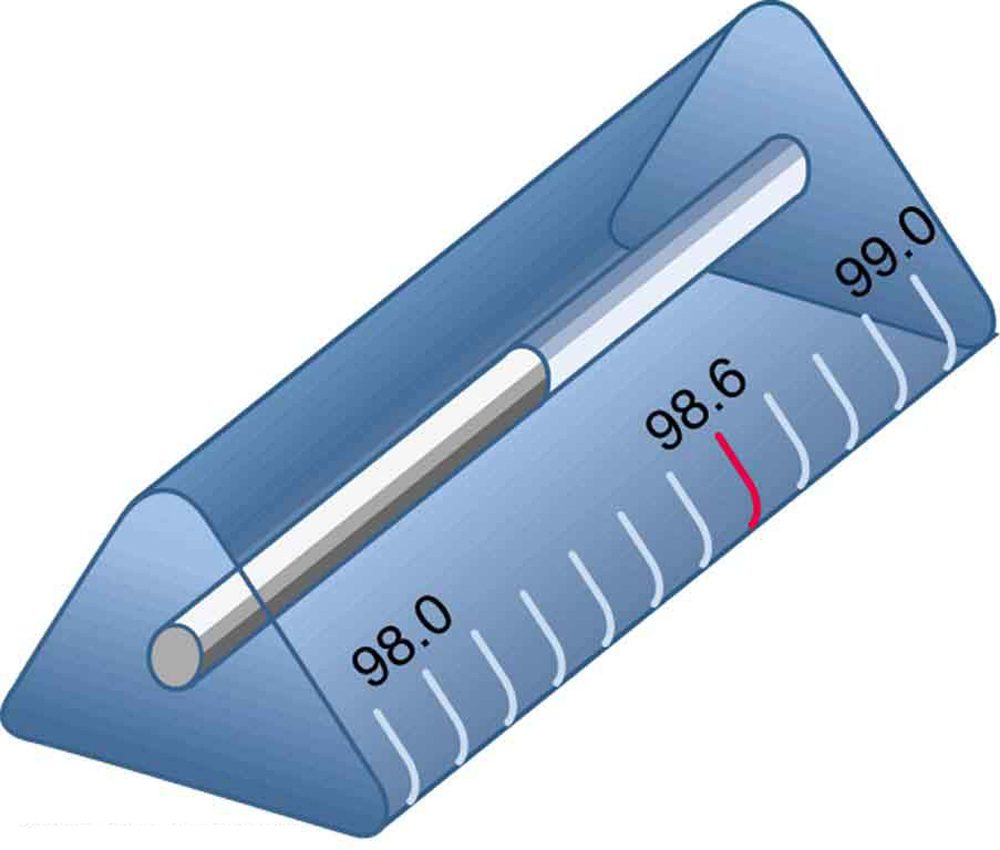
Why is the front surface of a thermometer curved as shown?
Suppose light were incident from air onto a material that had a negative index of refraction, say –1.3; where does the refracted light ray go?
Problems & Exercises
What is the speed of light in water? In glycerine?
in water
in glycerine
What is the speed of light in air? In crown glass?
Calculate the index of refraction for a medium in which the speed of light is , and identify the most likely substance based on Table 25.1.
, polystyrene
In what substance in Table 25.1 is the speed of light ?
There was a major collision of an asteroid with the Moon in medieval times. It was described by monks at Canterbury Cathedral in England as a red glow on and around the Moon. How long after the asteroid hit the Moon, which is away, would the light first arrive on Earth?
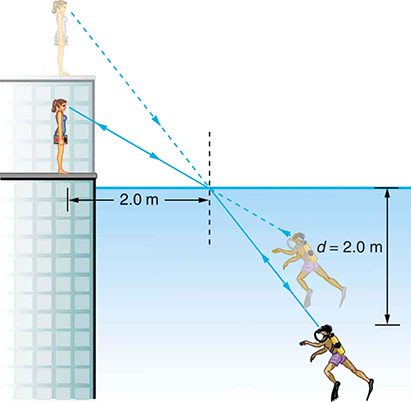
A scuba diver training in a pool looks at his instructor as shown in Figure 25.18. What angle does the ray from the instructor’s face make with the perpendicular to the water at the point where the ray enters? The angle between the ray in the water and the perpendicular to the water is .
Components of some computers communicate with each other through optical fibers having an index of refraction . What time in nanoseconds is required for a signal to travel 0.200 m through such a fiber?
(a) Given that the angle between the ray in the water and the perpendicular to the water is , and using information in Figure 25.18, find the height of the instructor’s head above the water, noting that you will first have to calculate the angle of refraction. (b) Find the apparent depth of the diver’s head below water as seen by the instructor. Assume the diver and the diver's image are the same horizontal distance from the normal.
Suppose you have an unknown clear substance immersed in water, and you wish to identify it by finding its index of refraction. You arrange to have a beam of light enter it at an angle of , and you observe the angle of refraction to be . What is the index of refraction of the substance and its likely identity?
, fused quartz
On the Moon’s surface, lunar astronauts placed a corner reflector, off which a laser beam is periodically reflected. The distance to the Moon is calculated from the round-trip time. What percent correction is needed to account for the delay in time due to the slowing of light in Earth’s atmosphere? Assume the distance to the Moon is precisely , and Earth’s atmosphere (which varies in density with altitude) is equivalent to a layer 30.0 km thick with a constant index of refraction .
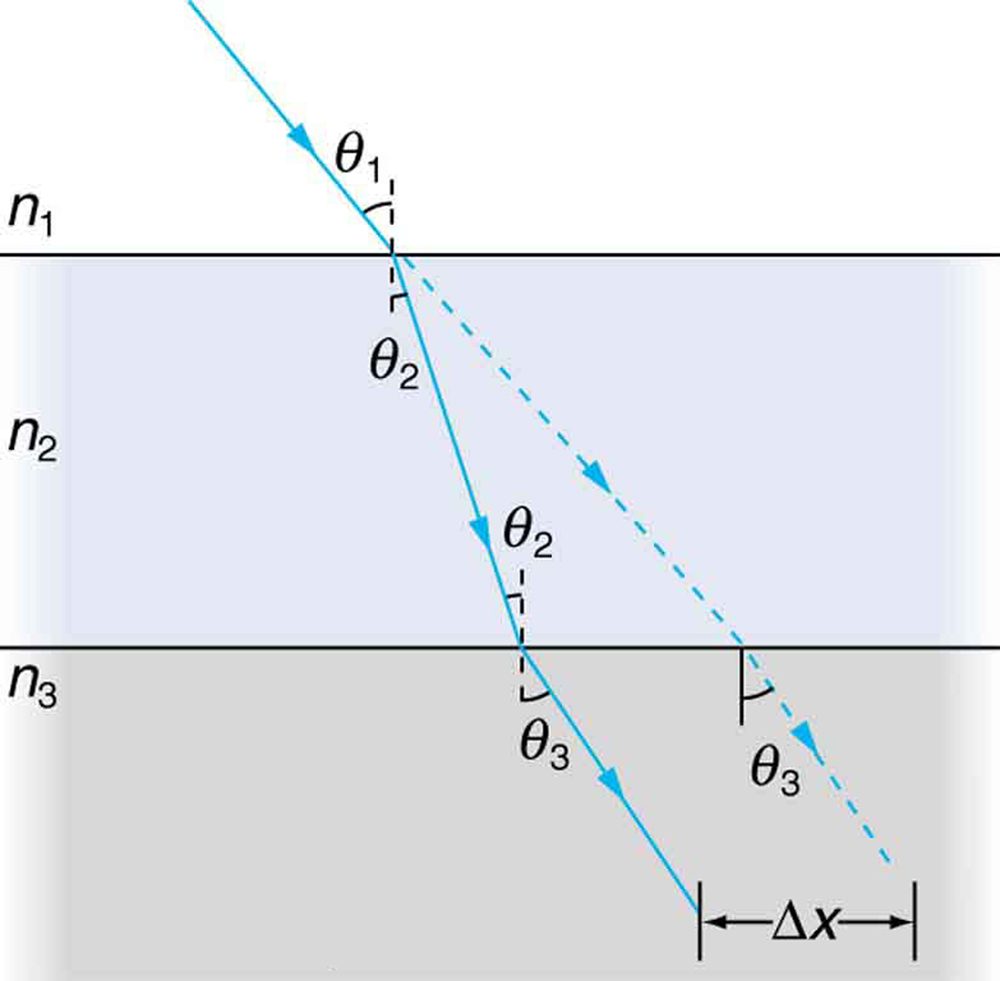
Suppose Figure 25.19 represents a ray of light going from air through crown glass into water, such as going into a fish tank. Calculate the amount the ray is displaced by the glass (), given that the incident angle is and the glass is 1.00 cm thick.
Figure 25.19 shows a ray of light passing from one medium into a second and then a third. Show that is the same as it would be if the second medium were not present (provided total internal reflection does not occur).
Unreasonable Results
Suppose light travels from water to another substance, with an angle of incidence of and an angle of refraction of . (a) What is the index of refraction of the other substance? (b) What is unreasonable about this result? (c) Which assumptions are unreasonable or inconsistent?
(a) 0.898
(b) Can’t have since this would imply a speed greater than .
(c) Refracted angle is too big relative to the angle of incidence.
Construct Your Own Problem
Consider sunlight entering the Earth’s atmosphere at sunrise and sunset—that is, at a incident angle. Taking the boundary between nearly empty space and the atmosphere to be sudden, calculate the angle of refraction for sunlight. This lengthens the time the Sun appears to be above the horizon, both at sunrise and sunset. Now construct a problem in which you determine the angle of refraction for different models of the atmosphere, such as various layers of varying density. Your instructor may wish to guide you on the level of complexity to consider and on how the index of refraction varies with air density.
Unreasonable Results
Light traveling from water to a gemstone strikes the surface at an angle of and has an angle of refraction of . (a) What is the speed of light in the gemstone? (b) What is unreasonable about this result? (c) Which assumptions are unreasonable or inconsistent?
(a)
(b) Speed of light too slow, since index is much greater than that of diamond.
(c) Angle of refraction is unreasonable relative to the angle of incidence.
Adapted from College Physics 2e by OpenStax (openstax.org), licensed under CC BY-NC-SA 4.0. Changes were made. License: CC-BY-NC-SA-4.0.