
25.2 The Law of Reflection
Learning Objectives
By the end of this section, you will be able to:
- Explain reflection of light from polished and rough surfaces.
Whenever we look into a mirror, or squint at sunlight glinting from a lake, we are seeing a reflection. When you look at this page, too, you are seeing light reflected from it. Large telescopes use reflection to form an image of stars and other astronomical objects.
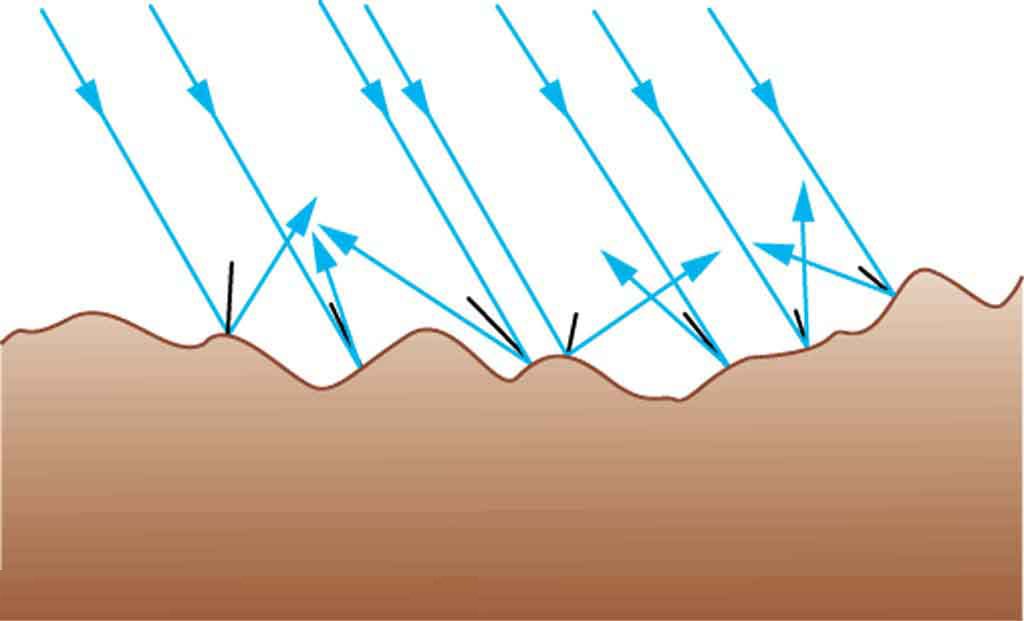
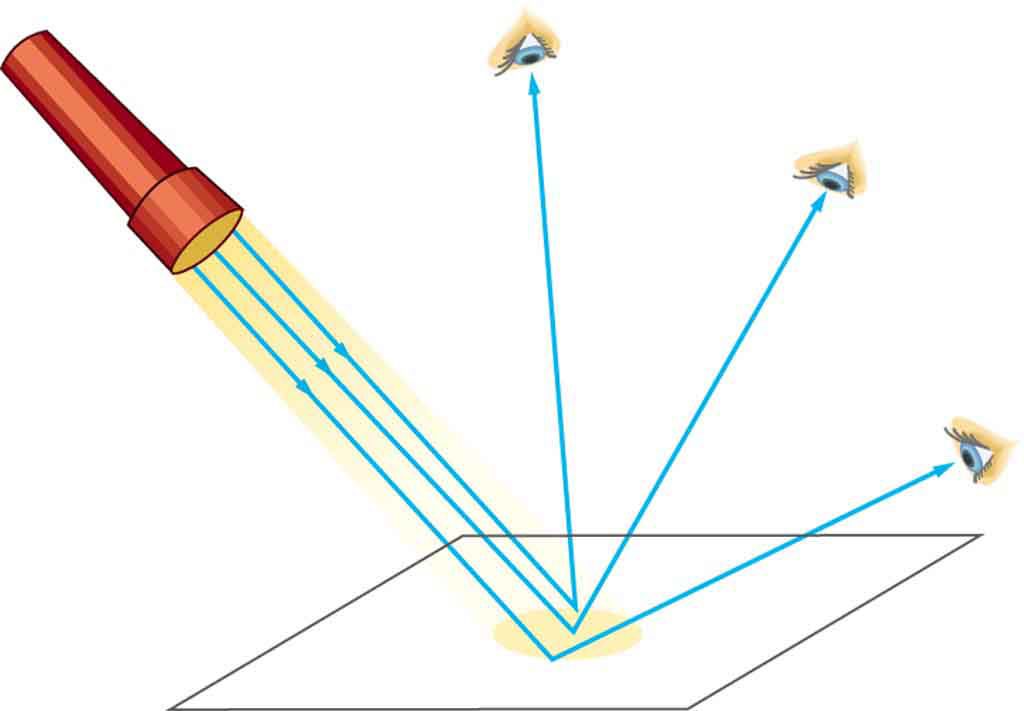
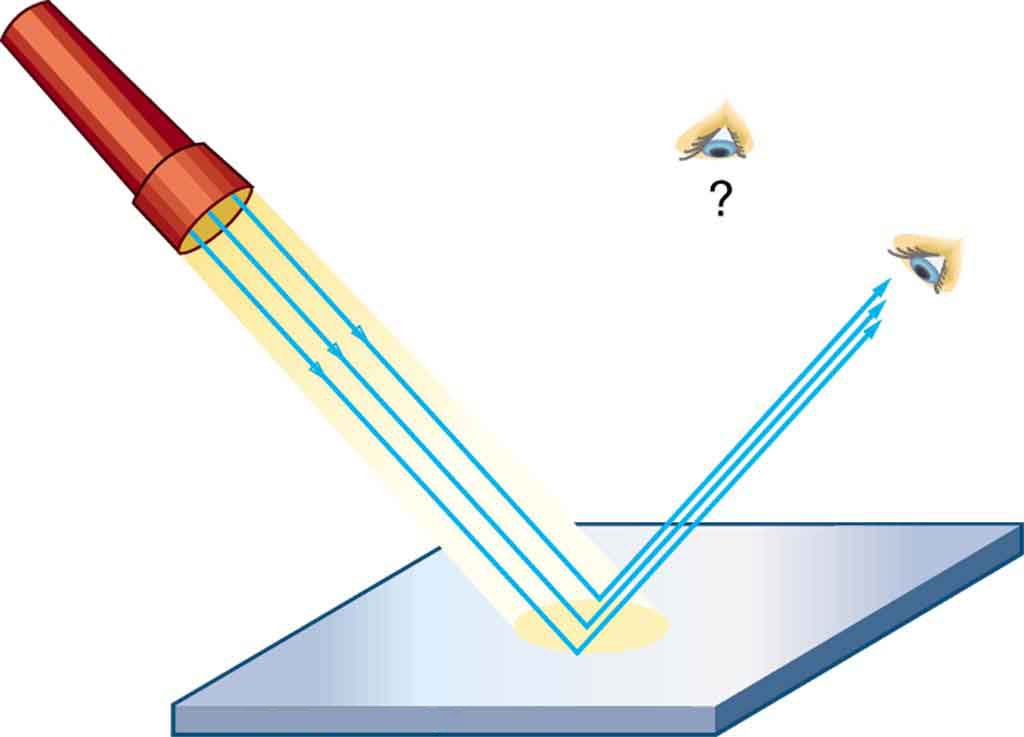
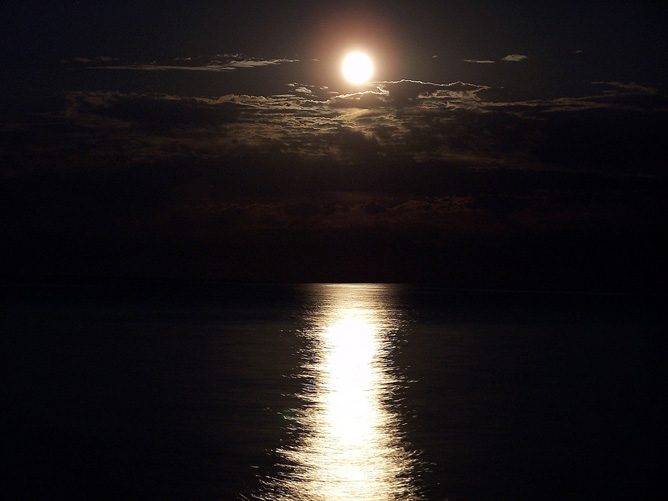
The law of reflection is illustrated in Figure 25.5, which also shows how the angles are measured relative to the perpendicular to the surface at the point where the light ray strikes. We expect to see reflections from smooth surfaces, but Figure 25.6 illustrates how a rough surface reflects light. Since the light strikes different parts of the surface at different angles, it is reflected in many different directions, or diffused. Diffused light is what allows us to see a sheet of paper from any angle, as illustrated in Figure 25.7. Many objects, such as people, clothing, leaves, and walls, have rough surfaces and can be seen from all sides. A mirror, on the other hand, has a smooth surface (compared with the wavelength of light) and reflects light at specific angles, as illustrated in Figure 25.8. When the moon reflects from a lake, as shown in Figure 25.9, a combination of these effects takes place.
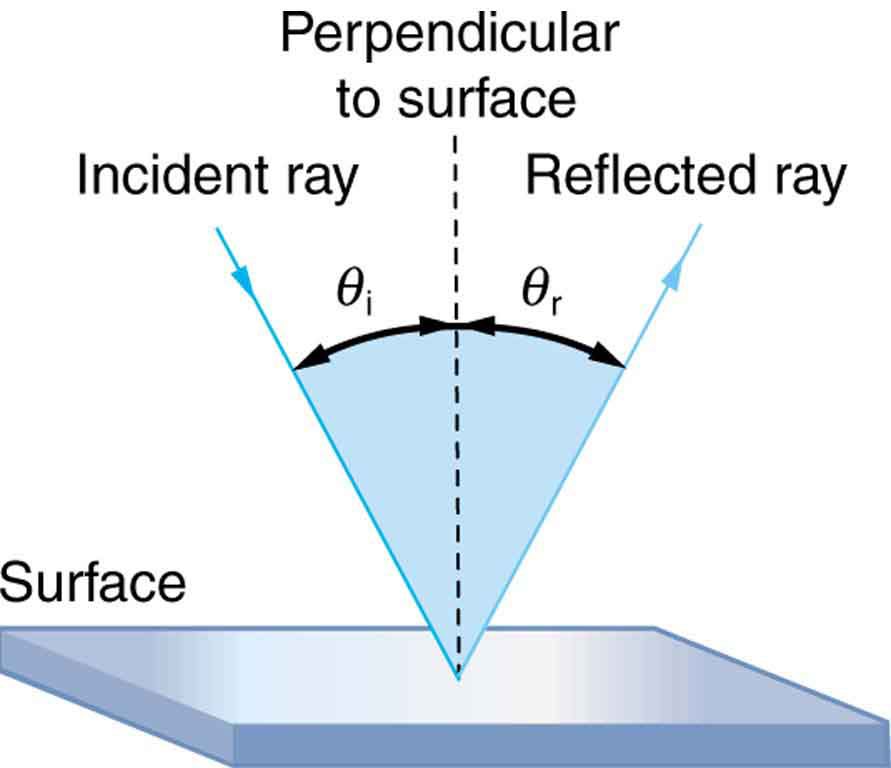
The law of reflection is very simple: The angle of reflection equals the angle of incidence.
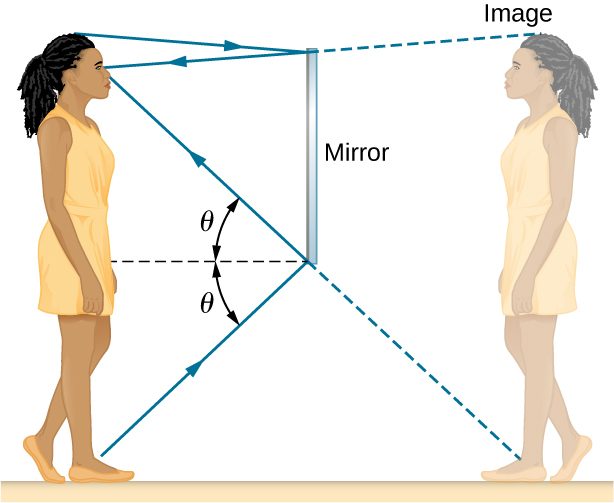
When we see ourselves in a mirror, it appears that our image is actually behind the mirror. This is illustrated in Figure 25.10. We see the light coming from a direction determined by the law of reflection. The angles are such that our image is exactly the same distance behind the mirror as we stand away from the mirror. If the mirror is on the wall of a room, the images in it are all behind the mirror, which can make the room seem bigger. Although these mirror images make objects appear to be where they cannot be (like behind a solid wall), the images are not figments of our imagination. Mirror images can be photographed and videotaped by instruments and look just as they do with our eyes (optical instruments themselves). The precise manner in which images are formed by mirrors and lenses will be treated in later sections of this chapter.
Test Prep for AP Courses
An object is 2 meters in front of a flat mirror. Ray 1 from the object travels in a direction toward the mirror and normal to the mirror’s surface. Ray 2 from the object travels at an angle of 5° from the direction of ray 1, and it also reflects off the mirror’s surface. At what distance behind the mirror do these two reflected rays appear to converge to form an image?
- 0.2 m
- 0.5 m
- 2 m
- 4 m
(c)
Two light rays originate from object A, at a distance of 50 cm in front of a flat mirror, diverging at an angle of 10°. Both of the rays strike a flat mirror and reflect. Two light rays originate from object B, at a distance of 50 cm in front of a convex mirror, diverging at an angle of 10°. Both of the rays strike the convex mirror and reflect. For which object do the reflected rays appear to converge behind the mirror closer to the surface of the mirror, thus forming a closer (larger) image? Explain with the help of a sketch or diagram.
Section Summary
- The angle of reflection equals the angle of incidence.
- A mirror has a smooth surface and reflects light at specific angles.
- Light is diffused when it reflects from a rough surface.
- Mirror images can be photographed and videotaped by instruments.
Conceptual Questions
Using the law of reflection, explain how powder takes the shine off of a person’s nose. What is the name of the optical effect?
Problems & Exercises
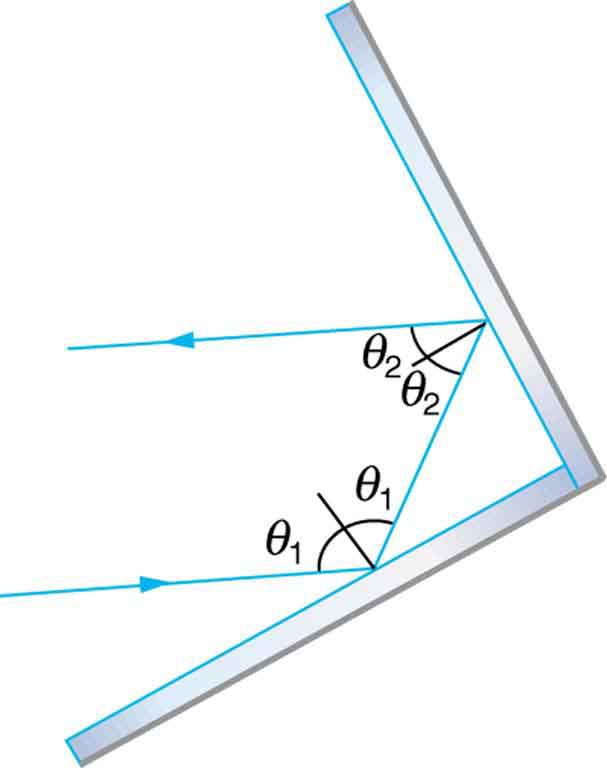
Show that when light reflects from two mirrors that meet each other at a right angle, the outgoing ray is parallel to the incoming ray, as illustrated in the following figure.
Light shows staged with lasers use moving mirrors to swing beams and create colorful effects. Show that a light ray reflected from a mirror changes direction by when the mirror is rotated by an angle .
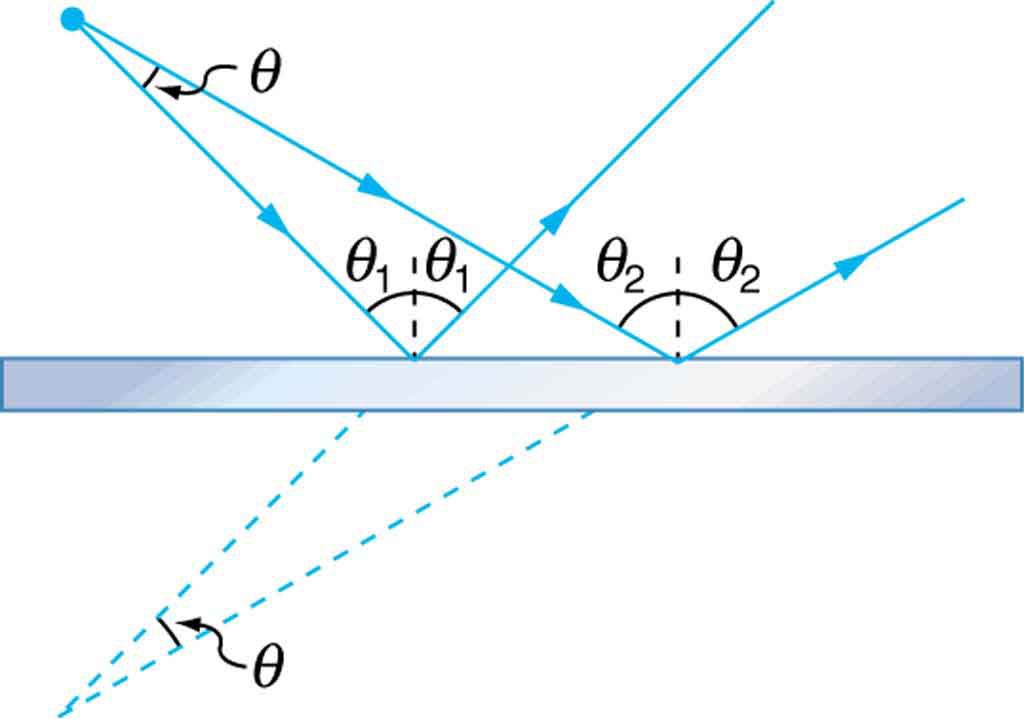
A flat mirror is neither converging nor diverging. To prove this, consider two rays originating from the same point and diverging at an angle . Show that after striking a plane mirror, the angle between their directions remains .
Adapted from College Physics 2e by OpenStax (openstax.org), licensed under CC BY-NC-SA 4.0. Changes were made. License: CC-BY-NC-SA-4.0.