
18.8 Applications of Electrostatics
Learning Objectives
By the end of this section, you will be able to:
- Name several real-world applications of the study of electrostatics.
The study of electrostatics has proven useful in many areas. This module covers just a few of the many applications of electrostatics.
The Van de Graaff Generator
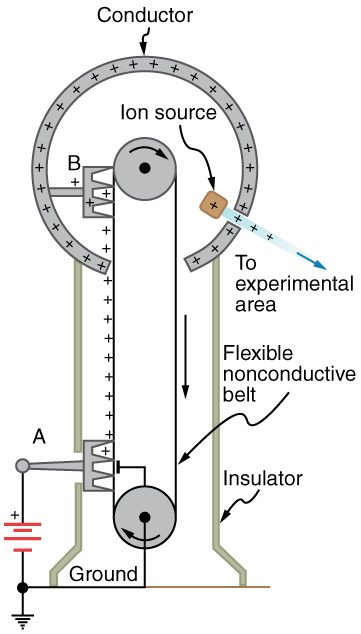
Van de Graaff generators (or Van de Graaffs) are not only spectacular devices used to demonstrate high voltage due to static electricity—they are also used for serious research. The first was built by Robert Van de Graaff in 1931 (based on original suggestions by Lord Kelvin) for use in nuclear physics research. Figure 18.56 shows a schematic of a large research version. Van de Graaffs utilize both smooth and pointed surfaces, and conductors and insulators to generate large static charges and, hence, large voltages.
A very large excess charge can be deposited on the sphere, because it moves quickly to the outer surface. Practical limits arise because the large electric fields polarize and eventually ionize surrounding materials, creating free charges that neutralize excess charge or allow it to escape. Nevertheless, voltages of 15 million volts are well within practical limits.
Xerography
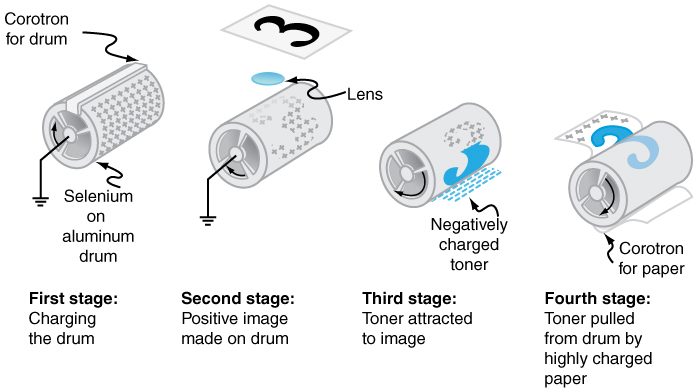
Most copy machines use an electrostatic process called xerography—a word coined from the Greek words xeros for dry and graphos for writing. The heart of the process is shown in simplified form in Figure 18.57.
A selenium-coated aluminum drum is sprayed with positive charge from points on a device called a corotron. Selenium is a substance with an interesting property—it is a photoconductor. That is, selenium is an insulator when in the dark and a conductor when exposed to light.
In the first stage of the xerography process, the conducting aluminum drum is grounded so that a negative charge is induced under the thin layer of uniformly positively charged selenium. In the second stage, the surface of the drum is exposed to the image of whatever is to be copied. Where the image is light, the selenium becomes conducting, and the positive charge is neutralized. In dark areas, the positive charge remains, and so the image has been transferred to the drum.
The third stage takes a dry black powder, called toner, and sprays it with a negative charge so that it will be attracted to the positive regions of the drum. Next, a blank piece of paper is given a greater positive charge than on the drum so that it will pull the toner from the drum. Finally, the paper and electrostatically held toner are passed through heated pressure rollers, which melt and permanently adhere the toner within the fibers of the paper.
Laser Printers
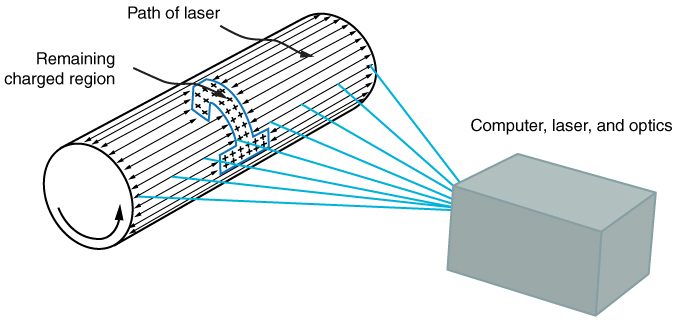
Laser printers use the xerographic process to make high-quality images on paper, employing a laser to produce an image on the photoconducting drum as shown in Figure 18.58. In its most common application, the laser printer receives output from a computer, and it can achieve high-quality output because of the precision with which laser light can be controlled. Many laser printers do significant information processing, such as making sophisticated letters or fonts, and may contain a computer more powerful than the one giving them the raw data to be printed.
Ink Jet Printers and Electrostatic Painting
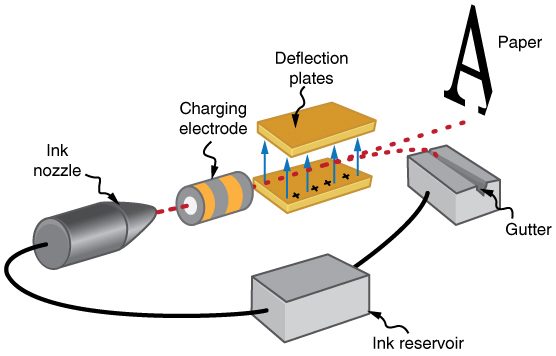
The ink jet printer, commonly used to print computer-generated text and graphics, also employs electrostatics. A nozzle makes a fine spray of tiny ink droplets, which are then given an electrostatic charge. (See Figure 18.59.)
Once charged, the droplets can be directed, using pairs of charged plates, with great precision to form letters and images on paper. Ink jet printers can produce color images by using a black jet and three other jets with primary colors, usually cyan, magenta, and yellow, much as a color television produces color. (This is more difficult with xerography, requiring multiple drums and toners.)
Electrostatic painting employs electrostatic charge to spray paint onto odd-shaped surfaces. Mutual repulsion of like charges causes the paint to fly away from its source. Surface tension forms drops, which are then attracted by unlike charges to the surface to be painted. Electrostatic painting can reach those hard-to-get at places, applying an even coat in a controlled manner. If the object is a conductor, the electric field is perpendicular to the surface, tending to bring the drops in perpendicularly. Corners and points on conductors will receive extra paint. Felt can similarly be applied.
Smoke Precipitators and Electrostatic Air Cleaning
Another important application of electrostatics is found in air cleaners, both large and small. The electrostatic part of the process places excess (usually positive) charge on smoke, dust, pollen, and other particles in the air and then passes the air through an oppositely charged grid that attracts and retains the charged particles. (See Figure 18.60.)
Large electrostatic precipitators are used industrially to remove over 99% of the particles from stack gas emissions associated with the burning of coal and oil. Home precipitators, often in conjunction with the home heating and air conditioning system, are very effective in removing polluting particles, irritants, and allergens.
![(a) Schematic of an electrostatic precipitator. Air is passed through grids of opposite charge. The first grid charges airborne particles, while the second attracts and collects them. (b) The dramatic effect of electrostatic precipitators is seen by the absence of smoke from this power plant.[alt]Schematic of an electrostatic precipitator is shown. Four filters are shown one after another. Air passes through initial filter, then through positively charged grid, then through the third grid which is negatively charged and finally through the final grid. The number of particles is shown decreasing as air passes through various filters.](photos/Figure_19_08_06a.jpg)
Integrated Concepts
The Integrated Concepts exercises for this module involve concepts such as electric charges, electric fields, and several other topics. Physics is most interesting when applied to general situations involving more than a narrow set of physical principles. The electric field exerts force on charges, for example, and hence the relevance of Dynamics: Force and Newton’s Laws of Motion. The following topics are involved in some or all of the problems labeled “Integrated Concepts”:
- Kinematics
- Two-Dimensional Kinematics
- Dynamics: Force and Newton’s Laws of Motion
- Uniform Circular Motion and Gravitation
- Statics and Torque
- Fluid Statics
The following worked example illustrates how this strategy is applied to an Integrated Concept problem:
Section Summary
- Electrostatics is the study of electric fields in static equilibrium.
- In addition to research using equipment such as a Van de Graaff generator, many practical applications of electrostatics exist, including photocopiers, laser printers, ink-jet printers and electrostatic air filters.
Problems & Exercises
(a) What is the electric field 5.00 m from the center of the terminal of a Van de Graaff with a 3.00 mC charge, noting that the field is equivalent to that of a point charge at the center of the terminal? (b) At this distance, what force does the field exert on a charge on the Van de Graaff’s belt?
(a) What is the direction and magnitude of an electric field that supports the weight of a free electron near the surface of Earth? (b) Discuss what the small value for this field implies regarding the relative strength of the gravitational and electrostatic forces.
(a)
(b)the coulomb force is extraordinarily stronger than gravity
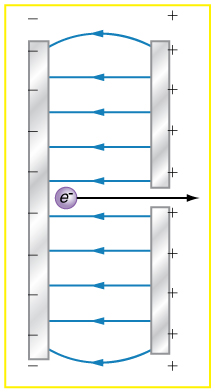
A simple and common technique for accelerating electrons is shown in Figure 18.61, where there is a uniform electric field between two plates. Electrons are released, usually from a hot filament, near the negative plate, and there is a small hole in the positive plate that allows the electrons to continue moving. (a) Calculate the acceleration of the electron if the field strength is . (b) Explain why the electron will not be pulled back to the positive plate once it moves through the hole.
Earth has a net charge that produces an electric field of approximately 150 N/C downward at its surface. (a) What is the magnitude and sign of the excess charge, noting the electric field of a conducting sphere is equivalent to a point charge at its center? (b) What acceleration will the field produce on a free electron near Earth’s surface? (c) What mass object with a single extra electron will have its weight supported by this field?
(a)
(b)
(c)
Point charges of and are placed 0.500 m apart. (a) At what point along the line between them is the electric field zero? (b) What is the electric field halfway between them?
What can you say about two charges and , if the electric field one-fourth of the way from to is zero?
The charge is 9 times greater than .
Integrated Concepts
Calculate the angular velocity of an electron orbiting a proton in the hydrogen atom, given the radius of the orbit is . You may assume that the proton is stationary and the centripetal force is supplied by Coulomb attraction.
Integrated Concepts
An electron has an initial velocity of in a uniform strength electric field. The field accelerates the electron in the direction opposite to its initial velocity. (a) What is the direction of the electric field? (b) How far does the electron travel before coming to rest? (c) How long does it take the electron to come to rest? (d) What is the electron’s velocity when it returns to its starting point?
Integrated Concepts
The practical limit to an electric field in air is about . Above this strength, sparking takes place because air begins to ionize and charges flow, reducing the field. (a) Calculate the distance a free proton must travel in this field to reach of the speed of light, starting from rest. (b) Is this practical in air, or must it occur in a vacuum?
Integrated Concepts
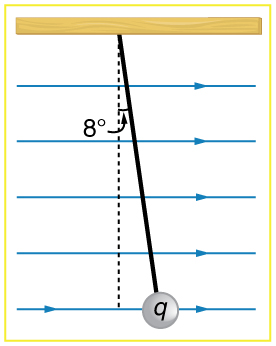
A 5.00 g charged insulating ball hangs on a 30.0 cm long string in a uniform horizontal electric field as shown in Figure 18.62. Given the charge on the ball is , find the strength of the field.
Integrated Concepts
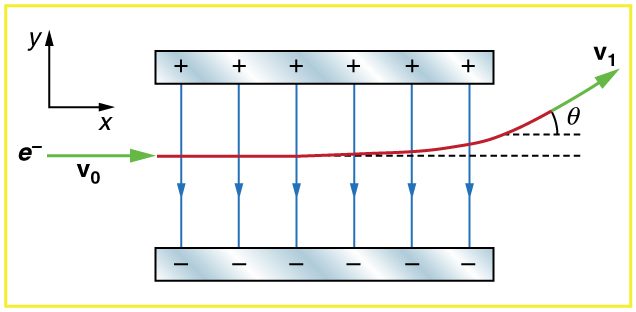
Figure 18.63 shows an electron passing between two charged metal plates that create an 100 N/C vertical electric field perpendicular to the electron’s original horizontal velocity. (These can be used to change the electron’s direction, such as in an oscilloscope.) The initial speed of the electron is , and the horizontal distance it travels in the uniform field is 4.00 cm. (a) What is its vertical deflection? (b) What is the vertical component of its final velocity? (c) At what angle does it exit? Neglect any edge effects.
Integrated Concepts
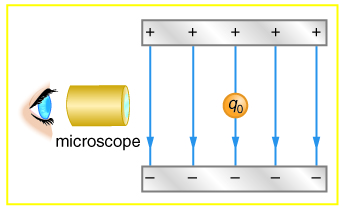
The classic Millikan oil drop experiment was the first to obtain an accurate measurement of the charge on an electron. In it, oil drops were suspended against the gravitational force by a vertical electric field. (See Figure 18.64.) Given the oil drop to be in radius and have a density of : (a) Find the weight of the drop. (b) If the drop has a single excess electron, find the electric field strength needed to balance its weight.
Integrated Concepts
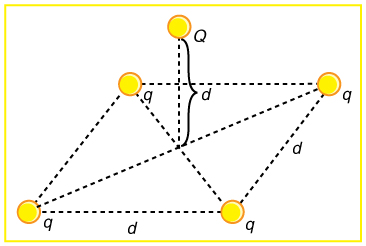
(a) In Figure 18.65, four equal charges lie on the corners of a square. A fifth charge is on a mass directly above the center of the square, at a height equal to the length of one side of the square. Determine the magnitude of in terms of , , and , if the Coulomb force is to equal the weight of . (b) Is this equilibrium stable or unstable? Discuss.
Unreasonable Results
(a) Calculate the electric field strength near a 10.0 cm diameter conducting sphere that has 1.00 C of excess charge on it. (b) What is unreasonable about this result? (c) Which assumptions are responsible?
Unreasonable Results
(a) Two 0.500 g raindrops in a thunderhead are 1.00 cm apart when they each acquire 1.00 mC charges. Find their acceleration. (b) What is unreasonable about this result? (c) Which premise or assumption is responsible?
Unreasonable Results
A wrecking yard inventor wants to pick up cars by charging a 0.400 m diameter ball and inducing an equal and opposite charge on the car. If a car has a 1000 kg mass and the ball is to be able to lift it from a distance of 1.00 m: (a) What minimum charge must be used? (b) What is the electric field near the surface of the ball? (c) Why are these results unreasonable? (d) Which premise or assumption is responsible?
Construct Your Own Problem
Consider two insulating balls with evenly distributed equal and opposite charges on their surfaces, held with a certain distance between the centers of the balls. Construct a problem in which you calculate the electric field (magnitude and direction) due to the balls at various points along a line running through the centers of the balls and extending to infinity on either side. Choose interesting points and comment on the meaning of the field at those points. For example, at what points might the field be just that due to one ball and where does the field become negligibly small? Among the things to be considered are the magnitudes of the charges and the distance between the centers of the balls. Your instructor may wish for you to consider the electric field off axis or for a more complex array of charges, such as those in a water molecule.
Construct Your Own Problem
Consider identical spherical conducting space ships in deep space where gravitational fields from other bodies are negligible compared to the gravitational attraction between the ships. Construct a problem in which you place identical excess charges on the space ships to exactly counter their gravitational attraction. Calculate the amount of excess charge needed. Examine whether that charge depends on the distance between the centers of the ships, the masses of the ships, or any other factors. Discuss whether this would be an easy, difficult, or even impossible thing to do in practice.
Critical Thinking A frictionless circular track with a diameter of 4.00 m has two spheres of 10.0 kg each anchored very near it. The track is oriented with a diameter along the x-axis. The anchored spheres are just outside the track. One of the anchored spheres is just left of the origin at a distance of from it, and the other is on the x-axis just right of the track at a distance of past . Each sphere carries a charge of . (Note: The slight distance from the track is so the particles cannot collide, and does not enter into the calculations for three significant figures.) (a) A third sphere has a mass of 10.00 kg and carries a charge of . It is free to move on the track. It is initially placed an equal length from the two anchored spheres at . What is the total force on the third sphere? (Be certain to include gravity between the spheres.) (b) Will the third sphere move? (c) Label the first two spheres A and B, and the movable sphere C. Now start sphere C at . What are the forces on sphere C? (d) Will sphere C now move? (e) If it does, where will it stop moving and reverse course? If it does not move, you may skip this part. (f) How many equilibrium points are there on the track at which the movable sphere will remain stationary? Where are they?
(a) The forces are balanced in the x-direction, so the net force is vertical. It is composed of the sum of the vertical components of the Coulomb force and the gravitational force.
(b) No, it is in a metastable position. Since it cannot move horizontally, it cannot traverse any part of the track.
(c)
(d) Yes.
(e) It will reach before it will change direction.
(f) The metastable positions where there is no component in one direction are , , , and . They number 4.
Adapted from College Physics 2e by OpenStax (openstax.org), licensed under CC BY-NC-SA 4.0. Changes were made. License: CC-BY-NC-SA-4.0.