
18.4 Electric Field: Concept of a Field Revisited
Learning Objectives
By the end of this section, you will be able to:
- Describe a force field and calculate the strength of an electric field due to a point charge.
- Calculate the force exerted on a test charge by an electric field.
- Explain the relationship between electrical force (F) on a test charge and electrical field strength (E).
Contact forces, such as between a baseball and a bat, are explained on the small scale by the interaction of the charges in atoms and molecules in close proximity. They interact through forces that include the Coulomb force. Action at a distance is a force between objects that are not close enough for their atoms to “touch.” That is, they are separated by more than a few atomic diameters.
For example, a charged rubber comb attracts neutral bits of paper from a distance via the Coulomb force. It is very useful to think of an object being surrounded in space by a force field. The force field carries the force to another object (called a test object) some distance away.
Concept of a Field
A field is a way of conceptualizing and mapping the force that surrounds any object and acts on another object at a distance without apparent physical connection. For example, the gravitational field surrounding the earth (and all other masses) represents the gravitational force that would be experienced if another mass were placed at a given point within the field.
In the same way, the Coulomb force field surrounding any charge extends throughout space. Using Coulomb’s law, , its magnitude is given by the equation , for a point charge (a particle having a charge ) acting on a test charge at a distance (see Figure 18.21). Both the magnitude and direction of the Coulomb force field depend on and the test charge .
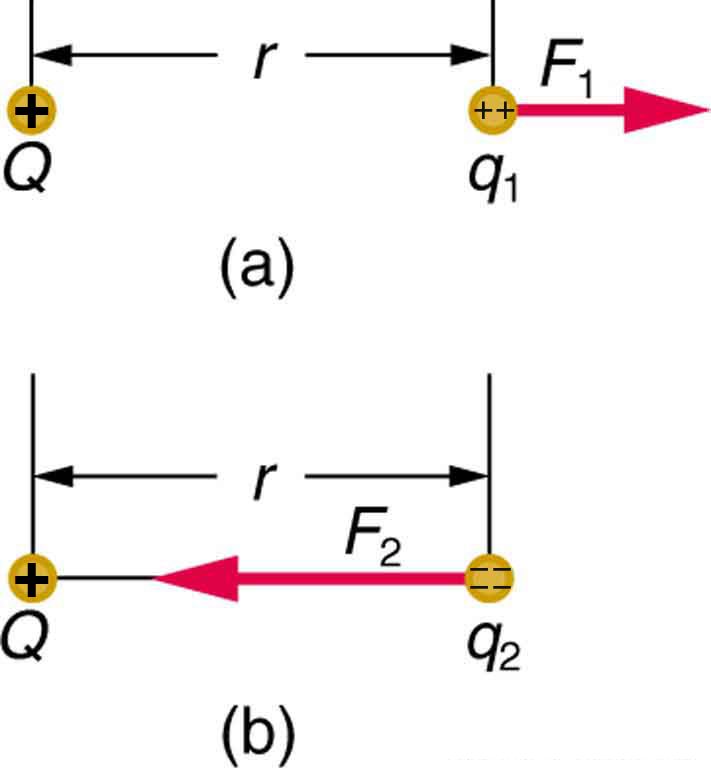
To simplify things, we would prefer to have a field that depends only on and not on the test charge . The electric field is defined in such a manner that it represents only the charge creating it and is unique at every point in space. Specifically, the electric field is defined to be the ratio of the Coulomb force to the test charge:
where is the electrostatic force (or Coulomb force) exerted on a positive test charge . It is understood that is in the same direction as . It is also assumed that is so small that it does not alter the charge distribution creating the electric field. The units of electric field are newtons per coulomb (N/C). If the electric field is known, then the electrostatic force on any charge is simply obtained by multiplying charge times electric field, or . Consider the electric field due to a point charge . According to Coulomb’s law, the force it exerts on a test charge is . Thus the magnitude of the electric field, , for a point charge is
Since the test charge cancels, we see that
The electric field is thus seen to depend only on the charge and the distance ; it is completely independent of the test charge .
Test Prep for AP Courses
Two particles with charges +2q and +q are separated by a distance r. The +2q particle has an electric field E at distance r and exerts a force F on the +q particle. Use this information to answer questions 31–32.
What is the electric field of the +q particle at the same distance and what force does it exert on the +2q particle?
- E/2, F/2
- E, F/2
- E/2, F
- E, F
(c)
When the +q particle is replaced by a +3q particle, what will be the electric field and force from the +2q particle experienced by the +3q particle?
- E/3, 3F
- E, 3F
- E/3, F
- E, F
The direction of the electric field of a negative charge is
- inward for both positive and negative charges.
- outward for both positive and negative charges.
- inward for other positive charges and outward for other negative charges.
- outward for other positive charges and inward for other negative charges.
(a)
The force responsible for holding an atom together is
- frictional
- electric
- gravitational
- magnetic
When a positively charged particle exerts an inward force on another particle P, what will be the charge of P?
- positive
- negative
- neutral
- cannot be determined
(b)
Find the force exerted due to a particle having a charge of 3.2×10⁻¹⁹ C on another identical particle 5 cm away.
Suppose that the force exerted on an electron is 5.6×10⁻¹⁷ N, directed to the east.
- Find the magnitude of the electric field that exerts the force.
- What will be the direction of the electric field?
- If the electron is replaced by a proton, what will be the magnitude of force exerted?
- What will be the direction of force on the proton?
(a) 350 N/C, (b) west, (c) 5.6×10⁻¹⁷ N, (d) west.
Section Summary
- The electrostatic force field surrounding a charged object extends out into space in all directions.
- The electrostatic force exerted by a point charge on a test charge at a distance depends on the charge of both charges, as well as the distance between the two.
- The electric field is defined to be
where is the Coulomb or electrostatic force exerted on a small positive test charge . has units of N/C.
- The magnitude of the electric field created by a point charge is
where is the distance from . The electric field is a vector and fields due to multiple charges add like vectors.
Conceptual Questions
Why must the test charge in the definition of the electric field be vanishingly small?
Are the direction and magnitude of the Coulomb force unique at a given point in space? What about the electric field?
Problem Exercises
What is the magnitude and direction of an electric field that exerts a upward force on a charge?
What is the magnitude and direction of the force exerted on a charge by a 250 N/C electric field that points due east?
N
Calculate the magnitude of the electric field 2.00 m from a point charge of 5.00 mC (such as found on the terminal of a Van de Graaff).
(a) What magnitude point charge creates a 10,000 N/C electric field at a distance of 0.250 m? (b) How large is the field at 10.0 m?
(a)
(b)
Calculate the initial (from rest) acceleration of a proton in a electric field (such as created by a research Van de Graaff). Explicitly show how you follow the steps in the Problem-Solving Strategy for electrostatics.
(a) Find the magnitude and direction of an electric field that exerts a westward force on an electron. (b) What magnitude and direction force does this field exert on a proton?
(a)
(b)
Adapted from College Physics 2e by OpenStax (openstax.org), licensed under CC BY-NC-SA 4.0. Changes were made. License: CC-BY-NC-SA-4.0.