
12.3 The Most General Applications of Bernoulli’s Equation
Learning Objectives
By the end of this section, you will be able to:
- Calculate using Torricelli’s theorem.
- Calculate power in fluid flow.
Torricelli’s Theorem
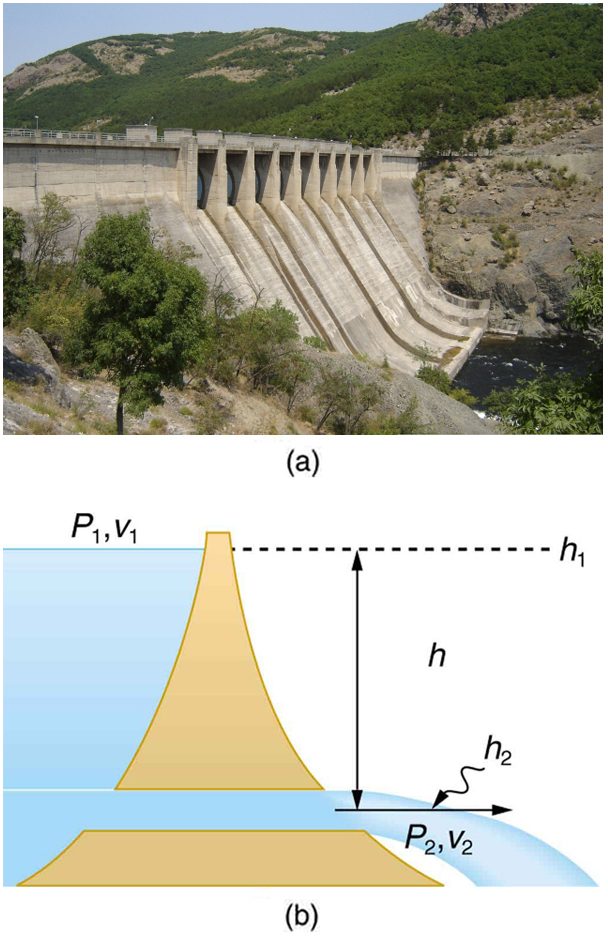
Figure 12.11 shows water gushing from a large tube through a dam. What is its speed as it emerges? Interestingly, if resistance is negligible, the speed is just what it would be if the water fell a distance from the surface of the reservoir; the water’s speed is independent of the size of the opening. Let us check this out. Bernoulli’s equation must be used since the depth is not constant. We consider water flowing from the surface (point 1) to the tube’s outlet (point 2). Bernoulli’s equation as stated in previously is
Both and equal atmospheric pressure ( is atmospheric pressure because it is the pressure at the top of the reservoir. must be atmospheric pressure, since the emerging water is surrounded by the atmosphere and cannot have a pressure different from atmospheric pressure.) and subtract out of the equation, leaving
Solving this equation for , noting that the density cancels (because the fluid is incompressible), yields
We let ; the equation then becomes
where is the height dropped by the water. This is simply a kinematic equation for any object falling a distance with negligible resistance. In fluids, this last equation is called Torricelli’s theorem. Note that the result is independent of the velocity’s direction, just as we found when applying conservation of energy to falling objects.
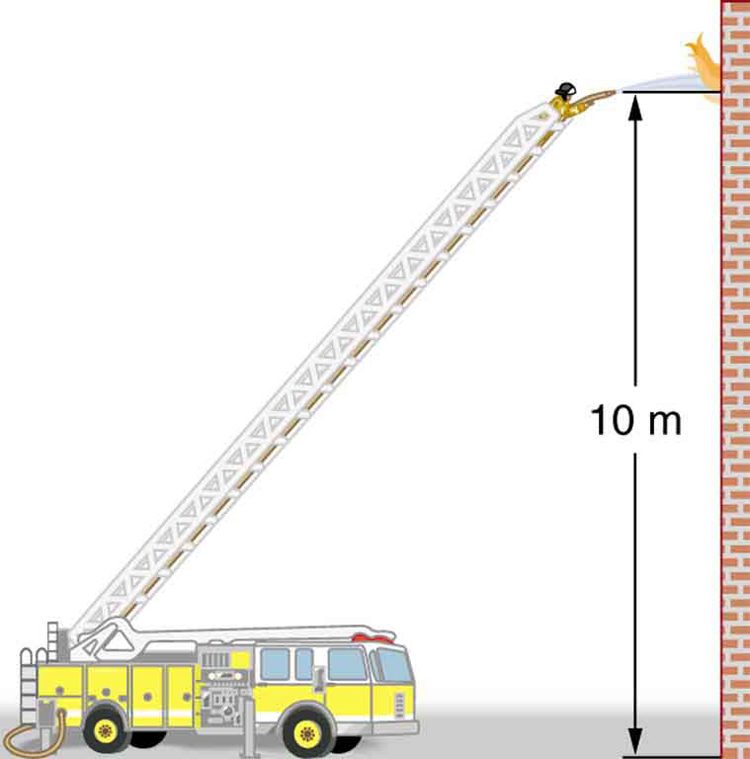
All preceding applications of Bernoulli’s equation involved simplifying conditions, such as constant height or constant pressure. The next example is a more general application of Bernoulli’s equation in which pressure, velocity, and height all change. (See Figure 12.12.)
Power in Fluid Flow
Power is the rate at which work is done or energy in any form is used or supplied. To see the relationship of power to fluid flow, consider Bernoulli’s equation:
All three terms have units of energy per unit volume, as discussed in the previous section. Now, considering units, if we multiply energy per unit volume by flow rate (volume per unit time), we get units of power. That is, . This means that if we multiply Bernoulli’s equation by flow rate , we get power. In equation form, this is
Each term has a clear physical meaning. For example, is the power supplied to a fluid, perhaps by a pump, to give it its pressure . Similarly, is the power supplied to a fluid to give it its kinetic energy. And is the power going to gravitational potential energy.
Test Prep for AP Courses
A horizontally oriented pipe has a diameter of 5.6 cm and is filled with water. The pipe draws water from a reservoir that is initially at rest. A manually operated plunger provides a force of 440 N in the pipe. Assuming that the other end of the pipe is open to the air, with what speed does the water emerge from the pipe?
- 12 m/s
- 19 m/s
- 150 m/s
- 190 m/s
(a)
A 3.5-cm-diameter pipe contains a pumping mechanism that provides a force of 320 N to push water up into a tall building. Upon entering the piston mechanism, the water is flowing at a rate of 2.5 m/s. The water is then pumped to a level 21 m higher where the other end of the pipe is open to the air. With what speed does water leave the pipe?
A large container of water is open to the air, and it develops a hole of area 10 cm2 at a point 5 m below the surface of the water. What is the flow rate (m3⁄s) of the water emerging from this hole?
- 99 m3⁄s
- 9.9 m3⁄s
- 0.099 m3⁄s
- 0.0099 m3⁄s
(d)
A pipe is tapered so that the large end has a diameter twice as large as the small end. What must be the gauge pressure (the difference between pressure at the large end and pressure at the small end) in order for water to emerge from the small end with a speed of 12 m/s if the small end is elevated 8 m above the large end of the pipe?
Summary
- Power in fluid flow is given by the equation where the first term is power associated with pressure, the second is power associated with velocity, and the third is power associated with height.
Conceptual Questions
Based on Bernoulli’s equation, what are three forms of energy in a fluid? (Note that these forms are conservative, unlike heat transfer and other dissipative forms not included in Bernoulli’s equation.)
Water that has emerged from a hose into the atmosphere has a gauge pressure of zero. Why? When you put your hand in front of the emerging stream you feel a force, yet the water’s gauge pressure is zero. Explain where the force comes from in terms of energy.
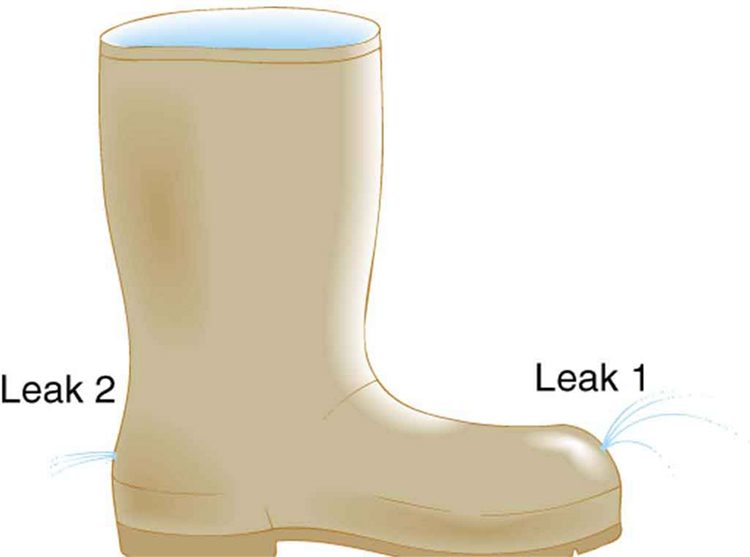
The old rubber boot shown in Figure 12.13 has two leaks. To what maximum height can the water squirt from Leak 1? How does the velocity of water emerging from Leak 2 differ from that of leak 1? Explain your responses in terms of energy.
Water pressure inside a hose nozzle can be less than atmospheric pressure due to the Bernoulli effect. Explain in terms of energy how the water can emerge from the nozzle against the opposing atmospheric pressure.
Problems & Exercises
Hoover Dam on the Colorado River is the highest dam in the United States at 221 m, with a maximum output of 1300 MW. The dam generates electricity with water taken from a depth of 150 m and an average flow rate of . (a) Calculate the power in this flow. (b) What is the ratio of this power to the facility’s average of 680 MW?
(a)
(b) 1.41
A frequently quoted rule of thumb in aircraft design is that wings should produce about 1000 N of lift per square meter of wing. (The fact that a wing has a top and bottom surface does not double its area.) (a) At takeoff, an aircraft travels at 60.0 m/s, so that the air speed relative to the bottom of the wing is 60.0 m/s. Given the sea level density of air to be , how fast must it move over the upper surface to create the ideal lift? (b) How fast must air move over the upper surface at a cruising speed of 245 m/s and at an altitude where air density is one-fourth that at sea level? (Note that this is not all of the aircraft’s lift—some comes from the body of the plane, some from engine thrust, and so on. Furthermore, Bernoulli’s principle gives an approximate answer because flow over the wing creates turbulence.)
The left ventricle of a resting adult’s heart pumps blood at a flow rate of , increasing its pressure by 110 mm Hg, its speed from zero to 30.0 cm/s, and its height by 5.00 cm. (All numbers are averaged over the entire heartbeat.) Calculate the total power output of the left ventricle. Note that most of the power is used to increase blood pressure.
1.26 W
A sump pump (used to drain water from the basement of houses built below the water table) is draining a flooded basement at the rate of 0.750 L/s, with an output pressure of . (a) The water enters a hose with a 3.00-cm inside diameter and rises 2.50 m above the pump. What is its pressure at this point? (b) The hose goes over the foundation wall, losing 0.500 m in height, and widens to 4.00 cm in diameter. What is the pressure now? You may neglect frictional losses in both parts of the problem.
Adapted from College Physics 2e by OpenStax (openstax.org), licensed under CC BY-NC-SA 4.0. Changes were made. License: CC-BY-NC-SA-4.0.