
12.1 Flow Rate and Its Relation to Velocity
Learning Objectives
By the end of this section, you will be able to:
- Calculate flow rate.
- Define units of volume.
- Describe incompressible fluids.
- Explain the consequences of the equation of continuity.
Flow rate is defined to be the volume of fluid passing by some location through an area during a period of time, as seen in Figure 12.2. In symbols, this can be written as
where is the volume and is the elapsed time.
The SI unit for flow rate is , but a number of other units for are in common use. For example, the heart of a resting adult pumps blood at a rate of 5.00 liters per minute (L/min). Note that a liter (L) is 1/1000 of a cubic meter or 1000 cubic centimeters ( or ). In this text we shall use whatever metric units are most convenient for a given situation.
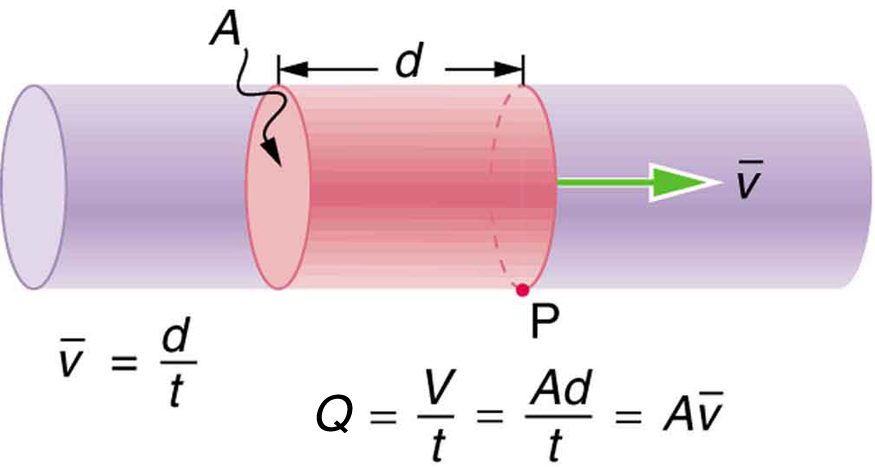
Flow rate and velocity are related, but quite different, physical quantities. To make the distinction clear, think about the flow rate of a river. The greater the velocity of the water, the greater the flow rate of the river. But flow rate also depends on the size of the river. A rapid mountain stream carries far less water than the Amazon River in Brazil, for example. The precise relationship between flow rate and velocity is
where is the cross-sectional area and is the average velocity. This equation seems logical enough. The relationship tells us that flow rate is directly proportional to both the magnitude of the average velocity (hereafter referred to as the speed) and the size of a river, pipe, or other conduit. The larger the conduit, the greater its cross-sectional area. Figure 12.2 illustrates how this relationship is obtained. The shaded cylinder has a volume
which flows past the point in a time . Dividing both sides of this relationship by gives
We note that and the average speed is . Thus the equation becomes .
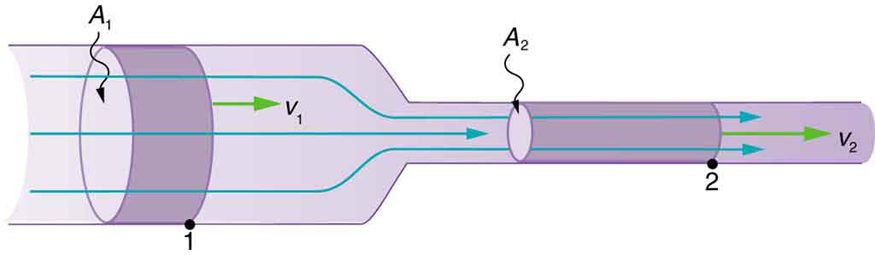
Figure 12.3 shows an incompressible fluid flowing along a pipe of decreasing radius. Because the fluid is incompressible, the same amount of fluid must flow past any point in the tube in a given time to ensure continuity of flow. In this case, because the cross-sectional area of the pipe decreases, the velocity must necessarily increase. This logic can be extended to say that the flow rate must be the same at all points along the pipe. In particular, for points 1 and 2,
This is called the equation of continuity and is valid for any incompressible fluid. The consequences of the equation of continuity can be observed when water flows from a hose into a narrow spray nozzle: it emerges with a large speed—that is the purpose of the nozzle. Conversely, when a river empties into one end of a reservoir, the water slows considerably, perhaps picking up speed again when it leaves the other end of the reservoir. In other words, speed increases when cross-sectional area decreases, and speed decreases when cross-sectional area increases.
Since liquids are essentially incompressible, the equation of continuity is valid for all liquids. However, gases are compressible, and so the equation must be applied with caution to gases if they are subjected to compression or expansion.
The solution to the last part of the example shows that speed is inversely proportional to the square of the radius of the tube, making for large effects when radius varies. We can blow out a candle at quite a distance, for example, by pursing our lips, whereas blowing on a candle with our mouth wide open is quite ineffective.
In many situations, including in the cardiovascular system, branching of the flow occurs. The blood is pumped from the heart into arteries that subdivide into smaller arteries (arterioles) which branch into very fine vessels called capillaries. In this situation, continuity of flow is maintained but it is the sum of the flow rates in each of the branches in any portion along the tube that is maintained. The equation of continuity in a more general form becomes
where and are the number of branches in each of the sections along the tube.
Test Prep for AP Courses
Water flows through a small horizontal pipe with a speed of 12 m/s into a larger part of the pipe for which the diameter of the pipe is doubled. What is the speed of the water in the larger part of the pipe?
- 0.75 m/s
- 3.0 m/s
- 6.0 m/s
- 12 m/s
(b)
A popular pool toy allows the user to push a plunger to compress water in a barrel with a diameter of 3.0 cm. The water is compressed with a speed of 1.2 m/s and emerges from a small opening with a speed of 15 m/s. What is the diameter of the opening? Assume the toy is oriented horizontally.
Section Summary
- Flow rate is defined to be the volume flowing past a point in time , or where is volume and is time.
- The SI unit of volume is .
- Another common unit is the liter (L), which is .
- Flow rate and velocity are related by where is the cross-sectional area of the flow and is its average velocity.
- For incompressible fluids, flow rate at various points is constant. That is,
Conceptual Questions
What is the difference between flow rate and fluid velocity? How are they related?
Many figures in the text show streamlines. Explain why fluid velocity is greatest where streamlines are closest together. (Hint: Consider the relationship between fluid velocity and the cross-sectional area through which it flows.)
Identify some substances that are incompressible and some that are not.
Problems & Exercises
What is the average flow rate in of gasoline to the engine of a car traveling at 100 km/h if it averages 10.0 km/L?
The heart of a resting adult pumps blood at a rate of 5.00 L/min. (a) Convert this to . (b) What is this rate in ?
Blood is pumped from the heart at a rate of 5.0 L/min into the aorta (of radius 1.0 cm). Determine the speed of blood through the aorta.
27 cm/s
Blood is flowing through an artery of radius 2 mm at a rate of 40 cm/s. Determine the flow rate and the volume that passes through the artery in a period of 30 s.
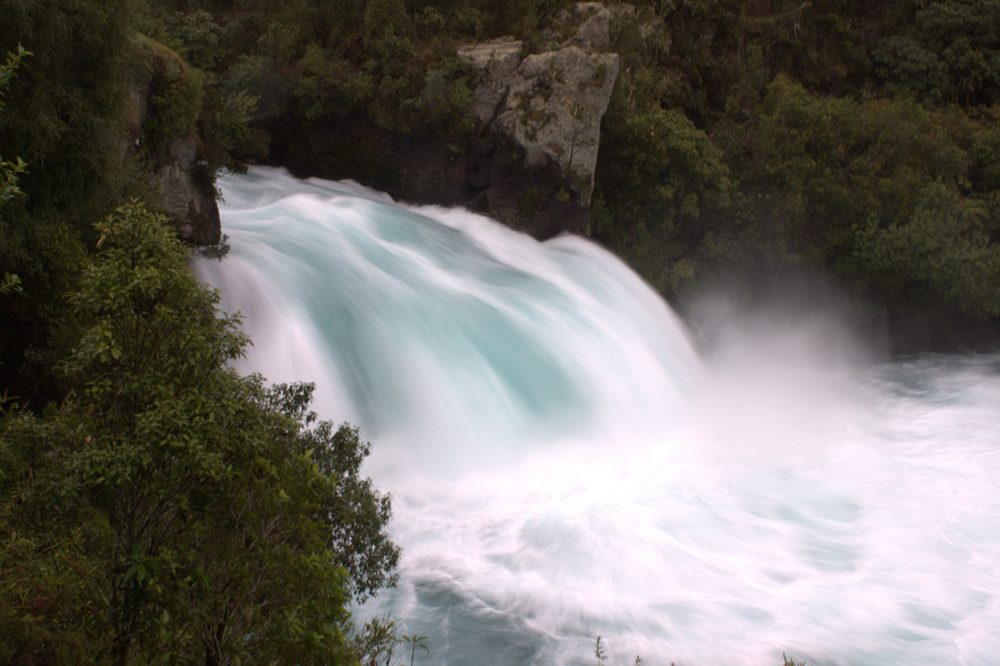
The Huka Falls on the Waikato River is one of New Zealand’s most visited natural tourist attractions (see Figure 12.4). On average the river has a flow rate of about 300,000 L/s. At the gorge, the river narrows to 20 m wide and averages 20 m deep. (a) What is the average speed of the river in the gorge? (b) What is the average speed of the water in the river downstream of the falls when it widens to 60 m and its depth increases to an average of 40 m?
(a) 0.75 m/s
(b) 0.13 m/s
A major artery with a cross-sectional area of branches into 18 smaller arteries, each with an average cross-sectional area of . By what factor is the average velocity of the blood reduced when it passes into these branches?
(a) As blood passes through the capillary bed in an organ, the capillaries join to form venules (small veins). If the blood speed increases by a factor of 4.00 and the total cross-sectional area of the venules is , what is the total cross-sectional area of the capillaries feeding these venules? (b) How many capillaries are involved if their average diameter is ?
(a)
(b)
The human circulation system has approximately capillary vessels. Each vessel has a diameter of about . Assuming cardiac output is 5 L/min, determine the average velocity of blood flow through each capillary vessel.
(a) Estimate the time it would take to fill a private swimming pool with a capacity of 80,000 L using a garden hose delivering 60 L/min. (b) How long would it take to fill if you could divert a moderate size river, flowing at , into it?
(a) 22 h
(b) 0.016 s
The flow rate of blood through a -radius capillary is . (a) What is the speed of the blood flow? (This small speed allows time for diffusion of materials to and from the blood.) (b) Assuming all the blood in the body passes through capillaries, how many of them must there be to carry a total flow of ? (The large number obtained is an overestimate, but it is still reasonable.)
(a) What is the fluid speed in a fire hose with a 9.00-cm diameter carrying 80.0 L of water per second? (b) What is the flow rate in cubic meters per second? (c) Would your answers be different if salt water replaced the fresh water in the fire hose?
(a) 12.6 m/s
(b)
(c) No, independent of density.
The main uptake air duct of a forced air gas heater is 0.300 m in diameter. What is the average speed of air in the duct if it carries a volume equal to that of the house’s interior every 15 min? The inside volume of the house is equivalent to a rectangular solid 13.0 m wide by 20.0 m long by 2.75 m high.
Water is moving at a velocity of 2.00 m/s through a hose with an internal diameter of 1.60 cm. (a) What is the flow rate in liters per second? (b) The fluid velocity in this hose’s nozzle is 15.0 m/s. What is the nozzle’s inside diameter?
(a) 0.402 L/s
(b) 0.584 cm
Prove that the speed of an incompressible fluid through a constriction, such as in a Venturi tube, increases by a factor equal to the square of the factor by which the diameter decreases. (The converse applies for flow out of a constriction into a larger-diameter region.)
Water emerges straight down from a faucet with a 1.80-cm diameter at a speed of 0.500 m/s. (Because of the construction of the faucet, there is no variation in speed across the stream.) (a) What is the flow rate in ? (b) What is the diameter of the stream 0.200 m below the faucet? Neglect any effects due to surface tension.
(a)
(b) 0.890 cm
Unreasonable Results
A mountain stream is 10.0 m wide and averages 2.00 m in depth. During the spring runoff, the flow in the stream reaches . (a) What is the average velocity of the stream under these conditions? (b) What is unreasonable about this velocity? (c) What is unreasonable or inconsistent about the premises?
Adapted from College Physics 2e by OpenStax (openstax.org), licensed under CC BY-NC-SA 4.0. Changes were made. License: CC-BY-NC-SA-4.0.