
10.5 Angular Momentum and Its Conservation
Learning Objectives
By the end of this section, you will be able to:
- Understand the analogy between angular momentum and linear momentum.
- Observe the relationship between torque and angular momentum.
- Apply the law of conservation of angular momentum.
Why does Earth keep on spinning? What started it spinning to begin with? And how does an ice skater manage to spin faster and faster simply by pulling her arms in? Why does she not have to exert a torque to spin faster? Questions like these have answers based in angular momentum, the rotational analog to linear momentum.
By now the pattern is clear—every rotational phenomenon has a direct translational analog. It seems quite reasonable, then, to define angular momentum as
This equation is an analog to the definition of linear momentum as . Units for linear momentum are while units for angular momentum are . As we would expect, an object that has a large moment of inertia , such as Earth, has a very large angular momentum. An object that has a large angular velocity , such as a centrifuge, also has a rather large angular momentum.
When you push a merry-go-round, spin a bike wheel, or open a door, you exert a torque. If the torque you exert is greater than opposing torques, then the rotation accelerates, and angular momentum increases. The greater the net torque, the more rapid the increase in . The relationship between torque and angular momentum is
This expression is exactly analogous to the relationship between force and linear momentum, . The equation is very fundamental and broadly applicable. It is, in fact, the rotational form of Newton’s second law.
Conservation of Angular Momentum
We can now understand why Earth keeps on spinning. As we saw in the previous example, . This equation means that, to change angular momentum, a torque must act over some period of time. Because Earth has a large angular momentum, a large torque acting over a long time is needed to change its rate of spin. So what external torques are there? Tidal friction exerts torque that is slowing Earth’s rotation, but tens of millions of years must pass before the change is very significant. Recent research indicates the length of the day was 18 h some 900 million years ago. Only the tides exert significant retarding torques on Earth, and so it will continue to spin, although ever more slowly, for many billions of years.
What we have here is, in fact, another conservation law. If the net torque is zero, then angular momentum is constant or conserved. We can see this rigorously by considering for the situation in which the net torque is zero. In that case,
implying that
If the change in angular momentum is zero, then the angular momentum is constant; thus,
or
These expressions are the law of conservation of angular momentum. Conservation laws are as scarce as they are important.
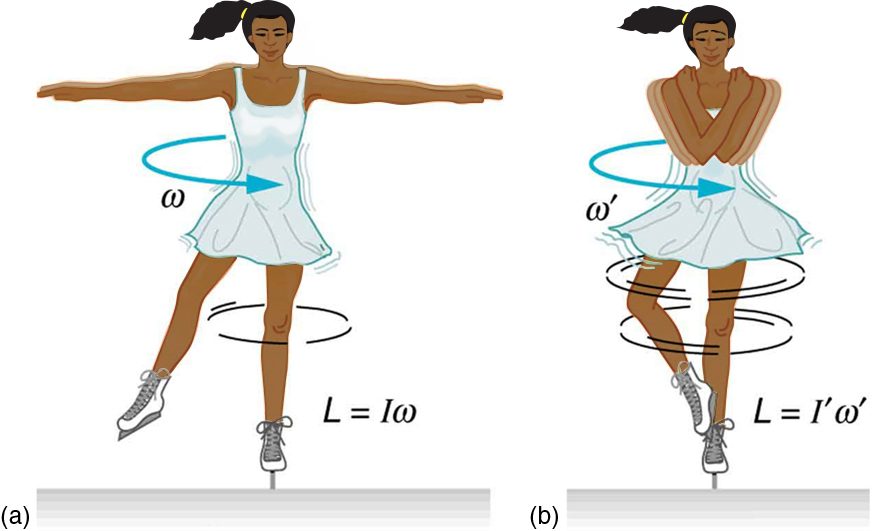
An example of conservation of angular momentum is seen in Figure 10.25, in which an ice skater is executing a spin. The net torque on her is very close to zero, because there is relatively little friction between her skates and the ice and because the friction is exerted very close to the pivot point. (Both and are small, and so is negligibly small.) Consequently, she can spin for quite some time. She can do something else, too. She can increase her rate of spin by pulling her arms and legs in. Why does pulling her arms and legs in increase her rate of spin? The answer is that her angular momentum is constant, so that
Expressing this equation in terms of the moment of inertia,
where the primed quantities refer to conditions after she has pulled in her arms and reduced her moment of inertia. Because is smaller, the angular velocity must increase to keep the angular momentum constant. The change can be dramatic, as the following example shows.
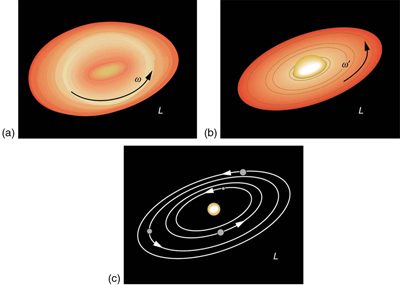
There are several other examples of objects that increase their rate of spin because something reduced their moment of inertia. Tornadoes are one example. Storm systems that create tornadoes are slowly rotating. When the radius of rotation narrows, even in a local region, angular velocity increases, sometimes to the furious level of a tornado. Earth is another example. Our planet was born from a huge cloud of gas and dust, the rotation of which came from turbulence in an even larger cloud. Gravitational forces caused the cloud to contract, and the rotation rate increased as a result. (See Figure 10.26.)
In case of human motion, one would not expect angular momentum to be conserved when a body interacts with the environment as its foot pushes off the ground. Astronauts floating in space aboard the International Space Station have no angular momentum relative to the inside of the ship if they are motionless. Their bodies will continue to have this zero value no matter how they twist about as long as they do not give themselves a push off the side of the vessel.
Is angular momentum completely analogous to linear momentum? What, if any, are their differences?
Yes, angular and linear momentums are completely analogous. While they are exact analogs they have different units and are not directly inter-convertible like forms of energy are.
Test Prep for AP Courses
Which rotational system would be best to use as a model to measure how angular momentum changes when forces on the system are changed?
- a fishing reel
- a planet and its moon
- a figure skater spinning
- a person's lower leg
(a)
You are collecting data to study changes in the angular momentum of a bicycle wheel when a force is applied to it. Which of the following measurements would be least helpful to you?
- the time for which the force is applied
- the radius at which the force is applied
- the angular velocity of the wheel when the force is applied
- the direction of the force
Which torque applied to a disk with radius 7.0 cm for 3.5 s will produce an angular momentum of 25 N⋅m⋅s?
- 7.1 N⋅m
- 357.1 N⋅m
- 3.6 N⋅m
- 612.5 N⋅m
(a)
Which of the following would be the best way to produce measurable amounts of torque on a system to test the relationship between the angular momentum of the system, the average torque applied to the system, and the time for which the torque is applied?
- having different numbers of people push on a merry-go-round
- placing known masses on one end of a seesaw
- touching the outer edge of a bicycle wheel to a treadmill that is moving at different speeds
- hanging known masses from a string that is wound around a spool suspended horizontally on an axle
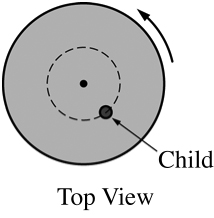
The diagram above shows a top view of a child of mass M on a circular platform of mass 2M that is rotating counterclockwise. Assume the platform rotates without friction. Which of the following describes an action by the child that will increase the angular speed of the platform-child system and why?
- The child moves toward the center of the platform, increasing the total angular momentum of the system.
- The child moves toward the center of the platform, decreasing the rotational inertia of the system.
- The child moves away from the center of the platform, increasing the total angular momentum of the system.
- The child moves away from the center of the platform, decreasing the rotational inertia of the system.
(b)
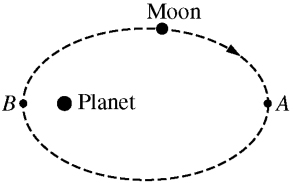
A moon is in an elliptical orbit about a planet as shown above. At point A the moon has speed uA and is at distance RA from the planet. At point B the moon has speed uB. Has the moon's angular momentum changed? Explain your answer.
A hamster sits 0.10 m from the center of a lazy Susan of negligible mass. The wheel spins with a frequency of 1.0 rev/s. How will the frequency of the lazy Susan change if the hamster walks to 0.30 m from the center of rotation? Assume zero friction and no external torque.
- It will speed up to 2.0 rev/s.
- It will speed up to 9.0 rev/s.
- It will slow to 0.11 rev/s.
- It will slow to 0.22 rev/s.
(c)
Earth has a mass of 6.0 × 1024 kg, a radius of 6.4 × 10⁶ m, and a rotational frequency of 1.2 × 10⁻⁵ rev/s. How would the planet's rotational frequency change if a layer of Earth with mass 1.0 × 10²³ kg broke off of the Earth, decreasing Earth's radius by 0.2 × 10⁶ m? Assume no friction.
Consider system A, consisting of two disks of radius R, with both rotating clockwise. Now consider system B, consisting of one disk of radius R rotating counterclockwise and another disk of radius 2R rotating clockwise. All of the disks have the same mass, and all have the same magnitude of angular velocity.
Which system has the greatest angular momentum?
- A
- B
- They're equal.
- Not enough information
(b)
Assume that a baseball bat being swung at 3π rad/s by a batting machine is equivalent to a 1.1 m thin rod with a mass of 1.0 kg. How fast would a 0.15 kg baseball that squarely hits the very tip of the bat have to be going for the net angular momentum of the bat-ball system to be zero?
Section Summary
- Every rotational phenomenon has a direct translational analog, likewise angular momentum can be defined as
- This equation is an analog to the definition of linear momentum as . The relationship between torque and angular momentum is
- Angular momentum, like energy and linear momentum, is conserved. This universally applicable law is another sign of underlying unity in physical laws. Angular momentum is conserved when net external torque is zero, just as linear momentum is conserved when the net external force is zero.
Conceptual Questions
When you start the engine of your car with the transmission in neutral, you notice that the car rocks in the opposite sense of the engine’s rotation. Explain in terms of conservation of angular momentum. Is the angular momentum of the car conserved for long (for more than a few seconds)?
Suppose a child walks from the outer edge of a rotating merry-go round to the inside. Does the angular velocity of the merry-go-round increase, decrease, or remain the same? Explain your answer.
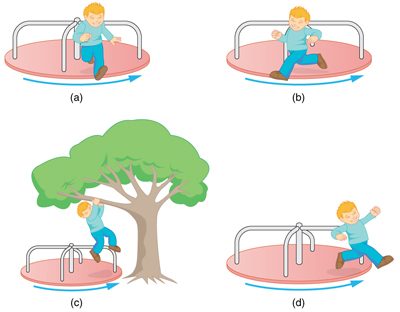
Suppose a child gets off a rotating merry-go-round. Does the angular velocity of the merry-go-round increase, decrease, or remain the same if: (a) He jumps off radially? (b) He jumps backward to land motionless? (c) He jumps straight up and hangs onto an overhead tree branch? (d) He jumps off forward, tangential to the edge? Explain your answers. (Refer to Figure 10.29).
Helicopters have a small propeller on their tail to keep them from rotating in the opposite direction of their main lifting blades. Explain in terms of Newton’s third law why the helicopter body rotates in the opposite direction to the blades.
Whenever a helicopter has two sets of lifting blades, they rotate in opposite directions (and there will be no tail propeller). Explain why it is best to have the blades rotate in opposite directions.
Describe how work is done by a skater pulling in her arms during a spin. In particular, identify the force she exerts on each arm to pull it in and the distance each moves, noting that a component of the force is in the direction moved. Why is angular momentum not increased by this action?
When there is a global heating trend on Earth, the atmosphere expands and the length of the day increases very slightly. Explain why the length of a day increases.
Nearly all conventional piston engines have flywheels on them to smooth out engine vibrations caused by the thrust of individual piston firings. Why does the flywheel have this effect?
Jet turbines spin rapidly. They are designed to fly apart if something makes them seize suddenly, rather than transfer angular momentum to the plane’s wing, possibly tearing it off. Explain how flying apart conserves angular momentum without transferring it to the wing.
An astronaut tightens a bolt on a satellite in orbit. He rotates in a direction opposite to that of the bolt, and the satellite rotates in the same direction as the bolt. Explain why. If a handhold is available on the satellite, can this counter-rotation be prevented? Explain your answer.
Competitive divers pull their limbs in and curl up their bodies when they do flips. Just before entering the water, they fully extend their limbs to enter straight down. Explain the effect of both actions on their angular velocities. Also explain the effect on their angular momenta.
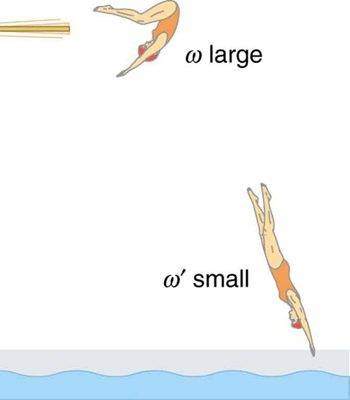
Draw a free body diagram to show how a diver gains angular momentum when leaving the diving board.
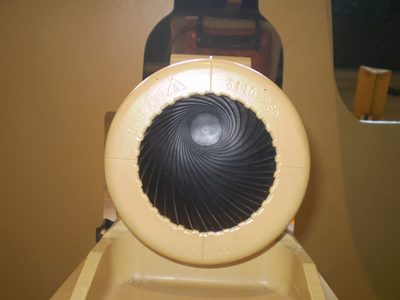
In terms of angular momentum, what is the advantage of giving a football or a rifle bullet a spin when throwing or releasing it?
Problems & Exercises
(a) Calculate the angular momentum of the Earth in its orbit around the Sun.
(b) Compare this angular momentum with the angular momentum of Earth on its axis.
(a)
(b)
The angular momentum of the Earth in its orbit around the Sun is times larger than the angular momentum of the Earth around its axis.
(a) What is the angular momentum of the Moon in its orbit around Earth?
(b) How does this angular momentum compare with the angular momentum of the Moon on its axis? Remember that the Moon keeps one side toward Earth at all times.
(c) Discuss whether the values found in parts (a) and (b) seem consistent with the fact that tidal effects with Earth have caused the Moon to rotate with one side always facing Earth.
Suppose you start an antique car by exerting a force of 300 N on its crank for 0.250 s. What angular momentum is given to the engine if the handle of the crank is 0.300 m from the pivot and the force is exerted to create maximum torque the entire time?
A playground merry-go-round has a mass of 120 kg and a radius of 1.80 m and it is rotating with an angular velocity of 0.500 rev/s. What is its angular velocity after a 22.0-kg child gets onto it by grabbing its outer edge? The child is initially at rest.
Three children are riding on the edge of a merry-go-round that is 100 kg, has a 1.60-m radius, and is spinning at 20.0 rpm. The children have masses of 22.0, 28.0, and 33.0 kg. If the child who has a mass of 28.0 kg moves to the center of the merry-go-round, what is the new angular velocity in rpm?
25.3 rpm
(a) Calculate the angular momentum of an ice skater spinning at 6.00 rev/s given his moment of inertia is . (b) He reduces his rate of spin (his angular velocity) by extending his arms and increasing his moment of inertia. Find the value of his moment of inertia if his angular velocity decreases to 1.25 rev/s. (c) Suppose instead he keeps his arms in and allows friction of the ice to slow him to 3.00 rev/s. What average torque was exerted if this takes 15.0 s?
Construct Your Own Problem Consider the Earth-Moon system. Construct a problem in which you calculate the total angular momentum of the system including the spins of the Earth and the Moon on their axes and the orbital angular momentum of the Earth-Moon system in its nearly monthly rotation. Calculate what happens to the Moon’s orbital radius if the Earth’s rotation decreases due to tidal drag. Among the things to be considered are the amount by which the Earth’s rotation slows and the fact that the Moon will continue to have one side always facing the Earth.
Adapted from College Physics 2e by OpenStax (openstax.org), licensed under CC BY-NC-SA 4.0. Changes were made. License: CC-BY-NC-SA-4.0.