
10.1 Angular Acceleration
Learning Objectives
By the end of this section, you will be able to:
- Describe uniform circular motion.
- Explain non-uniform circular motion.
- Calculate angular acceleration of an object.
- Observe the link between linear and angular acceleration.
Uniform Circular Motion and Gravitation discussed only uniform circular motion, which is motion in a circle at constant speed and, hence, constant angular velocity. Recall that angular velocity was defined as the time rate of change of angle :
where is the angle of rotation as seen in Figure 10.3. The relationship between angular velocity and linear velocity was also defined in Rotation Angle and Angular Velocity as
or
where is the radius of curvature, also seen in Figure 10.3. According to the sign convention, the counter clockwise direction is considered as positive direction and clockwise direction as negative
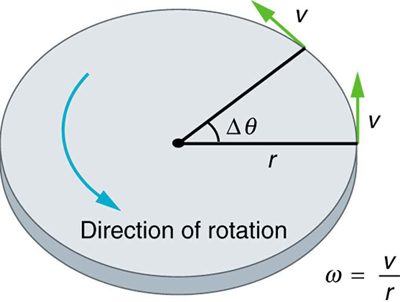
Angular velocity is not constant when a skater pulls in her arms, when a child starts up a merry-go-round from rest, or when a computer’s hard disk slows to a halt when switched off. In all these cases, there is an angular acceleration, in which changes. The faster the change occurs, the greater the angular acceleration. Angular acceleration is defined as the rate of change of angular velocity. In equation form, angular acceleration is expressed as follows:
where is the change in angular velocity and is the change in time. The units of angular acceleration are , or . If increases, then is positive. If decreases, then is negative.
If the bicycle in the preceding example had been on its wheels instead of upside-down, it would first have accelerated along the ground and then come to a stop. This connection between circular motion and linear motion needs to be explored. For example, it would be useful to know how linear and angular acceleration are related. In circular motion, linear acceleration is tangent to the circle at the point of interest, as seen in Figure 10.4. Thus, linear acceleration is called tangential acceleration .
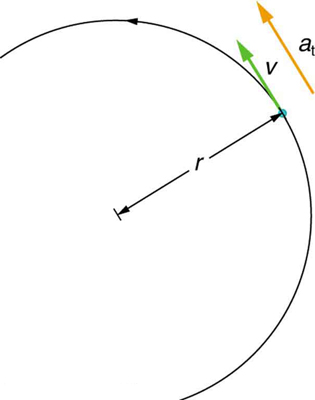
Linear or tangential acceleration refers to changes in the magnitude of velocity but not its direction. We know from Uniform Circular Motion and Gravitation that in circular motion centripetal acceleration, , refers to changes in the direction of the velocity but not its magnitude. An object undergoing circular motion experiences centripetal acceleration, as seen in Figure 10.5. Thus, and are perpendicular and independent of one another. Tangential acceleration is directly related to the angular acceleration and is linked to an increase or decrease in the velocity, but not its direction.
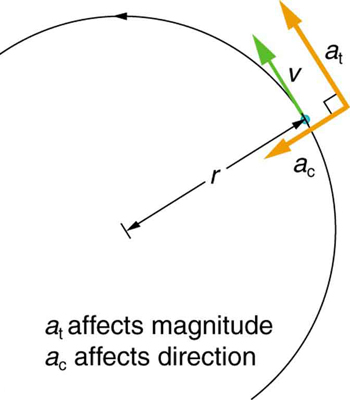
Now we can find the exact relationship between linear acceleration and angular acceleration . Because linear acceleration is proportional to a change in the magnitude of the velocity, it is defined (as it was in One-Dimensional Kinematics) to be
For circular motion, note that , so that
The radius is constant for circular motion, and so . Thus,
By definition, . Thus,
or
These equations mean that linear acceleration and angular acceleration are directly proportional. The greater the angular acceleration is, the larger the linear (tangential) acceleration is, and vice versa. For example, the greater the angular acceleration of a car’s drive wheels, the greater the acceleration of the car. The radius also matters. For example, the smaller a wheel, the smaller its linear acceleration for a given angular acceleration .
So far, we have defined three rotational quantities— , and . These quantities are analogous to the translational quantities , and . Table 10.1 displays rotational quantities, the analogous translational quantities, and the relationships between them.
| Rotational | Translational | Relationship |
|---|---|---|
Angular acceleration is a vector, having both magnitude and direction. How do we denote its magnitude and direction? Illustrate with an example.
The magnitude of angular acceleration is and its most common units are . The direction of angular acceleration along a fixed axis is denoted by a + or a – sign, just as the direction of linear acceleration in one dimension is denoted by a + or a – sign. For example, consider a gymnast doing a forward flip. Her angular momentum would be parallel to the mat and to her left. The magnitude of her angular acceleration would be proportional to her angular velocity (spin rate) and her moment of inertia about her spin axis.
Section Summary
- Uniform circular motion is the motion with a constant angular velocity .
- In non-uniform circular motion, the velocity changes with time and the rate of change of angular velocity (i.e. angular acceleration) is .
- Linear or tangential acceleration refers to changes in the magnitude of velocity but not its direction, given as .
- For circular motion, note that , so that
- The radius r is constant for circular motion, and so . Thus,
- By definition, . Thus,
or
Conceptual Questions
Analogies exist between rotational and translational physical quantities. Identify the rotational term analogous to each of the following: acceleration, force, mass, work, translational kinetic energy, linear momentum, impulse.
Explain why centripetal acceleration changes the direction of velocity in circular motion but not its magnitude.
In circular motion, a tangential acceleration can change the magnitude of the velocity but not its direction. Explain your answer.
Suppose a piece of food is on the edge of a rotating microwave oven plate. Does it experience nonzero tangential acceleration, centripetal acceleration, or both when: (a) The plate starts to spin? (b) The plate rotates at constant angular velocity? (c) The plate slows to a halt?
Problems & Exercises
At its peak, a tornado is 60.0 m in diameter and carries 500 km/h winds. What is its angular velocity in revolutions per second?
Integrated Concepts
An ultracentrifuge accelerates from rest to 100,000 rpm in 2.00 min. (a) What is its angular acceleration in ? (b) What is the tangential acceleration of a point 9.50 cm from the axis of rotation? (c) What is the radial acceleration in and multiples of of this point at full rpm?
Integrated Concepts
You have a grindstone (a disk) that is 90.0 kg, has a 0.340-m radius, and is turning at 90.0 rpm, and you press a steel axe against it with a radial force of 20.0 N. (a) Assuming the kinetic coefficient of friction between steel and stone is 0.20, calculate the angular acceleration of the grindstone. (b) How many turns will the stone make before coming to rest?
(a)
(b)
Unreasonable Results
You are told that a basketball player spins the ball with an angular acceleration of . (a) What is the ball’s final angular velocity if the ball starts from rest and the acceleration lasts 2.00 s? (b) What is unreasonable about the result? (c) Which premises are unreasonable or inconsistent?
Adapted from College Physics 2e by OpenStax (openstax.org), licensed under CC BY-NC-SA 4.0. Changes were made. License: CC-BY-NC-SA-4.0.