Evaluate problem solving strategies for rotational kinematics.
Just by using our intuition, we can begin to see how rotational quantities like , , and are related to one another. For example, if a motorcycle wheel has a large angular acceleration for a fairly long time, it ends up spinning rapidly and rotates through many revolutions. In more technical terms, if the wheel’s angular acceleration is large for a long period of time , then the final angular velocity and angle of rotation are large. The wheel’s rotational motion is exactly analogous to the fact that the motorcycle’s large translational acceleration produces a large final velocity, and the distance traveled will also be large.
Kinematics is the description of motion. The kinematics of rotational motion describes the relationships among rotation angle, angular velocity, angular acceleration, and time. Let us start by finding an equation relating , , and . To determine this equation, we recall a familiar kinematic equation for translational, or straight-line, motion:
Note that in rotational motion , and we shall use the symbol for tangential or linear acceleration from now on. As in linear kinematics, we assume is constant, which means that angular acceleration is also a constant, because . Now, let us substitute and into the linear equation above:
The radius cancels in the equation, yielding
where is the initial angular velocity. This last equation is a kinematic relationship among , , and —that is, it describes their relationship without reference to forces or masses that may affect rotation. It is also precisely analogous in form to its translational counterpart.
Starting with the four kinematic equations we developed in One-Dimensional Kinematics, we can derive the following four rotational kinematic equations (presented together with their translational counterparts):
Table 10.2 Rotational Kinematic Equations
Rotational
Translational
(constant , )
(constant , )
(constant , )
In these equations, the subscript 0 denotes initial values (, , and are initial values), and the average angular velocity and average velocity are defined as follows:
The equations given above in Table 10.2 can be used to solve any rotational or translational kinematics problem in which and are constant.
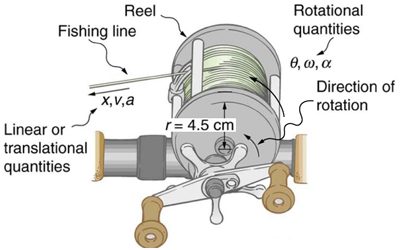
Figure 10.7Fishing line coming off a rotating reel moves linearly. Example 1 and Example 2 consider relationships between rotational and linear quantities associated with a fishing reel.
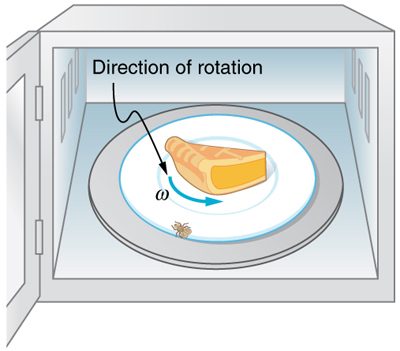
There is translational motion even for something spinning in place, as the following example illustrates. Figure 10.8 shows a fly on the edge of a rotating microwave oven plate. The example below calculates the total distance it travels.
Figure 10.8The image shows a microwave plate. The fly makes revolutions while the food is heated (along with the fly).
Rotational kinematics has many useful relationships, often expressed in equation form. Are these relationships laws of physics or are they simply descriptive? (Hint: the same question applies to linear kinematics.)
Rotational kinematics (just like linear kinematics) is descriptive and does not represent laws of nature. With kinematics, we can describe many things to great precision but kinematics does not consider causes. For example, a large angular acceleration describes a very rapid change in angular velocity without any consideration of its cause.
Section Summary
Kinematics is the description of motion.
The kinematics of rotational motion describes the relationships among rotation angle, angular velocity, angular acceleration, and time.
Starting with the four kinematic equations we developed in the One-Dimensional Kinematics, we can derive the four rotational kinematic equations (presented together with their translational counterparts) seen in Table 10.2.
In these equations, the subscript 0 denotes initial values ( and are initial values), and the average angular velocity and average velocity are defined as follows:
Problems & Exercises
With the aid of a string, a gyroscope is accelerated from rest to 32 rad/s in 0.40 s.
(a) What is its angular acceleration in rad/s2?
(b) How many revolutions does it go through in the process?
(a)
(b) 1.0 rev
Suppose a piece of dust finds itself on a CD. If the spin rate of the CD is 500 rpm, and the piece of dust is 4.3 cm from the center, what is the total distance traveled by the dust in 3 minutes? (Ignore accelerations due to getting the CD rotating.)
A gyroscope slows from an initial rate of 32.0 rad/s at a rate of .
(a) How long does it take to come to rest?
(b) How many revolutions does it make before stopping?
(a) 45.7 s
(b) 116 rev
During a very quick stop, a car decelerates at .
(a) What is the angular acceleration of its 0.280-m-radius tires, assuming they do not slip on the pavement?
(b) How many revolutions do the tires make before coming to rest, given their initial angular velocity is ?
(c) How long does the car take to stop completely?
(d) What distance does the car travel in this time?
(e) What was the car’s initial velocity?
(f) Do the values obtained seem reasonable, considering that this stop happens very quickly?
Figure 10.9Yo-yos are amusing toys that display significant physics and are engineered to enhance performance based on physical laws.Yo-yos are amusing toys that display significant physics and are engineered to enhance performance based on physical laws. (credit: Beyond Neon, Flickr)
Everyday application: Suppose a yo-yo has a center shaft that has a 0.250 cm radius and that its string is being pulled.
(a) If the string is stationary and the yo-yo accelerates away from it at a rate of , what is the angular acceleration of the yo-yo?
(b) What is the angular velocity after 0.750 s if it starts from rest?
(c) The outside radius of the yo-yo is 3.50 cm. What is the tangential acceleration of a point on its edge?
a)
b) 450 rad/ss
c) 21.0 m/ss
Adapted from College Physics 2e by OpenStax (openstax.org), licensed under CC BY-NC-SA 4.0. Changes were made. License: CC-BY-NC-SA-4.0.
These eBooks are a prerelease and are not yet certified conformant with WCAG 2.1 AA or ADA Title II. Every page is built against an automated accessibility gate, and the published editions will meet ADA Title II requirements when they release in late September 2026. If something is unusable, please tell us.