
2.1 Displacement
Learning Objectives
By the end of this section, you will be able to:
- Define position, displacement, distance, and distance traveled.
- Explain the relationship between position and displacement.
- Distinguish between displacement and distance traveled.
- Calculate displacement and distance given initial position, final position, and the path between the two.

Position
In order to describe the motion of an object, you must first be able to describe its position—where it is at any particular time. More precisely, you need to specify its position relative to a convenient reference frame. Earth is often used as a reference frame, and we often describe the position of an object as it relates to stationary objects in that reference frame. For example, a rocket launch would be described in terms of the position of the rocket with respect to the Earth as a whole, while a professor’s position could be described in terms of where she is in relation to the nearby white board. (See Figure 2.3.) In other cases, we use reference frames that are not stationary but are in motion relative to the Earth. To describe the position of a person in an airplane, for example, we use the airplane, not the Earth, as the reference frame. (See Figure 2.4.)
Displacement
If an object moves relative to a reference frame (for example, if a professor moves to the right relative to a white board or a passenger moves toward the rear of an airplane), then the object’s position changes. This change in position is known as displacement. The word “displacement” implies that an object has moved, or has been displaced.
In this text the upper case Greek letter (delta) always means “change in” whatever quantity follows it; thus, means change in position. Always solve for displacement by subtracting initial position from final position .
Note that the SI unit for displacement is the meter (m) (see Physical Quantities and Units), but sometimes kilometers, miles, feet, and other units of length are used. Keep in mind that when units other than the meter are used in a problem, you may need to convert them into meters to complete the calculation.
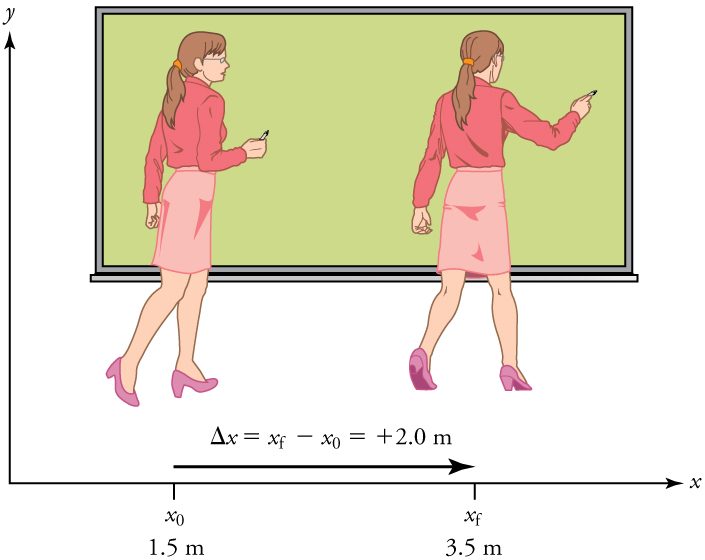
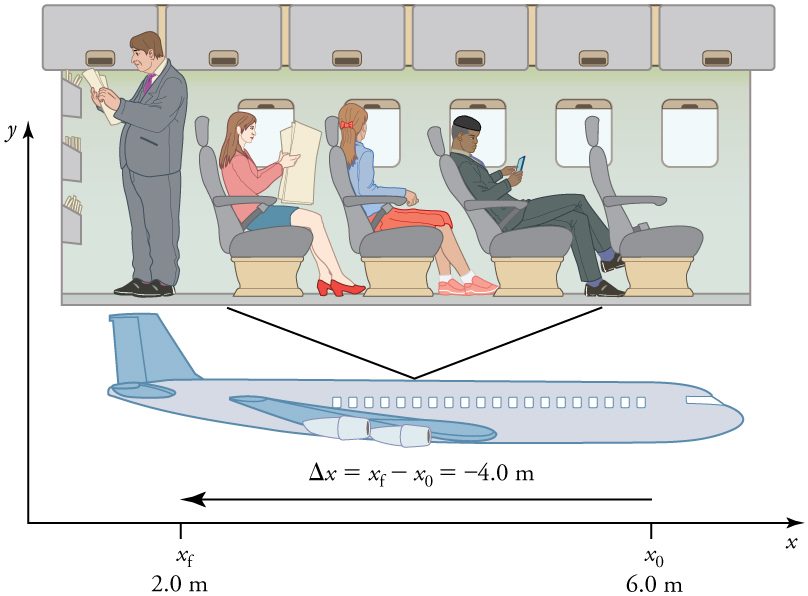
Note that displacement has a direction as well as a magnitude. The professor’s displacement is 2.0 m to the right, and the airline passenger’s displacement is 4.0 m toward the rear. In one-dimensional motion, direction can be specified with a plus or minus sign. When you begin a problem, you should select which direction is positive (usually that will be to the right or up, but you are free to select positive as being any direction). The professor’s initial position is and her final position is . Thus her displacement is
In this coordinate system, motion to the right is positive, whereas motion to the left is negative. Similarly, the airplane passenger’s initial position is and his final position is , so his displacement is
His displacement is negative because his motion is toward the rear of the plane, or in the negative direction in our coordinate system.
Distance
Although displacement is described in terms of direction, distance is not. Distance is defined to be the magnitude or size of displacement between two positions. Note that the distance between two positions is not the same as the distance traveled between them. Distance traveled is the total length of the path traveled between two positions. Distance has no direction and, thus, no sign. For example, the distance the professor walks is 2.0 m. The distance the airplane passenger walks is 4.0 m.
A cyclist rides 3 km west and then turns around and rides 2 km east. (a) What is their displacement? (b) What distance do they ride? (c) What is the magnitude of their displacement?
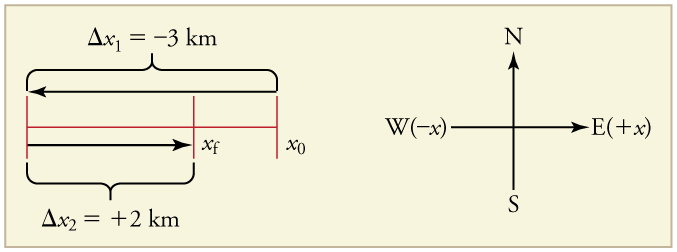
(a) The rider’s displacement is . (The displacement is negative because we take east to be positive and west to be negative.)
(b) The distance traveled is .
(c) The magnitude of the displacement is .
Test Prep for AP Courses
Which of the following statements comparing position, distance traveled, and displacement is correct?
- An object may record a distance traveled of zero while recording a non-zero displacement.
- An object may record a non-zero distance traveled while recording a displacement of zero.
- An object may record a non-zero distance traveled while maintaining a position of zero.
- An object may record a non-zero displacement while maintaining a position of zero.
(b)
Section Summary
- Kinematics is the study of motion without considering its causes. In this chapter, it is limited to motion along a straight line, called one-dimensional motion.
- Displacement is the change in position of an object.
- In symbols, displacement is defined to be where is the initial position and is the final position. In this text, the Greek letter (delta) always means “change in” whatever quantity follows it. The SI unit for displacement is the meter (m). Displacement has a direction as well as a magnitude.
- When you start a problem, assign which direction will be positive.
- Distance is the magnitude of displacement between two positions.
- Distance traveled is the total length of the path traveled between two positions.
Conceptual Questions
Give an example in which there are clear distinctions among distance traveled, displacement, and magnitude of displacement. Specifically identify each quantity in your example.
Under what circumstances does distance traveled equal magnitude of displacement? What is the only case in which magnitude of displacement and displacement are exactly the same?
Bacteria move back and forth by using their flagella (structures that look like little tails). Speeds of up to have been observed. The total distance traveled by a bacterium is large for its size, while its displacement is small. Why is this?
Problems & Exercises
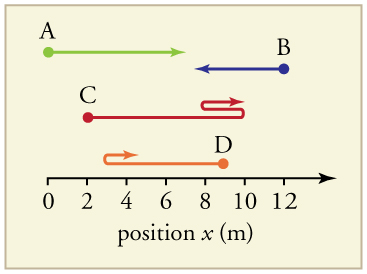
Find the following for path A in Figure 2.6: (a) The distance traveled. (b) The magnitude of the displacement from start to finish. (c) The displacement from start to finish.
(a) 7 m
(b) 7 m
(c)
Find the following for path B in Figure 2.6: (a) The distance traveled. (b) The magnitude of the displacement from start to finish. (c) The displacement from start to finish.
Find the following for path C in Figure 2.6: (a) The distance traveled. (b) The magnitude of the displacement from start to finish. (c) The displacement from start to finish.
a.
b.
c.
Find the following for path D in Figure 2.6: (a) The distance traveled. (b) The magnitude of the displacement from start to finish. (c) The displacement from start to finish.
Adapted from College Physics 2e by OpenStax (openstax.org), licensed under CC BY-NC-SA 4.0. Changes were made. License: CC-BY-NC-SA-4.0.