
Chapter 9: Markov Chains
In this chapter, you will learn to:
- Write transition matrices for Markov Chain problems.
- Find the long term trend for a Regular Markov Chain.
- Solve and interpret Absorbing Markov Chains.
We will now study stochastic processes, experiments in which the outcomes of events depend on the previous outcomes. Such a process or experiment is called a Markov Chain or Markov process. The process was first studied by a Russian mathematician named Andrei A. Markov in the early 1900s.
A small town is served by two telephone companies, Mama Bell and Papa Bell. Due to their aggressive sales tactics, each month 40% of Mama Bell customers switch to Papa Bell, that is, the other 60% stay with Mama Bell. On the other hand, 30% of the Papa Bell customers switch to Mama Bell. The above information can be expressed in a matrix which lists the probabilities of going from one state into another state. This matrix is called a transition matrix.
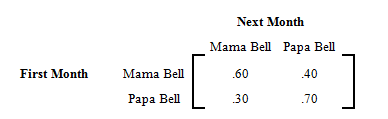
The reader should observe that a transition matrix is always a square matrix because all possible states must have both rows and columns. All entries in a transition matrix are non-negative as they represent probabilities. Furthermore, since all possible outcomes are considered in the Markov process, the sum of the row entries is always 1.
Adapted from Applied Finite Mathematics by Rupinder Sekhon (De Anza College), originally published by OpenStax CNX (cnx.org, collection col10613) under CC BY 3.0 (creativecommons.org/licenses/by/3.0/); that original material remains under CC BY 3.0. Includes material adapted from Applied Finite Mathematics (Sekhon and Bloom), LibreTexts, under CC BY 4.0. Changes were made. This adaptation by XYZ Homework is licensed under CC BY 4.0. License: CC-BY-4.0.