
9.2 Markov Chains: Homework
MARKOV CHAINS
Is the matrix given below a transition matrix for a Markov chain? Explain.
- No
- No
A survey of American car buyers indicates that if a person buys a Ford, there is a 60% chance that their next purchase will be a Ford, while owners of a GM will buy a GM again with a probability of .80. The buying habits of these consumers are represented in the transition matrix below.
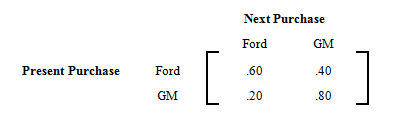
Find the following probabilities:
The probability that a present owner of a Ford will buy a GM as his next car.
The probability that a present owner of a GM will buy a GM as his next car.
The probability that a present owner of a Ford will buy a GM as his third car.
The probability that a present owner of a GM will buy a GM as his fourth car.
Professor Hay has breakfast at Hogee's every morning. He either orders an Egg Scramble, or a Tofu Scramble. He never orders Eggs on two consecutive days, but if he does order Tofu one day, then the next day he can order Tofu or Eggs with equal probability.
Write a transition matrix for this problem.
If Professor Hay has Tofu on the first day, what is the probability he will have Tofu on the second day?
If Professor Hay has Eggs on the first day, what is the probability he will have Tofu on the third day?
If Professor Hay has Eggs on the first day, what is the probability he will have Tofu on the fourth day?
A professional tennis player always hits cross-court or down the line. In order to give himself a tactical edge, he never hits down the line two consecutive times, but if he hits cross-court on one shot, on the next shot he can hit cross-court with .75 probability and down the line with .25 probability.
Write a transition matrix for this problem.
If the player hit the first shot cross-court, what is the probability that he will hit the third shot down the line?
The transition matrix for switching political parties in an election year is given below, where Democrats, Republicans, and Independents are denoted by the letters , , and , respectively.
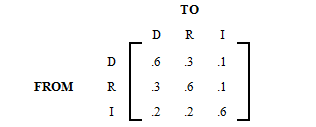
Find the probability of a Democrat voting Republican.
Find the probability of a Democrat voting Republican in the second election.
Find the probability of a Republican voting Independent in the second election.
Find the probability of a Democrat voting Independent in the third election.
- 0.3
- 0.38
- 0.15
- 0.175
REGULAR MARKOV CHAINS
Determine whether the following matrices are regular Markov chains.
a. No c. No
Company I and Company II compete against each other, and the transition matrix for people switching from Company I to Company II is given below.
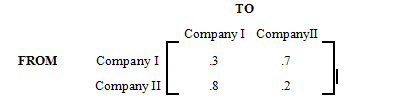
Find the following.
If the initial market share is 40% for Company I and 60% for Company II, what will the market share be after 3 steps?
If this trend continues, what is the long range expectation for the market?
Suppose the transition matrix for the tennis player in is as follows, where denotes the cross-court shots and denotes down-the-line shots.
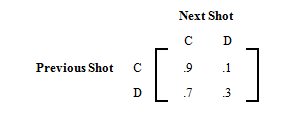
Find the following.
If the player hit the first shot cross-court, what is the probability he will hit the fourth shot cross-court?
Determine the long term shot distribution.
- 0.876
Professor Hay never orders eggs two days in a row, but if he orders tofu one day, then there is an equal probability that he will order tofu or eggs the next day.
Find the following:
If Professor Hay had eggs on Monday, what is the probability that he will have tofu on Friday?
Find the long term distribution for breakfast choices for Professor Hay.
In a multi-party parliamentary system, political analysts study how voters switch support among three major parties between elections. The transition matrix for voter movement is given below, where Centrists, Nationalists, and Reformists are denoted by the letters , , and , respectively.
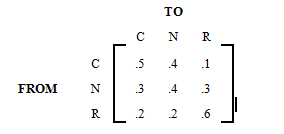
Find the following.
If in this election Centrists received 25% of the votes, Nationalists 30%, and Reformists the rest 45%, what will the distribution be in the next election?
What will the distribution be in the third election?
What will the distribution be in the fourth election?
Determine the long term distribution.
a. c.
ABSORBING MARKOV CHAINS
Given the following absorbing Markov chain.
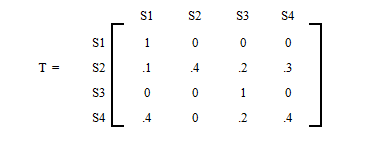
Find the following:
Identify the absorbing states.
Write the solution matrix.
Starting from state 4, what is the probability of eventual absorption in state 1?
Starting from state 2, what is the probability of eventual absorption in state 3?
1 and 3
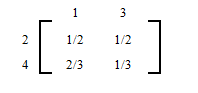
Figure 9.22
Two tennis players, Carlos and Jannik each with two dollars in their pocket, decide to bet each other $1, for every game they play. They continue playing until one of them is broke.
Do the following:
Write the transition matrix for Carlos.
Identify the absorbing states.
Write the solution matrix.
At a given stage if Carlos has $1, what is the chance that he will eventually lose it all?
Repeat, if the chance of winning for Andre is .4 and for Vijay .6.
Write the transition matrix for Andre.
Write the solution matrix.
If Andre has $3, what is the probability that he will eventually be ruined?
If Vijay has $1, what is the probability that he will eventually triumph?
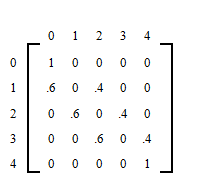
Figure 9.23 - Andre's solution matrix
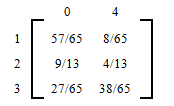
Figure 9.24
Repeat, if initially Andre has $3 and Vijay has $2.
Write the transition matrix.
Identify the absorbing states.
Write the solution matrix.
If Andre has $4, what is the probability that he will eventually be ruined?
The non-tenured professors at a community college are regularly evaluated. After an evaluation they are classified as good, bad, or improvable. The "improvable" are given a set of recommendations and are re-evaluated the following semester. At the next evaluation, 60% of the improvable turn out to be good, 20% bad, and 20% improvable. These percentages never change and the process continues.
Write the transition matrix.
Identify the absorbing states.
Write the solution matrix.
What is the probability that a professor who is improvable will eventually become good?
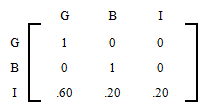
Figure 9.25 - I and II
- 0.75
A rat is placed in the maze shown below, and it moves from room to room randomly. From any room, the rat will choose a door to the next room with equal probabilities. Once it reaches room 1, it finds food and never leaves that room. And when it reaches room 5, it is trapped and cannot leave that room. What is the probability the rat will end up in room 5 if it was initially placed in room 3?
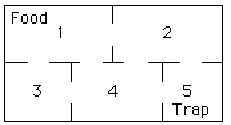
In, what is the probability the rat will end up in room 1 if it was initially placed in room 2?
CHAPTER REVIEW
Is the matrix given below a transition matrix for a Markov chain? Explain.
- No
- No
A survey of computer buyers indicates that if a person buys an Apple computer, there is an 80% chance that their next purchase will be an Apple, while owners of a Dell will buy a Dell again with a probability of .70. The buying habits of these consumers are represented in the transition matrix below.
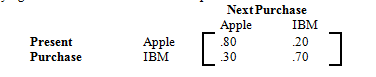
Find the following probabilities:
The probability that a present owner of an Apple will buy a Dell as their next computer.
The probability that a present owner of an Apple will buy a Dell as their third computer.
The probability that a present owner of a Dell will buy a Dell as their fourth computer.
- 0.2
- 0.3
- 0.475
Professor Trayer either teaches Finite Math or Statistics each quarter. She never teaches Finite Math two consecutive quarters, but if she teaches Statistics one quarter, then the next quarter she will teach Statistics with a probability.
Write a transition matrix for this problem.
If Professor Trayer teaches Finite Math in the Fall quarter, what is the probability that she will teach Statistics in the Winter quarter.
If Professor Trayer teaches Finite Math in the Fall quarter, what is the probability that she will teach Statistics in the Spring quarter.
- 1
The transition matrix for switching academic majors each quarter by students at a university is given below, where Science, Business, and Liberal Arts majors are denoted by the letters , , and , respectively.
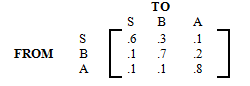
Find the probability of a science major switching to a business major during their first quarter.
Find the probability of a business major switching to a Liberal Arts major during their second quarter.
Find the probability of a science major switching to a Liberal Arts major during their third quarter.
- 0.3
- 0.31
- 0.28
Determine whether the following matrices are regular Markov chains.
- No
- Yes
Patrick Mahomes, the football quarterback for the Kansas City Chiefs, calls his own plays. At every play he has to decide to either pass the ball or hand it off. The transition matrix for his plays is given in the following table, where represents a pass and a handoff.
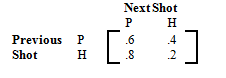
Find the following.
If Patrick Mahomes threw a pass on the first play, what is the probability that he will handoff on the third play?
Determine the long term play distribution.
- 0.32
- ,
Company I, Company II, and Company III compete against each other, and the transition matrix for people switching from company to company each year is given below.
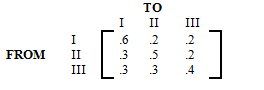
Find the following.
If the initial market share is 20% for Company I, 30% for Company II and 50% for Company III, what will the market share be after the next year?
If this trend continues, what is the long range expectation for the market?
Given the following absorbing Markov chain.
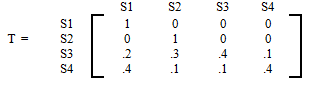
Identify the absorbing states.
Write the solution matrix.
Starting from state 4, what is the probability of eventual absorption in state 1?
Starting from state 3, what is the probability of eventual absorption in state 2?
- and
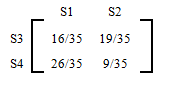
Figure 9.32
A rat is placed in the maze shown below, and it moves from room to room randomly. From any room, the rat will choose a door to the next room with equal probabilities. Once it reaches room 1, it finds food and never leaves that room. And when it reaches room 6, it is trapped and cannot leave that room. What is the probability that the rat will end up in room 1 if it was initially placed in room 3?
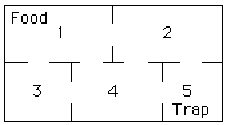
In, what is the probability that the rat will end up in room 6 if it was initially in room 2?
Adapted from Applied Finite Mathematics by Rupinder Sekhon (De Anza College), originally published by OpenStax CNX (cnx.org, collection col10613) under CC BY 3.0 (creativecommons.org/licenses/by/3.0/); that original material remains under CC BY 3.0. Includes material adapted from Applied Finite Mathematics (Sekhon and Bloom), LibreTexts, under CC BY 4.0. Changes were made. This adaptation by XYZ Homework is licensed under CC BY 4.0. License: CC-BY-4.0.