
11.3 Quarks
In the 1960s, particle physicists began to realize that hadrons are not elementary particles but are made of particles called quarks. (The name ‘quark’ was coined by the physicist Murray Gell-Mann, from a phrase in the James Joyce novel Finnegans Wake.) Initially, it was believed there were only three types of quarks, called up (u), down (d), and strange (s). However, this number soon grew to six—interestingly, the same as the number of leptons—to include charmed (c), bottom (b), and top (t).
All quarks are spin-half fermions have a fractional charge , and have baryon number Each quark has an antiquark with the same mass but opposite charge and baryon number. The names and properties of the six quarks are listed in Table 11.3.
| Quark | Charge (units of e) | Spin (s) | Baryon number | Strangeness number |
|---|---|---|---|---|
| Down (d) | 1/2 | 1/3 | 0 | |
| Up (u) | 1/2 | 1/3 | 0 | |
| Strange (s) | 1/2 | 1/3 | ||
| Charm (c) | 1/2 | 1/3 | 0 | |
| Bottom (b) | 1/2 | 1/3 | 0 | |
| Top (t) | 1/2 | 1/3 | 0 |
Quark Combinations
As mentioned earlier, quarks bind together in groups of two or three to form hadrons. Baryons are formed from three quarks. Sample baryons, including quark content and properties, are given in Table 11.4. Interestingly, the delta plus () baryon is formed from the same three quarks as the proton, but the total spin of the particle is 3/2 rather than 1/2. Similarly, the mass of with spin 3/2 is 1.3 times the mass of the proton, and the delta zero () baryon with a spin 3/2 is 1.3 times the neutron mass. Evidently, the energy associated with the spin (or angular momentum) of the particle contributes to its mass energy. It is also interesting that no baryons are believed to exist with top quarks, because top quarks decay too quickly to bind to the other quarks in their production.
| Name | Symbol | Quarks | Charge (unit of e) | Spin (s) | Mass () |
|---|---|---|---|---|---|
| Proton | p | u u d | 1 | 1/2 | 0.938 |
| Neutron | n | u d d | 0 | 1/2 | 0.940 |
| Delta plus plus | ∆++ | u u u | 2 | 3/2 | 1.232 |
| Delta plus | ∆+ | u u d | 1 | 3/2 | 1.232 |
| Delta zero | ∆0 | u d d | 0 | 3/2 | 1.232 |
| Delta minus | ∆− | d d d | 3/2 | 1.232 | |
| Lambda zero | u d s | 0 | 1/2 | 1.116 | |
| Positive sigma | u u s | 1 | 1/2 | 1.189 | |
| Neutral sigma | u d s | 0 | 1/2 | 1.192 | |
| Negative xi | s d s | 1/2 | 1.321 | ||
| Neutral xi | s u s | 0 | 1/2 | 1.315 | |
| Omega minus | s s s | 3/2 | 1.672 | ||
| Charmed lambda | u d c | 1 | 1/2 | 2.281 | |
| Bottom lambda | u d b | 0 | 1/2 | 5.619 |
Mesons are formed by two quarks—a quark-antiquark pair. Sample mesons, including quark content and properties, are given in Table 11.5. Consider the formation of the pion (). Based on its quark content, the charge of the pion is
Both quarks are spin-half (), so the resultant spin is either 0 or 1. The spin of the meson is 0. The same quark-antiquark combination gives the rho () meson with spin 1. This meson has a mass approximately 5.5 times that of the meson.
| Name | Symbol | Quarks | Charge (e) | Spin | Mass |
|---|---|---|---|---|---|
| Positive pion | 1 | 0 | 0.140 | ||
| Positive rho | 1 | 1 | 0.768 | ||
| Negative pion | 0 | 0.140 | |||
| Negative rho | 1 | 0.768 | |||
| Neutral Pion | or | 0 | 0 | 0.135 | |
| Neutral eta | , or | 0 | 0 | 0.547 | |
| Positive kaon | 1 | 0 | 0.494 | ||
| Neutral kaon | 0 | 0 | 0.498 | ||
| Negative kaon | 0 | 0.494 | |||
| J/Psi | 0 | 1 | 3.10 | ||
| Charmed eta | 0 | 0 | 2.98 | ||
| Neutral D | 0 | 0 | 1.86 | ||
| Neutral D | 0 | 1 | 2.01 | ||
| Positive D | 1 | 0 | 1.87 | ||
| Neutral B | 0 | 0 | 5.26 | ||
| Upsilon | 0 | 1 | 9.46 |
Color
Quarks are fermions that obey Pauli’s exclusion principle, so it might be surprising to learn that three quarks can bind together within a nucleus. For example, how can two up quarks exist in the same small region of space within a proton? The solution is to invent a third new property to distinguish them. This property is called color, and it plays the same role in the strong nuclear interaction as charge does in electromagnetic interactions. For this reason, quark color is sometimes called “strong charge.”
Quarks come in three colors: red, green, and blue. (These are just labels—quarks are not actually colored.) Each type of quark can possess any other colors. For example, three strange quarks exist: a red strange quark, a green strange quark, and a blue strange quark. Antiquarks have anticolor. Quarks that bind together to form hadrons (baryons and mesons) must be color neutral, colorless, or “white.” Thus, a baryon must contain a red, blue, and green quark. Likewise, a meson contains either a red-antired, blue-antiblue, or green-antigreen quark pair. Thus, two quarks can be found in the same spin state in a hadron, without violating Pauli’s exclusion principle, because their colors are different.
Quark Confinement
The first strong evidence for the existence of quarks came from a series of experiments performed at the Stanford Linear Accelerator Center (SLAC) and at CERN around 1970. This experiment was designed to probe the structure of the proton, much like Rutherford studied structure inside the atom with his -particle scattering experiments. Electrons were collided with protons with energy in excess of 20 GeV. At this energy, , so the de Broglie wavelength of an electron is
The wavelength of the electron is much smaller than the diameter of the proton (about Thus, like an automobile traveling through a rocky mountain range, electrons can be used to probe the structure of the nucleus.
The SLAC experiments found that some electrons were deflected at very large angles, indicating small scattering centers within the proton. The scattering distribution was consistent with electrons being scattered from sites with spin 1/2, the spin of quarks. The experiments at CERN used neutrinos instead of electrons. This experiment also found evidence for the tiny scattering centers. In both experiments, the results suggested that the charges of the scattering particles were either or , in agreement with the quark model.
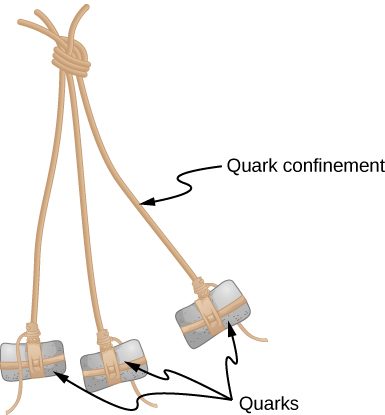
The quark model has been extremely successful in organizing the complex world of subatomic particles. Interestingly, however, no experiment has ever produced an isolated quark. All quarks have fractional charge and should therefore be easily distinguishable from the known elementary particles, whose charges are all an integer multiple of e. Why are isolated quarks not observed? In current models of particle interactions, the answer is expressed in terms of quark confinement. Quark confinement refers to the confinement of quarks in groups of two or three in a small region of space. The quarks are completely free to move about in this space, and send and receive gluons (the carriers of the strong force). However, if these quarks stray too far from one another, the strong force pulls them back it. This action is likened to a bola, a weapon used for hunting (Figure 11.5). The stones are tied to a central point by a string, so none of the rocks can move too far from the others. The bola corresponds to a baryon, the stones correspond to quarks, and the string corresponds to the gluons that hold the system together.
Summary
- Six known quarks exist: up (u), down (d), charm (c), strange (s), top (t), and bottom (b). These particles are fermions with half-integral spin and fractional charge.
- Baryons consist of three quarks, and mesons consist of a quark-antiquark pair. Due to the strong force, quarks cannot exist in isolation.
- Evidence for quarks is found in scattering experiments.
Conceptual Questions
What are the six known quarks? Summarize their properties.
What is the general quark composition of a baryon? Of a meson?
3 quarks, 2 quarks (a quark-antiquark pair)
What evidence exists for the existence of quarks?
Why do baryons with the same quark composition sometimes differ in their rest mass energies?
Baryons with the same quark composition differ in rest energy because this energy depends on the internal energy of the quarks . So, a baryon that contains a quark with a large angular momentum is expected to be more massive than the same baryon with less angular momentum.
Problems
Based on quark composition of a proton, show that its charge is .
A proton consists of two up quarks and one down quark. The total charge of a proton is therefore
Based on the quark composition of a neutron, show that is charge is 0.
Argue that the quark composition given in Table 11.5 for the positive kaon is consistent with the known charge, spin, and strangeness of this baryon.
The meson is composed of an up quark and a strange antiquark (). Since the changes of this quark and antiquark are 2e/3 and e/3, respectively, the net charge of the meson is e, in agreement with its known value. Two spin particles can combine to produce a particle with spin of either 0 or 1, consistent with the meson’s spin of 0. The net strangeness of the up quark and strange antiquark is , in agreement with the measured strangeness of the meson.
Mesons are formed from the following combinations of quarks (subscripts indicate color and ): , (), and ().
(a) Determine the charge and strangeness of each combination. (b) Identify one or more mesons formed by each quark-antiquark combination.
Why can’t either set of quarks shown below form a hadron?
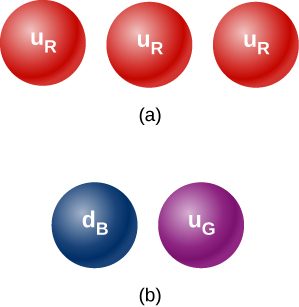
a. color; b. quark-antiquark
Experimental results indicate an isolate particle with charge —an isolated quark. What quark could this be? Why would this discovery be important?
Express the decays and in terms of decays of quarks. Check to see that the conservation laws for charge, lepton number, and baryon number are satisfied by the quark decays.
Adapted from University Physics Volume 3 by OpenStax (openstax.org), licensed under CC BY-NC-SA 4.0. Changes were made. License: CC-BY-NC-SA-4.0.