
11.2 Particle Conservation Laws
Conservation laws are critical to an understanding of particle physics. Strong evidence exists that energy, momentum, and angular momentum are all conserved in all particle interactions. The annihilation of an electron and positron at rest, for example, cannot produce just one photon because this violates the conservation of linear momentum. As discussed in Relativity, the special theory of relativity modifies definitions of momentum, energy, and other familiar quantities. In particular, the relativistic momentum of a particle differs from its classical momentum by a factor that varies from 1 to depending on the speed of the particle.
In previous chapters, we encountered other conservation laws as well. For example, charge is conserved in all electrostatic phenomena. Charge lost in one place is gained in another because charge is carried by particles. No known physical processes violate charge conservation. In the next section, we describe three less-familiar conservation laws: baryon number, lepton number, and strangeness. These are by no means the only conservation laws in particle physics.
Baryon Number Conservation
No conservation law considered thus far prevents a neutron from decaying via a reaction such as
This process conserves charge, energy, and momentum. However, it does not occur because it violates the law of baryon number conservation. This law requires that the total baryon number of a reaction is the same before and after the reaction occurs. To determine the total baryon number, every elementary particle is assigned a baryon number B. The baryon number has the value for baryons, –1 for antibaryons, and 0 for all other particles. Returning to the above case (the decay of the neutron into an electron-positron pair), the neutron has a value whereas the electron and the positron each has a value of 0. Thus, the decay does not occur because the total baryon number changes from 1 to 0. However, the proton-antiproton collision process
does satisfy the law of conservation of baryon number because the baryon number is zero before and after the interaction. The baryon number for several common particles is given in Table 11.2.
| Particle name | Symbol | Lepton number | Lepton number | Lepton number | Baryon number (B) | Strange-ness number |
|---|---|---|---|---|---|---|
| Electron | 1 | 0 | 0 | 0 | 0 | |
| Electron neutrino | 1 | 0 | 0 | 0 | 0 | |
| Muon | 0 | 1 | 0 | 0 | 0 | |
| Muon neutrino | 0 | 1 | 0 | 0 | 0 | |
| Tau | 0 | 0 | 1 | 0 | 0 | |
| Tau neutrino | 0 | 0 | 1 | 0 | 0 | |
| Pion | 0 | 0 | 0 | 0 | 0 | |
| Positive kaon | 0 | 0 | 0 | 0 | 1 | |
| Negative kaon | 0 | 0 | 0 | 0 | –1 | |
| Proton | p | 0 | 0 | 0 | 1 | 0 |
| Neutron | n | 0 | 0 | 0 | 1 | 0 |
| Lambda zero | 0 | 0 | 0 | 1 | –1 | |
| Positive sigma | 0 | 0 | 0 | 1 | –1 | |
| Negative sigma | 0 | 0 | 0 | 1 | –1 | |
| Xi zero | 0 | 0 | 0 | 1 | –2 | |
| Negative xi | 0 | 0 | 0 | 1 | –2 | |
| Omega | 0 | 0 | 0 | 1 | –3 |
Lepton Number Conservation
Lepton number conservation states that the sum of lepton numbers before and after the interaction must be the same. There are three different lepton numbers: the electron-lepton number the muon-lepton number and the tau-lepton number In any interaction, each of these quantities must be conserved separately. For electrons and electron neutrinos, for their antiparticles, all other particles have Similarly, for muons and muon neutrinos, for their antiparticles, and for all other particles. Finally, , or 0, depending on whether we have a tau or tau neutrino, their antiparticles, or any other particle, respectively. Lepton number conservation guarantees that the number of electrons and positrons in the universe stays relatively constant. (Note: The total lepton number is, as far as we know, conserved in nature. However, observations have shown variations of family lepton number (for example, in a phenomenon called neutrino oscillations.)
To illustrate the lepton number conservation law, consider the following known two-step decay process:
In the first decay, all of the lepton numbers for are 0. For the products of this decay, for and for Therefore, muon-lepton number is conserved. Neither electrons nor tau are involved in this decay, so and for the initial particle and all decay products. Thus, electron-lepton and tau-lepton numbers are also conserved. In the second decay, has a muon-lepton number whereas the net muon-lepton number of the decay products is . Thus, the muon-lepton number is conserved. Electron-lepton number is also conserved, as for , whereas the net electron-lepton number of the decay products is . Finally, since no taus or tau-neutrinos are involved in this decay, the tau-lepton number is also conserved.
Strangeness Conservation
In the late 1940s and early 1950s, cosmic-ray experiments revealed the existence of particles that had never been observed on Earth. These particles were produced in collisions of pions with protons or neutrons in the atmosphere. Their production and decay were unusual. They were produced in the strong nuclear interactions of pions and nucleons, and were therefore inferred to be hadrons; however, their decay was mediated by the much more slowly acting weak nuclear interaction. Their lifetimes were on the order of to whereas a typical lifetime for a particle that decays via the strong nuclear reaction is These particles were also unusual because they were always produced in pairs in the pion-nucleon collisions. For these reasons, these newly discovered particles were described as strange. The production and subsequent decay of a pair of strange particles is illustrated in Figure 11.4 and follows the reaction
The lambda particle then decays through the weak nuclear interaction according to
and the kaon decays via the weak interaction
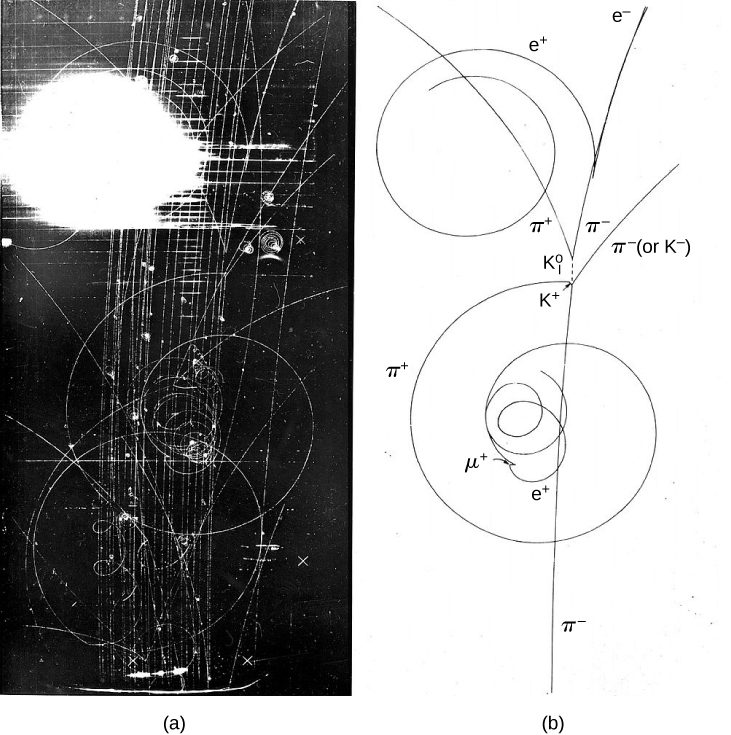
To rationalize the behavior of these strange particles, particle physicists invented a particle property conserved in strong interactions but not in weak interactions. This property is called strangeness and, as the name suggests, is associated with the presence of a strange quark. The strangeness of a particle is equal to the number of strange quarks of the particle. Strangeness conservation requires the total strangeness of a reaction or decay (summing the strangeness of all the particles) is the same before and after the interaction. Strangeness conservation is not absolute: It is conserved in strong interactions and electromagnetic interactions but not in weak interactions. The strangeness number for several common particles is given in Table 11.2.
Summary
- Elementary particle interactions are governed by particle conservation laws, which can be used to determine what particle reactions and decays are possible (or forbidden).
- The baryon number conservation law and the three lepton number conversation law are valid for all physical processes. However, conservation of strangeness is valid only for strong nuclear interactions and electromagnetic interactions.
Conceptual Questions
What are six particle conservation laws? Briefly describe them.
Conservation energy, momentum, and charge (familiar to classical and relativistic mechanics). Also, conservation of baryon number, lepton number, and strangeness—numbers that do not change before and after a collision or decay.
In general, how do we determine if a particle reaction or decay occurs?
Why might the detection of particle interaction that violates an established particle conservation law be considered a good thing for a scientist?
It means that the theory that requires the conservation law is not understood. The failure of a long-established theory often leads to a deeper understanding of nature.
Problems
Which of the following decays cannot occur because the law of conservation of lepton number is violated?
a, b, and c
Which of the following reactions cannot because the law of conservation of strangeness is violated?
Identify one possible decay for each of the following antiparticles:
(a) , (b) , (c) , (d) , and (e) .
a. ; b. or ; c. or ; d. or ; e. or
Each of the following strong nuclear reactions is forbidden. Identify a conservation law that is violated for each one.
Adapted from University Physics Volume 3 by OpenStax (openstax.org), licensed under CC BY-NC-SA 4.0. Changes were made. License: CC-BY-NC-SA-4.0.