
10.4 Nuclear Reactions
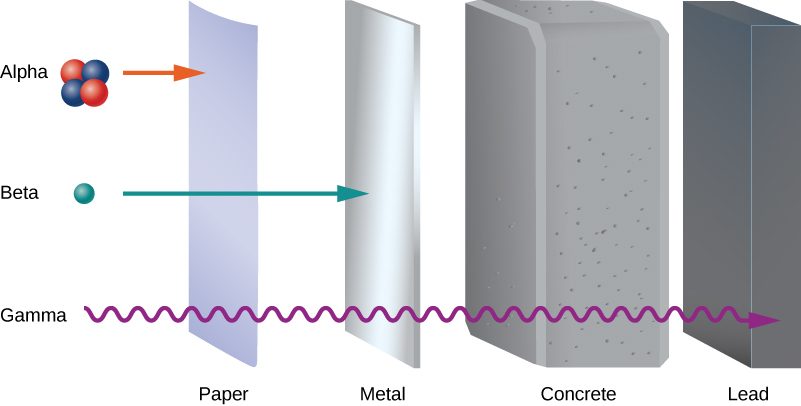
Early experiments revealed three types of nuclear “rays” or radiation: alpha () rays, beta () rays, and gamma () rays. These three types of radiation are differentiated by their ability to penetrate matter. Alpha radiation is barely able to pass through a thin sheet of paper. Beta radiation can penetrate aluminum to a depth of about 3 mm, and gamma radiation can penetrate lead to a depth of 2 or more centimeters (Figure 10.11).
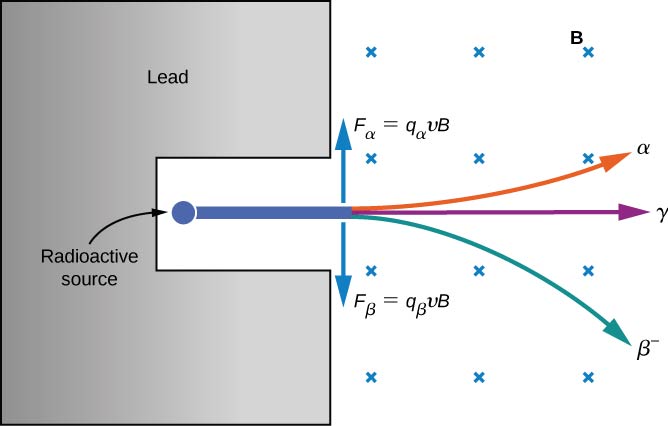
The electrical properties of these three types of radiation are investigated by passing them through a uniform magnetic field, as shown in Figure 10.12. According to the magnetic force equation positively charged particles are deflected upward, negatively charged particles are deflected downward, and particles with no charge pass through the magnetic field undeflected. Eventually, rays were identified with helium nuclei rays with electrons and positrons (positively charged electrons or antielectrons), and rays with high-energy photons. We discuss alpha, beta, and gamma radiation in detail in the remainder of this section.
Alpha Decay
Heavy unstable nuclei emit radiation. In -particle decay (or alpha decay), the nucleus loses two protons and two neutrons, so the atomic number decreases by two, whereas its mass number decreases by four. Before the decay, the nucleus is called the parent nucleus. The nucleus or nuclei produced in the decay are referred to as the daughter nucleus or daughter nuclei. We represent an decay symbolically by
where is the parent nucleus, is the daughter nucleus, and is the particle. In decay, a nucleus of atomic number Z decays into a nucleus of atomic number and atomic mass Interestingly, the dream of the ancient alchemists to turn other metals into gold is scientifically feasible through the alpha-decay process. The efforts of the alchemists failed because they relied on chemical interactions rather than nuclear interactions.
An example of alpha decay is uranium-238:
The atomic number has dropped from 92 to 90. The chemical element with is thorium. Hence, Uranium-238 has decayed to Thorium-234 by the emission of an particle, written
Subsequently, decays by emission with a half-life of 24 days. The energy released in this alpha decay takes the form of kinetic energies of the thorium and helium nuclei, although the kinetic energy of thorium is smaller than helium due to its heavier mass and smaller velocity.
Beta Decay
In most particle decays (or beta decay), either an electron () or positron () is emitted by a nucleus. A positron has the same mass as the electron, but its charge is . For this reason, a positron is sometimes called an antielectron. How does decay occur? A possible explanation is the electron (positron) is confined to the nucleus prior to the decay and somehow escapes. To obtain a rough estimate of the escape energy, consider a simplified model of an electron trapped in a box (or in the terminology of quantum mechanics, a one-dimensional square well) that has the width of a typical nucleus (). According to the Heisenberg uncertainty principle in Quantum Mechanics, the uncertainty of the momentum of the electron is:
Taking this momentum value (an underestimate) to be the “true value,” the kinetic energy of the electron on escape is approximately
Experimentally, the electrons emitted in decay are found to have kinetic energies of the order of only a few MeV. We therefore conclude that the electron is somehow produced in the decay rather than escaping the nucleus. Particle production (annihilation) is described by theories that combine quantum mechanics and relativity, a subject of a more advanced course in physics.
Nuclear beta decay involves the conversion of one nucleon into another. For example, a neutron can decay to a proton by the emission of an electron () and a nearly massless particle called an antineutrino ():
The notation is used to designate the electron. Its mass number is 0 because it is not a nucleon, and its atomic number is to signify that it has a charge of . The proton is represented by because its mass number and atomic number are 1. When this occurs within an atomic nucleus, we have the following equation for beta decay:
Enrico Fermi proposed a theory of beta decay in 1934, but his work was initially rejected. Other physicists' experiments to prove it were unsuccessful, casting further doubt on the theory. Chinese-born physicist Chien-Shiung Wu, who had developed a number of processes critical to the Manhattan Project and related research, identified a number of flaws in the earlier experimental methods and materials. She designed a new method, verified Fermi's theory, and later went on to establish the core principles of beta decay. As discussed in another chapter, this process occurs due to the weak nuclear force.
As an example, the isotope is unstable and decays by emission with a half-life of 24 days. Its decay can be represented as
Since the chemical element with atomic number 91 is protactinium (Pa), we can write the decay of thorium as
The reverse process is also possible: A proton can decay to a neutron by the emission of a positron () and a nearly massless particle called a neutrino (v). This reaction is written as
The positron is emitted with the neutrino v, and the neutron remains in the nucleus. (Like decay, the positron does not precede the decay but is produced in the decay.) For an isolated proton, this process is impossible because the neutron is heavier than the proton. However, this process is possible within the nucleus because the proton can receive energy from other nucleons for the transition. As an example, the isotope of aluminum decays by emission with a half-life of The decay is written as
The atomic number 12 corresponds to magnesium. Hence,
As a nuclear reaction, positron emission can be written as
The neutrino was not detected in the early experiments on decay. However, the laws of energy and momentum seemed to require such a particle. Later, neutrinos were detected through their interactions with nuclei.
Gamma Decay
A nucleus in an excited state can decay to a lower-level state by the emission of a “gamma-ray” photon, and this is known as gamma decay. This is analogous to de-excitation of an atomic electron. Gamma decay is represented symbolically by
where the asterisk (*) on the nucleus indicates an excited state. In decay, neither the atomic number nor the mass number changes, so the type of nucleus does not change.
Radioactive Decay Series
Nuclei with are unstable and decay naturally. Many of these nuclei have very short lifetimes, so they are not found in nature. Notable exceptions include (or Th-232) with a half-life of years, and (or U-238) with a half-life of years. When a heavy nucleus decays to a lighter one, the lighter daughter nucleus can become the parent nucleus for the next decay, and so on. This process can produce a long series of nuclear decays called a decay series. The series ends with a stable nucleus.
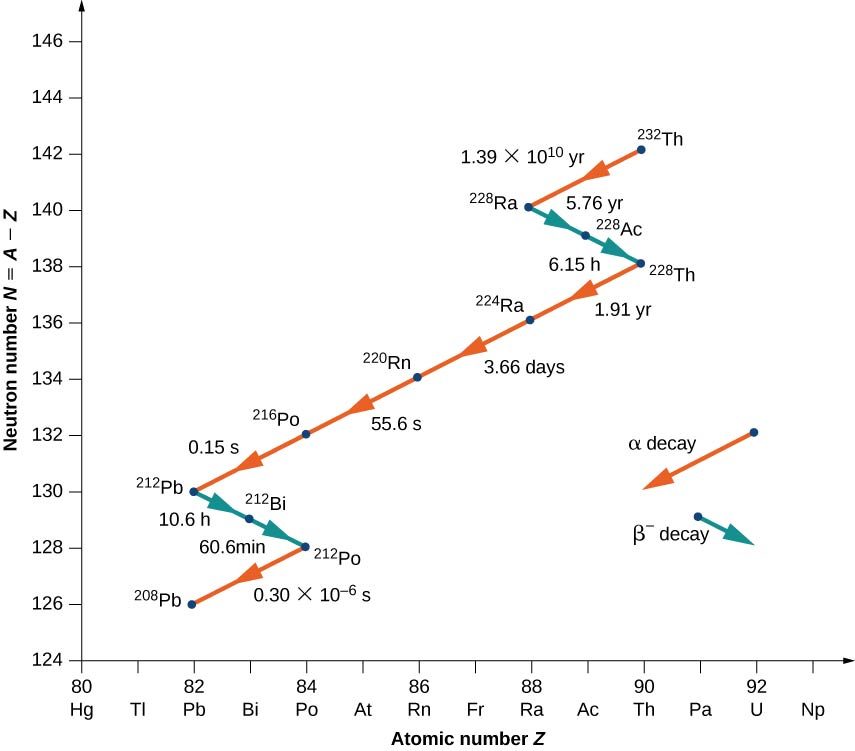
To illustrate the concept of a decay series, consider the decay of Th-232 series (Figure 10.13). The neutron number, N, is plotted on the vertical y-axis, and the atomic number, Z, is plotted on the horizontal x-axis, so Th-232 is found at the coordinates Th-232 decays by emission with a half-life of years. Alpha decay decreases the atomic number by 2 and the mass number by 4, so we have
The neutron number for Radium-228 is 140, so it is found in the diagram at the coordinates Radium-228 is also unstable and decays by emission with a half-life of 5.76 years to Actinum-228. The atomic number increases by 1, the mass number remains the same, and the neutron number decreases by 1. Notice that in the graph, emission appears as a line sloping downward to the left, with both N and Z decreasing by 2. Beta emission, on the other hand, appears as a line sloping downward to the right with N decreasing by 1, and Z increasing by 1. After several additional alpha and beta decays, the series ends with the stable nucleus Pb-208.
The relative frequency of different types of radioactive decays (alpha, beta, and gamma) depends on many factors, including the strength of the forces involved and the number of ways a given reaction can occur without violating the conservation of energy and momentum. How often a radioactive decay occurs often depends on a sensitive balance of the strong and electromagnetic forces. These forces are discussed in Particle Physics and Cosmology.
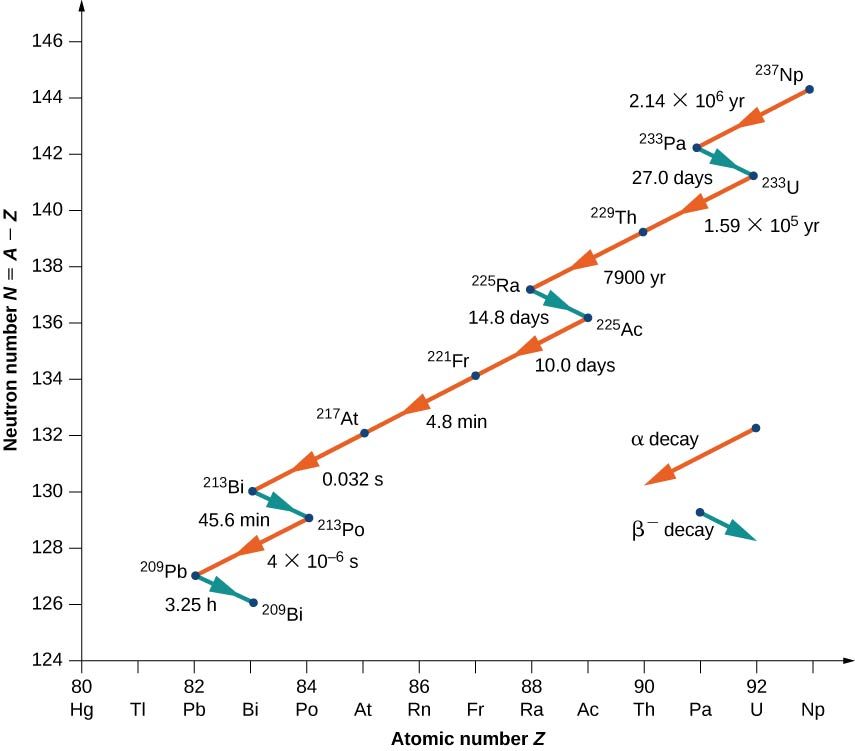
As another example, consider the U-238 decay series shown in Figure 10.14. After numerous alpha and beta decays, the series ends with the stable nucleus Pb-206. An example of a decay whose parent nucleus no longer exists naturally is shown in Figure 10.15. It starts with Neptunium-237, which decays to Bismuth-209, long thought to be stable, but which decays with a half-life of 2.01 × 10¹⁹ years (much longer than the age of the universe) to the stable nucleus Thallium-205. Neptunium is called a transuranic element because it lies beyond uranium in the periodic table. Uranium has the highest atomic number of any element found in nature. Elements with can be produced only in the laboratory. They most probably also existed in nature at the time of the formation of Earth, but because of their relatively short lifetimes, they have completely decayed. There is nothing fundamentally different between naturally occurring and artificial elements.
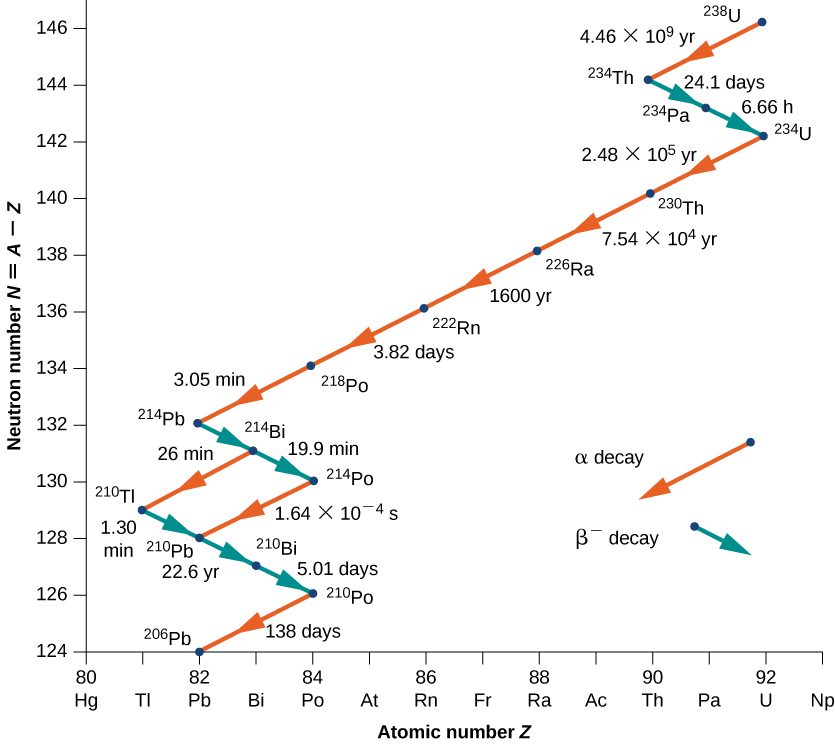
Notice that for Bi (21), the decay may proceed through either alpha or beta decay.
Radioactivity in the Earth
According to geologists, if there were no heat source, Earth should have cooled to its present temperature in no more than 1 × 10⁹ years. Yet, Earth is more than 4 × 10⁹ years old. Why is Earth cooling so slowly? The answer is nuclear radioactivity, that is, high-energy particles produced in radioactive decays heat Earth from the inside (Figure 10.16).
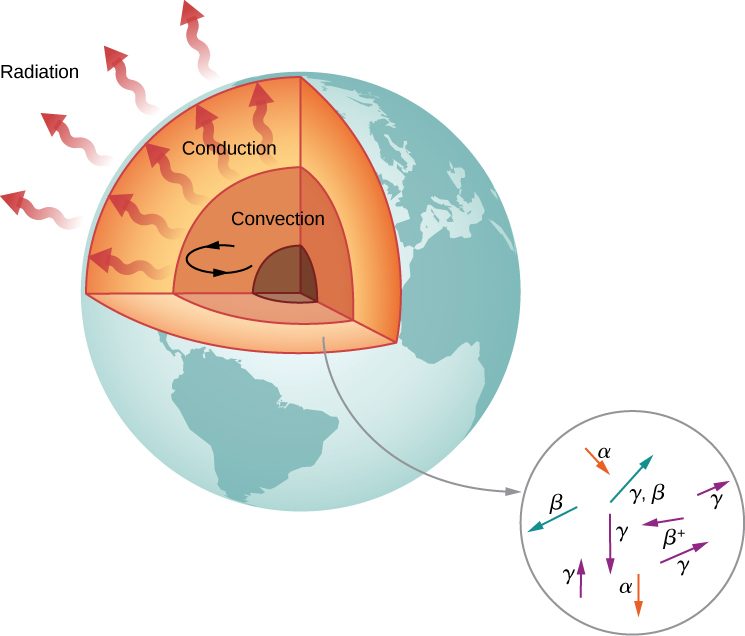
Candidate nuclei for this heating model are , which possess half-lives similar to or longer than the age of Earth. The energy produced by these decays (per second per cubic meter) is small, but the energy cannot escape easily, so Earth’s core is very hot. Thermal energy in Earth’s core is transferred to Earth’s surface and away from it through the processes of convection, conduction, and radiation.
Summary
- The three types of nuclear radiation are alpha () rays, beta () rays, and gamma () rays.
- We represent decay symbolically by . There are two types of decay: either an electron () or a positron () is emitted by a nucleus. decay is represented symbolically by .
- When a heavy nucleus decays to a lighter one, the lighter daughter nucleus can become the parent nucleus for the next decay, and so on, producing a decay series.
Conceptual Questions
What is the key difference and the key similarity between beta () decay and alpha decay?
What is the difference between rays and characteristic X-rays and visible light?
Gamma (γ) rays are produced by nuclear interactions and X-rays and light are produced by atomic interactions. Gamma rays are typically shorter wavelength than X-rays, and X-rays are shorter wavelength than light.
What characteristics of radioactivity show it to be nuclear in origin and not atomic?
Consider Figure 10.12. If the magnetic field is replaced by an electric field pointed in toward the page, in which directions will the -, -, and rays bend?
Assume a rectangular coordinate system with an xy-plane that corresponds to the plane of the paper. bends into the page (trajectory parabolic in the xz-plane); bends into the page (trajectory parabolic in the xz-plane); and is unbent.
Why is Earth’s core molten?
Problems
undergoes alpha decay. (a) Write the reaction equation. (b) Find the energy released in the decay.
(a) Calculate the energy released in the decay of . (b) What fraction of the mass of a single is destroyed in the decay? The mass of is 234.043593 u. (c) Although the fractional mass loss is large for a single nucleus, it is difficult to observe for an entire macroscopic sample of uranium. Why is this?
a. 4.273 MeV; b. ; c. Since is a slowly decaying substance, only a very small number of nuclei decay on human timescales; therefore, although those nuclei that decay lose a noticeable fraction of their mass, the change in the total mass of the sample is not detectable for a macroscopic sample.
The particles emitted in the decay of (tritium) interact with matter to create light in a glow-in-the-dark exit sign. At the time of manufacture, such a sign contains 15.0 Ci of . (a) What is the mass of the tritium? (b) What is its activity 5.00 y after manufacture?
(a) Write the complete decay equation for a major waste product of nuclear reactors. (b) Find the energy released in the decay.
a. ; b. 0.546 MeV
Write a nuclear decay reaction that produces the nucleus. (Hint: The parent nuclide is a major waste product of reactors and has chemistry similar to calcium, so that it is concentrated in bones if ingested.)
Write the complete decay equation in the complete notation for the beta () decay of (tritium), a manufactured isotope of hydrogen used in some digital watch displays, and manufactured primarily for use in hydrogen bombs.
If a 1.50-cm-thick piece of lead can absorb of the rays from a radioactive source, how many centimeters of lead are needed to absorb all but of the rays?
An electron can interact with a nucleus through the beta-decay process:
.
(a) Write the complete reaction equation for electron capture by .
(b) Calculate the energy released.
a. ; b. 0.862 MeV
(a) Write the complete reaction equation for electron capture by
(b) Calculate the energy released.
A rare decay mode has been observed in which emits a nucleus. (a) The decay equation is . Identify the nuclide . (b) Find the energy emitted in the decay. The mass of is 222.015353 u.
a. ; b. 33.05 MeV
Adapted from University Physics Volume 3 by OpenStax (openstax.org), licensed under CC BY-NC-SA 4.0. Changes were made. License: CC-BY-NC-SA-4.0.