
10.3 Radioactive Decay
In 1896, Antoine Henri Becquerel discovered that a uranium-rich rock emits invisible rays that can darken a photographic plate in an enclosed container. Scientists offer three arguments for the nuclear origin of these rays. First, the effects of the radiation do not vary with chemical state; that is, whether the emitting material is in the form of an element or compound. Second, the radiation does not vary with changes in temperature or pressure—both factors that in sufficient degree can affect electrons in an atom. Third, the very large energy of the invisible rays (up to hundreds of eV) is not consistent with atomic electron transitions (only a few eV). Today, this radiation is explained by the conversion of mass into energy deep within the nucleus of an atom. The spontaneous emission of radiation from nuclei is called nuclear radioactivity (Figure 10.8).
Radioactive Decay Law
When an individual nucleus transforms into another with the emission of radiation, the nucleus is said to decay. Radioactive decay occurs for all nuclei with and also for some unstable isotopes with The decay rate is proportional to the number of original (undecayed) nuclei N in a substance. The number of nuclei lost to decay, in time interval dt, is written
where is called the decay constant. (The minus sign indicates the number of original nuclei decreases over time.) In other words, the more nuclei available to decay, the more that do decay (in time dt). This equation can be rewritten as
Integrating both sides of the equation, and defining to be the number of nuclei at , we obtain
This gives us
Taking the left and right sides of the equation as a power of e, we have the radioactive decay law.
The total number of nuclei drops very rapidly at first, and then more slowly (Figure 10.9).
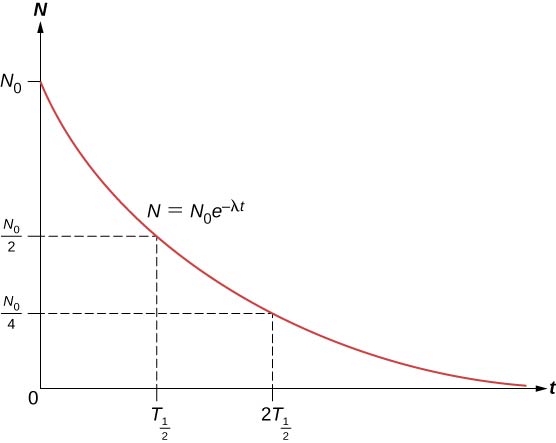
The half-life of a radioactive substance is defined as the time for half of the original nuclei to decay (or the time at which half of the original nuclei remain). The half-lives of unstable isotopes are shown in the chart of nuclides in Figure 10.4. The number of radioactive nuclei remaining after an integer (n) number of half-lives is therefore
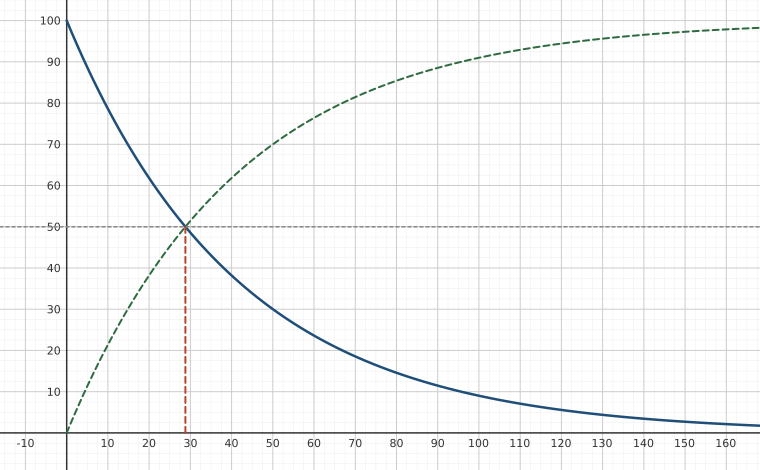
If the decay constant () is large, the half-life is small, and vice versa. To determine the relationship between these quantities, note that when , then . Thus, Equation 10.10 can be rewritten as
Dividing both sides by and taking the natural logarithm yields
which reduces to
Thus, if we know the half-life T1/2 of a radioactive substance, we can find its decay constant. The lifetime of a radioactive substance is defined as the average amount of time that a nucleus exists before decaying. The lifetime of a substance is just the reciprocal of the decay constant, written as
The activity A is defined as the magnitude of the decay rate, or
The infinitesimal change dN in the time interval dt is negative because the number of parent (undecayed) particles is decreasing, so the activity (A) is positive. Defining the initial activity as , we have
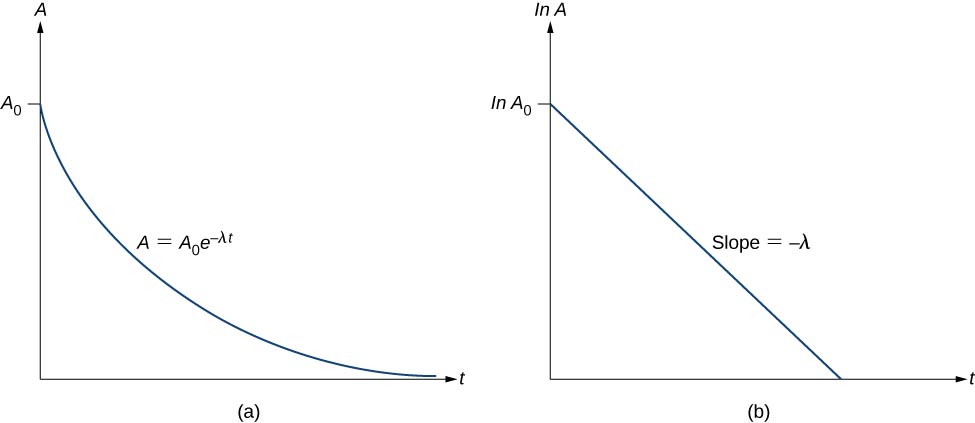
Thus, the activity A of a radioactive substance decreases exponentially with time (Figure 10.10).
Expressing in terms of the half-life of the substance, we get
Therefore, the activity is halved after one half-life. We can determine the decay constant by measuring the activity as a function of time. Taking the natural logarithm of the left and right sides of Equation 10.17, we get
This equation follows the linear form . If we plot ln A versus t, we expect a straight line with slope and y-intercept (Figure 10.10(b)). Activity A is expressed in units of becquerels (Bq), where one . This quantity can also be expressed in decays per minute or decays per year. One of the most common units for activity is the curie (Ci), defined to be the activity of 1 g of . The relationship between the Bq and Ci is
Radioactive Dating
Radioactive dating is a technique that uses naturally occurring radioactivity to determine the age of a material, such as a rock or an ancient artifact. The basic approach is to estimate the original number of nuclei in a material and the present number of nuclei in the material (after decay), and then use the known value of the decay constant and Equation 10.10 to calculate the total time of the decay, t.
An important method of radioactive dating is carbon-14 dating. Carbon-14 nuclei are produced when high-energy solar radiation strikes nuclei in the upper atmosphere and subsequently decay with a half-life of 5730 years. Radioactive carbon has the same chemistry as stable carbon, so it combines with the ecosphere and eventually becomes part of every living organism. Carbon-14 has an abundance of 1.3 parts per trillion of normal carbon. Therefore, if you know the number of carbon nuclei in an object, you multiply that number by to find the number of nuclei in that object. When an organism dies, carbon exchange with the environment ceases, and is not replenished as it decays.
By comparing the abundance of in an artifact, such as mummy wrappings, with the normal abundance in living tissue, it is possible to determine the mummy’s age (or the time since the person’s death). Carbon-14 dating can be used for biological tissues as old as 50,000 years, but is generally most accurate for younger samples, since the abundance of nuclei in them is greater. Very old biological materials contain no at all. The validity of carbon dating can be checked by other means, such as by historical knowledge or by tree-ring counting.
Summary
- In the decay of a radioactive substance, if the decay constant () is large, the half-life is small, and vice versa.
- The radioactive decay law, uses the properties of radioactive substances to estimate the age of a substance.
- Radioactive carbon has the same chemistry as stable carbon, so it mixes into the ecosphere and eventually becomes part of every living organism. By comparing the abundance of in an artifact with the normal abundance in living tissue, it is possible to determine the artifact’s age.
Conceptual Questions
How is the initial activity rate of a radioactive substance related to its half-life?
For the carbon dating described in this chapter, what important assumption is made about the time variation in the intensity of cosmic rays?
That it is constant.
Problems
A sample of radioactive material is obtained from a very old rock. A plot lnA verses t yields a slope value of (see Figure 10.10(b)). What is the half-life of this material?
The decay constant is equal to the negative value of the slope or The half-life of the nuclei, and thus the material, is
Show that: .
The half-life of strontium-91, is 9.70 h. Find (a) its decay constant and (b) for an initial 1.00-g sample, the activity after 15 hours.
a. The decay constant is . b. Since strontium-91 has an atomic mass of 90.90 g, the number of nuclei in a 1.00-g sample is initially
The initial activity for strontium-91 is
The activity at is
A sample of pure carbon-14 has an activity of What is the mass of the sample?
A radioactive sample initially contains mol of a radioactive material whose half-life is 6.00 h. How many moles of the radioactive material remain after 6.00 h? After 12.0 h? After 36.0 h?
; ;
An old campfire is uncovered during an archaeological dig. Its charcoal is found to contain less than 1/1000 the normal amount of . Estimate the minimum age of the charcoal, noting that
Calculate the activity , in curies of 1.00 g of (b) Explain why your answer is not exactly 1.00 Ci, given that the curie was originally supposed to be exactly the activity of a gram of radium.
a. 0.988 Ci; b. The half-life of is more precisely known than it was when the Ci unit was established.
Natural uranium consists of , and , What were the values for percent abundance of and when Earth formed years ago?
World War II aircraft had instruments with glowing radium-painted dials. The activity of one such instrument was Bq when new. (a) What mass of was present? (b) After some years, the phosphors on the dials deteriorated chemically, but the radium did not escape. What is the activity of this instrument 57.0 years after it was made?
a. ; b.
The source used in a physics laboratory is labeled as having an activity of on the date it was prepared. A student measures the radioactivity of this source with a Geiger counter and observes 1500 counts per minute. She notices that the source was prepared 120 days before her lab. What fraction of the decays is she observing with her apparatus?
Armor-piercing shells with depleted uranium cores are fired by aircraft at tanks. (The high density of the uranium makes them effective.) The uranium is called depleted because it has had its removed for reactor use and is nearly pure . Depleted uranium has been erroneously called nonradioactive. To demonstrate that this is wrong: (a) Calculate the activity of 60.0 g of pure . (b) Calculate the activity of 60.0 g of natural uranium, neglecting the and all daughter nuclides.
a. ; b.
Adapted from University Physics Volume 3 by OpenStax (openstax.org), licensed under CC BY-NC-SA 4.0. Changes were made. License: CC-BY-NC-SA-4.0.