
3.2 Mathematics of Interference
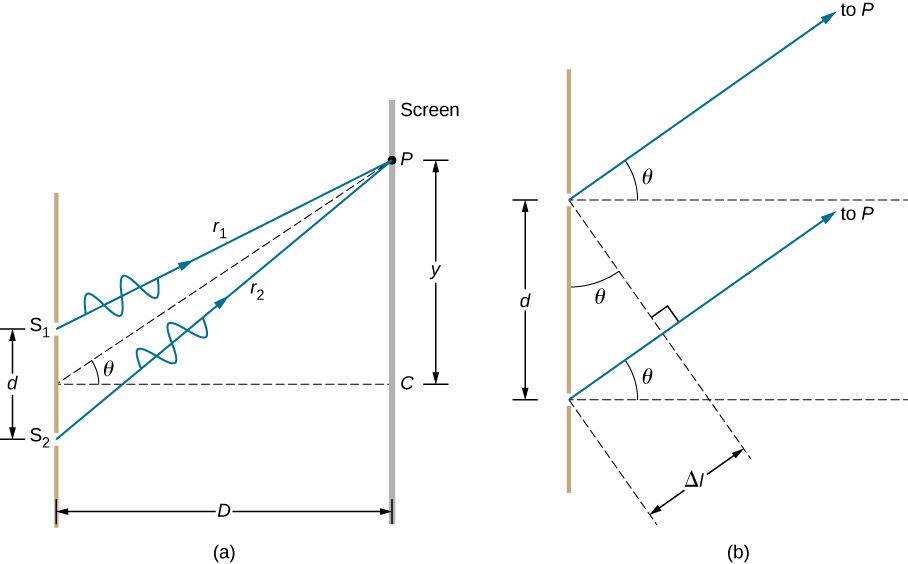
Figure 3.7(a) shows how to determine the path length difference for waves traveling from two slits to a common point on a screen. If the screen is a large distance away compared with the distance between the slits, then the angle between the path and a line from the slits to the screen [part (b)] is nearly the same for each path. In other words, and are essentially parallel. The lengths of and differ by , as indicated by the two dashed lines in the figure. Simple trigonometry shows
where d is the distance between the slits. Combining this result with Equation 3.1, we obtain constructive interference for a double slit when the path length difference is an integral multiple of the wavelength, or
Similarly, to obtain destructive interference for a double slit, the path length difference must be a half-integral multiple of the wavelength, or
where is the wavelength of the light, d is the distance between slits, and is the angle from the original direction of the beam as discussed above. We call m the order of the interference. For example, is fourth-order interference.
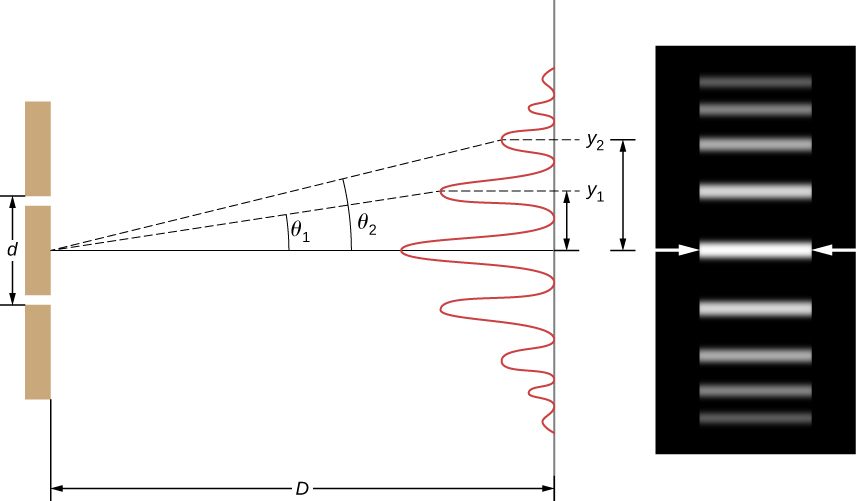
The equations for double-slit interference imply that a series of bright and dark lines are formed. For vertical slits, the light spreads out horizontally on either side of the incident beam into a pattern called interference fringes (Figure 3.8). The closer the slits are, the more the bright fringes spread apart. We can see this by examining the equation
. For fixed and m, the smaller d is, the larger must be, since . This is consistent with our contention that wave effects are most noticeable when the object the wave encounters (here, slits a distance d apart) is small. Small d gives large , hence, a large effect.
Referring back to part (a) of the figure, is typically small enough that , where is the distance from the central maximum to the mth bright fringe and D is the distance between the slit and the screen. Equation 3.4 may then be written as
or
Summary
- In double-slit diffraction, constructive interference occurs when , where d is the distance between the slits, is the angle relative to the incident direction, and m is the order of the interference.
- Destructive interference occurs when .
Conceptual Questions
Suppose you use the same double slit to perform Young’s double-slit experiment in air and then repeat the experiment in water. Do the angles to the same parts of the interference pattern get larger or smaller? Does the color of the light change? Explain.
Why is monochromatic light used in the double slit experiment? What would happen if white light were used?
Monochromatic sources produce fringes at angles according to . With white light, each constituent wavelength will produce fringes at its own set of angles, blending into the fringes of adjacent wavelengths. This results in rainbow patterns.
Problems
At what angle is the first-order maximum for 450-nm wavelength blue light falling on double slits separated by 0.0500 mm?
Calculate the angle for the third-order maximum of 580-nm wavelength yellow light falling on double slits separated by 0.100 mm.
What is the separation between two slits for which 610-nm orange light has its first maximum at an angle of ?
Find the distance between two slits that produces the first minimum for 410-nm violet light at an angle of
Calculate the wavelength of light that has its third minimum at an angle of when falling on double slits separated by . Explicitly show how you follow the steps from the Problem-Solving Strategy: Wave Optics, located at the end of the chapter.
What is the wavelength of light falling on double slits separated by if the third-order maximum is at an angle of ?
At what angle is the second-order maximum for the situation in the preceding problem?
What is the highest-order maximum for 400-nm light falling on double slits separated by ?
62.5; since m must be an integer, the highest order is then .
Find the largest wavelength of light falling on double slits separated by for which there is a first-order maximum. Is this in the visible part of the spectrum?
What is the smallest separation between two slits that will produce a second-order maximum for 720-nm red light?
(a) What is the smallest separation between two slits that will produce a second-order maximum for any visible light? (b) For all visible light?
(a) If the first-order maximum for monochromatic light falling on a double slit is at an angle of , at what angle is the second-order maximum? (b) What is the angle of the first minimum? (c) What is the highest-order maximum possible here?
a. ; b. ; c. 5.76, the highest order is .
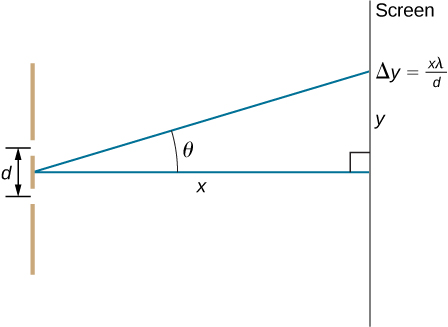
Shown below is a double slit located a distance x from a screen, with the distance from the center of the screen given by y. When the distance d between the slits is relatively large, numerous bright spots appear, called fringes. Show that, for small angles (where , with in radians), the distance between fringes is given by
Using the result of the preceding problem, (a) calculate the distance between fringes for 633-nm light falling on double slits separated by 0.0800 mm, located 3.00 m from a screen. (b) What would be the distance between fringes if the entire apparatus were submersed in water, whose index of refraction is 1.33?
a. 2.37 cm; b. 1.78 cm
Using the result of the problem two problems prior, find the wavelength of light that produces fringes 7.50 mm apart on a screen 2.00 m from double slits separated by 0.120 mm.
In a double-slit experiment, the fifth maximum is 2.8 cm from the central maximum on a screen that is 1.5 m away from the slits. If the slits are 0.15 mm apart, what is the wavelength of the light being used?
560 nm
The source in Young’s experiment emits at two wavelengths. On the viewing screen, the fourth maximum for one wavelength is located at the same spot as the fifth maximum for the other wavelength. What is the ratio of the two wavelengths?
If 500-nm and 650-nm light illuminates two slits that are separated by 0.50 mm, how far apart are the second-order maxima for these two wavelengths on a screen 2.0 m away?
1.2 mm
Red light of wavelength of 700 nm falls on a double slit separated by 400 nm. (a) At what angle is the first-order maximum in the diffraction pattern? (b) What is unreasonable about this result? (c) Which assumptions are unreasonable or inconsistent?
Adapted from University Physics Volume 3 by OpenStax (openstax.org), licensed under CC BY-NC-SA 4.0. Changes were made. License: CC-BY-NC-SA-4.0.