
4.6 Entropy
The second law of thermodynamics is best expressed in terms of a change in the thermodynamic variable known as entropy, which is represented by the symbol S. Entropy, like internal energy, is a state function. This means that when a system makes a transition from one state into another, the change in entropy is independent of path and depends only on the thermodynamic variables of the two states.
We first consider for a system undergoing a reversible process at a constant temperature. In this case, the change in entropy of the system is given by
where Q is the heat exchanged by the system kept at a temperature T (in kelvin). If the system absorbs heat—that is, with —the entropy of the system increases. As an example, suppose a gas is kept at a constant temperature of 300 K while it absorbs 10 J of heat in a reversible process. Then from Equation 4.8, the entropy change of the gas is
Similarly, if the gas loses 5.0 J of heat; that is, , at temperature , we have the entropy change of the system given by
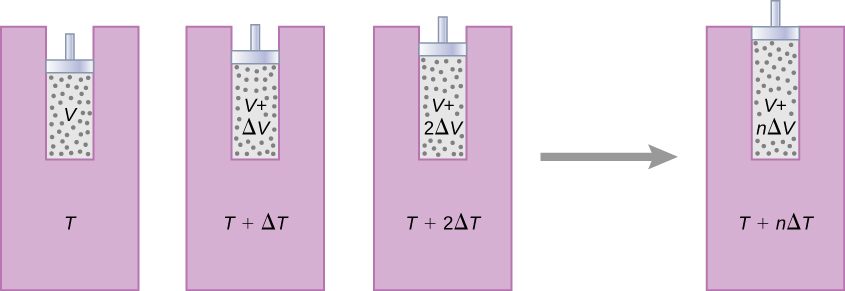
The change in entropy of a system for an arbitrary, reversible transition for which the temperature is not necessarily constant is defined by modifying . Imagine a system making a transition from state A to B in small, discrete steps. The temperatures associated with these states are and respectively. During each step of the transition, the system exchanges heat reversibly at a temperature This can be accomplished experimentally by placing the system in thermal contact with a large number of heat reservoirs of varying temperatures , as illustrated in Figure 4.15. The change in entropy for each step is The net change in entropy of the system for the transition is
We now take the limit as , and the number of steps approaches infinity. Then, replacing the summation by an integral, we obtain
where the integral is taken between the initial state A and the final state B. This equation is valid only if the transition from A to B is reversible.
As an example, let us determine the net entropy change of a reversible engine while it undergoes a single Carnot cycle. In the adiabatic steps 2 and 4 of the cycle shown in Figure 4.11, no heat exchange takes place, so In step 1, the engine absorbs heat at a temperature so its entropy change is Similarly, in step 3, The net entropy change of the engine in one cycle of operation is then
However, we know that for a Carnot engine,
so
There is no net change in the entropy of the Carnot engine over a complete cycle. Although this result was obtained for a particular case, its validity can be shown to be far more general: There is no net change in the entropy of a system undergoing any complete reversible cyclic process. Mathematically, we write this statement as
where represents the integral over a closed reversible path.
We can use Equation 4.11 to show that the entropy change of a system undergoing a reversible process between two given states is path independent. An arbitrary, closed path for a reversible cycle that passes through the states A and B is shown in Figure 4.16. From Equation 4.11, for this closed path. We may split this integral into two segments, one along I, which leads from A to B, the other along II, which leads from B to A. Then
Since the process is reversible,
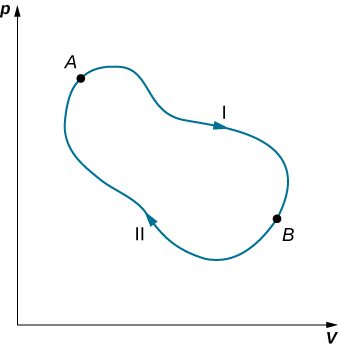
Hence, the entropy change in going from A to B is the same for paths I and II. Since paths I and II are arbitrary, reversible paths, the entropy change in a transition between two equilibrium states is the same for all the reversible processes joining these states. Entropy, like internal energy, is therefore a state function.
What happens if the process is irreversible? When the process is irreversible, we expect the entropy of a closed system, or the system and its environment (the universe), to increase. Therefore we can rewrite this expression as
where S is the total entropy of the closed system or the entire universe, and the equal sign is for a reversible process. The fact is the entropy statement of the second law of thermodynamics:
We can show that this statement is consistent with the Kelvin statement, the Clausius statement, and the Carnot principle.
Summary
- The change in entropy for a reversible process at constant temperature is equal to the heat divided by the temperature. The entropy change of a system under a reversible process is given by .
- A system’s change in entropy between two states is independent of the reversible thermodynamic path taken by the system when it makes a transition between the states.
Conceptual Questions
Does the entropy increase for a Carnot engine for each cycle?
Is it possible for a system to have an entropy change if it neither absorbs nor emits heat during a reversible transition? What happens if the process is irreversible?
Entropy will not change if it is a reversible transition but will change if the process is irreversible.
Problems
Two hundred joules of heat are removed from a heat reservoir at a temperature of 200 K. What is the entropy change of the reservoir?
–1 J/K
In an isothermal reversible expansion at , an ideal gas does 20 J of work. What is the entropy change of the gas?
An ideal gas at 300 K is compressed isothermally to one-fifth its original volume. Determine the entropy change per mole of the gas.
–13 J(K mole)
What is the entropy change of 10 g of steam at when it condenses to water at the same temperature?
A metal rod is used to conduct heat between two reservoirs at temperatures respectively. When an amount of heat Q flows through the rod from the hot to the cold reservoir, what is the net entropy change of the rod, the hot reservoir, the cold reservoir, and the universe?
0 (no net heat remains in or leaves the rod),
For the Carnot cycle of Figure 4.12, what is the entropy change of the hot reservoir, the cold reservoir, and the universe?
A 5.0-kg piece of lead at a temperature of is placed in a lake whose temperature is . Determine the entropy change of (a) the lead piece, (b) the lake, and (c) the universe.
a. –709 J/K; b. 1300 J/K; c. 591 J/K
One mole of an ideal gas doubles its volume in a reversible isothermal expansion. (a) What is the change in entropy of the gas? (b) If 1500 J of heat are added in this process, what is the temperature of the gas?
An ideal monatomic gas is confined to a rigid container. When heat is added reversibly to the gas, its temperature changes from (a) How much heat is added? (b) What is the change in entropy of the gas?
a. ; b.
(a) A 5.0-kg rock at a temperature of is dropped into a shallow lake also at from a height of . What is the resulting change in entropy of the universe? (b) If the temperature of the rock is when it is dropped, what is the change of entropy of the universe? Assume that air friction is negligible (not a good assumption) and that is the specific heat of the rock.
Adapted from University Physics Volume 2 by OpenStax (openstax.org), licensed under CC BY-NC-SA 4.0. Changes were made. License: CC-BY-NC-SA-4.0.