
4.5 The Carnot Cycle
In the early 1820s, Sadi Carnot (1786−1832), a French engineer, became interested in improving the efficiencies of practical heat engines. In 1824, his studies led him to propose a hypothetical working cycle with the highest possible efficiency between the same two reservoirs, known now as the Carnot cycle. An engine operating in this cycle is called a Carnot engine. The Carnot cycle is of special importance for a variety of reasons. At a practical level, this cycle represents a reversible model for the steam power plant and the refrigerator or heat pump. Yet, it is also very important theoretically, for it plays a major role in the development of another important statement of the second law of thermodynamics. Finally, because only two reservoirs are involved in its operation, it can be used along with the second law of thermodynamics to define an absolute temperature scale that is truly independent of any substance used for temperature measurement.
With an ideal gas as the working substance, the steps of the Carnot cycle, as represented by Figure 4.11, are as follows.
- Isothermal expansion. The gas is placed in thermal contact with a heat reservoir at a temperature The gas absorbs heat from the heat reservoir and is allowed to expand isothermally, doing work Because the internal energy of an ideal gas is a function of the temperature only, the change of the internal energy is zero, that is, during this isothermal expansion. With the first law of thermodynamics, we find that the heat absorbed by the gas is
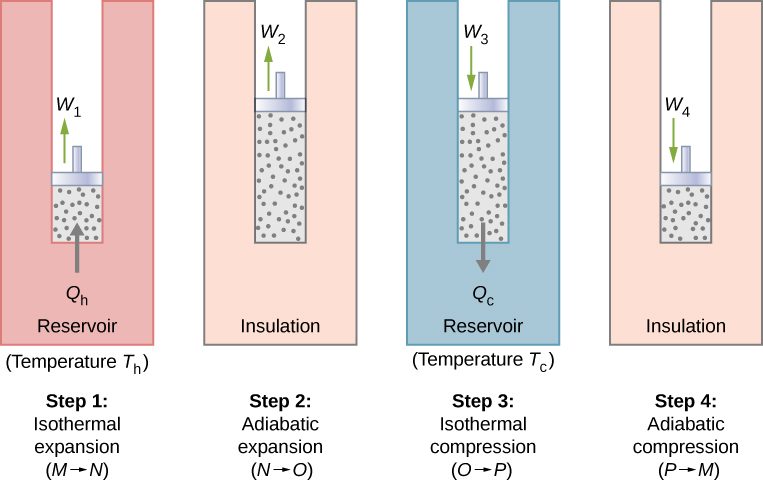
Figure 4.11 The four processes of the Carnot cycle. The working substance is assumed to be an ideal gas whose thermodynamic path MNOP is represented in Figure 4.12. 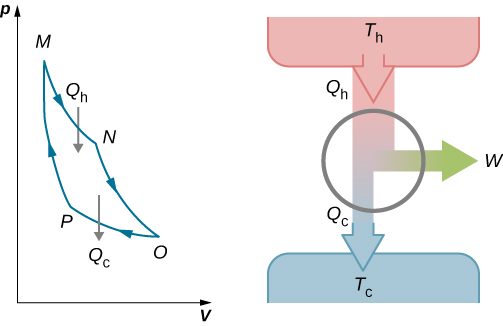
Figure 4.12 The total work done by the gas in the Carnot cycle is shown and given by the area enclosed by the loop MNOPM. - Adiabatic expansion. The gas is thermally isolated and allowed to expand further, doing work Because this expansion is adiabatic, the temperature of the gas falls—in this case, from From and the equation of state for an ideal gas, , we have so that
- Isothermal compression. The gas is placed in thermal contact with a cold reservoir at temperature and compressed isothermally. During this process, work is done on the gas and it gives up heat to the cold reservoir. The reasoning used in step 1 now yields where is the heat dumped to the cold reservoir by the gas.
- Adiabatic compression. The gas is thermally isolated and returned to its initial state by compression. In this process, work is done on the gas. Because the compression is adiabatic, the temperature of the gas rises—from in this particular case. The reasoning of step 2 now gives The total work done by the gas in the Carnot cycle is given by
This work is equal to the area enclosed by the loop shown in the pV diagram of Figure 4.12. Because the initial and final states of the system are the same, the change of the internal energy of the gas in the cycle must be zero, that is, . The first law of thermodynamics then gives
and
To find the efficiency of this engine, we first divide
When the adiabatic constant from step 2 is divided by that of step 4, we find
Substituting this into the equation for we obtain
Finally, with Equation 4.2, we find that the efficiency of this ideal gas Carnot engine is given by
An engine does not necessarily have to follow a Carnot engine cycle. All engines, however, have the same net effect, namely the absorption of heat from a hot reservoir, the production of work, and the discarding of heat to a cold reservoir. This leads us to ask: Do all reversible cycles operating between the same two reservoirs have the same efficiency? The answer to this question comes from the second law of thermodynamics discussed earlier: All reversible engine cycles produce exactly the same efficiency. Also, as you might expect, all real engines operating between two reservoirs are less efficient than reversible engines operating between the same two reservoirs. This too is a consequence of the second law of thermodynamics shown earlier.
The cycle of an ideal gas Carnot refrigerator is represented by the pV diagram of Figure 4.13. It is a Carnot engine operating in reverse. The refrigerator extracts heat from a cold-temperature reservoir at when the ideal gas expands isothermally. The gas is then compressed adiabatically until its temperature reaches after which an isothermal compression of the gas results in heat being discarded to a high-temperature reservoir at Finally, the cycle is completed by an adiabatic expansion of the gas, causing its temperature to drop to
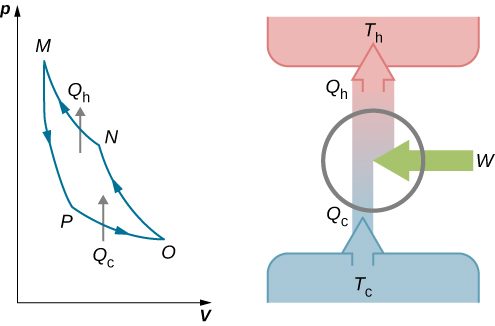
The work done on the ideal gas is equal to the area enclosed by the path of the pV diagram. From the first law, this work is given by
An analysis just like the analysis done for the Carnot engine gives
When combined with Equation 4.3, this yields
for the coefficient of performance of the ideal-gas Carnot refrigerator. Similarly, we can work out the coefficient of performance for a Carnot heat pump as
We have just found equations representing the efficiency of a Carnot engine and the coefficient of performance of a Carnot refrigerator or a Carnot heat pump, assuming an ideal gas for the working substance in both devices. However, these equations are more general than their derivations imply. We will soon show that they are both valid no matter what the working substance is.
Carnot summarized his study of the Carnot engine and Carnot cycle into what is now known as Carnot’s principle:
This principle can be viewed as another statement of the second law of thermodynamics and can be shown to be equivalent to the Kelvin statement and the Clausius statement.
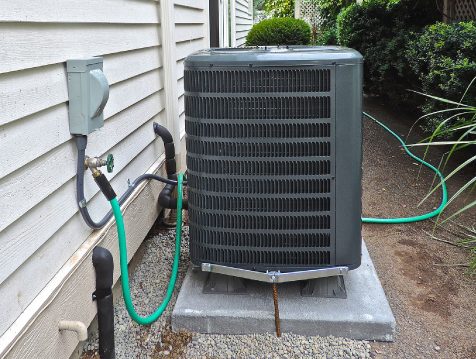
In terms of energy costs, the heat pump is a very economical means for heating buildings (Figure 4.14). Contrast this method with turning electrical energy directly into heat with resistive heating elements. In this case, one unit of electrical energy furnishes at most only one unit of heat. Unfortunately, heat pumps have problems that do limit their usefulness. They are quite expensive to purchase compared to resistive heating elements, and, as the performance coefficient for a Carnot heat pump shows, they become less effective as the outside temperature decreases. In fact, below about , the heat they furnish is less than the energy used to operate them.
Summary
- The Carnot cycle is the most efficient engine for a reversible cycle designed between two reservoirs.
- The Carnot principle is another way of stating the second law of thermodynamics.
Conceptual Questions
To increase the efficiency of a Carnot engine, should the temperature of the hot reservoir be raised or lowered? What about the cold reservoir?
In order to increase the efficiency, the temperature of the hot reservoir should be raised, and the cold reservoir should be lowered as much as possible. This can be seen in Equation 4.3.
How could you design a Carnot engine with efficiency?
What type of processes occur in a Carnot cycle?
adiabatic and isothermal processes
Problems
The temperature of the cold and hot reservoirs between which a Carnot heat pump operates are and , respectively. Which is its coefficient of performance?
1.58
Suppose a Carnot refrigerator operates between Calculate the amount of work required to extract 1.0 J of heat from the cold reservoir if (a) , ; (b) , (c) , ; and (d) , .
A Carnot engine operates between reservoirs at 600 and 300 K. If the engine absorbs 100 J per cycle at the hot reservoir, what is its work output per cycle?
50 J
A 500-W motor operates a Carnot refrigerator between and . (a) What is the amount of heat per second extracted from the inside of the refrigerator? (b) How much heat is exhausted to the outside air per second?
Sketch a Carnot cycle on a temperature-volume diagram.
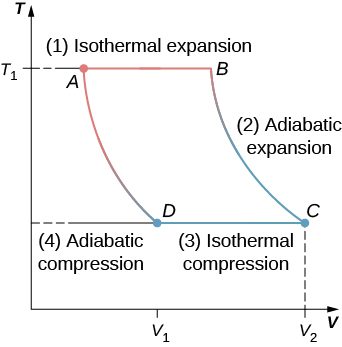
A Carnot heat pump operates between and . How much heat is exhausted into the interior of a house for every 1.0 J of work done by the pump?
An engine operating between heat reservoirs at and extracts 1000 J per cycle from the hot reservoir. (a) What is the maximum possible work that engine can do per cycle? (b) For this maximum work, how much heat is exhausted to the cold reservoir per cycle?
a. 381 J; b. 619 J
Suppose a Carnot engine can be operated between two reservoirs as either a heat engine or a refrigerator. How is the coefficient of performance of the refrigerator related to the efficiency of the heat engine?
A Carnot engine is used to measure the temperature of a heat reservoir. The engine operates between the heat reservoir and a reservoir consisting of water at its triple point. (a) If 400 J per cycle are removed from the heat reservoir while 200 J per cycle are deposited in the triple-point reservoir, what is the temperature of the heat reservoir? (b) If 400 J per cycle are removed from the triple-point reservoir while 200 J per cycle are deposited in the heat reservoir, what is the temperature of the heat reservoir?
a. 546 K; b. 137 K
What is the minimum work required of a refrigerator if it is to extract 50 J per cycle from the inside of a freezer at and exhaust heat to the air at ?
Adapted from University Physics Volume 2 by OpenStax (openstax.org), licensed under CC BY-NC-SA 4.0. Changes were made. License: CC-BY-NC-SA-4.0.