
13.3 Gravitational Potential Energy and Total Energy
We studied gravitational potential energy in Potential Energy and Conservation of Energy, where the value of g remained constant. We now develop an expression that works over distances such that g is not constant. This is necessary to correctly calculate the energy needed to place satellites in orbit or to send them on missions in space.
Gravitational Potential Energy beyond Earth
We defined work and potential energy in Work and Kinetic Energy and Potential Energy and Conservation of Energy. The usefulness of those definitions is the ease with which we can solve many problems using conservation of energy. Potential energy is particularly useful for forces that change with position, as the gravitational force does over large distances. In Potential Energy and Conservation of Energy, we showed that the change in gravitational potential energy near Earth’s surface is . This works very well if g does not change significantly between and . We return to the definition of work and potential energy to derive an expression that is correct over larger distances.
Recall that work (W) is the integral of the dot product between force and distance. Essentially, it is the product of the component of a force along a displacement times that displacement. We define as the negative of the work done by the force we associate with the potential energy. For clarity, we derive an expression for moving a mass m from distance from the center of Earth to distance . However, the result can easily be generalized to any two objects changing their separation from one value to another.
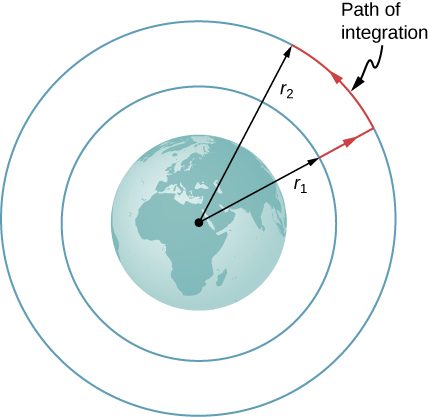
Consider Figure 13.12, in which we take m from a distance from Earth’s center to a distance that is from the center. Gravity is a conservative force (its magnitude and direction are functions of location only), so we can take any path we wish, and the result for the calculation of work is the same. We take the path shown, as it greatly simplifies the integration. We first move radially outward from distance to distance , and then move along the arc of a circle until we reach the final position. During the radial portion, is opposite to the direction we travel along , so Along the arc, is perpendicular to , so . No work is done as we move along the arc. Using the expression for the gravitational force and noting the values for along the two segments of our path, we have
Since , we can adopt a simple expression for :
Note two important items with this definition. First, . The potential energy is zero when the two masses are infinitely far apart. Only the difference in U is important, so the choice of is merely one of convenience. (Recall that in earlier gravity problems, you were free to take at the top or bottom of a building, or anywhere.) Second, note that U becomes increasingly more negative as the masses get closer. That is consistent with what you learned about potential energy in Potential Energy and Conservation of Energy. As the two masses are separated, positive work must be done against the force of gravity, and hence, U increases (becomes less negative). All masses naturally fall together under the influence of gravity, falling from a higher to a lower potential energy.
Conservation of Energy
In Potential Energy and Conservation of Energy, we described how to apply conservation of energy for systems with conservative forces. We were able to solve many problems, particularly those involving gravity, more simply using conservation of energy. Those principles and problem-solving strategies apply equally well here. The only change is to place the new expression for potential energy into the conservation of energy equation, .
Note that we use M, rather than , as a reminder that we are not restricted to problems involving Earth. However, we still assume that . (For problems in which this is not true, we need to include the kinetic energy of both masses and use conservation of momentum to relate the velocities to each other. But the principle remains the same.)
Escape velocity
Escape velocity is often defined to be the minimum initial velocity of an object that is required to escape the surface of a planet (or any large body like a moon) and never return. As usual, we assume no energy lost to an atmosphere, should there be any.
Consider the case where an object is launched from the surface of a planet with an initial velocity directed away from the planet. With the minimum velocity needed to escape, the object would just come to rest infinitely far away, that is, the object gives up the last of its kinetic energy just as it reaches infinity, where the force of gravity becomes zero. Since , this means the total energy is zero. Thus, we find the escape velocity from the surface of an astronomical body of mass M and radius R by setting the total energy equal to zero. At the surface of the body, the object is located at and it has escape velocity . It reaches with velocity . Substituting into Equation 13.5, we have
Solving for the escape velocity,
Notice that m has canceled out of the equation. The escape velocity is the same for all objects, regardless of mass. Also, we are not restricted to the surface of the planet; R can be any starting point beyond the surface of the planet.
Energy and gravitationally bound objects
As stated previously, escape velocity can be defined as the initial velocity of an object that can escape the surface of a moon or planet. More generally, it is the speed at any position such that the total energy is zero. If the total energy is zero or greater, the object escapes. If the total energy is negative, the object cannot escape. Let’s see why that is the case.
As noted earlier, we see that . If the total energy is zero, then as m reaches a value of r that approaches infinity, U becomes zero and so must the kinetic energy. Hence, m comes to rest infinitely far away from M. It has “just escaped” M. If the total energy is positive, then kinetic energy remains at and certainly m does not return. When the total energy is zero or greater, then we say that m is not gravitationally bound to M.
On the other hand, if the total energy is negative, then the kinetic energy must reach zero at some finite value of r, where U is negative and equal to the total energy. The object can never exceed this finite distance from M, since to do so would require the kinetic energy to become negative, which is not possible. We say m is gravitationally bound to M.
We have simplified this discussion by assuming that the object was headed directly away from the planet. What is remarkable is that the result applies for any velocity. Energy is a scalar quantity and hence Equation 13.5 is a scalar equation—the direction of the velocity plays no role in conservation of energy. It is possible to have a gravitationally bound system where the masses do not “fall together,” but maintain an orbital motion about each other.
We have one important final observation. Earlier we stated that if the total energy is zero or greater, the object escapes. Strictly speaking, Equation 13.5 and Equation 13.6 apply for point objects. They apply to finite-sized, spherically symmetric objects as well, provided that the value for r in Equation 13.5 is always greater than the sum of the radii of the two objects. If r becomes less than this sum, then the objects collide. (Even for greater values of r, but near the sum of the radii, gravitational tidal forces could create significant effects if both objects are planet sized. We examine tidal effects in Tidal Forces.) Neither positive nor negative total energy precludes finite-sized masses from colliding. For real objects, direction is important.
Summary
- The acceleration due to gravity changes as we move away from Earth, and the expression for gravitational potential energy must reflect this change.
- The total energy of a system is the sum of kinetic and gravitational potential energy, and this total energy is conserved in orbital motion.
- Objects must have a minimum velocity, the escape velocity, to leave a planet and not return.
- Objects with total energy less than zero are bound; those with zero or greater are unbounded.
Conceptual Questions
It was stated that a satellite with negative total energy is in a bound orbit, whereas one with zero or positive total energy is in an unbounded orbit. Why is this true? What choice for gravitational potential energy was made such that this is true?
It was shown that the energy required to lift a satellite into a low Earth orbit (the change in potential energy) is only a small fraction of the kinetic energy needed to keep it in orbit. Is this true for larger orbits? Is there a trend to the ratio of kinetic energy to change in potential energy as the size of the orbit increases?
As we move to larger orbits, the change in potential energy increases, whereas the orbital velocity decreases. Hence, the ratio is highest near Earth’s surface (technically infinite if we orbit at Earth’s surface with no elevation change), moving to zero as we reach infinitely far away.
Problems
Find the escape speed of a projectile from the surface of Mars.
5000 m/s
Find the escape speed of a projectile from the surface of Jupiter.
What is the escape speed of a satellite located at the Moon’s orbit about Earth? Assume the Moon is not nearby.
1440 m/s
(a) Evaluate the gravitational potential energy between two 5.00-kg spherical steel balls separated by a center-to-center distance of 15.0 cm. (b) Assuming that they are both initially at rest relative to each other in deep space, use conservation of energy to find how fast will they be traveling upon impact. Each sphere has a radius of 5.10 cm.
An average-sized asteroid located from Earth with mass is detected headed directly toward Earth with speed of 2.0 km/s. What will its speed be just before it hits our atmosphere? (You may ignore the size of the asteroid.)
11 km/s
(a) What will be the kinetic energy of the asteroid in the previous problem just before it hits Earth? b) Compare this energy to the output of the largest fission bomb, 2100 TJ. What impact would this have on Earth?
(a) What is the change in energy of a 1000-kg payload taken from rest at the surface of Earth and placed at rest on the surface of the Moon? (b) What would be the answer if the payload were taken from the Moon’s surface to Earth? Is this a reasonable calculation of the energy needed to move a payload back and forth?
a. ; b. ; No. It assumes the kinetic energy is recoverable. This would not even be reasonable if we had an elevator between Earth and the Moon.
Adapted from University Physics Volume 1 by OpenStax (openstax.org), licensed under CC BY-NC-SA 4.0. Changes were made. License: CC-BY-NC-SA-4.0.