
7.1 Work
In physics, work is done on an object when energy is transferred to the object. In other words, work is done when a force acts on something that undergoes a displacement from one position to another. Forces can vary as a function of position, and displacements can be along various paths between two points. We first define the increment of work dW done by a force acting through an infinitesimal displacement as the dot product of these two vectors:
Then, we can add up the contributions for infinitesimal displacements, along a path between two positions, to get the total work.
The vectors involved in the definition of the work done by a force acting on a particle are illustrated in Figure 7.2. While in general, Equation 7.2 requires mathematics beyond the scope of this text, in many simple situations this integral becomes a familiar integral in one variable. We will examine several such examples and restrict our discussion to these cases.
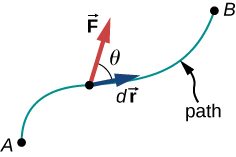
We choose to express the dot product in terms of the magnitudes of the vectors and the cosine of the angle between them, because the meaning of the dot product for work can be put into words more directly in terms of magnitudes and angles. We could equally well have expressed the dot product in terms of the various components introduced in Vectors. In two dimensions, these were the x- and y-components in Cartesian coordinates, or the r- and -components in polar coordinates; in three dimensions, it was just x-, y-, and z-components. Which choice is more convenient depends on the situation. In words, you can express Equation 7.1 for the work done by a force acting over a displacement as a product of one component acting parallel to the other component. From the properties of vectors, it doesn’t matter if you take the component of the force parallel to the displacement or the component of the displacement parallel to the force—you get the same result either way.
Recall that the magnitude of a force times the cosine of the angle the force makes with a given direction is the component of the force in the given direction. The components of a vector can be positive, negative, or zero, depending on whether the angle between the vector and the component-direction is between and or and , or is equal to . As a result, the work done by a force can be positive, negative, or zero, depending on whether the force is generally in the direction of the displacement, generally opposite to the displacement, or perpendicular to the displacement. The maximum work is done by a given force when it is along the direction of the displacement (), and zero work is done when the force is perpendicular to the displacement ().
The units of work are units of force multiplied by units of length, which in the SI system is newtons times meters, This combination is called a joule, for historical reasons that we will mention later, and is abbreviated as J. In the English system, still used in the United States, the unit of force is the pound (lb) and the unit of distance is the foot (ft), so the unit of work is the foot-pound
Work Done by Constant Forces and Contact Forces
The simplest work to evaluate is that done by a force that is constant in magnitude and direction. In this case, we can factor out the force; the remaining integral is just the total displacement, which only depends on the end points A and B, but not on the path between them:
Figure 7.3(a) shows a person exerting a constant force along the handle of a lawn mower, which makes an angle with the horizontal. The horizontal displacement of the lawn mower, over which the force acts, is The work done on the lawn mower is, which the figure also illustrates as the horizontal component of the force times the magnitude of the displacement.
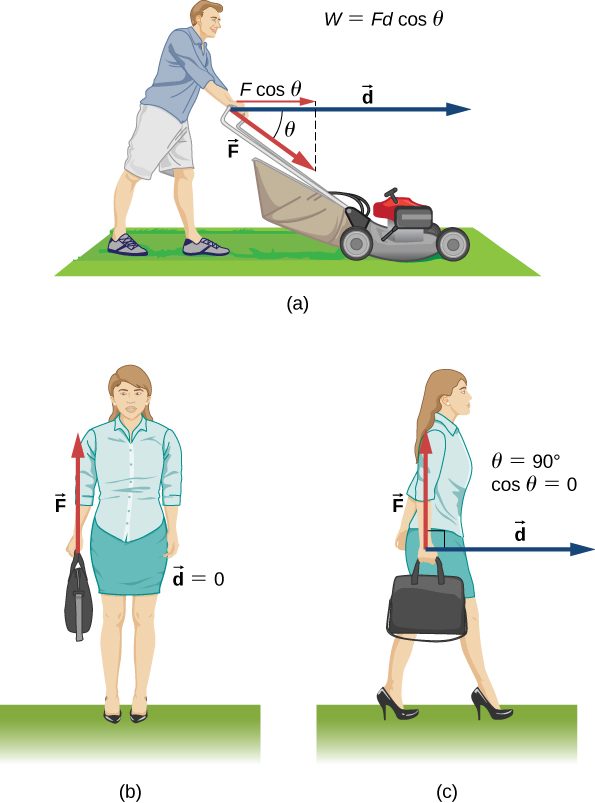
Figure 7.3(b) shows a person holding a briefcase. The person must exert an upward force, equal in magnitude to the weight of the briefcase, but this force does no work, because the displacement over which it acts is zero.
In Figure 7.3(c), where the person in (b) is walking horizontally with constant speed, the work done by the person on the briefcase is still zero, but now because the angle between the force exerted and the displacement is ( perpendicular to ) and .
When you mow the grass, other forces act on the lawn mower besides the force you exert—namely, the contact force of the ground and the gravitational force of Earth. Let’s consider the work done by these forces in general. For an object moving on a surface, the displacement is tangent to the surface. The part of the contact force on the object that is perpendicular to the surface is the normal force Since the cosine of the angle between the normal and the tangent to a surface is zero, we have
The normal force never does work under these circumstances. (Note that if the displacement did have a relative component perpendicular to the surface, the object would either leave the surface or break through it, and there would no longer be any normal contact force. However, if the object is more than a particle, and has an internal structure, the normal contact force can do work on it, for example, by displacing it or deforming its shape. This will be mentioned in the next chapter.)
The part of the contact force on the object that is parallel to the surface is friction, For this object sliding along the surface, kinetic friction is opposite to relative to the surface, so the work done by kinetic friction is negative. If the magnitude of is constant (as it would be if all the other forces on the object were constant), then the work done by friction is
where is the path length on the surface. The force of static friction does no work in the reference frame between two surfaces because there is never displacement between the surfaces. As an external force, static friction can do work. Static friction can keep someone from sliding off a sled when the sled is moving and perform positive work on the person. If you’re driving your car at the speed limit on a straight, level stretch of highway, the negative work done by air resistance is balanced by the positive work done by the static friction of the road on the drive wheels. You can pull the rug out from under an object in such a way that it slides backward relative to the rug, but forward relative to the floor. In this case, kinetic friction exerted by the rug on the object could be in the same direction as the displacement of the object, relative to the floor, and do positive work. The bottom line is that you need to analyze each particular case to determine the work done by the forces, whether positive, negative or zero.
The other force on the lawn mower mentioned above was Earth’s gravitational force, or the weight of the mower. Near the surface of Earth, the gravitational force on an object of mass m has a constant magnitude, mg, and constant direction, vertically down. Therefore, the work done by gravity on an object is the dot product of its weight and its displacement. In many cases, it is convenient to express the dot product for gravitational work in terms of the x-, y-, and z-components of the vectors. A typical coordinate system has the x-axis horizontal and the y-axis vertically up. Then the gravitational force is so the work done by gravity, over any path from A to B, is
The work done by a constant force of gravity on an object depends only on the object’s weight and the difference in height through which the object is displaced. Gravity does negative work on an object that moves upward (), or, in other words, you must do positive work against gravity to lift an object upward. Alternately, gravity does positive work on an object that moves downward (), or you do negative work against gravity to “lift” an object downward, controlling its descent so it doesn’t drop to the ground. (“Lift” is used as opposed to “drop”.)
Work Done by Forces that Vary
In general, forces may vary in magnitude and direction at points in space, and paths between two points may be curved. The infinitesimal work done by a variable force can be expressed in terms of the components of the force and the displacement along the path,
Here, the components of the force are functions of position along the path, and the displacements depend on the equations of the path. (Although we chose to illustrate dW in Cartesian coordinates, other coordinates are better suited to some situations.) Equation 7.2 defines the total work as a line integral, or the limit of a sum of infinitesimal amounts of work. The physical concept of work is straightforward: you calculate the work for tiny displacements and add them up. Sometimes the mathematics can seem complicated, but the following example demonstrates how cleanly they can operate.
One very important and widely applicable variable force is the force exerted by a perfectly elastic spring, which satisfies Hooke’s law where k is the spring constant, and is the displacement from the spring’s unstretched (equilibrium) position (Newton’s Laws of Motion). Note that the unstretched position is only the same as the equilibrium position if no other forces are acting (or, if they are, they cancel one another). Forces between molecules, or in any system undergoing small displacements from a stable equilibrium, behave approximately like a spring force.
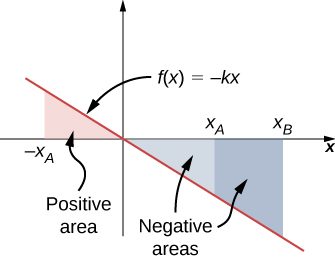
To calculate the work done by a spring force, we can choose the x-axis along the length of the spring, in the direction of increasing length, as in Figure 7.7, with the origin at the equilibrium position (Then positive x corresponds to a stretch and negative x to a compression.) With this choice of coordinates, the spring force has only an x-component,, and the work done when x changes from to is
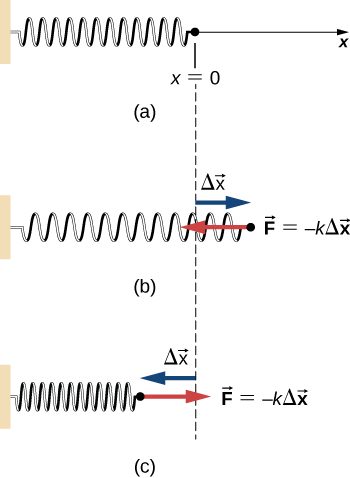
Notice that depends only on the starting and ending points, A and B, and is independent of the actual path between them, as long as it starts at A and ends at B. That is, the actual path could involve going back and forth before ending.
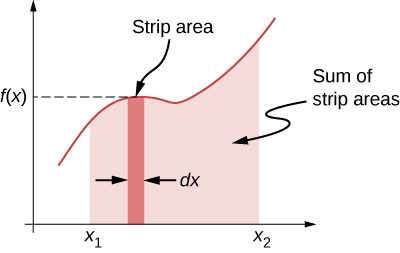
Another interesting thing to notice about Equation 7.5 is that, for this one-dimensional case, you can readily see the correspondence between the work done by a force and the area under the curve of the force versus its displacement. Recall that, in general, a one-dimensional integral is the limit of the sum of infinitesimals,, representing the area of strips, as shown in Figure 7.8. In Equation 7.5, since is a straight line with slope , when plotted versus x, the “area” under the line is just an algebraic combination of triangular “areas,” where “areas” above the x-axis are positive and those below are negative, as shown in Figure 7.9. The magnitude of one of these “areas” is just one-half the triangle’s base, along the x-axis, times the triangle’s height, along the force axis. (There are quotation marks around “area” because this base-height product has the units of work, rather than square meters.)
Summary
- The infinitesimal increment of work done by a force, acting over an infinitesimal displacement, is the dot product of the force and the displacement.
- The work done by a force, acting over a finite path, is the integral of the infinitesimal increments of work done along the path.
- The work done against a force is the negative of the work done by the force.
- The work done by a normal or frictional contact force must be determined in each particular case.
- The work done by the force of gravity, on an object near the surface of Earth, depends only on the weight of the object and the difference in height through which it moved.
- The work done by a spring force, acting from an initial position to a final position, depends only on the spring constant and the squares of those positions.
Conceptual Questions
Give an example of something we think of as work in everyday circumstances that is not work in the scientific sense. Is energy transferred or changed in form in your example? If so, explain how this is accomplished without doing work.
When you push on the wall, this “feels” like work; however, there is no displacement so there is no physical work. Energy is consumed, but no energy is transferred.
Give an example of a situation in which there is a force and a displacement, but the force does no work. Explain why it does no work.
Describe a situation in which a force is exerted for a long time but does no work. Explain.
If you continue to push on a wall without breaking through the wall, you continue to exert a force with no displacement, so no work is done.
A body moves in a circle at constant speed. Does the centripetal force that accelerates the body do any work? Explain.
Suppose you throw a ball upward and catch it when it returns at the same height. How much work does the gravitational force do on the ball over its entire trip?
The total displacement of the ball is zero, so no work is done.
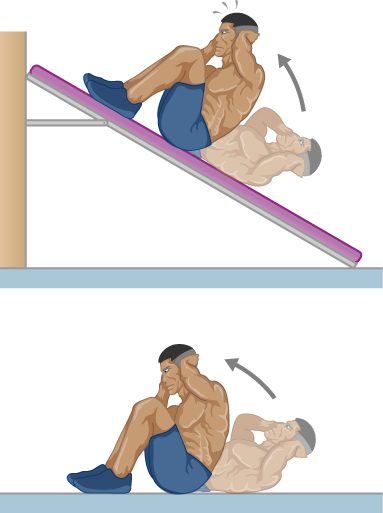
Why is it more difficult to do sit-ups while on a slant board than on a horizontal surface? (See below.)
As a young man, Tarzan climbed up a vine to reach his tree house. As he got older, he decided to build and use a staircase instead. Since the work of the gravitational force mg is path independent, what did the King of the Apes gain in using stairs?
Both require the same gravitational work, but the stairs allow Tarzan to take this work over a longer time interval and hence gradually exert his energy, rather than dramatically by climbing a vine.
Problems
How much work does a supermarket checkout attendant do on a can of soup he pushes 0.600 m horizontally with a force of 5.00 N?
3.00 J
A 75.0-kg person climbs stairs, gaining 2.50 m in height. Find the work done to accomplish this task.
(a) Calculate the work done on a 1500-kg elevator car by its cable to lift it 40.0 m at constant speed, assuming friction averages 100 N. (b) What is the work done on the elevator car by the gravitational force in this process? (c) What is the total work done on the elevator car?
a. 592 kJ; b. –588 kJ; c. 0 J
Suppose a car travels 108 km at a speed of 30.0 m/s, and uses 2.0 gal of gasoline. Only 30% of the gasoline goes into useful work by the force that keeps the car moving at constant speed despite friction. (The energy content of gasoline is about 140 MJ/gal.) (a) What is the magnitude of the force exerted to keep the car moving at constant speed? (b) If the required force is directly proportional to speed, how many gallons will be used to drive 108 km at a speed of 28.0 m/s?
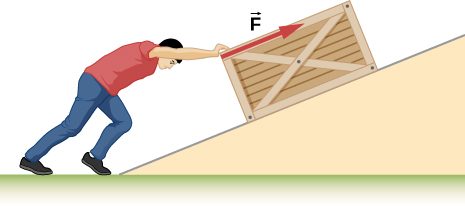
An 85.0-kg man who pushes a crate 4.00 m up along a ramp that makes an angle of with the horizontal (see below). He exerts a force of 500 N on the crate parallel to the ramp and moves at a constant speed. Find the total work done on the crate and the man.
3.14 kJ
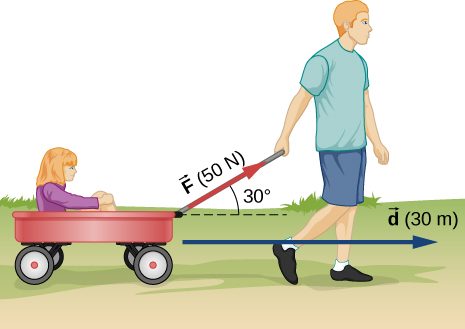
How much work is done by the boy pulling his sister 30.0 m in a wagon as shown below?
A shopper pushes a grocery cart 20.0 m at constant speed on level ground, against a 35.0 N frictional force. He pushes in a direction below the horizontal. (a) What is the work done on the cart by friction? (b) What is the work done on the cart by the gravitational force? (c) What is the work done on the cart by the shopper? (d) Find the force the shopper exerts, using energy considerations. (e) What is the total work done on the cart?
a. –700 J; b. 0 J; c. 700 J; d. 38.6 N; e. 0 J
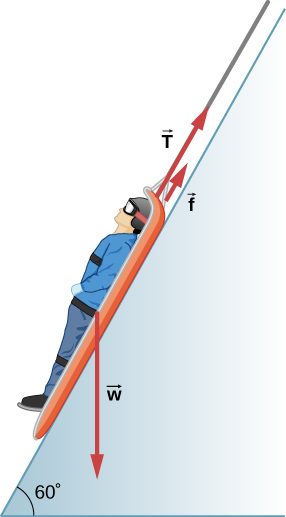
Suppose the ski patrol lowers a rescue sled and victim, having a total mass of 90.0 kg, down a slope at constant speed, as shown below. The coefficient of friction between the sled and the snow is 0.100. (a) How much work is done by friction as the sled moves 30.0 m along the hill? (b) How much work is done by the rope on the sled in this distance? (c) What is the work done by the gravitational force on the sled? (d) What is the total work done?
A constant 20-N force pushes a small ball in the direction of the force over a distance of 5.0 m. What is the work done by the force?
100 J
A toy cart is pulled a distance of 6.0 m in a straight line across the floor. The force pulling the cart has a magnitude of 20 N and is directed at above the horizontal. What is the work done by this force?
A 5.0-kg box rests on a horizontal surface. The coefficient of kinetic friction between the box and surface is A horizontal force pulls the box at constant velocity for 10 cm. Find the work done by (a) the applied horizontal force, (b) the frictional force, and (c) the net force.
a. 2.45 J; b. – 2.45 J; c. 0 J
A sled plus passenger with total mass 50 kg is pulled 20 m across the snow at constant velocity by a force directed above the horizontal. Calculate (a) the work of the applied force, (b) the work of friction, and (c) the total work.
Suppose that the sled plus passenger of the preceding problem is pushed 20 m across the snow at constant velocity by a force directed below the horizontal. Calculate (a) the work of the applied force, (b) the work of friction, and (c) the total work.
a. 2.22 kJ; b. −2.22 kJ; c. 0 J
How much work does the force do on a particle as it moves from to
How much work is done against the gravitational force on a 5.0-kg briefcase when it is carried from the ground floor to the roof of the Empire State Building, a vertical climb of 380 m?
18.6 kJ
It takes 500 J of work to compress a spring 10 cm. What is the force constant of the spring?
A bungee cord is essentially a very long rubber band that can stretch up to four times its unstretched length. However, its spring constant varies over its stretch [see Menz, P.G. “The Physics of Bungee Jumping.” The Physics Teacher (November 1993) 31: 483-487]. Take the length of the cord to be along the x-direction and define the stretch x as the length of the cord l minus its un-stretched length that is, (see below). Suppose a particular bungee cord has a spring constant, for , of and for , of (Recall that the spring constant is the slope of the force F(x) versus its stretch x.) (a) What is the tension in the cord when the stretch is 16.7 m (the maximum desired for a given jump)? (b) How much work must be done against the elastic force of the bungee cord to stretch it 16.7 m?
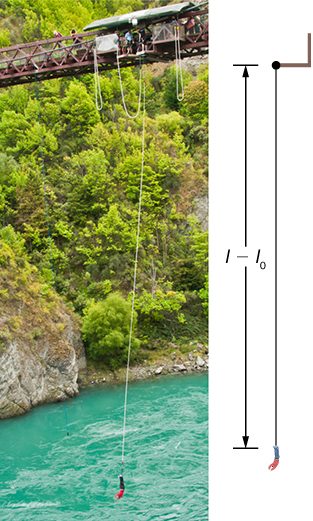
a. 2.32 kN; b. 22.0 kJ
A bungee cord exerts a nonlinear elastic force of magnitude where x is the distance the cord is stretched, and How much work must be done on the cord to stretch it 16.7 m?
Engineers desire to model the magnitude of the elastic force of a bungee cord using the equation
,
where x is the stretch of the cord along its length and a is a constant. If it takes 22.0 kJ of work to stretch the cord by 16.7 m, determine the value of the constant a.
835 N
A particle moving in the xy-plane is subject to a force
where x and y are in meters. Calculate the work done on the particle by this force, as it moves in a straight line from the point (3 m, 4 m) to the point (6 m, 8 m).
A particle moves along a curved path from to subject to a tangential force of variable magnitude How much work does the force do? (Hint: Consult a table of integrals or use a numerical integration program.)
257 J
Adapted from University Physics Volume 1 by OpenStax (openstax.org), licensed under CC BY-NC-SA 4.0. Changes were made. License: CC-BY-NC-SA-4.0.