Precalculus with Integrated CalculusXYZ Homework Edition

⇩ Download ▾

12.3 The Inverse Circular Functions

In this section we concern ourselves with finding inverses of the circular (trigonometric) functions.1 Our immediate problem is that, owing to their periodic nature, none of the six circular functions is one-to-one. To remedy this, we restrict the domains of the circular functions in the same way we restricted the domain of the quadratic function in Example 5.6.3 in Section 5.6 to obtain a one-to-one function.

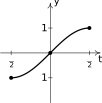
We start with f ( t ) = sin ( t ) and restrict our domain to [ π 2 , π 2 ] in order to keep the range as [ 1 , 1 ] as well as the properties of being smooth and continuous.

Figure: Restricting the domain of to .
Figure 12.10 Restricting the domain of f ( t ) = sin ( t ) to [ π 2 , π 2 ] .

Recall from Section 5.6 that the inverse of a function f is typically denoted f 1 . For this reason, some textbooks use the notation f 1 ( t ) = sin 1 ( t ) for the inverse of f ( t ) = sin ( t ) . The obvious pitfall here is our convention of writing ( sin ( t ) ) 2 as sin 2 ( t ) , ( sin ( t ) ) 3 as sin 3 ( t ) and so on. It is far too easy to confuse sin 1 ( t ) with 1 sin ( t ) = csc ( t ) so we will not use this notation in our text.2

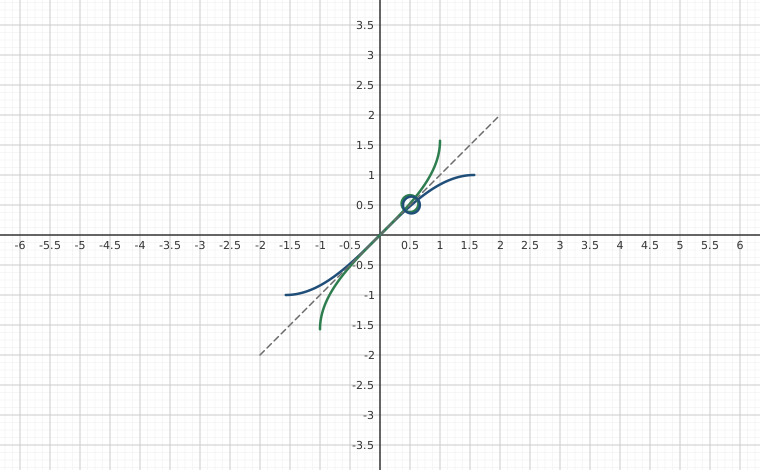
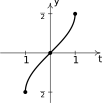
Instead, we use the notation f 1 ( t ) = arcsin ( t ) , read `arc-sine of t '. We'll explain the `arc' in `arcsine' shortly. For now, we graph f ( t ) = sin ( t ) and f 1 ( t ) = arcsin ( t ) , where we obtain the latter from the former by reflecting it across the line y = t , in accordance with Theorem 5.13.

Figure: , .
Figure 12.11 f ( t ) = sin ( t ) , π 2 t π 2 .

  switch  t  and  y  coordinates reflect across  y = t

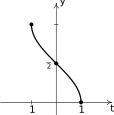
Figure: .
Figure 12.12 f 1 ( t ) = arcsin ( t ) .

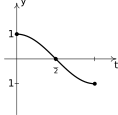
Next, we consider g ( t ) = cos ( t ) . Here, we select the interval [ 0 , π ] for our restriction.

Figure: Restricting the domain of to .
Figure 12.13 Restricting the domain of f ( t ) = cos ( t ) to [ 0 , π ] .

Reflecting the across the line y = t produces the graph y = g 1 ( t ) = arccos ( t ) .

Figure: ,
Figure 12.14 f ( t ) = cos ( t ) , 0 t π

  switch  t  and  y  coordinates reflect across  y = t

Figure: .
Figure 12.15 f 1 ( t ) = arccos ( t ) .

We list some important facts about the arcsine and arccosine functions in the following theorem.3 Everything in Theorem 12.14 is a direct consequence of Theorem 5.13 as applied to the (restricted) sine and cosine functions, and as such, its proof is left to the reader.

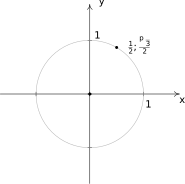
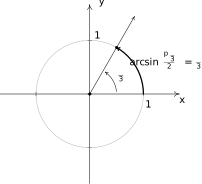
Before moving to an example, we take a moment to understand the `arc' in `arcsine.' Consider the figure below which illustrates the specific case of arcsin ( 3 2 ) .

By definition, the real number t = arcsin ( 3 2 ) satisfies sin ( t ) = 3 2 with π 2 t π 2 . In other words, we are looking for angle measuring t radians between π 2 and π 2 with a sine of 3 2 . Hence, arcsin ( 3 2 ) = π 3 .

In terms of oriented arcs4, if we start at ( 1 , 0 ) and travel along the Unit Circle in the positive (counterclockwise) direction for π 3 units, we will arrive at the point whose y -coordinate is 3 2 . Hence, the real number π 3 also corresponds to `arc' corresponding to the `sine' that is 3 2 .

Coordinate-plane figure.
Figure 12.16
Coordinate-plane figure.
Figure 12.17

y -value on Unit Circle is 3 2 .

corresponding oriented arc: t = π 3

In general, the function f ( t ) = sin ( t ) takes a real number input t , associates it with the angle θ = t radians, and returns the value sin ( θ ) . The value sin ( θ ) = sin ( t ) is the y -coordinate of the terminal point on the Unit Circle of an oriented arc of length | t | whose initial point is ( 1 , 0 ) .

Hence, we may view the inputs to f ( t ) = sin ( t ) as oriented arcs and the outputs as y -coordinates on the Unit Circle. Therefore, the function f 1 reverses this process and takes y -coordinates on the Unit Circle and return oriented arcs, hence the `arc' in arcsine.

It is high time for an example.

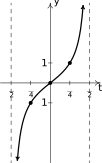
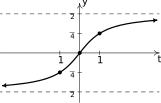
The next pair of functions we wish to discuss are the inverses of tangent and cotangent. First, we restrict f ( t ) = tan ( t ) to its fundamental cycle on ( π 2 , π 2 ) to obtain the arctangent function, f 1 ( t ) = arctan ( t ) . Among other things, note that the vertical asymptotes t = π 2 and t = π 2 of the graph of f ( t ) = tan ( t ) become the horizontal asymptotes y = π 2 and y = π 2 of the graph of f 1 ( t ) = arctan ( t ) .

Figure: , .
Figure 12.18 f ( t ) = tan ( t ) , π 2 < t < π 2 .

  switch  t  and  y  coordinates reflect across  y = t

Figure: .
Figure 12.19 f 1 ( t ) = arctan ( t ) .

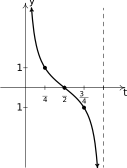
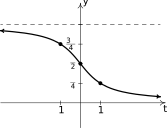
Next, we restrict g ( t ) = cot ( t ) to its fundamental cycle on ( 0 , π ) to obtain g 1 ( t ) = arccot ( t ) , the arccotangent function. Once again, the vertical asymptotes t = 0 and t = π of the graph of g ( t ) = cot ( t ) become the horizontal asymptotes y = 0 and y = π of the graph of g 1 ( t ) = arccot ( t ) .

Figure: , .
Figure 12.20 g ( t ) = cot ( t ) , 0 < t < π .

  switch  t  and  y  coordinates reflect across  y = t

Figure: .
Figure 12.21 g 1 ( t ) = arccot ( t ) .

Below we summarize the important properties of the arctangent and arccotangent functions.

The properties listed in Theorem 12.15 are consequences of the definitions of the arctangent and arccotangent functions along with Theorem 5.13, and its proof is left to the reader.

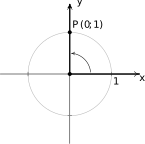
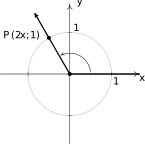
The reader may well wonder if there isn't a more direct way to handle Example 12.3.2 number. Indeed, we can take some inspiration from Section 11.4 and imagine an angle θ measuring t radians so that cot ( θ ) = cot ( t ) = 2 x where 0 < θ < π .

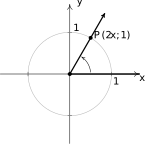
Thinking of cot ( θ ) as a ratio of coordinates on a circle, we may rewrite cot ( θ ) = 2 x = 2 x 1 and we would like to identify a point P ( 2 x , 1 ) on the terminal side of θ .

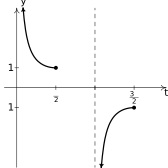
We need to be careful here. Since cot ( θ ) = 2 x , x = 1 2 cot ( θ ) , so as θ ranges between 0 and π , x can take on positive, negative or 0 values. We need to argue that the point P ( 2 x , 1 ) lies in the quadrant we expect (as depicted below) in all cases before we delve too far into our analysis.

Coordinate-plane figure.
Figure 12.23
Coordinate-plane figure.
Figure 12.24
Coordinate-plane figure.
Figure 12.25

0 < θ < π 2 , x > 0 .

θ = π 2 , x = 0 .

π 2 < θ < π , x < 0 .

If 0 < θ < π 2 , then cot ( θ ) > 0 . Hence, x > 0 so the point P ( 2 x , 1 ) is in Quadrant I, as required. If θ = π 2 , then x = 0 , and our point P ( 2 x , 1 ) = ( 0 , 1 ) , as required. If π 2 < θ < π , then cot ( θ ) < 0 . Hence, x < 0 , so P ( 2 x , 1 ) is in Quadrant II, as required.

Hence, in all three cases, our formula for the point P ( 2 x , 1 ) determines a point in the same quadrant as the terminal side of θ , as illustrated above.

This allows us to use Theorem 11.9 from Section 11.4. We find r = ( 2 x ) 2 + 1 2 = 4 x 2 + 1 , and hence, cos ( θ ) = 2 x 4 x 2 + 1 , which agrees with our answer from Example 12.3.2.

It shouldn't surprise the reader that there are some cases where the approach outlined above doesn't go as smoothly (as we'll see in the discussion following Example 12.3.3.)

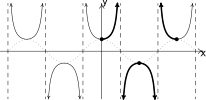
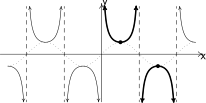
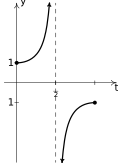
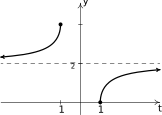
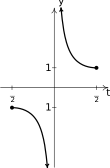
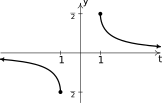
The last two functions to invert are secant and cosecant. A portion of each of their graphs, which were first discussed in Subsection 11.5.1, are given below with the fundamental cycles highlighted.

Figure: The graph of .
Figure 12.26 The graph of y = sec ( x ) .
Figure: The graph of .
Figure 12.27 The graph of y = csc ( x ) .

It is clear from the graph of secant that we cannot find one single continuous piece of its graph which covers its entire range of ( , 1 ] [ 1 , ) and restricts the domain of the function so that it is one-to-one. The same is true for cosecant.

Thus in order to define the arcsecant and arccosecant functions, we must settle for a piecewise approach wherein we choose one piece to cover the top of the range, namely [ 1 , ) , and another piece to cover the bottom, namely ( , 1 ] .

There are two generally accepted ways make these choices which restrict the domains of these functions so that they are one-to-one. One approach simplifies the Trigonometry associated with the inverse functions, but complicates the Calculus; the other makes the Calculus easier, but the Trigonometry less so.

For completeness, we present both points of view, each in its own subsection.

Inverses of Secant and Cosecant: Trigonometry Friendly Approach

In this subsection, we restrict the secant and cosecant functions to coincide with the restrictions on cosine and sine, respectively. For f ( t ) = sec ( t ) , we restrict the domain to [ 0 , π 2 ) ( π 2 , π ]

Figure: on
Figure 12.28 f ( t ) = sec ( t ) on [ 0 , π 2 ) ( π 2 , π ]

  switch  t  and  y  coordinates reflect across  y = t

Coordinate-plane figure.
Figure 12.29 f 1 ( t ) = arcsec ( t )

and we restrict g ( t ) = csc ( t ) to [ π 2 , 0 ) ( 0 , π 2 ] .

Figure: on
Figure 12.30 g ( t ) = csc ( t ) on [ π 2 , 0 ) ( 0 , π 2 ]

  switch  t  and  y  coordinates reflect across  y = t

Coordinate-plane figure.
Figure 12.31 g 1 ( t ) = arccsc ( t )

Note that for both arcsecant and arccosecant, the domain is ( , 1 ] [ 1 , ) . Taking a page from Section A.7, we can rewrite this as { x | | x | 1 } . (This is often done in Calculus textbooks, so we include it here for completeness.)

Using these definitions along with Theorem 5.13, we get the following properties of the arcsecant and arccosecant functions.

The reason the ranges here are called `Trigonometry Friendly' is specifically because of two properties listed in Theorem 12.16: arcsec ( x ) = arccos ( 1 x ) and arccsc ( x ) = arcsin ( 1 x ) .

These formulas essentially allow us to always convert arcsecants and arccosecants back to arccosines and arcsines, respectively. We see this play out in our next example.

As promised in the discussion following Example 12.3.2, in which we used the methods from Section 11.4 to circumvent some onerous identity work, we take some time here to revisit number to see what issues arise when we take a Section 11.4 approach here.

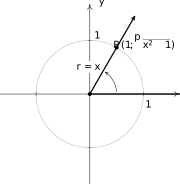
As above, we start rewriting f ( x ) = tan ( arcsec ( x ) ) by letting t = arcsec ( x ) so that sec ( t ) = x where 0 t < π 2 or π 2 < t π . We let θ = t radians and wish to view sec ( θ ) = sec ( t ) = x as described in Theorem 11.9: the ratio of the radius of a circle, r centered at the origin, divided by the abscissa8 of a point on the terminal side of θ which intersects said circle.

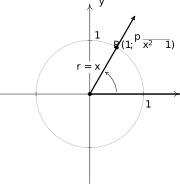
If we make the usual identification sec ( θ ) = x = x 1 , we see that if 0 θ < π 2 , then x = sec θ 1 , so it makes sense to identify the quantity x as the radius of the circle with 1 as the abscissa of the point where the terminal side of θ intersects said circle. To find the associated ordinate ( y -coordinate), we have 1 2 + y 2 = x 2 so y = x 2 1 , where we have chosen the positive root since we are in Quadrant I. We sketch out this scenario below on the left.

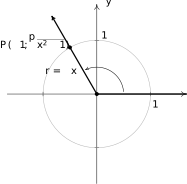
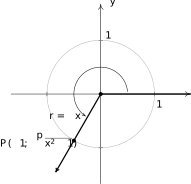
If, however, π 2 < t π , then x = sec ( t ) 1 , so we need to rewrite sec ( θ ) = x = x 1 = x 1 in order to keep the radius of the circle, r = x > 0 and the abscissa, 1 < 0 . From ( 1 ) 2 + y 2 = ( x ) 2 , we still get y = x 2 1 , as shown below on the right.

Coordinate-plane figure.
Figure 12.32
Coordinate-plane figure.
Figure 12.33

0 < θ < π 2 , x 1 , r = x .

π 2 < θ < π , x 1 , r = x .

In the Quadrant I case, when x 1 , we get tan ( θ ) = x 2 1 1 = x 2 1 . In Quadrant II, when x 1 , we obtain tan ( θ ) = x 2 1 1 = x 2 1 . Hence, we get the piecewise definition for f ( x ) as we did in number above: f ( x ) = tan ( arcsec ( x ) ) = x 2 1 if x 1 and f ( x ) = tan ( arcsec ( x ) ) = x 2 1 if x 1 .

The moral of the story here is that you are free to choose whichever route you like to simplify expressions like those found in Example 12.3.3 number. Whether you choose identities or a more geometric route, just be careful to keep in mind which quadrants are in play, which variables represent which quantities, and what signs ( ± ) each should have.

Inverses of Secant and Cosecant: Calculus Friendly Approach

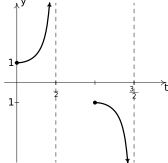
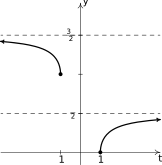
In this subsection, we restrict f ( t ) = sec ( t ) to [ 0 , π 2 ) [ π , 3 π 2 ) and g ( t ) = csc ( t ) to ( 0 , π 2 ] ( π , 3 π 2 ] . Using these restrictions we get the graphs and properties below.

Figure: on
Figure 12.34 f ( t ) = sec ( t ) on [ 0 , π 2 ) [ π , 3 π 2 )

  switch  t  and  y  coordinates reflect across  y = t

Coordinate-plane figure.
Figure 12.35 f 1 ( t ) = arcsec ( t )
Figure: on
Figure 12.36 g ( t ) = csc ( t ) on ( 0 , π 2 ] ( π , 3 π 2 ]

  switch  x  and  y  coordinates reflect across  y = t

Coordinate-plane figure.
Figure 12.37 g 1 ( t ) = arccsc ( t )

While it is difficult to explain why the choices here for the ranges for the arcsecant an arccosecant are, indeed, `Calculus Friendly,' we can demonstrate how they are slightly less `Trigonometry Friendly.' Note the equivalences arcsec ( x ) = arccos ( 1 x ) and arccsc ( x ) = arcsin ( 1 x ) hold for x 1 only, and not for all x in the domain. We will need to remember this as we work through the problems in the next example.

Speaking of which, our next example is a duplicate of Example 12.3.3. The interested reader is invited to see what differences are to be had as a consequence of the change in ranges.

For completeness, we embark here on a discussion of how the techniques from Section 11.4, in particular Theorem 11.9 can be used to circumvent some of the identity work in number above.11

As above, we start rewriting f ( x ) = tan ( arcsec ( x ) ) by letting t = arcsec ( x ) so that sec ( t ) = x where 0 t < π 2 or π t < 3 π 2 . We let θ = t radians and wish to view sec ( θ ) = sec ( t ) = x as described in Theorem 11.9: the ratio of the radius of a circle, r centered at the origin, divided by the abscissa12 of a point on the terminal side of θ which intersects said circle.

If we make the usual identification sec ( θ ) = x = x 1 , we see that if 0 θ < π 2 , then x = sec θ 1 , so it makes sense to identify the quantity x as the radius of the circle with 1 as the abscissa of the point where the terminal side of θ intersects said circle. To find the associated ordinate ( y -coordinate), we have 1 2 + y 2 = x 2 so y = x 2 1 , where we have chosen the positive root since we are in Quadrant I. We sketch out this scenario below on the left.

If, however, π t < 3 π 2 , then x = sec ( t ) 1 , so we need to rewrite sec ( θ ) = x = x 1 = x 1 in order to keep the radius of the circle, r = x > 0 and the abscissa, 1 < 0 . From ( 1 ) 2 + y 2 = ( x ) 2 , we get y = x 2 1 , in this case choosing the negative root since we are in Quadrant III.

Coordinate-plane figure.
Figure 12.38
Coordinate-plane figure.
Figure 12.39

0 < θ < π 2 , x 1 , r = x .

π < θ < 3 π 2 , x 1 , r = x .

In the Quadrant I case, when x 1 , we get tan ( θ ) = x 2 1 1 = x 2 1 . In Quadrant III, when x 1 , we obtain tan ( θ ) = x 2 1 1 = x 2 1 . Hence, in both cases, we obtain the same answer as we did in number above: f ( x ) = tan ( arcsec ( x ) ) = x 2 1 for x in ( , 1 ] [ 1 , ) .

Calculators and the Inverse Circular Functions.

In the sections to come, we will have need to approximate the values of the inverse circular functions. On most calculators, only the arcsine, arccosine and arctangent functions are available and they are usually labeled as sin 1 , cos 1 and tan 1 , respectively. If we are asked to approximate these values, it is a simple matter to punch up the appropriate decimal on the calculator.

If we are asked for an arccotangent, arcsecant or arccosecant, however, we often need to employ some ingenuity, as our next example illustrates.

Solving Equations Using the Inverse Trigonometric Functions.

In Sections 11.2 and 11.4, we learned how to solve equations like sin ( θ ) = 1 2 and tan ( t ) = 1 . In each case, we ultimately appealed to the Unit Circle and relied on the fact that the answers corresponded to a set of `common angles' listed on page the related section.

If, on the other hand, we had been asked to find all angles with sin ( θ ) = 1 3 or solve tan ( t ) = 2 for real numbers t , we would have been hard-pressed to do so. With the introduction of the inverse trigonometric functions, however, we are now in a position to solve these equations.

A good parallel to keep in mind is how the square root function can be used to solve certain quadratic equations. The equation x 2 = 4 is a lot like sin ( θ ) = 1 2 in that it has friendly, `common value' answers x = ± 2 . The equation x 2 = 7 , on the other hand, is a lot like sin ( θ ) = 1 3 . We know there are answers, but we can't express them using `friendly' numbers.

To solve x 2 = 7 , we make use of the square root function (which is an inverse to f ( x ) = x 2 on a restricted domain) and write our answer as x = ± 7 . We need the ± to adjust for the fact that 7 is defined to be positive only, but we know we have two solutions, one positive and one negative. Using a calculator, we can certainly approximate the values ± 7 , but as far as exact answers go, we leave them as x = ± 7 .

In the same way, we will use the arcsine function (the inverse to the sine function on a restricted domain) to solve sin ( θ ) = 1 3 . However, we will need to adjust for the fact that there is more than one answer to this equation (infinitely many, in fact!) As it turns out, we will be able to express every solution in terms of arcsin ( 1 3 ) , as our next example illustrates.

We close this section with one last sinusoid example.

Exercises

In Exercises -, find the exact value.

  1. arcsin ( 1 )
  2. arcsin ( 3 2 )
  3. arcsin ( 2 2 )
  4. arcsin ( 1 2 )
  5. arcsin ( 0 )
  6. arcsin ( 1 2 )
  7. arcsin ( 2 2 )
  8. arcsin ( 3 2 )
  9. arcsin ( 1 )
  10. arccos ( 1 )
  11. arccos ( 3 2 )
  12. arccos ( 2 2 )
  13. arccos ( 1 2 )
  14. arccos ( 0 )
  15. arccos ( 1 2 )
  16. arccos ( 2 2 )
  17. arccos ( 3 2 )
  18. arccos ( 1 )
  19. arctan ( 3 )
  20. arctan ( 1 )
  21. arctan ( 3 3 )
  22. arctan ( 0 )
  23. arctan ( 3 3 )
  24. arctan ( 1 )
  25. arctan ( 3 )
  26. arccot ( 3 )
  27. arccot ( 1 )
  28. arccot ( 3 3 )
  29. arccot ( 0 )
  30. arccot ( 3 3 )
  31. arccot ( 1 )
  32. arccot ( 3 )
  33. arcsec ( 2 )
  34. arccsc ( 2 )
  35. arcsec ( 2 )
  36. arccsc ( 2 )
  37. arcsec ( 2 3 3 )
  38. arccsc ( 2 3 3 )
  39. arcsec ( 1 )
  40. arccsc ( 1 )

In Exercises -, assume that the range of arcsecant is [ 0 , π 2 ) ( π 2 , π ] and that the range of arccosecant is [ π 2 , 0 ) ( 0 , π 2 ] when finding the exact value. (See Section 12.3.1.)

  1. arcsec ( 2 )
  2. arcsec ( 2 )
  3. arcsec ( 2 3 3 )
  4. arcsec ( 1 )
  5. arccsc ( 2 )
  6. arccsc ( 2 )
  7. arccsc ( 2 3 3 )
  8. arccsc ( 1 )

In Exercises -, assume that the range of arcsecant is [ 0 , π 2 ) [ π , 3 π 2 ) and that the range of arccosecant is ( 0 , π 2 ] ( π , 3 π 2 ] when finding the exact value. (See Section 12.3.2.)

  1. arcsec ( 2 )
  2. arcsec ( 2 )
  3. arcsec ( 2 3 3 )
  4. arcsec ( 1 )
  5. arccsc ( 2 )
  6. arccsc ( 2 )
  7. arccsc ( 2 3 3 )
  8. arccsc ( 1 )

In Exercises -, find the exact value or state that it is undefined.

  1. sin ( arcsin ( 1 2 ) )
  2. sin ( arcsin ( 2 2 ) )
  3. sin ( arcsin ( 3 5 ) )
  4. sin ( arcsin ( 0.42 ) )
  5. sin ( arcsin ( 5 4 ) )
  6. cos ( arccos ( 2 2 ) )
  7. cos ( arccos ( 1 2 ) )
  8. cos ( arccos ( 5 13 ) )
  9. cos ( arccos ( 0.998 ) )
  10. cos ( arccos ( π ) )
  11. tan ( arctan ( 1 ) )
  12. tan ( arctan ( 3 ) )
  13. tan ( arctan ( 5 12 ) )
  14. tan ( arctan ( 0.965 ) )
  15. tan ( arctan ( 3 π ) )
  16. cot ( arccot ( 1 ) )
  17. cot ( arccot ( 3 ) )
  18. cot ( arccot ( 7 24 ) )
  19. cot ( arccot ( 0.001 ) )
  20. cot ( arccot ( 17 π 4 ) )
  21. sec ( arcsec ( 2 ) )
  22. sec ( arcsec ( 1 ) )
  23. sec ( arcsec ( 1 2 ) )
  24. sec ( arcsec ( 0.75 ) )
  25. sec ( arcsec ( 117 π ) )
  26. csc ( arccsc ( 2 ) )
  27. csc ( arccsc ( 2 3 3 ) )
  28. csc ( arccsc ( 2 2 ) )
  29. csc ( arccsc ( 1.0001 ) )
  30. csc ( arccsc ( π 4 ) )

In Exercises -, find the exact value or state that it is undefined.

  1. arcsin ( sin ( π 6 ) )
  2. arcsin ( sin ( π 3 ) )
  3. arcsin ( sin ( 3 π 4 ) )
  4. arcsin ( sin ( 11 π 6 ) )
  5. arcsin ( sin ( 4 π 3 ) )
  6. arccos ( cos ( π 4 ) )
  7. arccos ( cos ( 2 π 3 ) )
  8. arccos ( cos ( 3 π 2 ) )
  9. arccos ( cos ( π 6 ) )
  10. arccos ( cos ( 5 π 4 ) )
  11. arctan ( tan ( π 3 ) )
  12. arctan ( tan ( π 4 ) )
  13. arctan ( tan ( π ) )
  14. arctan ( tan ( π 2 ) )
  15. arctan ( tan ( 2 π 3 ) )
  16. arccot ( cot ( π 3 ) )
  17. arccot ( cot ( π 4 ) )
  18. arccot ( cot ( π ) )
  19. arccot ( cot ( π 2 ) )
  20. arccot ( cot ( 2 π 3 ) )

In Exercises -, assume that the range of arcsecant is [ 0 , π 2 ) ( π 2 , π ] and that the range of arccosecant is [ π 2 , 0 ) ( 0 , π 2 ] when finding the exact value. (See Section 12.3.1.)

  1. arcsec ( sec ( π 4 ) )
  2. arcsec ( sec ( 4 π 3 ) )
  3. arcsec ( sec ( 5 π 6 ) )
  4. arcsec ( sec ( π 2 ) )
  5. arcsec ( sec ( 5 π 3 ) )
  6. arccsc ( csc ( π 6 ) )
  7. arccsc ( csc ( 5 π 4 ) )
  8. arccsc ( csc ( 2 π 3 ) )
  9. arccsc ( csc ( π 2 ) )
  10. arccsc ( csc ( 11 π 6 ) )
  11. arcsec ( sec ( 11 π 12 ) )
  12. arccsc ( csc ( 9 π 8 ) )

In Exercises -, assume that the range of arcsecant is [ 0 , π 2 ) [ π , 3 π 2 ) and that the range of arccosecant is ( 0 , π 2 ] ( π , 3 π 2 ] when finding the exact value. (See Section 12.3.2.)

  1. arcsec ( sec ( π 4 ) )
  2. arcsec ( sec ( 4 π 3 ) )
  3. arcsec ( sec ( 5 π 6 ) )
  4. arcsec ( sec ( π 2 ) )
  5. arcsec ( sec ( 5 π 3 ) )
  6. arccsc ( csc ( π 6 ) )
  7. arccsc ( csc ( 5 π 4 ) )
  8. arccsc ( csc ( 2 π 3 ) )
  9. arccsc ( csc ( π 2 ) )
  10. arccsc ( csc ( 11 π 6 ) )
  11. arcsec ( sec ( 11 π 12 ) )
  12. arccsc ( csc ( 9 π 8 ) )

In Exercises -, find the exact value or state that it is undefined.

  1. sin ( arccos ( 1 2 ) )
  2. sin ( arccos ( 3 5 ) )
  3. sin ( arctan ( 2 ) )
  4. sin ( arccot ( 5 ) )
  5. sin ( arccsc ( 3 ) )
  6. cos ( arcsin ( 5 13 ) )
  7. cos ( arctan ( 7 ) )
  8. cos ( arccot ( 3 ) )
  9. cos ( arcsec ( 5 ) )
  10. tan ( arcsin ( 2 5 5 ) )
  11. tan ( arccos ( 1 2 ) )
  12. tan ( arcsec ( 5 3 ) )
  13. tan ( arccot ( 12 ) )
  14. cot ( arcsin ( 12 13 ) )
  15. cot ( arccos ( 3 2 ) )
  16. cot ( arccsc ( 5 ) )
  17. cot ( arctan ( 0.25 ) )
  18. sec ( arccos ( 3 2 ) )
  19. sec ( arcsin ( 12 13 ) )
  20. sec ( arctan ( 10 ) )
  21. sec ( arccot ( 10 10 ) )
  22. csc ( arccot ( 9 ) )
  23. csc ( arcsin ( 3 5 ) )
  24. csc ( arctan ( 2 3 ) )

In Exercises -, find the exact value or state that it is undefined.

  1. sin ( arcsin ( 5 13 ) + π 4 )
  2. cos ( arcsec ( 3 ) + arctan ( 2 ) )
  3. tan ( arctan ( 3 ) + arccos ( 3 5 ) )
  4. sin ( 2 arcsin ( 4 5 ) )
  5. sin ( 2 arccsc ( 13 5 ) )
  6. sin ( 2 arctan ( 2 ) )
  7. cos ( 2 arcsin ( 3 5 ) )
  8. cos ( 2 arcsec ( 25 7 ) )
  9. cos ( 2 arccot ( 5 ) )
  10. sin ( arctan ( 2 ) 2 )

In Exercises -, rewrite each of the following composite functions as algebraic functions of x and state the domain.

  1. f ( x ) = sin ( arccos ( x ) )
  2. f ( x ) = cos ( arctan ( x ) )
  3. f ( x ) = tan ( arcsin ( x ) )
  4. f ( x ) = sec ( arctan ( x ) )
  5. f ( x ) = csc ( arccos ( x ) )
  6. f ( x ) = sin ( 2 arctan ( x ) )
  7. f ( x ) = sin ( 2 arccos ( x ) )
  8. f ( x ) = cos ( 2 arctan ( x ) )
  9. f ( x ) = sin ( arccos ( 2 x ) )
  10. f ( x ) = sin ( arccos ( x 5 ) )
  11. f ( x ) = cos ( arcsin ( x 2 ) )
  12. f ( x ) = cos ( arctan ( 3 x ) )
  13. f ( x ) = sin ( 2 arcsin ( 7 x ) )
  14. f ( x ) = sin ( 2 arcsin ( x 3 3 ) )
  15. f ( x ) = cos ( 2 arcsin ( 4 x ) )
  16. f ( x ) = sec ( arctan ( 2 x ) ) tan ( arctan ( 2 x ) )
  17. f ( x ) = sin ( arcsin ( x ) + arccos ( x ) )
  18. f ( x ) = cos ( arcsin ( x ) + arctan ( x ) )
  19. f ( x ) = tan ( 2 arcsin ( x ) )
  20. f ( x ) = sin ( 1 2 arctan ( x ) )
  21. If θ = arcsin ( x 2 ) , find an expression for θ + sin ( 2 θ ) in terms of x .
  22. If θ = arctan ( x 7 ) , find an expression for 1 2 θ 1 2 sin ( 2 θ ) in terms of x .
  23. If θ = arcsec ( x 4 ) , find an expression for 4 tan ( θ ) 4 θ in terms of x assuming x 4 .

In Exercises -, solve the equation using the techniques discussed in Example 12.3.6 then approximate the solutions which lie in the interval [ 0 , 2 π ) to four decimal places.

  1. sin ( θ ) = 7 11
  2. cos ( θ ) = 2 9
  3. sin ( θ ) = 0.569
  4. cos ( θ ) = 0.117
  5. sin ( θ ) = 0.008
  6. cos ( θ ) = 359 360
  7. tan ( t ) = 117
  8. cot ( t ) = 12
  9. sec ( t ) = 3 2
  10. csc ( t ) = 90 17
  11. tan ( t ) = 10
  12. sin ( t ) = 3 8
  13. cos ( x ) = 7 16
  14. tan ( x ) = 0.03
  15. sin ( x ) = 0.3502
  16. sin ( x ) = 0.721
  17. cos ( x ) = 0.9824
  18. cos ( x ) = 0.5637
  19. cot ( x ) = 1 117
  20. tan ( x ) = 0.6109

In Exercises -, rewrite the given function as a sinusoid of the form C ( t ) = A cos ( ω t + ϕ ) and S ( t ) = A sin ( ω t + ϕ ) (See Example 12.3.7.) Approximate the value of ϕ (which is in radians, of course) to four decimal places.

  1. f ( t ) = 5 sin ( 3 t ) + 12 cos ( 3 t )
  2. f ( t ) = 3 cos ( 2 t ) + 4 sin ( 2 t )
  3. f ( t ) = cos ( t ) 3 sin ( t )
  4. f ( t ) = 7 sin ( 10 t ) 24 cos ( 10 t )
  5. f ( t ) = cos ( t ) 2 2 sin ( t )
  6. f ( t ) = 2 sin ( t ) cos ( t )

In Exercises -, find the domain of the given function. Write your answers in interval notation.

  1. f ( x ) = arcsin ( 5 x )
  2. f ( x ) = arccos ( 3 x 1 2 )
  3. f ( x ) = arcsin ( 2 x 2 )
  4. f ( x ) = arccos ( 1 x 2 4 )
  5. f ( x ) = arctan ( 4 x )
  6. f ( x ) = arccot ( 2 x x 2 9 )
  7. f ( x ) = arctan ( ln ( 2 x 1 ) )
  8. f ( x ) = arccot ( 2 x 1 )
  9. f ( x ) = arcsec ( 12 x )
  10. f ( x ) = arccsc ( x + 5 )
  11. f ( x ) = arcsec ( x 3 8 )
  12. f ( x ) = arccsc ( e 2 x )
  13. Find the following limits.

    1. lim x 1 arcsin ( x )
    2. lim x arctan ( 3 x )
    3. lim x 1 arcsec ( 2 x )
  14. Find a nonzero number x where arccot ( x ) arctan ( 1 x ) .
  15. Find an example where arcsec ( x ) arccos ( 1 x ) if we use [ 0 , π 2 ) [ π , 3 π 2 ) as the range of f ( x ) = arcsec ( x ) .
  16. Show that arcsin ( x ) + arccos ( x ) = π 2 for 1 x 1 .
  17. Discuss with your classmates why arcsin ( 1 2 ) 30 .
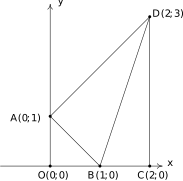
  18. Use the diagram below along with the accompanying questions to show:

    arctan ( 1 ) + arctan ( 2 ) + arctan ( 3 ) = π

    Coordinate-plane figure.
    Figure 12.55
    1. Clearly A O B and B C D are right triangles because the line through O and A and the line through C and D are perpendicular to the x -axis. Use the distance formula to show that B A D is also a right triangle (with B A D being the right angle) by showing that the sides of the triangle satisfy the Pythagorean Theorem.
    2. Use A O B to show that α = arctan ( 1 )
    3. Use B A D to show that β = arctan ( 2 )
    4. Use B C D to show that γ = arctan ( 3 )
    5. Use the fact that O , B and C all lie on the x -axis to conclude that α + β + γ = π . Thus arctan ( 1 ) + arctan ( 2 ) + arctan ( 3 ) = π .

Answers

  1. arcsin ( 1 ) = π 2
  2. arcsin ( 3 2 ) = π 3
  3. arcsin ( 2 2 ) = π 4
  4. arcsin ( 1 2 ) = π 6
  5. arcsin ( 0 ) = 0
  6. arcsin ( 1 2 ) = π 6
  7. arcsin ( 2 2 ) = π 4
  8. arcsin ( 3 2 ) = π 3
  9. arcsin ( 1 ) = π 2
  10. arccos ( 1 ) = π
  11. arccos ( 3 2 ) = 5 π 6
  12. arccos ( 2 2 ) = 3 π 4
  13. arccos ( 1 2 ) = 2 π 3
  14. arccos ( 0 ) = π 2
  15. arccos ( 1 2 ) = π 3
  16. arccos ( 2 2 ) = π 4
  17. arccos ( 3 2 ) = π 6
  18. arccos ( 1 ) = 0
  19. arctan ( 3 ) = π 3
  20. arctan ( 1 ) = π 4
  21. arctan ( 3 3 ) = π 6
  22. arctan ( 0 ) = 0
  23. arctan ( 3 3 ) = π 6
  24. arctan ( 1 ) = π 4
  25. arctan ( 3 ) = π 3
  26. arccot ( 3 ) = 5 π 6
  27. arccot ( 1 ) = 3 π 4
  28. arccot ( 3 3 ) = 2 π 3
  29. arccot ( 0 ) = π 2
  30. arccot ( 3 3 ) = π 3
  31. arccot ( 1 ) = π 4
  32. arccot ( 3 ) = π 6
  33. arcsec ( 2 ) = π 3
  34. arccsc ( 2 ) = π 6
  35. arcsec ( 2 ) = π 4
  36. arccsc ( 2 ) = π 4
  37. arcsec ( 2 3 3 ) = π 6
  38. arccsc ( 2 3 3 ) = π 3
  39. arcsec ( 1 ) = 0
  40. arccsc ( 1 ) = π 2
  41. arcsec ( 2 ) = 2 π 3
  42. arcsec ( 2 ) = 3 π 4
  43. arcsec ( 2 3 3 ) = 5 π 6
  44. arcsec ( 1 ) = π
  45. arccsc ( 2 ) = π 6
  46. arccsc ( 2 ) = π 4
  47. arccsc ( 2 3 3 ) = π 3
  48. arccsc ( 1 ) = π 2
  49. arcsec ( 2 ) = 4 π 3
  50. arcsec ( 2 ) = 5 π 4
  51. arcsec ( 2 3 3 ) = 7 π 6
  52. arcsec ( 1 ) = π
  53. arccsc ( 2 ) = 7 π 6
  54. arccsc ( 2 ) = 5 π 4
  55. arccsc ( 2 3 3 ) = 4 π 3
  56. arccsc ( 1 ) = 3 π 2
  57. sin ( arcsin ( 1 2 ) ) = 1 2
  58. sin ( arcsin ( 2 2 ) ) = 2 2
  59. sin ( arcsin ( 3 5 ) ) = 3 5
  60. sin ( arcsin ( 0.42 ) ) = 0.42
  61. sin ( arcsin ( 5 4 ) ) is undefined.
  62. cos ( arccos ( 2 2 ) ) = 2 2
  63. cos ( arccos ( 1 2 ) ) = 1 2
  64. cos ( arccos ( 5 13 ) ) = 5 13
  65. cos ( arccos ( 0.998 ) ) = 0.998
  66. cos ( arccos ( π ) ) is undefined.
  67. tan ( arctan ( 1 ) ) = 1
  68. tan ( arctan ( 3 ) ) = 3
  69. tan ( arctan ( 5 12 ) ) = 5 12
  70. tan ( arctan ( 0.965 ) ) = 0.965
  71. tan ( arctan ( 3 π ) ) = 3 π
  72. cot ( arccot ( 1 ) ) = 1
  73. cot ( arccot ( 3 ) ) = 3
  74. cot ( arccot ( 7 24 ) ) = 7 24
  75. cot ( arccot ( 0.001 ) ) = 0.001
  76. cot ( arccot ( 17 π 4 ) ) = 17 π 4
  77. sec ( arcsec ( 2 ) ) = 2
  78. sec ( arcsec ( 1 ) ) = 1
  79. sec ( arcsec ( 1 2 ) ) is undefined.
  80. sec ( arcsec ( 0.75 ) ) is undefined.
  81. sec ( arcsec ( 117 π ) ) = 117 π
  82. csc ( arccsc ( 2 ) ) = 2
  83. csc ( arccsc ( 2 3 3 ) ) = 2 3 3
  84. csc ( arccsc ( 2 2 ) ) is undefined.
  85. csc ( arccsc ( 1.0001 ) ) = 1.0001
  86. csc ( arccsc ( π 4 ) ) is undefined.
  87. arcsin ( sin ( π 6 ) ) = π 6
  88. arcsin ( sin ( π 3 ) ) = π 3
  89. arcsin ( sin ( 3 π 4 ) ) = π 4
  90. arcsin ( sin ( 11 π 6 ) ) = π 6
  91. arcsin ( sin ( 4 π 3 ) ) = π 3
  92. arccos ( cos ( π 4 ) ) = π 4
  93. arccos ( cos ( 2 π 3 ) ) = 2 π 3
  94. arccos ( cos ( 3 π 2 ) ) = π 2
  95. arccos ( cos ( π 6 ) ) = π 6
  96. arccos ( cos ( 5 π 4 ) ) = 3 π 4
  97. arctan ( tan ( π 3 ) ) = π 3
  98. arctan ( tan ( π 4 ) ) = π 4
  99. arctan ( tan ( π ) ) = 0
  100. arctan ( tan ( π 2 ) ) is undefined
  101. arctan ( tan ( 2 π 3 ) ) = π 3
  102. arccot ( cot ( π 3 ) ) = π 3
  103. arccot ( cot ( π 4 ) ) = 3 π 4
  104. arccot ( cot ( π ) ) is undefined
  105. arccot ( cot ( 3 π 2 ) ) = π 2
  106. arccot ( cot ( 2 π 3 ) ) = 2 π 3
  107. arcsec ( sec ( π 4 ) ) = π 4
  108. arcsec ( sec ( 4 π 3 ) ) = 2 π 3
  109. arcsec ( sec ( 5 π 6 ) ) = 5 π 6
  110. arcsec ( sec ( π 2 ) ) is undefined.
  111. arcsec ( sec ( 5 π 3 ) ) = π 3
  112. arccsc ( csc ( π 6 ) ) = π 6
  113. arccsc ( csc ( 5 π 4 ) ) = π 4
  114. arccsc ( csc ( 2 π 3 ) ) = π 3
  115. arccsc ( csc ( π 2 ) ) = π 2
  116. arccsc ( csc ( 11 π 6 ) ) = π 6
  117. arcsec ( sec ( 11 π 12 ) ) = 11 π 12
  118. arccsc ( csc ( 9 π 8 ) ) = π 8
  119. arcsec ( sec ( π 4 ) ) = π 4
  120. arcsec ( sec ( 4 π 3 ) ) = 4 π 3
  121. arcsec ( sec ( 5 π 6 ) ) = 7 π 6
  122. arcsec ( sec ( π 2 ) ) is undefined.
  123. arcsec ( sec ( 5 π 3 ) ) = π 3
  124. arccsc ( csc ( π 6 ) ) = π 6
  125. arccsc ( csc ( 5 π 4 ) ) = 5 π 4
  126. arccsc ( csc ( 2 π 3 ) ) = π 3
  127. arccsc ( csc ( π 2 ) ) = 3 π 2
  128. arccsc ( csc ( 11 π 6 ) ) = 7 π 6
  129. arcsec ( sec ( 11 π 12 ) ) = 13 π 12
  130. arccsc ( csc ( 9 π 8 ) ) = 9 π 8
  131. sin ( arccos ( 1 2 ) ) = 3 2
  132. sin ( arccos ( 3 5 ) ) = 4 5
  133. sin ( arctan ( 2 ) ) = 2 5 5
  134. sin ( arccot ( 5 ) ) = 6 6
  135. sin ( arccsc ( 3 ) ) = 1 3
  136. cos ( arcsin ( 5 13 ) ) = 12 13
  137. cos ( arctan ( 7 ) ) = 2 4
  138. cos ( arccot ( 3 ) ) = 3 10 10
  139. cos ( arcsec ( 5 ) ) = 1 5
  140. tan ( arcsin ( 2 5 5 ) ) = 2
  141. tan ( arccos ( 1 2 ) ) = 3
  142. tan ( arcsec ( 5 3 ) ) = 4 3
  143. tan ( arccot ( 12 ) ) = 1 12
  144. cot ( arcsin ( 12 13 ) ) = 5 12
  145. cot ( arccos ( 3 2 ) ) = 3
  146. cot ( arccsc ( 5 ) ) = 2
  147. cot ( arctan ( 0.25 ) ) = 4
  148. sec ( arccos ( 3 2 ) ) = 2 3 3
  149. sec ( arcsin ( 12 13 ) ) = 13 5
  150. sec ( arctan ( 10 ) ) = 101
  151. sec ( arccot ( 10 10 ) ) = 11
  152. csc ( arccot ( 9 ) ) = 82
  153. csc ( arcsin ( 3 5 ) ) = 5 3
  154. csc ( arctan ( 2 3 ) ) = 13 2
  155. sin ( arcsin ( 5 13 ) + π 4 ) = 17 2 26
  156. cos ( arcsec ( 3 ) + arctan ( 2 ) ) = 5 4 10 15
  157. tan ( arctan ( 3 ) + arccos ( 3 5 ) ) = 1 3
  158. sin ( 2 arcsin ( 4 5 ) ) = 24 25
  159. sin ( 2 arccsc ( 13 5 ) ) = 120 169
  160. sin ( 2 arctan ( 2 ) ) = 4 5
  161. cos ( 2 arcsin ( 3 5 ) ) = 7 25
  162. cos ( 2 arcsec ( 25 7 ) ) = 527 625
  163. cos ( 2 arccot ( 5 ) ) = 2 3
  164. sin ( arctan ( 2 ) 2 ) = 5 5 10
  165. f ( x ) = sin ( arccos ( x ) ) = 1 x 2 for 1 x 1
  166. f ( x ) = cos ( arctan ( x ) ) = 1 1 + x 2 for all x
  167. f ( x ) = tan ( arcsin ( x ) ) = x 1 x 2 for 1 < x < 1
  168. f ( x ) = sec ( arctan ( x ) ) = 1 + x 2 for all x
  169. f ( x ) = csc ( arccos ( x ) ) = 1 1 x 2 for 1 < x < 1
  170. f ( x ) = sin ( 2 arctan ( x ) ) = 2 x x 2 + 1 for all x
  171. f ( x ) = sin ( 2 arccos ( x ) ) = 2 x 1 x 2 for 1 x 1
  172. f ( x ) = cos ( 2 arctan ( x ) ) = 1 x 2 1 + x 2 for all x
  173. f ( x ) = sin ( arccos ( 2 x ) ) = 1 4 x 2 for 1 2 x 1 2
  174. f ( x ) = sin ( arccos ( x 5 ) ) = 25 x 2 5 for 5 x 5
  175. f ( x ) = cos ( arcsin ( x 2 ) ) = 4 x 2 2 for 2 x 2
  176. f ( x ) = cos ( arctan ( 3 x ) ) = 1 1 + 9 x 2 for all x
  177. f ( x ) = sin ( 2 arcsin ( 7 x ) ) = 14 x 1 49 x 2 for 1 7 x 1 7
  178. f ( x ) = sin ( 2 arcsin ( x 3 3 ) ) = 2 x 3 x 2 3 for 3 x 3
  179. f ( x ) = cos ( 2 arcsin ( 4 x ) ) = 1 32 x 2 for 1 4 x 1 4
  180. f ( x ) = sec ( arctan ( 2 x ) ) tan ( arctan ( 2 x ) ) = 2 x 1 + 4 x 2 for all x
  181. f ( x ) = sin ( arcsin ( x ) + arccos ( x ) ) = 1 for 1 x 1
  182. f ( x ) = cos ( arcsin ( x ) + arctan ( x ) ) = 1 x 2 x 2 1 + x 2 for 1 x 1
  183. 14 f ( x ) = tan ( 2 arcsin ( x ) ) = 2 x 1 x 2 1 2 x 2 for x in ( 1 , 2 2 ) ( 2 2 , 2 2 ) ( 2 2 , 1 )
  184. f ( x ) = sin ( 1 2 arctan ( x ) ) = { x 2 + 1 1 2 x 2 + 1 for  x 0 x 2 + 1 1 2 x 2 + 1 for  x < 0
  185. θ + sin ( 2 θ ) = arcsin ( x 2 ) + x 4 x 2 2
  186. 1 2 θ 1 2 sin ( 2 θ ) = 1 2 arctan ( x 7 ) 7 x x 2 + 49
  187. 4 tan ( θ ) 4 θ = x 2 16 4 arcsec ( x 4 )
  188. θ = arcsin ( 7 11 ) + 2 π k or θ = π arcsin ( 7 11 ) + 2 π k , in [ 0 , 2 π ) , θ 0.6898 , 2.4518
  189. θ = arccos ( 2 9 ) + 2 π k or θ = arccos ( 2 9 ) + 2 π k , in [ 0 , 2 π ) , θ 1.7949 , 4.4883
  190. θ = π + arcsin ( 0.569 ) + 2 π k or θ = 2 π arcsin ( 0.569 ) + 2 π k , in [ 0 , 2 π ) , θ 3.7469 , 5.6779
  191. θ = arccos ( 0.117 ) + 2 π k or θ = 2 π arccos ( 0.117 ) + 2 π k , in [ 0 , 2 π ) , θ 1.4535 , 4.8297
  192. θ = arcsin ( 0.008 ) + 2 π k or θ = π arcsin ( 0.008 ) + 2 π k , in [ 0 , 2 π ) , θ 0.0080 , 3.1336
  193. θ = arccos ( 359 360 ) + 2 π k or θ = 2 π arccos ( 359 360 ) + 2 π k , in [ 0 , 2 π ) , θ 0.0746 , 6.2086
  194. t = arctan ( 117 ) + π k , in [ 0 , 2 π ) , t 1.56225 , 4.70384
  195. t = arctan ( 1 12 ) + π k , in [ 0 , 2 π ) , t 3.0585 , 6.2000
  196. t = arccos ( 2 3 ) + 2 π k or t = 2 π arccos ( 2 3 ) + 2 π k , in [ 0 , 2 π ) , t 0.8411 , 5.4422
  197. t = π + arcsin ( 17 90 ) + 2 π k or t = 2 π arcsin ( 17 90 ) + 2 π k , in [ 0 , 2 π ) , t 3.3316 , 6.0932
  198. t = arctan ( 10 ) + π k , in [ 0 , 2 π ) , t 1.8771 , 5.0187
  199. t = arcsin ( 3 8 ) + 2 π k or t = π arcsin ( 3 8 ) + 2 π k , in [ 0 , 2 π ) , t 0.3844 , 2.7572
  200. x = arccos ( 7 16 ) + 2 π k or x = arccos ( 7 16 ) + 2 π k , in [ 0 , 2 π ) , x 2.0236 , 4.2596
  201. x = arctan ( 0.03 ) + π k , in [ 0 , 2 π ) , x 0.0300 , 3.1716
  202. x = arcsin ( 0.3502 ) + 2 π k or x = π arcsin ( 0.3502 ) + 2 π k , in [ 0 , 2 π ) , x 0.3578 , 2.784
  203. x = π + arcsin ( 0.721 ) + 2 π k or x = 2 π arcsin ( 0.721 ) + 2 π k , in [ 0 , 2 π ) , x 3.9468 , 5.4780
  204. x = arccos ( 0.9824 ) + 2 π k or x = 2 π arccos ( 0.9824 ) + 2 π k , in [ 0 , 2 π ) , x 0.1879 , 6.0953
  205. x = arccos ( 0.5637 ) + 2 π k or x = arccos ( 0.5637 ) + 2 π k , in [ 0 , 2 π ) , x 2.1697 , 4.1135
  206. x = arctan ( 117 ) + π k , in [ 0 , 2 π ) , x 1.5622 , 4.7038
  207. x = arctan ( 0.6109 ) + π k , in [ 0 , 2 π ) , x 2.5932 , 5.7348
  208. f ( t ) = 5 sin ( 3 t ) + 12 cos ( 3 t ) = 13 sin ( 3 t + arcsin ( 12 13 ) ) 13 sin ( 3 t + 1.1760 )

    f ( t ) = 5 sin ( 3 t ) + 12 cos ( 3 t ) = 13 cos ( 3 t + arcsin ( 5 13 ) ) 13 cos ( 3 t 0.3948 )

  209. f ( t ) = 3 cos ( 2 t ) + 4 sin ( 2 t ) = 5 sin ( 2 t + arcsin ( 3 5 ) ) 5 sin ( 2 t + 0.6435 )

    f ( t ) = 3 cos ( 2 t ) + 4 sin ( 2 t ) = 5 cos ( 2 t + arcsin ( 4 5 ) ) 5 cos ( 2 t 0.9273 )

  210. f ( t ) = cos ( t ) 3 sin ( t ) = 10 sin ( t + arccos ( 3 10 10 ) ) 10 sin ( t + 2.8198 )

    f ( t ) = cos ( t ) 3 sin ( t ) = 10 cos ( t + arcsin ( 3 10 10 ) ) 10 cos ( t + 1.2490 )

  211. f ( t ) = 7 sin ( 10 t ) 24 cos ( 10 t ) = 25 sin ( 10 t + arcsin ( 24 25 ) ) 25 sin ( 10 t 1.2870 )

    f ( t ) = 7 sin ( 10 t ) 24 cos ( 10 t ) = 25 cos ( 10 t + π + arcsin ( 7 25 ) ) 25 cos ( 10 t + 3.4254 )

  212. f ( t ) = cos ( t ) 2 2 sin ( t ) = 3 sin ( t + π + arcsin ( 1 3 ) ) 3 sin ( t + 3.4814 )

    f ( t ) = cos ( t ) 2 2 sin ( t ) = 3 cos ( t + arccos ( 1 3 ) ) 3 cos ( t + 1.9106 )

  213. f ( t ) = 2 sin ( t ) cos ( t ) = 5 sin ( t + arcsin ( 5 5 ) ) 5 sin ( t 0.4636 )

    f ( t ) = 2 sin ( t ) cos ( t ) = 5 cos ( t + π + arcsin ( 2 5 5 ) ) 5 cos ( t + 4.2487 )

  214. [ 1 5 , 1 5 ]
  215. [ 1 3 , 1 ]
  216. [ 2 2 , 2 2 ]
  217. ( , 5 ] [ 3 , 3 ] [ 5 , )
  218. ( , )
  219. ( , 3 ) ( 3 , 3 ) ( 3 , )
  220. ( 1 2 , )
  221. [ 1 2 , )
  222. ( , 1 12 ] [ 1 12 , )
  223. ( , 6 ] [ 4 , )
  224. ( , 2 ] [ 2 , )
  225. [ 0 , )
    1. lim x 1 arcsin ( x ) = π 2
    2. lim x arctan ( 3 x ) =
    3. lim x 1 arcsec ( 2 x ) = π 3

Adapted from Precalculus, Preliminary 4th Edition (integrated calculus), by Carl Stitz and Jeff Zeager (stitz-zeager.com), licensed under CC BY-NC-SA 3.0. Changes were made: reformatted as an accessible XYZ web edition. License: CC-BY-NC-SA-3.0.

These eBooks are a prerelease and are not yet certified conformant with WCAG 2.1 AA or ADA Title II. Every page is built against an automated accessibility gate, and the published editions will meet ADA Title II requirements when they release in late September 2026. If something is unusable, please tell us.