
3.5 Solve Equations Using Integers; The Division Property of Equality
Determine Whether a Number is a Solution of an Equation
In Solve Equations with the Subtraction and Addition Properties of Equality, we saw that a solution of an equation is a value of a variable that makes a true statement when substituted into that equation. In that section, we found solutions that were whole numbers. Now that we’ve worked with integers, we’ll find integer solutions to equations.
The steps we take to determine whether a number is a solution to an equation are the same whether the solution is a whole number or an integer.
Solve Equations with Integers Using the Addition and Subtraction Properties of Equality
In Solve Equations with the Subtraction and Addition Properties of Equality, we solved equations similar to the two shown here using the Subtraction and Addition Properties of Equality. Now we can use them again with integers.
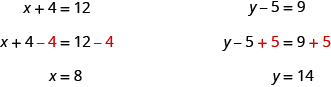
When you add or subtract the same quantity from both sides of an equation, you still have equality.
Model the Division Property of Equality
All of the equations we have solved so far have been of the form or We were able to isolate the variable by adding or subtracting the constant term. Now we’ll see how to solve equations that involve division.
We will model an equation with envelopes and counters in Figure 3.25.
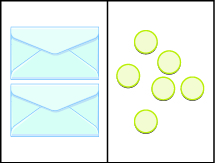
Here, there are two identical envelopes that contain the same number of counters. Remember, the left side of the workspace must equal the right side, but the counters on the left side are “hidden” in the envelopes. So how many counters are in each envelope?
To determine the number, separate the counters on the right side into groups of the same size. So counters divided into groups means there must be counters in each group (since
What equation models the situation shown in Figure 3.26? There are two envelopes, and each contains counters. Together, the two envelopes must contain a total of counters. So the equation that models the situation is
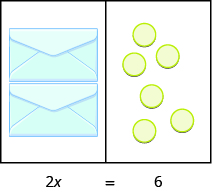
We can divide both sides of the equation by as we did with the envelopes and counters.

We found that each envelope contains Does this check? We know so it works. Three counters in each of two envelopes does equal six.
Figure 3.27 shows another example.
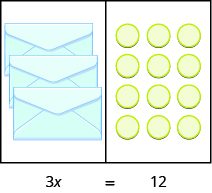
Now we have identical envelopes and How many counters are in each envelope? We have to separate the into Since there must be in each envelope. See Figure 3.28.
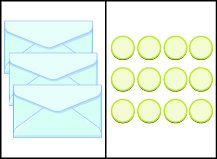
The equation that models the situation is We can divide both sides of the equation by

Does this check? It does because
Solve Equations Using the Division Property of Equality
The previous examples lead to the Division Property of Equality. When you divide both sides of an equation by any nonzero number, you still have equality.
Translate to an Equation and Solve
In the past several examples, we were given an equation containing a variable. In the next few examples, we’ll have to first translate word sentences into equations with variables and then we will solve the equations.
Key Concepts
- How to determine whether a number is a solution to an equation.
- Step 1. Substitute the number for the variable in the equation.
- Step 2. Simplify the expressions on both sides of the equation.
- Step 3. Determine whether the resulting equation is true.
- If it is true, the number is a solution.
- If it is not true, the number is not a solution.
- Properties of Equalities
Subtraction Property of Equality Addition Property of Equality - Division Property of Equality
- For any numbers and
If , then .
- For any numbers and
Section Exercises
Practice Makes Perfect
Determine Whether a Number is a Solution of an Equation
In the following exercises, determine whether each number is a solution of the given equation.
- ⓐ
- ⓑ
- ⓒ
- ⓐ no
- ⓑ no
- ⓒ yes
- ⓐ
- ⓑ
- ⓒ
- ⓐ
- ⓑ
- ⓒ
- ⓐ no
- ⓑ no
- ⓒ yes
- ⓐ
- ⓑ
- ⓒ
Solve Equations Using the Addition and Subtraction Properties of Equality
In the following exercises, solve for the unknown.
n = −7
p = −17
u = −4
h = 6
x = −16
r = −14
Model the Division Property of Equality
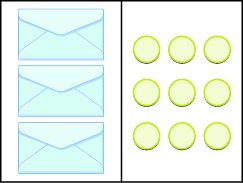
In the following exercises, write the equation modeled by the envelopes and counters and then solve it.
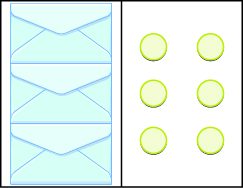
3x = 6; x = 2
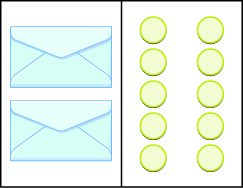
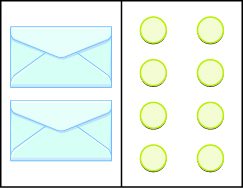
2x = 8; x = 4
Solve Equations Using the Division Property of Equality
In the following exercises, solve each equation using the division property of equality and check the solution.
x = 9
c = −8
p = 3
q = −12
x = 20
z = 0
Translate to an Equation and Solve
In the following exercises, translate and solve.
Four more than is equal to 1.
n + 4 = 1; n = −3
Nine more than is equal to 5.
The sum of eight and is .
8 + p = −3; p = −11
The sum of two and is .
The difference of and three is .
a − 3 = −14; a = −11
The difference of and is .
The number −42 is the product of −7 and .
−42 = −7x; x = 6
The number −54 is the product of −9 and .
The product of -15 and is 75.
−15f = 75; f = −5
The product of −18 and is 36.
−6 plus is equal to 4.
−6 + c = 4; c = 10
−2 plus is equal to 1.
Nine less than is −4.
m − 9 = −4; m = 5
Thirteen less than is .
Mixed Practice
In the following exercises, solve.
- ⓐ
- ⓑ
- ⓐ x = 8
- ⓑ x = 5
- ⓐ
- ⓑ
- ⓐ
- ⓑ
- ⓐ p = −9
- ⓑ p = 30
- ⓐ
- ⓑ
a = 20
m = 7
u = −52
r = −9
d = 5
x = −42
Everyday Math
Cookie packaging A package of has equal rows of cookies. Find the number of cookies in each row, by solving the equation
17 cookies
Kindergarten class Connie’s kindergarten class has She wants them to get into equal groups. Find the number of children in each group, by solving the equation
Writing Exercises
Is modeling the Division Property of Equality with envelopes and counters helpful to understanding how to solve the equation Explain why or why not.
Sample answer: It is helpful because it shows how the counters can be divided among the envelopes.
Suppose you are using envelopes and counters to model solving the equations and Explain how you would solve each equation.
Frida started to solve the equation by adding to both sides. Explain why Frida’s method will not solve the equation.
Sample answer: The operation used in the equation is multiplication. The inverse of multiplication is division, not addition.
Raoul started to solve the equation by subtracting from both sides. Explain why Raoul’s method will not solve the equation.
Self Check
ⓐ After completing the exercises, use this checklist to evaluate your mastery of the objectives of this section.
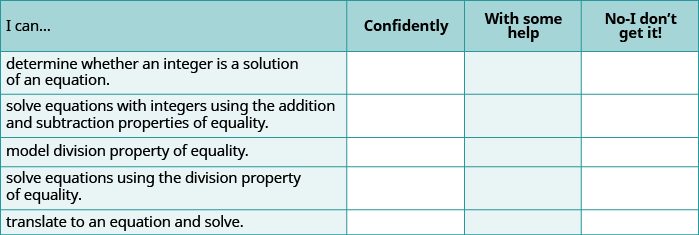
ⓑ Overall, after looking at the checklist, do you think you are well-prepared for the next Chapter? Why or why not?
Chapter Review Exercises
Introduction to Integers
Locate Positive and Negative Numbers on the Number Line
In the following exercises, locate and label the integer on the number line.



Order Positive and Negative Numbers
In the following exercises, order each of the following pairs of numbers, using or
<
>
>
Find Opposites
In the following exercises, find the opposite of each number.
−6
4
In the following exercises, simplify.
- ⓐ
- ⓑ
- ⓐ −8
- ⓑ 8
- ⓐ
- ⓑ
In the following exercises, evaluate.
- ⓐ
- ⓑ
- ⓐ −32
- ⓑ 32
- ⓐ
- ⓐ
Simplify Absolute Values
In the following exercises, simplify.
21
36
0
In the following exercises, evaluate.
14
−33
In the following exercises, fill in for each of the following pairs of numbers.
<
=
In the following exercises, simplify.
55; −55
7
54
−1
Translate Phrases to Expressions with Integers
In the following exercises, translate each of the following phrases into expressions with positive or negative numbers.
the opposite of
−16
the opposite of
negative
−3
minus negative
a temperature of below zero
−10°
an elevation of below sea level
Add Integers
Model Addition of Integers
In the following exercises, model the following to find the sum.
10
1
Simplify Expressions with Integers
In the following exercises, simplify each expression.
96
−50
−1
21
Evaluate Variable Expressions with Integers
In the following exercises, evaluate each expression.
- ⓐ
- ⓑ
- ⓐ 3
- ⓑ −16
- ⓐ
- ⓑ
−27
Translate Word Phrases to Algebraic Expressions
In the following exercises, translate each phrase into an algebraic expression and then simplify.
−8 + 2 = −6
10 + [−5 + (−6)] = −1
Add Integers in Applications
In the following exercises, solve.
Temperature On Monday, the high temperature in Denver was Tuesday’s high temperature was more. What was the high temperature on Tuesday?
16 degrees
Credit Frida owed on her credit card. Then she charged more. What was her new balance?
Subtract Integers
Model Subtraction of Integers
In the following exercises, model the following.

5

7
Simplify Expressions with Integers
In the following exercises, simplify each expression.
8
−38
−58
−1
Evaluate Variable Expressions with Integers
In the following exercises, evaluate each expression.
- ⓐ
- ⓑ
- ⓐ −2
- ⓑ −11
- ⓐ
- ⓑ
41
Translate Phrases to Algebraic Expressions
In the following exercises, translate each phrase into an algebraic expression and then simplify.
the difference of
−12 − 5 = −17
subtract from
Subtract Integers in Applications
In the following exercises, solve the given applications.
Temperature One morning the temperature in Bangor, Maine was By afternoon, it had dropped What was the afternoon temperature?
−2 degrees
Temperature On January 4, the high temperature in Laredo, Texas was and the high in Houlton, Maine was What was the difference in temperature of Laredo and Houlton?
Multiply and Divide Integers
Multiply Integers
In the following exercises, multiply.
−36
121
Divide Integers
In the following exercises, divide.
−7
−8
−45
Simplify Expressions with Integers
In the following exercises, simplify each expression.
−9
−81
54
4
Evaluate Variable Expressions with Integers
In the following exercises, evaluate each expression.
−66
−58
Translate Word Phrases to Algebraic Expressions
In the following exercises, translate to an algebraic expression and simplify if possible.
the product of and
−12(6) = −72
the quotient of and the sum of and
Solve Equations using Integers; The Division Property of Equality
Determine Whether a Number is a Solution of an Equation
In the following exercises, determine whether each number is a solution of the given equation.
- ⓐ
- ⓑ
- ⓒ
- ⓐ no
- ⓑ yes
- ⓒ no
- ⓐ
- ⓑ
- ⓒ
Using the Addition and Subtraction Properties of Equality
In the following exercises, solve.
−12
−7
Model the Division Property of Equality
In the following exercises, write the equation modeled by the envelopes and counters. Then solve it.
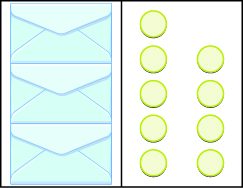
3x = 9; x = 3
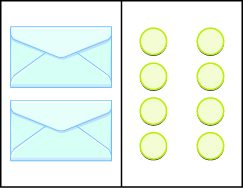
Solve Equations Using the Division Property of Equality
In the following exercises, solve each equation using the division property of equality and check the solution.
9
4
Translate to an Equation and Solve.
In the following exercises, translate and solve.
−6y = −42; y = 7
Four more than is
m + 4 = −48; m = −52
Everyday Math
Describe how you have used two topics from this chapter in your life outside of your math class during the past month.
Answers will vary.
Chapter Practice Test
Locate and label and on a number line.
In the following exercises, compare the numbers, using
- ⓐ
- ⓑ
- ⓐ <
- ⓑ >
- ⓐ
- ⓑ
In the following exercises, find the opposite of each number.
- ⓐ
- ⓑ
- ⓐ 7
- ⓑ −8
In the following exercises, simplify.
5
−27
11
54
−8
22
In the following exercises, evaluate.
39
34
In the following exercises, translate each phrase into an algebraic expression and then simplify, if possible.
the difference of −7 and −4
−7 − (−4) = −3
the quotient of and the sum of and
In the following exercises, solve.
Early one morning, the temperature in Syracuse was By noon, it had risen What was the temperature at noon?
4°F
Collette owed on her credit card. Then she charged What was her new balance?
In the following exercises, solve.
n = −1
r = 6
In the following exercises, translate and solve.
y − 8 = −32; y = −24