
3.4 Multiply and Divide Integers
Multiply Integers
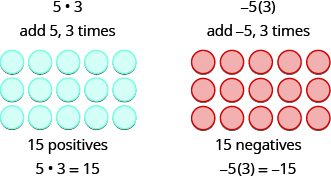
Since multiplication is mathematical shorthand for repeated addition, our counter model can easily be applied to show multiplication of integers. Let’s look at this concrete model to see what patterns we notice. We will use the same examples that we used for addition and subtraction.
We remember that means add times. Here, we are using the model shown in Figure 3.22 just to help us discover the pattern.
Now consider what it means to multiply by It means subtract times. Looking at subtraction as taking away, it means to take away times. But there is nothing to take away, so we start by adding neutral pairs as shown in Figure 3.23.
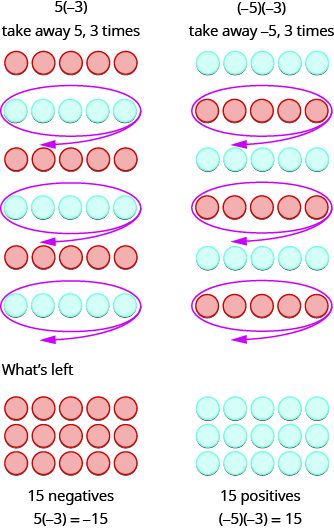
In both cases, we started with neutral pairs. In the case on the left, we took away times and the result was To multiply we took away times and the result was So we found that
Notice that for multiplication of two signed numbers, when the signs are the same, the product is positive, and when the signs are different, the product is negative.
When we multiply a number by the result is the same number. What happens when we multiply a number by Let’s multiply a positive number and then a negative number by to see what we get.
Each time we multiply a number by we get its opposite.
Divide Integers
Division is the inverse operation of multiplication. So, because In words, this expression says that can be divided into groups of each because adding five three times gives If we look at some examples of multiplying integers, we might figure out the rules for dividing integers.
Division of signed numbers follows the same rules as multiplication. When the signs are the same, the quotient is positive, and when the signs are different, the quotient is negative.
Remember, you can always check the answer to a division problem by multiplying.
Just as we saw with multiplication, when we divide a number by the result is the same number. What happens when we divide a number by Let’s divide a positive number and then a negative number by to see what we get.
When we divide a number by, we get its opposite.
Simplify Expressions with Integers
Now we’ll simplify expressions that use all four operations–addition, subtraction, multiplication, and division–with integers. Remember to follow the order of operations.
Evaluate Variable Expressions with Integers
Now we can evaluate expressions that include multiplication and division with integers. Remember that to evaluate an expression, substitute the numbers in place of the variables, and then simplify.
Translate Word Phrases to Algebraic Expressions
Once again, all our prior work translating words to algebra transfers to phrases that include both multiplying and dividing integers. Remember that the key word for multiplication is product and for division is quotient.
Key Concepts
- Multiplication of Signed Numbers
- To determine the sign of the product of two signed numbers:
Same Signs Product Two positives
Two negativesPositive
PositiveDifferent Signs Product Positive ⋅ negative
Negative ⋅ positiveNegative
Negative
- To determine the sign of the product of two signed numbers:
- Division of Signed Numbers
- To determine the sign of the quotient of two signed numbers:
Same Signs Quotient Two positives
Two negativesPositive
PositiveDifferent Signs Quotient Positive ⋅ negative
Negative ⋅ PositiveNegative
Negative
- To determine the sign of the quotient of two signed numbers:
- Multiplication by
- Multiplying a number by gives its opposite:
- Division by
- Dividing a number by gives its opposite:
Practice Makes Perfect
Multiply Integers
In the following exercises, multiply each pair of integers.
−32
−35
36
−63
−6
14
Divide Integers
In the following exercises, divide.
−4
−8
13
−12
−49
Simplify Expressions with Integers
In the following exercises, simplify each expression.
−47
43
−125
64
−16
90
−88
9
41
−5
−9
−29
5
Evaluate Variable Expressions with Integers
In the following exercises, evaluate each expression.
- ⓐ
- ⓑ
- ⓐ 1
- ⓑ 33
- ⓐ
- ⓑ
- ⓐ
- ⓑ
- ⓐ −5
- ⓑ 25
- ⓐ
- ⓑ
11
when
when
21
when
when and
38
when and
when and
−56
when and
Translate Word Phrases to Algebraic Expressions
In the following exercises, translate to an algebraic expression and simplify if possible.
The product of and 15
−3·15 = −45
The product of and
The quotient of and
−60 ÷ (−20) = 3
The quotient of and
The quotient of and the sum of and
The quotient of and the sum of and
The product of and the difference of
−10 (p − q)
The product of and the difference of
Everyday Math
Stock market Javier owns shares of stock in one company. On Tuesday, the stock price dropped per share. What was the total effect on Javier’s portfolio?
−$3,600
Weight loss In the first week of a diet program, eight women lost an average of each. What was the total weight change for the eight women?
Writing Exercises
In your own words, state the rules for multiplying two integers.
Sample answer: Multiplying two integers with the same sign results in a positive product. Multiplying two integers with different signs results in a negative product.
In your own words, state the rules for dividing two integers.
Why is
Sample answer: In the first expression the base is positive and after you raise it to the power you should take the opposite. Then in the second expression the base is negative so you simply raise it to the power.
Why is
Self Check
ⓐ After completing the exercises, use this checklist to evaluate your mastery of the objectives of this section.
ⓑ On a scale of 1–10, how would you rate your mastery of this section in light of your responses on the checklist? How can you improve this?
Adapted from Prealgebra 2e by OpenStax (openstax.org), licensed under CC BY-NC-SA 4.0. Changes were made. License: CC-BY-NC-SA-4.0.