
1.5 Divide Whole Numbers
Use Division Notation
So far we have explored addition, subtraction, and multiplication. Now let’s consider division. Suppose you have the cookies in Figure 1.20 and want to package them in bags with cookies in each bag. How many bags would we need?
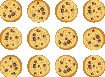
You might put cookies in first bag, in the second bag, and so on until you run out of cookies. Doing it this way, you would fill bags.
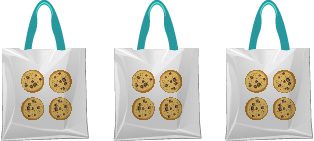
In other words, starting with the cookies, you would take away, or subtract, cookies at a time. Division is a way to represent repeated subtraction just as multiplication represents repeated addition.
Instead of subtracting repeatedly, we can write
We read this as twelve divided by four and the result is the quotient of and The quotient is because we can subtract from exactly times. We call the number being divided the dividend and the number dividing it the divisor. In this case, the dividend is and the divisor is
In the past you may have used the notation , but this division also can be written as In each case the is the dividend and the is the divisor.
Model Division of Whole Numbers
As we did with multiplication, we will model division using counters. The operation of division helps us organize items into equal groups as we start with the number of items in the dividend and subtract the number in the divisor repeatedly.
Divide Whole Numbers
We said that addition and subtraction are inverse operations because one undoes the other. Similarly, division is the inverse operation of multiplication. We know because Knowing all the multiplication number facts is very important when doing division.
We check our answer to division by multiplying the quotient by the divisor to determine if it equals the dividend. In Example 2, we know is correct because
What is the quotient when you divide a number by itself?
Dividing any number by itself produces a quotient of Also, any number divided by produces a quotient of the number. These two ideas are stated in the Division Properties of One.
Suppose we have and want to divide it among people. How much would each person get? Each person would get Zero divided by any number is
Now suppose that we want to divide by That means we would want to find a number that we multiply by to get This cannot happen because times any number is Division by zero is said to be undefined.
These two ideas make up the Division Properties of Zero.
Another way to explain why division by zero is undefined is to remember that division is really repeated subtraction. How many times can we take away from Because subtracting will never change the total, we will never get an answer. So we cannot divide a number by
When the divisor or the dividend has more than one digit, it is usually easier to use the notation. This process is called long division. Let’s work through the process by dividing by
| Divide the first digit of the dividend, 7, by the divisor, 3. | |
|---|---|
| The divisor 3 can go into 7 two times since . Write the 2 above the 7 in the quotient. |  |
| Multiply the 2 in the quotient by 3 and write the product, 6, under the 7. |  |
| Subtract that product from the first digit in the dividend. Subtract . Write the difference, 1, under the first digit in the dividend. |  |
| Bring down the next digit of the dividend. Bring down the 8. |  |
| Divide 18 by the divisor, 3. The divisor 3 goes into 18 six times. |  |
| Write 6 in the quotient above the 8. | |
| Multiply the 6 in the quotient by the divisor and write the product, 18, under the dividend. Subtract 18 from 18. | 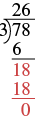 |
We would repeat the process until there are no more digits in the dividend to bring down. In this problem, there are no more digits to bring down, so the division is finished.
Check by multiplying the quotient times the divisor to get the dividend. Multiply to make sure that product equals the dividend,
It does, so our answer is correct.
So far all the division problems have worked out evenly. For example, if we had cookies and wanted to make bags of cookies, we would have bags. But what if there were cookies and we wanted to make bags of Start with the cookies as shown in Figure 1.21.
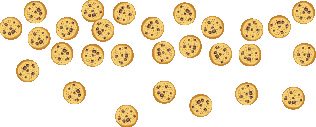
Try to put the cookies in groups of eight as in Figure 1.22.
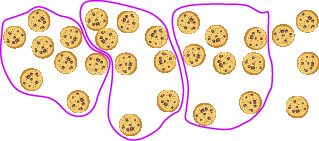
There are groups of eight cookies, and cookies left over. We call the cookies that are left over the remainder and show it by writing R4 next to the (The R stands for remainder.)
To check this division we multiply times to get and then add the remainder of
Translate Word Phrases to Math Notation
Earlier in this section, we translated math notation for division into words. Now we’ll translate word phrases into math notation. Some of the words that indicate division are given in Table 1.8.
| Operation | Word Phrase | Example | Expression |
|---|---|---|---|
| Division | divided by quotient of divided into | divided by the quotient of and divided into |
Divide Whole Numbers in Applications
We will use the same strategy we used in previous sections to solve applications. First, we determine what we are looking for. Then we write a phrase that gives the information to find it. We then translate the phrase into math notation and simplify it to get the answer. Finally, we write a sentence to answer the question.
Key Concepts
| Operation | Notation | Expression | Read as | Result |
|---|---|---|---|---|
|
|
- Division Properties of One
- Any number (except 0) divided by itself is one.
- Any number divided by one is the same number.
- Division Properties of Zero
- Zero divided by any number is 0.
- Dividing a number by zero is undefined. undefined
- Divide whole numbers.
- Divide the first digit of the dividend by the divisor.
If the divisor is larger than the first digit of the dividend, divide the first two digits of the dividend by the divisor, and so on. - Write the quotient above the dividend.
- Multiply the quotient by the divisor and write the product under the dividend.
- Subtract that product from the dividend.
- Bring down the next digit of the dividend.
- Repeat from Step 1 until there are no more digits in the dividend to bring down.
- Check by multiplying the quotient times the divisor.
- Divide the first digit of the dividend by the divisor.
Section Exercises
Practice Makes Perfect
Use Division Notation
In the following exercises, translate from math notation to words.
fifty-four divided by nine; the quotient of fifty-four and nine
thirty-two divided by eight; the quotient of thirty-two and eight
forty-eight divided by six; the quotient of forty-eight and six
sixty-three divided by seven; the quotient of sixty-three and seven
Model Division of Whole Numbers
In the following exercises, model the division.
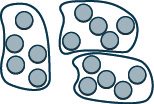
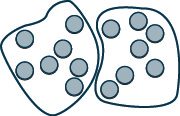
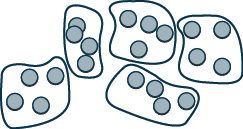
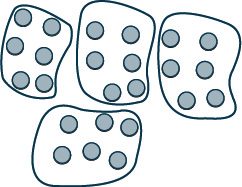
Divide Whole Numbers
In the following exercises, divide. Then check by multiplying.
9
9
7
9
9
5
1
1
23
19
0
undefined
undefined
0
24
12
93
132
871
7,831
2,403
901
704
10,209
352 R6
6,913 R1
86,234 R4
43,338 R2
382 R5
849
96
1,986 R17
Mixed Practice
In the following exercises, simplify.
3,060
72
1,060
35
Translate Word Phrases to Algebraic Expressions
In the following exercises, translate and simplify.
the quotient of and
45 ÷ 15; 3
the quotient of and
the quotient of and
288 ÷ 24; 12
the quotient of and
Divide Whole Numbers in Applications
In the following exercises, solve.
Trail mix Ric bought ounces of trail mix. He wants to divide it into small bags, with ounces of trail mix in each bag. How many bags can Ric fill?
Ric can fill 32 bags.
Crackers Evie bought a ounce box of crackers. She wants to divide it into bags with ounces of crackers in each bag. How many bags can Evie fill?
Astronomy class There are students in an astronomy class. The professor assigns them into groups of How many groups of students are there?
There are 25 groups.
Flower shop Melissa’s flower shop got a shipment of roses. She wants to make bouquets of roses each. How many bouquets can Melissa make?
Baking One roll of plastic wrap is feet long. Marta uses feet of plastic wrap to wrap each cake she bakes. How many cakes can she wrap from one roll?
Marta can wrap 16 cakes from 1 roll.
Dental floss One package of dental floss is feet long. Brian uses feet of dental floss every day. How many days will one package of dental floss last Brian?
Mixed Practice
In the following exercises, solve.
Miles per gallon Susana’s hybrid car gets miles per gallon. Her son’s truck gets miles per gallon. What is the difference in miles per gallon between Susana’s car and her son’s truck?
The difference is 28 miles per gallon.
Distance Mayra lives miles from her mother’s house and miles from her mother-in-law’s house. How much farther is Mayra from her mother-in-law’s house than from her mother’s house?
Field trip The students in a Geology class will go on a field trip, using the college’s vans. Each van can hold students. How many vans will they need for the field trip?
They will need 5 vans for the field trip
Potting soil Aki bought a ounce bag of potting soil. How many ounce pots can he fill from the bag?
Hiking Bill hiked miles on the first day of his backpacking trip, miles the second day, miles the third day, and miles the fourth day. What is the total number of miles Bill hiked?
Bill hiked 50 miles
Reading Last night Emily read pages in her Business textbook, pages in her History text, pages in her Psychology text, and pages in her math text. What is the total number of pages Emily read?
Patients LaVonne treats patients each day in her dental office. Last week she worked days. How many patients did she treat last week?
LaVonne treated 48 patients last week.
Scouts There are boys in Dave’s scout troop. At summer camp, each boy earned merit badges. What was the total number of merit badges earned by Dave’s scout troop at summer camp?
Writing Exercises
Contact lenses Jenna puts in a new pair of contact lenses every days. How many pairs of contact lenses does she need for days?
Jenna uses 26 pairs of contact lenses, but there is 1 day left over, so she needs 27 pairs for 365 days.
Cat food One bag of cat food feeds Lara’s cat for days. How many bags of cat food does Lara need for days?
Everyday Math
Explain how you use the multiplication facts to help with division.
Answers may vary. Using multiplication facts can help you check your answers once you’ve finished division.
Oswaldo divided by and said his answer was with a remainder of How can you check to make sure he is correct?
Self Check
ⓐ After completing the exercises, use this checklist to evaluate your mastery of the objectives of this section.
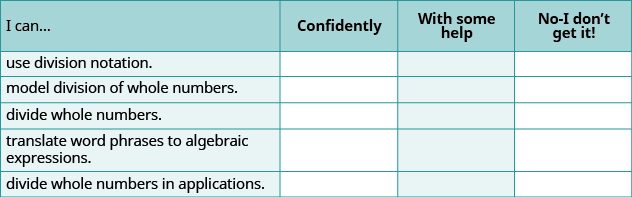
ⓑ Overall, after looking at the checklist, do you think you are well-prepared for the next Chapter? Why or why not?
Chapter Review Exercises
Introduction to Whole Numbers
Identify Counting Numbers and Whole Numbers
In the following exercises, determine which of the following are (a) counting numbers (b) whole numbers.
- ⓐ 2, 99
- ⓑ 0, 2, 99
- ⓐ 4, 90
- ⓑ 0, 4, 90
Model Whole Numbers
In the following exercises, model each number using blocks and then show its value using place value notation.
258
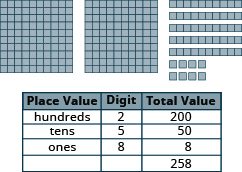
104
Identify the Place Value of a Digit
In the following exercises, find the place value of the given digits.
- ⓐ
- ⓑ
- ⓒ
- ⓓ
- ⓔ
- ⓐ tens
- ⓑ hundred thousands
- ⓒ ones
- ⓓ ten thousands
- ⓔ thousands
- ⓐ
- ⓑ
- ⓒ
- ⓓ
- ⓔ
Use Place Value to Name Whole Numbers
In the following exercises, name each number in words.
Five thousand, two hundred eighty
Five million, twelve thousand, five hundred eighty-two
Use Place Value to Write Whole Numbers
In the following exercises, write as a whole number using digits.
six hundred two
fifteen thousand, two hundred fifty-three
15,253
three hundred forty million, nine hundred twelve thousand, sixty-one
340,912,061
two billion, four hundred ninety-two million, seven hundred eleven thousand, two
Round Whole Numbers
In the following exercises, round to the nearest ten.
410
3,560
In the following exercises, round to the nearest hundred.
39,000
81,500
Add Whole Numbers
Use Addition Notation
In the following exercises, translate the following from math notation to words.
four plus three; the sum of four and three
five hundred seventy-one plus six hundred twenty-nine; the sum of five hundred seventy-one and six hundred twenty-nine
Model Addition of Whole Numbers
In the following exercises, model the addition.

Add Whole Numbers
In the following exercises, fill in the missing values in each chart.
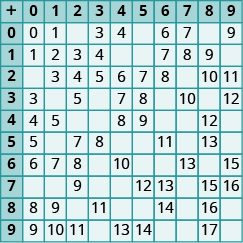
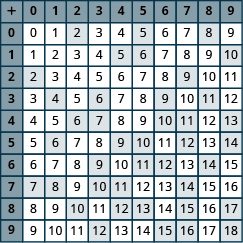
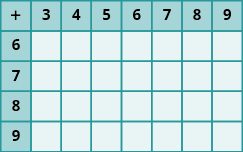
In the following exercises, add.
ⓐ ⓑ
- ⓐ 19
- ⓑ 19
ⓐ ⓑ
ⓐ ⓑ
- ⓐ 13
- ⓑ 13
ⓐ ⓑ
79
154
19,827
Translate Word Phrases to Math Notation
In the following exercises, translate each phrase into math notation and then simplify.
the sum of and
30 + 12; 42
increased by
more than
39 + 25; 64
total of and
Add Whole Numbers in Applications
In the following exercises, solve.
Shopping for an interview Nathan bought a new shirt, tie, and slacks to wear to a job interview. The shirt cost the tie cost and the slacks cost What was Nathan’s total cost?
$76
Running Jackson ran miles on Monday, miles on Tuesday, mile on Wednesday, miles on Thursday, and miles on Friday. What was the total number of miles Jackson ran?
In the following exercises, find the perimeter of each figure.
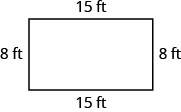
46 feet
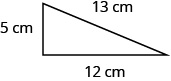
Subtract Whole Numbers
Use Subtraction Notation
In the following exercises, translate the following from math notation to words.
fourteen minus five; the difference of fourteen and five
three hundred fifty-one minus two hundred forty-nine; the difference between three hundred fifty-one and two hundred forty-nine
Model Subtraction of Whole Numbers
In the following exercises, model the subtraction.

Subtract Whole Numbers
In the following exercises, subtract and then check by adding.
3
14
23
322
380
9,985
Translate Word Phrases to Math Notation
In the following exercises, translate and simplify.
the difference of nineteen and thirteen
19 − 13; 6
subtract sixty-five from one hundred
seventy-four decreased by eight
74 − 8; 66
twenty-three less than forty-one
Subtract Whole Numbers in Applications
In the following exercises, solve.
Temperature The high temperature in Peoria one day was degrees Fahrenheit and the low temperature was degrees Fahrenheit. What was the difference between the high and low temperatures?
58 degrees Fahrenheit
Savings Lynn wants to go on a cruise that costs She has in her vacation savings account. How much more does she need to save in order to pay for the cruise?
Multiply Whole Numbers
Use Multiplication Notation
In the following exercises, translate from math notation to words.
eight times five; the product of eight and five
ten times ninety-five; the product of ten and ninety-five
Model Multiplication of Whole Numbers
In the following exercises, model the multiplication.

Multiply Whole Numbers
In the following exercises, fill in the missing values in each chart.
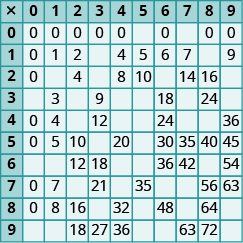
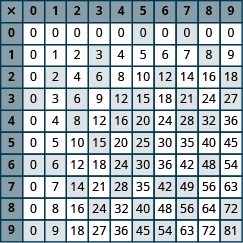
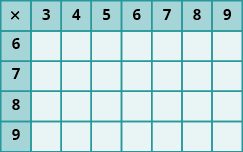
In the following exercises, multiply.
0
99
ⓐ ⓑ
- ⓐ 28
- ⓑ 28
27,783
640
79,866
1,873,608
Translate Word Phrases to Math Notation
In the following exercises, translate and simplify.
the product of and
15(28); 420
ninety-four times thirty-three
twice
2(575); 1,150
ten times two hundred sixty-four
Multiply Whole Numbers in Applications
In the following exercises, solve.
Gardening Geniece bought packs of marigolds to plant in her yard. Each pack has flowers. How many marigolds did Geniece buy?
48 marigolds
Cooking Ratika is making rice for a dinner party. The number of cups of water is twice the number of cups of rice. If Ratika plans to use cups of rice, how many cups of water does she need?
Multiplex There are twelve theaters at the multiplex and each theater has seats. What is the total number of seats at the multiplex?
1,800 seats
Roofing Lewis needs to put new shingles on his roof. The roof is a rectangle, feet by feet. What is the area of the roof?
Divide Whole Numbers
Use Division Notation
Translate from math notation to words.
fifty-four divided by nine; the quotient of fifty-four and nine
seventy-two divided by eight; the quotient of seventy-two and eight
Model Division of Whole Numbers
In the following exercises, model.

Divide Whole Numbers
In the following exercises, divide. Then check by multiplying.
7
13
97
undefined
638
300 R5
Translate Word Phrases to Math Notation
In the following exercises, translate and simplify.
the quotient of and
64 ÷ 16; 4
the quotient of and
Divide Whole Numbers in Applications
In the following exercises, solve.
Ribbon One spool of ribbon is feet. Lizbeth uses feet of ribbon for each gift basket that she wraps. How many gift baskets can Lizbeth wrap from one spool of ribbon?
9 baskets
Juice One carton of fruit juice is ounces. How many ounce cups can Shayla fill from one carton of juice?
Chapter Practice Test
Determine which of the following numbers are
- ⓐ counting numbers
- ⓑ whole numbers.
- ⓐ 4, 87
- ⓑ 0, 4, 87
Find the place value of the given digits in the number
- ⓐ
- ⓑ
- ⓒ
- ⓓ
Write each number as a whole number using digits.
- ⓐ six hundred thirteen
- ⓑ fifty-five thousand two hundred eight
- ⓐ 613
- ⓑ 55,208
Round to the nearest hundred.
Simplify.
68
17
32
0
0
66
3,325
490
442
11
Translate each phrase to math notation and then simplify.
The sum of and
16 + 58; 74
The product of and
The difference of and
32 − 18; 14
The quotient of and
Twice
2(524); 1,048
more than
less than
300 − 50; 250
In the following exercises, solve.
LaVelle buys a jumbo bag of candies to make favor bags for her son’s party. If she wants to make bags, how many candies should she put in each bag?
Last month, Stan’s take-home pay was and his expenses were How much of his take-home pay did Stan have left after he paid his expenses?
Stan had $344 left.
Each class at Greenville School has children enrolled. The school has classes. How many children are enrolled at Greenville School?
Clayton walked blocks to his mother’s house, blocks to the gym, and blocks to the grocery store before walking the last blocks home. What was the total number of blocks that Clayton walked?
Clayton walked 30 blocks.
Adapted from Prealgebra 2e by OpenStax (openstax.org), licensed under CC BY-NC-SA 4.0. Changes were made. License: CC-BY-NC-SA-4.0.