
1.4 Multiply Whole Numbers
Use Multiplication Notation
Suppose you were asked to count all these pennies shown in Figure 1.16.
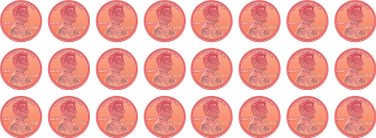
Would you count the pennies individually? Or would you count the number of pennies in each row and add that number times.
Multiplication is a way to represent repeated addition. So instead of adding three times, we could write a multiplication expression.
We call each number being multiplied a factor and the result the product. We read as three times eight, and the result as the product of three and eight.
There are several symbols that represent multiplication. These include the symbol as well as the dot, , and parentheses
Model Multiplication of Whole Numbers
There are many ways to model multiplication. Unlike in the previous sections where we used blocks, here we will use counters to help us understand the meaning of multiplication. A counter is any object that can be used for counting. We will use round blue counters.
Multiply Whole Numbers
In order to multiply without using models, you need to know all the one digit multiplication facts. Make sure you know them fluently before proceeding in this section.
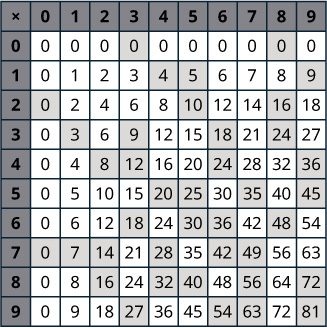
Table 1.4 shows the multiplication facts. Each box shows the product of the number down the left column and the number across the top row. If you are unsure about a product, model it. It is important that you memorize any number facts you do not already know so you will be ready to multiply larger numbers.
| × | 0 | 1 | 2 | 3 | 4 | 5 | 6 | 7 | 8 | 9 |
|---|---|---|---|---|---|---|---|---|---|---|
| 0 | 0 | 0 | 0 | 0 | 0 | 0 | 0 | 0 | 0 | 0 |
| 1 | 0 | 1 | 2 | 3 | 4 | 5 | 6 | 7 | 8 | 9 |
| 2 | 0 | 2 | 4 | 6 | 8 | 10 | 12 | 14 | 16 | 18 |
| 3 | 0 | 3 | 6 | 9 | 12 | 15 | 18 | 21 | 24 | 27 |
| 4 | 0 | 4 | 8 | 12 | 16 | 20 | 24 | 28 | 32 | 36 |
| 5 | 0 | 5 | 10 | 15 | 20 | 25 | 30 | 35 | 40 | 45 |
| 6 | 0 | 6 | 12 | 18 | 24 | 30 | 36 | 42 | 48 | 54 |
| 7 | 0 | 7 | 14 | 21 | 28 | 35 | 42 | 49 | 56 | 63 |
| 8 | 0 | 8 | 16 | 24 | 32 | 40 | 48 | 56 | 64 | 72 |
| 9 | 0 | 9 | 18 | 27 | 36 | 45 | 54 | 63 | 72 | 81 |
What happens when you multiply a number by zero? You can see that the product of any number and zero is zero. This is called the Multiplication Property of Zero.
What happens when you multiply a number by one? Multiplying a number by one does not change its value. We call this fact the Identity Property of Multiplication, and is called the multiplicative identity.
Earlier in this chapter, we learned that the Commutative Property of Addition states that changing the order of addition does not change the sum. We saw that is the same as
Is this also true for multiplication? Let’s look at a few pairs of factors.
When the order of the factors is reversed, the product does not change. This is called the Commutative Property of Multiplication.
To multiply numbers with more than one digit, it is usually easier to write the numbers vertically in columns just as we did for addition and subtraction.
We start by multiplying by
We write the in the ones place of the product. We carry the tens by writing above the tens place.
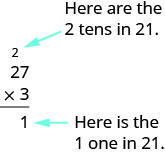
Then we multiply the by the and add the above the tens place to the product. So and Write the in the tens place of the product.
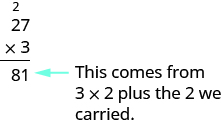
The product is
When we multiply two numbers with a different number of digits, it’s usually easier to write the smaller number on the bottom. You could write it the other way, too, but this way is easier to work with.
When we multiply by a number with two or more digits, we multiply by each of the digits separately, working from right to left. Each separate product of the digits is called a partial product. When we write partial products, we must make sure to line up the place values.
When there are three or more factors, we multiply the first two and then multiply their product by the next factor. For example:
| to multiply | |
|---|---|
| first multiply | |
| then multiply . |
Translate Word Phrases to Math Notation
Earlier in this section, we translated math notation into words. Now we’ll reverse the process and translate word phrases into math notation. Some of the words that indicate multiplication are given in Table 1.5.
| Operation | Word Phrase | Example | Expression |
|---|---|---|---|
| Multiplication | times product twice | times the product of and twice |
Multiply Whole Numbers in Applications
We will use the same strategy we used previously to solve applications of multiplication. First, we need to determine what we are looking for. Then we write a phrase that gives the information to find it. We then translate the phrase into math notation and simplify to get the answer. Finally, we write a sentence to answer the question.
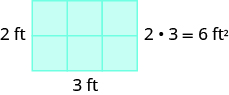
If we want to know the size of a wall that needs to be painted or a floor that needs to be carpeted, we will need to find its area. The area is a measure of the amount of surface that is covered by the shape. Area is measured in square units. We often use square inches, square feet, square centimeters, or square miles to measure area. A square centimeter is a square that is one centimeter (cm.) on a side. A square inch is a square that is one inch on each side, and so on.
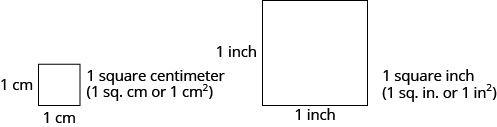
For a rectangular figure, the area is the product of the length and the width. Figure 1.18 shows a rectangular rug with a length of feet and a width of feet. Each square is foot wide by foot long, or square foot. The rug is made of squares. The area of the rug is square feet.
Key Concepts
| Operation | Notation | Expression | Read as | Result |
|---|---|---|---|---|
- Multiplication Property of Zero
- The product of any number and 0 is 0.
- The product of any number and 0 is 0.
- Identity Property of Multiplication
- The product of any number and 1 is the number.
- The product of any number and 1 is the number.
- Commutative Property of Multiplication
- Changing the order of the factors does not change their product.
- Changing the order of the factors does not change their product.
- Multiply two whole numbers to find the product.
- Write the numbers so each place value lines up vertically.
- Multiply the digits in each place value.
- Work from right to left, starting with the ones place in the bottom number.
- Multiply the bottom number by the ones digit in the top number, then by the tens digit, and so on.
- If a product in a place value is more than 9, carry to the next place value.
- Write the partial products, lining up the digits in the place values with the numbers above. Repeat for the tens place in the bottom number, the hundreds place, and so on.
- Insert a zero as a placeholder with each additional partial product.
- Add the partial products.
Practice Makes Perfect
Use Multiplication Notation
In the following exercises, translate from math notation to words.
four times seven; the product of four and seven
five times twelve; the product of five and twelve
ten times twenty-five; the product of ten and twenty-five
forty-two times thirty-three; the product of forty-two and thirty-three
Model Multiplication of Whole Numbers
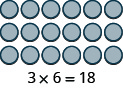
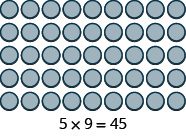
In the following exercises, model the multiplication.
Multiply Whole Numbers
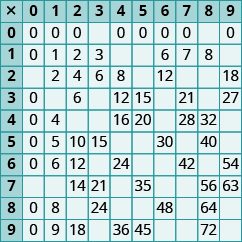
In the following exercises, fill in the missing values in each chart.
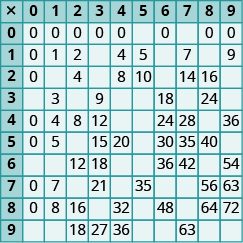
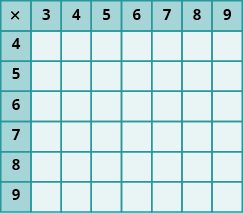
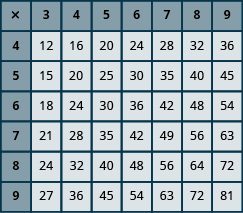
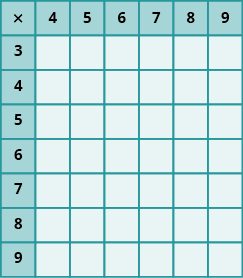
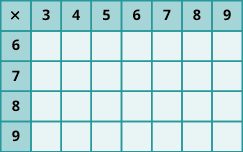
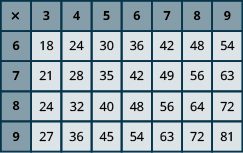
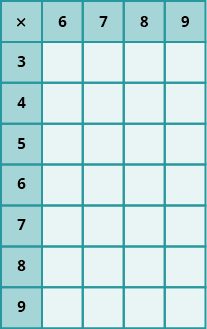
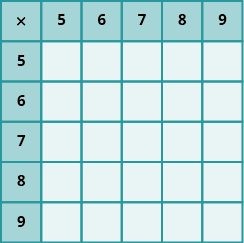
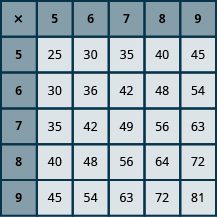
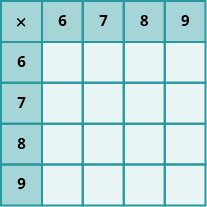
In the following exercises, multiply.
0
0
43
28
240,055
- ⓐ
- ⓑ
- ⓐ 42
- ⓑ 42
- ⓐ
- ⓑ
395
1,650
23,947
1,976
7,008
2,295
230
3,600
88,000
50,000,000
34,333
422,506
804,285
26,624
245,340
1,476,417
Translate Word Phrases to Math Notation
In the following exercises, translate and simplify.
the product of and
18 · 33; 594
the product of and
fifty-one times sixty-seven
51(67); 3,417
forty-eight times seventy-one
twice
2(249); 498
twice
ten times three hundred seventy-five
10(375); 3,750
ten times two hundred fifty-five
Mixed Practice
In the following exercises, simplify.
1,406
148
11,000
11,424
0
15,383
In the following exercises, translate and simplify.
the difference of 50 and 18
50 − 18; 32
the difference of 90 and 66
twice 35
2(35); 70
twice 140
20 more than 980
20 + 980; 1,000
65 more than 325
the product of 12 and 875
12(875); 10,500
the product of 15 and 905
subtract 74 from 89
89 − 74; 15
subtract 45 from 99
the sum of 3,075 and 95
3,075 + 95; 3,170
the sum of 6,308 and 724
366 less than 814
814 − 366; 448
388 less than 925
Multiply Whole Numbers in Applications
In the following exercises, solve.
Party supplies Tim brought 9 six-packs of soda to a club party. How many cans of soda did Tim bring?
Tim brought 54 cans of soda to the party.
Sewing Kanisha is making a quilt. She bought 6 cards of buttons. Each card had four buttons on it. How many buttons did Kanisha buy?
Field trip Seven school busses let off their students in front of a museum in Washington, DC. Each school bus had 44 students. How many students were there?
There were 308 students.
Gardening Kathryn bought 8 flats of impatiens for her flower bed. Each flat has 24 flowers. How many flowers did Kathryn buy?
Charity Rey donated 15 twelve-packs of t-shirts to a homeless shelter. How many t-shirts did he donate?
Rey donated 180 t-shirts.
School There are 28 classrooms at Anna C. Scott elementary school. Each classroom has 26 student desks. What is the total number of student desks?
Recipe Stephanie is making punch for a party. The recipe calls for twice as much fruit juice as club soda. If she uses 10 cups of club soda, how much fruit juice should she use?
Stephanie should use 20 cups of fruit juice.
Gardening Hiroko is putting in a vegetable garden. He wants to have twice as many lettuce plants as tomato plants. If he buys 12 tomato plants, how many lettuce plants should he get?
Government The United States Senate has twice as many senators as there are states in the United States. There are 50 states. How many senators are there in the United States Senate?
There are 100 senators in the U.S. senate.
Recipe Andrea is making potato salad for a buffet luncheon. The recipe says the number of servings of potato salad will be twice the number of pounds of potatoes. If she buys 30 pounds of potatoes, how many servings of potato salad will there be?
Painting Jane is painting one wall of her living room. The wall is rectangular, 13 feet wide by 9 feet high. What is the area of the wall?
The area of the wall is 117 square feet.
Home décor Shawnte bought a rug for the hall of her apartment. The rug is 3 feet wide by 18 feet long. What is the area of the rug?
Room size The meeting room in a senior center is rectangular, with length 42 feet and width 34 feet. What is the area of the meeting room?
The area of the room is 1,428 square feet.
Gardening June has a vegetable garden in her yard. The garden is rectangular, with length 23 feet and width 28 feet. What is the area of the garden?
NCAA basketball According to NCAA regulations, the dimensions of a rectangular basketball court must be 94 feet by 50 feet. What is the area of the basketball court?
The area of the court is 4,700 square feet.
NCAA football According to NCAA regulations, the dimensions of a rectangular football field must be 360 feet by 160 feet. What is the area of the football field?
Everyday Math
Stock market Javier owns 300 shares of stock in one company. On Tuesday, the stock price rose per share. How much money did Javier’s portfolio gain?
Javier’s portfolio gained $3,600.
Salary Carlton got a raise in each paycheck. He gets paid 24 times a year. How much higher is his new annual salary?
Writing Exercises
How confident do you feel about your knowledge of the multiplication facts? If you are not fully confident, what will you do to improve your skills?
Answers will vary.
How have you used models to help you learn the multiplication facts?
Self Check
ⓐ After completing the exercises, use this checklist to evaluate your mastery of the objectives of this section.
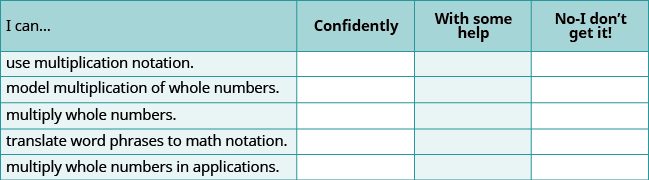
ⓑ On a scale of 1–10, how would you rate your mastery of this section in light of your responses on the checklist? How can you improve this?
Adapted from Prealgebra 2e by OpenStax (openstax.org), licensed under CC BY-NC-SA 4.0. Changes were made. License: CC-BY-NC-SA-4.0.