
4.3 The Determinant as Volume
Section 4.1 established what means for a matrix: the area of the parallelogram built on its columns, and therefore the factor by which the transformation scales every area. Nothing in that argument was two-dimensional. Chop any region into a fine mosaic of tiny cubes, note that a linear map takes each cube to the same slanted box scaled by the same factor, and the same conclusion follows one dimension up:
The parallelepiped is the solid Section 0.3 already built: the three-dimensional analogue of a parallelogram, swept out by three edge vectors leaving a common corner, with each pair of opposite faces parallel. There it was a device for adding — three vectors laid head to tail arrive at the far corner, which the long diagonal reaches directly. Here the same solid is asked a different question, about the space it encloses rather than the corner it reaches, and the determinant is the answer. Take the columns from the last section as its edges:
Their determinant is , so the box's volume is and the slider drives it through the interesting event.
 Explore in 3D (opens in a new tab)
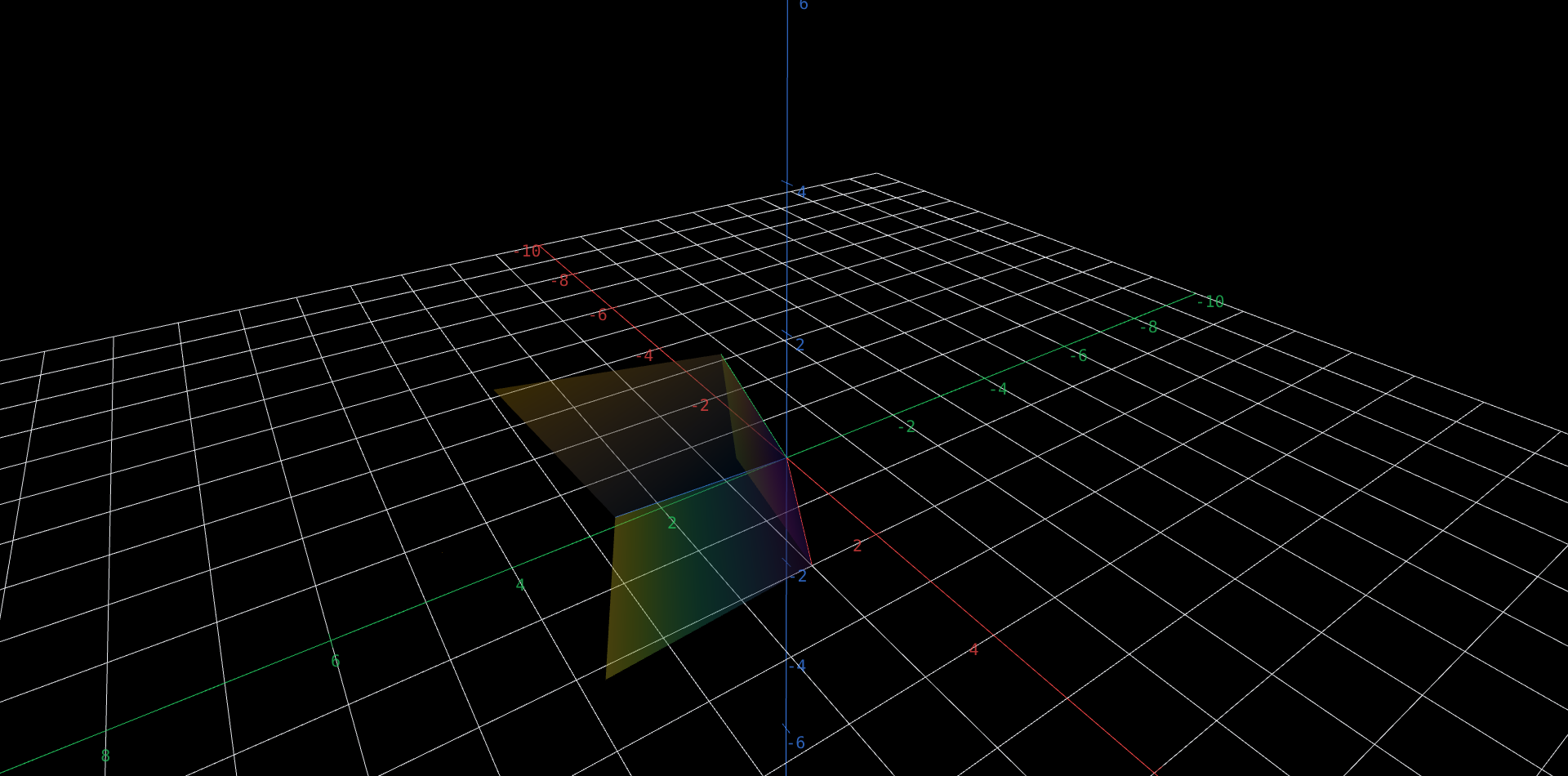
Three semi-transparent parallelogram faces meeting at the origin, forming half of a slanted box - a parallelepiped - with a red, a blue and a green segment along the three edges that leave the origin, and three amber edges meeting at the far corner, where the sum of the three edge vectors lands. A slider tilts the green edge. As it comes down the box flattens and the far corner descends; at one particular setting all three edges lie in a single plane and the box has no thickness at all, and pushing further reopens it with its corner on the other side, so the frame of edges has turned inside out.
Explore the figure
- At the default the box is comfortably solid. Its volume is , the determinant computed by cofactor expansion in the last section — now visible as an amount of space rather than an amount of arithmetic.
- Drag down towards . The box flattens: the green edge is folding down towards the plane of the other two, and the far corner is descending with it. The volume is shrinking at a steady rate, because the determinant is linear in .
- At the solid has no thickness at all. All three edges lie in one plane, the box is a flat sheet, and the volume is exactly zero — which is the determinant vanishing, and also the columns being dependent, and also the matrix losing its inverse. Three descriptions, one event.
- Continue to . The box reopens, and , so it has volume — but it is not the same box scaled down. Compare the arrangement of the three edges now with their arrangement at : the frame has been turned inside out.
What the sign means with three vectors
In the plane, a negative determinant meant the image had been flipped over. In space the corresponding idea is handedness. Point the fingers of your right hand along and curl them towards ; your thumb points to one side of their common plane. If points to that side, the triple is right-handed and the determinant is positive; if points the other way, it is left-handed and the determinant is negative.
Handedness cannot be changed by any amount of rotating or stretching, exactly as a left glove cannot be rotated into a right one. So a continuous journey from a positive determinant to a negative one must pass through zero — the box must flatten completely before it can reopen the other way, which is what step 4 made you watch.
The determinant at , where exploration step 4 stops. The magnitude is the box's volume, and the minus sign says the three edges, in the order written, form a left-handed frame. The sign belongs to the ordered triple, not to the solid: listing the same three edges in a different order flips it without moving the box at all. What cannot be rotated onto one another are two frames of opposite handedness.
The determinant at : zero, on the nose. Three vectors in space are coplanar exactly when the box they build has no volume, and that is the whole content of a vanishing determinant. Every other statement in the Invertible Matrix Theorem fails at this same slider setting.
Volume scaling, not just one box
The reading that matters most is the one about every region, not the one special box. If then takes the unit cube — volume — to the parallelepiped on the columns of , of volume . Since any solid can be approximated by a mosaic of small cubes, and each is scaled by that same factor, multiplies the volume of any region by .
Two consequences worth stating. First, determinants multiply, and now you can see why they must: doing and then scales volume by and then by , so the composite scales it by the product, and the signs compose in the same way because handedness either survives each step or is reversed by it. Second, a matrix with destroys volume everywhere at once — every solid is flattened into something with no thickness. Usually that is a sheet; if the matrix is more degenerate still it can be a line or even the single point , as the zero matrix shows. Either way no inverse can exist, because no transformation manufactures volume from something flat.
An original work of XYZ Homework, built around interactive XYZ 3D figures. Chapters 1–6 follow the topic sequence of Interactive Linear Algebra (Margalit & Rabinoff, Georgia Tech, GNU FDL). Chapter 0's scope (its topics, their order, and the idea each figure shows) follows the Vectors chapter of Ximera's Linear Algebra: An Interactive Introduction. The prose, worked examples and figures were written for this book, which is not affiliated with or endorsed by the authors of either work. License: CC-BY-NC-SA-4.0.