
4.1 The Determinant as Area
The determinant of the matrix with columns and is the number . The definition earns its keep through two facts you can watch. First, is the area of the image of the unit square — and therefore the factor by which the transformation multiplies the area of any region, since any region is well approximated by a fine mosaic of little squares, each of which is scaled by the same factor. Second, the sign of records whether the plane kept its orientation or was flipped over.
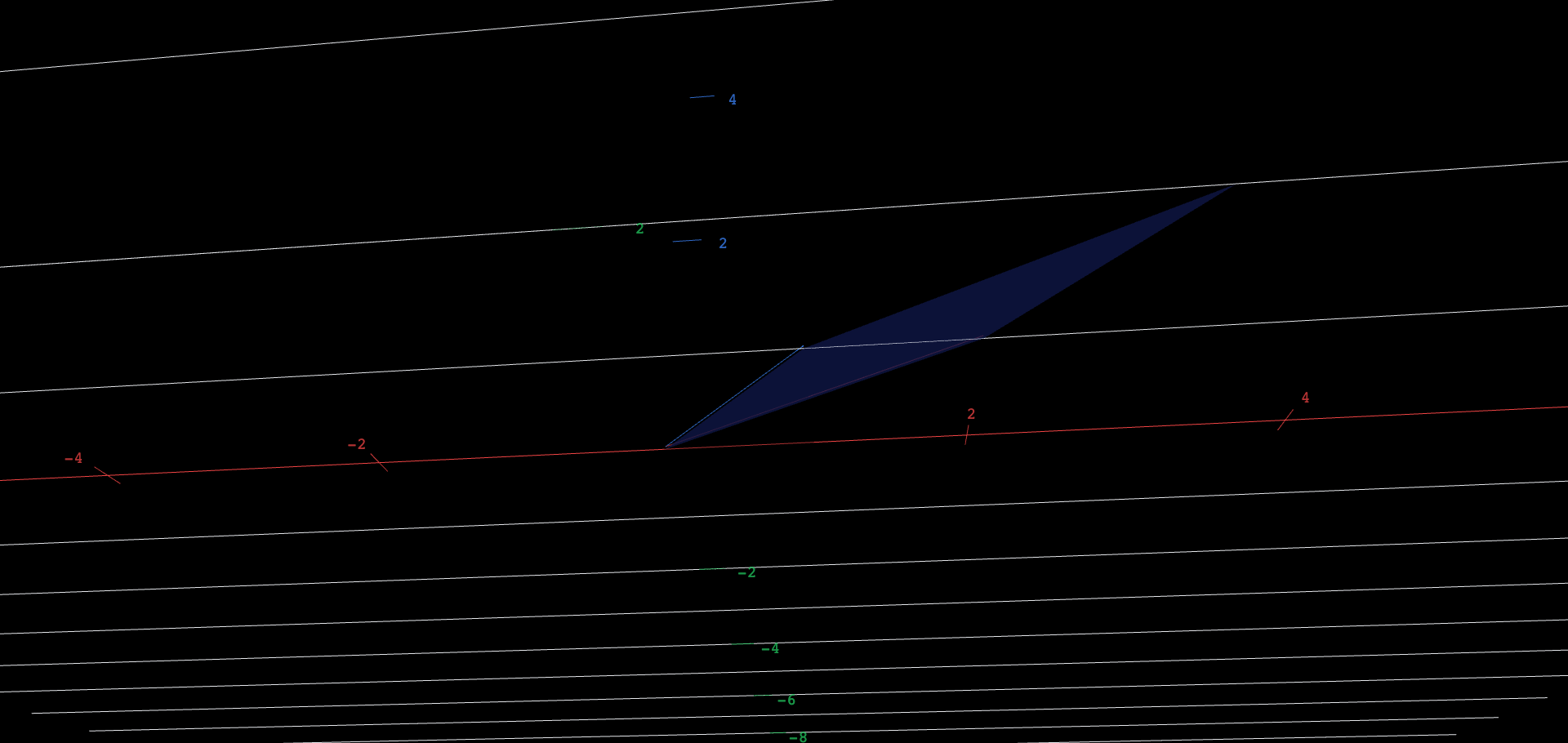
The figure below is built to be driven through the interesting event. It starts at , , , , where : a sheared parallelogram with exactly the area of the gray unit square beneath it.
 Explore in 3D (opens in a new tab)
The determinant at the figure's starting entries, computed by a computer algebra system: the matrix with columns and has determinant exactly — a violently sheared parallelogram covering precisely one gray square of area.
Explore the figure
- At the defaults, compare the parallelogram with the gray unit square. The shapes differ, but the areas match: . A matrix can distort violently while preserving area exactly.
- Drag up to . Now ; judge by eye that the parallelogram holds about three gray squares.
- Drag slowly down to . Watch the parallelogram thin and die: at the blue edge is exactly half the red edge , the columns are dependent, and .
- Keep going to . The parallelogram reopens — but flipped. Before the collapse, sweeping from the red edge to the blue edge went one way around; now it goes the other. Here : area again, orientation reversed.
Read the number while you drag
Everything above you judged by eye: three gray squares, about half, flipped. The determinant is a number, though, and the second figure prints it — the same four entries on sliders, in the plane the parallelogram actually lives in, with updating as you drag. Use it to check the estimates you just made.
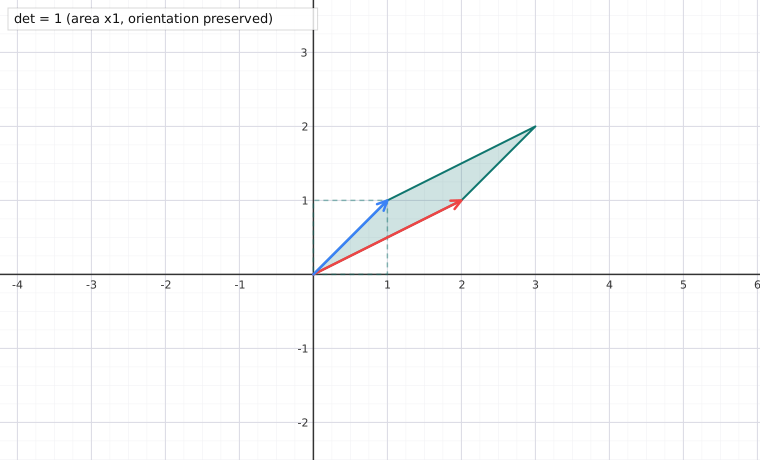
- At the starting entries the readout says — the number you took on trust in step 1 above. The parallelogram and the dashed unit square have the same area.
- Drag to and read . Compare with your by-eye estimate of "about three squares": how close were you?
- Drag down through slowly and watch the readout rather than the shape. It reaches exactly at the instant the parallelogram becomes a segment, and the readout says so in words instead of leaving you to judge a flat sliver.
- Continue to . The readout now reports a negative determinant and orientation reversed — the same flip you saw, stated as the sign of a number.
Sign is orientation
Why does the sign change mean a flip? For edge vectors and , the quantity is positive exactly when the second edge lies counterclockwise from the first — the same relative position holds to . A positive-determinant matrix moves both basis vectors while preserving that relative arrangement; a negative determinant means the images are in the reversed arrangement, which no amount of rotating or stretching within the plane can produce — the plane must have been turned over. And because your slider moved continuously, the only route from to passed through : you cannot flip a page without, at some instant, seeing it edge-on.
Determinant zero is the same event Chapter 2 called dependence and Chapter 3 called collapse, viewed once more. Dependent columns span a line instead of a plane; the transformation crushes two dimensions of input into one dimension of output; distinct points are forced to share images, so no inverse transformation can exist. A matrix is invertible exactly when its determinant is nonzero — a numerical test for a geometric catastrophe.
At the figure's starting entries the test passes: , and the inverse exists concretely — the matrix with rows and , which carries the sheared parallelogram back onto the unit square. A determinant of exactly even keeps the inverse's entries whole numbers.
The undo matrix, computed entry by entry and checked against the rows stated above. Determinant is what keeps every entry a whole number: the inverse's entries are the original's, shuffled and signed, divided by the determinant.
The whole slider experiment as one symbolic determinant: with , , held fixed, a computer algebra system expands — the line that vanishes at , reaches at , and lands on at .
An original work of XYZ Homework, built around interactive XYZ 3D figures. Its chapter sequence is aligned to Interactive Linear Algebra (Margalit & Rabinoff, Georgia Tech, GNU FDL); this work is original, copies nothing from it, and is not affiliated with or endorsed by its authors. License: CC-BY-NC-SA-4.0.