
6.5 Polynomial Equations
We have spent considerable time learning how to factor polynomials. We will now look at polynomial equations and solve them using factoring, if possible.
A polynomial equation is an equation that contains a polynomial expression. The degree of the polynomial equation is the degree of the polynomial.
We have already solved polynomial equations of degree one. Polynomial equations of degree one are linear equations are of the form
We are now going to solve polynomial equations of degree two. A polynomial equation of degree two is called a quadratic equation. Listed below are some examples of quadratic equations:
The last equation doesn’t appear to have the variable squared, but when we simplify the expression on the left we will get
The general form of a quadratic equation is with (If then and we are left with no quadratic term.)
To solve quadratic equations we need methods different from the ones we used in solving linear equations. We will look at one method here and then several others in a later chapter.
Use the Zero Product Property
We will first solve some quadratic equations by using the Zero Product Property. The Zero Product Property says that if the product of two quantities is zero, then at least one of the quantities is zero. The only way to get a product equal to zero is to multiply by zero itself.
We will now use the Zero Product Property, to solve a quadratic equation.
Solve Quadratic Equations by Factoring
The Zero Product Property works very nicely to solve quadratic equations. The quadratic equation must be factored, with zero isolated on one side. So we must be sure to start with the quadratic equation in standard form, Then we must factor the expression on the left.
Before we factor, we must make sure the quadratic equation is in standard form.
Solving quadratic equations by factoring will make use of all the factoring techniques you have learned in this chapter! Do you recognize the special product pattern in the next example?
In the next example, the left side of the equation is factored, but the right side is not zero. In order to use the Zero Product Property, one side of the equation must be zero. We’ll multiply the factors and then write the equation in standard form.
In the next example, when we factor the quadratic equation we will get three factors. However the first factor is a constant. We know that factor cannot equal 0.
The Zero Product Property also applies to the product of three or more factors. If the product is zero, at least one of the factors must be zero. We can solve some equations of degree greater than two by using the Zero Product Property, just like we solved quadratic equations.
Solve Equations with Polynomial Functions
As our study of polynomial functions continues, it will often be important to know when the function will have a certain value or what points lie on the graph of the function. Our work with the Zero Product Property will be help us find these answers.
The Zero Product Property also helps us determine where the function is zero. A value of x where the function is 0, is called a zero of the function.
When the point is a point on the graph. This point is an x-intercept of the graph. It is often important to know where the graph of a function crosses the axes. We will see some examples later.
Solve Applications Modeled by Polynomial Equations
The problem-solving strategy we used earlier for applications that translate to linear equations will work just as well for applications that translate to polynomial equations. We will copy the problem-solving strategy here so we can use it for reference.
We will start with a number problem to get practice translating words into a polynomial equation.
Were you surprised by the pair of negative integers that is one of the solutions to the previous example? The product of the two positive integers and the product of the two negative integers both give positive results.
In some applications, negative solutions will result from the algebra, but will not be realistic for the situation.
In the next example, we will use the Pythagorean Theorem This formula gives the relation between the legs and the hypotenuse of a right triangle.
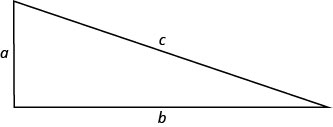
We will use this formula in the next example.
The next example uses the function that gives the height of an object as a function of time when it is thrown from 80 feet above the ground.
Key Concepts
- Polynomial Equation: A polynomial equation is an equation that contains a polynomial expression. The degree of the polynomial equation is the degree of the polynomial.
- Quadratic Equation: An equation of the form is called a quadratic equation.
- Zero Product Property: If then either or or both.
- How to use the Zero Product Property
- Set each factor equal to zero.
- Solve the linear equations.
- Check.
- How to solve a quadratic equation by factoring.
- Write the quadratic equation in standard form,
- Factor the quadratic expression.
- Use the Zero Product Property.
- Solve the linear equations.
- Check. Substitute each solution separately into the original equation.
- Zero of a Function: For any function f, if then x is a zero of the function.
- How to use a problem solving strategy to solve word problems.
- Read the problem. Make sure all the words and ideas are understood.
- Identify what we are looking for.
- Name what we are looking for. Choose a variable to represent that quantity.
- Translate into an equation. It may be helpful to restate the problem in one sentence with all the important information. Then, translate the English sentence into an algebraic equation.
- Solve the equation using appropriate algebra techniques.
- Check the answer in the problem and make sure it makes sense.
- Answer the question with a complete sentence.
Section Exercises
Practice Makes Perfect
Use the Zero Product Property
In the following exercises, solve.
Solve Quadratic Equations by Factoring
In the following exercises, solve.
Solve Equations with Polynomial Functions
In the following exercises, solve.
For the function, ⓐ find when ⓑ Use this information to find two points that lie on the graph of the function.
ⓐ or ⓑ
For the function, ⓐ find when ⓑ Use this information to find two points that lie on the graph of the function.
For the function, ⓐ find when ⓑ Use this information to find two points that lie on the graph of the function.
ⓐ or
ⓑ
For the function, ⓐ find when ⓑ Use this information to find two points that lie on the graph of the function.
In the following exercises, for each function, find: ⓐ the zeros of the function ⓑ the x-intercepts of the graph of the function ⓒ the y-intercept of the graph of the function.
ⓐ or
ⓑ , ⓒ
ⓐ or
ⓑ , ⓒ
Solve Applications Modeled by Quadratic Equations
In the following exercises, solve.
The product of two consecutive odd integers is 143. Find the integers.
and 11, 13
The product of two consecutive odd integers is 195. Find the integers.
The product of two consecutive even integers is 168. Find the integers.
and 12, 14
The product of two consecutive even integers is 288. Find the integers.
The area of a rectangular carpet is 28 square feet. The length is three feet more than the width. Find the length and the width of the carpet.
Width: 4 feet; Length: 7 feet.
A rectangular retaining wall has area 15 square feet. The height of the wall is two feet less than its length. Find the height and the length of the wall.
The area of a bulletin board is 55 square feet. The length is four feet less than three times the width. Find the length and the width of the a bulletin board.
Width: 5 feet; Length: 11 feet.
A rectangular carport has area 150 square feet. The width of the carport is five feet less than twice its length. Find the width and the length of the carport.
A pennant is shaped like a right triangle, with hypotenuse 10 feet. The length of one side of the pennant is two feet longer than the length of the other side. Find the length of the two sides of the pennant.
The sides are 6 feet and 8 feet.
A stained glass window is shaped like a right triangle. The hypotenuse is 15 feet. One leg is three more than the other. Find the lengths of the legs.
A reflecting pool is shaped like a right triangle, with one leg along the wall of a building. The hypotenuse is 9 feet longer than the side along the building. The third side is 7 feet longer than the side along the building. Find the lengths of all three sides of the reflecting pool.
The building side is 8 feet, the hypotenuse is 17 feet, and the third side is 15 feet.
A goat enclosure is in the shape of a right triangle. One leg of the enclosure is built against the side of the barn. The other leg is 4 feet more than the leg against the barn. The hypotenuse is 8 feet more than the leg along the barn. Find the three sides of the goat enclosure.
Juli is going to launch a model rocket in her back yard. When she launches the rocket, the function models the height, h, of the rocket above the ground as a function of time, t. Find:
ⓐ the zeros of this function, which tell us when the rocket will be on the ground. ⓑ the time the rocket will be 16 feet above the ground.
ⓐ 0 seconds and 2 seconds ⓑ 1 second
Gianna is going to throw a ball from the top floor of her middle school. When she throws the ball from 48 feet above the ground, the function models the height, h, of the ball above the ground as a function of time, t. Find:
ⓐ the zeros of this function which tells us when the ball will hit the ground. ⓑ the time(s) the ball will be 48 feet above the ground. ⓒ the height the ball will be at seconds which is when the ball will be at its highest point.
Writing Exercises
Explain how you solve a quadratic equation. How many answers do you expect to get for a quadratic equation?
Answers will vary.
Give an example of a quadratic equation that has a GCF and none of the solutions to the equation is zero.
Self Check
ⓐ After completing the exercises, use this checklist to evaluate your mastery of the objectives of this section.
ⓑ Overall, after looking at the checklist, do you think you are well-prepared for the next section? Why or why not?
Chapter Review Exercises
Greatest Common Factor and Factor by Grouping
Find the Greatest Common Factor of Two or More Expressions
In the following exercises, find the greatest common factor.
Factor the Greatest Common Factor from a Polynomial
In the following exercises, factor the greatest common factor from each polynomial.
Factor by Grouping
In the following exercises, factor by grouping.
Factor Trinomials
Factor Trinomials of the Form
In the following exercises, factor each trinomial of the form
In the following examples, factor each trinomial of the form
Prime
Factor Trinomials of the Form Using Trial and Error
In the following exercises, factor completely using trial and error.
Factor Trinomials of the Form using the ‘ac’ Method
In the following exercises, factor.
Prime
Factor using substitution
In the following exercises, factor using substitution.
Factor Special Products
Factor Perfect Square Trinomials
In the following exercises, factor completely using the perfect square trinomials pattern.
Factor Differences of Squares
In the following exercises, factor completely using the difference of squares pattern, if possible.
Factor Sums and Differences of Cubes
In the following exercises, factor completely using the sums and differences of cubes pattern, if possible.
General Strategy for Factoring Polynomials
Recognize and Use the Appropriate Method to Factor a Polynomial Completely
In the following exercises, factor completely.
prime
Polynomial Equations
Use the Zero Product Property
In the following exercises, solve.
Solve Quadratic Equations by Factoring
In the following exercises, solve.
Solve Equations with Polynomial Functions
In the following exercises, solve.
For the function, ⓐ find when ⓑ Use this information to find two points that lie on the graph of the function.
ⓐ or
ⓑ
For the function, ⓐ find when ⓑ Use this information to find two points that lie on the graph of the function.
In each function, find: ⓐ the zeros of the function ⓑ the x-intercepts of the graph of the function ⓒ the y-intercept of the graph of the function.
ⓐ or
ⓑ ⓒ
Solve Applications Modeled by Quadratic Equations
In the following exercises, solve.
The product of two consecutive odd numbers is 399. Find the numbers.
The numbers are and or 19 and 21.
The area of a rectangular shaped patio 432 square feet. The length of the patio is 6 feet more than its width. Find the length and width.
A ladder leans against the wall of a building. The length of the ladder is 9 feet longer than the distance of the bottom of the ladder from the building. The distance of the top of the ladder reaches up the side of the building is 7 feet longer than the distance of the bottom of the ladder from the building. Find the lengths of all three sides of the triangle formed by the ladder leaning against the building.
The lengths are 8, 15, and 17 ft.
Shruti is going to throw a ball from the top of a cliff. When she throws the ball from 80 feet above the ground, the function models the height, h, of the ball above the ground as a function of time, t. Find: ⓐ the zeros of this function which tells us when the ball will hit the ground. ⓑ the time(s) the ball will be 80 feet above the ground. ⓒ the height the ball will be at seconds which is when the ball will be at its highest point.
Chapter Practice Test
In the following exercises, factor completely.
In the following exercises, solve
The product of two consecutive integers is 156. Find the integers.
The area of a rectangular place mat is 168 square inches. Its length is two inches longer than the width. Find the length and width of the placemat.
The width is 12 inches and the length is 14 inches.
Jing is going to throw a ball from the balcony of her condo. When she throws the ball from 80 feet above the ground, the function models the height, h, of the ball above the ground as a function of time, t. Find: ⓐ the zeros of this function which tells us when the ball will hit the ground. ⓑ the time(s) the ball will be 128 feet above the ground. ⓒ the height the ball will be at seconds.
For the function, ⓐ find when ⓑ Use this information to find two points that lie on the graph of the function.
ⓐ or ⓑ
For the function find: ⓐ the zeros of the function ⓑ the x-intercepts of the graph of the function ⓒ the y-intercept of the graph of the function.
Adapted from Intermediate Algebra 2e by OpenStax (openstax.org), licensed under CC BY-NC-SA 4.0. Changes were made. License: CC-BY-NC-SA-4.0.