
10.3 Solve Quadratic Equations Using the Quadratic Formula
When we solved quadratic equations in the last section by completing the square, we took the same steps every time. By the end of the exercise set, you may have been wondering ‘isn’t there an easier way to do this?’ The answer is ‘yes.’ In this section, we will derive and use a formula to find the solution of a quadratic equation.
We have already seen how to solve a formula for a specific variable ‘in general’ so that we would do the algebraic steps only once and then use the new formula to find the value of the specific variable. Now, we will go through the steps of completing the square in general to solve a quadratic equation for x. It may be helpful to look at one of the examples at the end of the last section where we solved an equation of the form as you read through the algebraic steps below, so you see them with numbers as well as ‘in general.’
| We start with the standard form of a quadratic equation and solve it for x by completing the square. | |
|---|---|
| Isolate the variable terms on one side. | |
| Make leading coefficient 1, by dividing by a. | |
| Simplify. | |
| To complete the square, find and add it to both sides of the equation. | |
| The left side is a perfect square, factor it. | |
| Find the common denominator of the right side and write equivalent fractions with the common denominator. | |
| Simplify. | |
| Combine to one fraction. | |
| Use the square root property. | |
| Simplify. | |
| Add to both sides of the equation. | |
| Combine the terms on the right side. |
This last equation is the Quadratic Formula.
To use the Quadratic Formula, we substitute the values of into the expression on the right side of the formula. Then, we do all the math to simplify the expression. The result gives the solution(s) to the quadratic equation.
If you say the formula as you write it in each problem, you’ll have it memorized in no time. And remember, the Quadratic Formula is an equation. Be sure you start with ‘’.
When we solved quadratic equations by using the Square Root Property, we sometimes got answers that had radicals. That can happen, too, when using the Quadratic Formula. If we get a radical as a solution, the final answer must have the radical in its simplified form.
We cannot take the square root of a negative number. So, when we substitute , , and into the Quadratic Formula, if the quantity inside the radical is negative, the quadratic equation has no real solution. We will see this in the next example.
The quadratic equations we have solved so far in this section were all written in standard form, . Sometimes, we will need to do some algebra to get the equation into standard form before we can use the Quadratic Formula.
When we solved linear equations, if an equation had too many fractions we ‘cleared the fractions’ by multiplying both sides of the equation by the LCD. This gave us an equivalent equation—without fractions—to solve. We can use the same strategy with quadratic equations.
Think about the equation . We know from the Zero Products Principle that this equation has only one solution: .
We will see in the next example how using the Quadratic Formula to solve an equation with a perfect square also gives just one solution.
Use the Discriminant to Predict the Number of Solutions of a Quadratic Equation
When we solved the quadratic equations in the previous examples, sometimes we got two solutions, sometimes one solution, sometimes no real solutions. Is there a way to predict the number of solutions to a quadratic equation without actually solving the equation?
Yes, the quantity inside the radical of the Quadratic Formula makes it easy for us to determine the number of solutions. This quantity is called the discriminant.
Let’s look at the discriminant of the equations in Example 1, Example 5, and Example 8, and the number of solutions to those quadratic equations.
| Quadratic Equation (in standard form) | Discriminant | Sign of the Discriminant | Number of real solutions | |
|---|---|---|---|---|
| Example 1 | + | 2 | ||
| Example 8 | 0 | 1 | ||
| Example 5 | − | 0 |
When the discriminant is positive the quadratic equation has two solutions.
When the discriminant is zero the quadratic equation has one solution.
When the discriminant is negative the quadratic equation has no real solutions.
Identify the Most Appropriate Method to Use to Solve a Quadratic Equation
We have used four methods to solve quadratic equations:
- Factoring
- Square Root Property
- Completing the Square
- Quadratic Formula
You can solve any quadratic equation by using the Quadratic Formula, but that is not always the easiest method to use.
What about the method of completing the square? Most people find that method cumbersome and prefer not to use it. We needed to include it in this chapter because we completed the square in general to derive the Quadratic Formula. You will also use the process of completing the square in other areas of algebra.
Key Concepts
- Quadratic Formula The solutions to a quadratic equation of the form are given by the formula:
- Solve a Quadratic Equation Using the Quadratic Formula
To solve a quadratic equation using the Quadratic Formula.- Write the quadratic formula in standard form. Identify the values.
- Write the quadratic formula. Then substitute in the values of
- Simplify.
- Check the solutions.
- Using the Discriminant, , to Determine the Number of Solutions of a Quadratic Equation
For a quadratic equation of the form- if , the equation has 2 solutions.
- if , the equation has 1 solution.
- if , the equation has no real solutions.
- To identify the most appropriate method to solve a quadratic equation:
- Try Factoring first. If the quadratic factors easily this method is very quick.
- Try the Square Root Property next. If the equation fits the form or , it can easily be solved by using the Square Root Property.
- Use the Quadratic Formula. Any other quadratic equation is best solved by using the Quadratic Formula.
Practice Makes Perfect
Solve Quadratic Equations Using the Quadratic Formula
In the following exercises, solve by using the Quadratic Formula.
no real solution
Use the Discriminant to Predict the Number of Solutions of a Quadratic Equation
In the following exercises, determine the number of solutions to each quadratic equation.
- ⓐ
- ⓑ
- ⓒ
- ⓓ
ⓐ no real solutions ⓑ 1
ⓒ 2 ⓓ no real solutions
- ⓐ
- ⓑ
- ⓒ
- ⓓ
- ⓐ
- ⓑ
- ⓒ
- ⓓ
ⓐ 1 ⓑ no real solutions
ⓒ 1 ⓓ 2
- ⓐ
- ⓑ
- ⓒ
- ⓓ
Identify the Most Appropriate Method to Use to Solve a Quadratic Equation
In the following exercises, identify the most appropriate method (Factoring, Square Root, or Quadratic Formula) to use to solve each quadratic equation. Do not solve.
ⓐ ⓑ ⓒ
ⓐ factor ⓑ square root
ⓒ Quadratic Formula
ⓐ ⓑ ⓒ
ⓐ ⓑ ⓒ
ⓐ square root ⓑ square root
ⓒ factor
ⓐ ⓑ ⓒ
Everyday Math
A flare is fired straight up from a ship at sea. Solve the equation for , the number of seconds it will take for the flare to be at an altitude of 640 feet.
5 seconds, 8 seconds
An architect is designing a hotel lobby. She wants to have a triangular window looking out to an atrium, with the width of the window 6 feet more than the height. Due to energy restrictions, the area of the window must be 140 square feet. Solve the equation for , the height of the window.
Writing Exercises
Solve the equation
ⓐ by completing the square
ⓑ using the Quadratic Formula
ⓒ Which method do you prefer? Why?
ⓐ ⓑ
ⓒ answers will vary
Solve the equation
ⓐ by completing the square
ⓑ using the Quadratic Formula
ⓒ Which method do you prefer? Why?
Self Check
ⓐ After completing the exercises, use this checklist to evaluate your mastery of the objectives of this section.
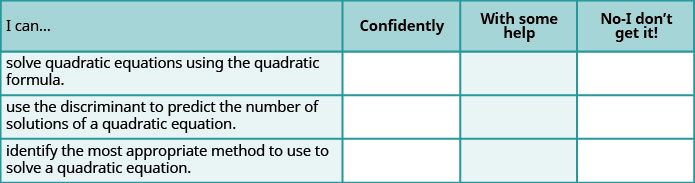
ⓑ What does this checklist tell you about your mastery of this section? What steps will you take to improve?