
10.2 Solve Quadratic Equations by Completing the Square
So far, we have solved quadratic equations by factoring and using the Square Root Property. In this section, we will solve quadratic equations by a process called ‘completing the square.’
Complete The Square of a Binomial Expression
In the last section, we were able to use the Square Root Property to solve the equation because the left side was a perfect square.
We also solved an equation in which the left side was a perfect square trinomial, but we had to rewrite it the form in order to use the square root property.
What happens if the variable is not part of a perfect square? Can we use algebra to make a perfect square?
Let’s study the binomial square pattern we have used many times. We will look at two examples.
We can use this pattern to “make” a perfect square.
We will start with the expression . Since there is a plus sign between the two terms, we will use the pattern.
Notice that the first term of is a square, .
We now know .
What number can we add to to make a perfect square trinomial?

The middle term of the Binomial Squares Pattern, , is twice the product of the two terms of the binomial. This means twice the product of and some number is . So, two times some number must be six. The number we need is The second term in the binomial, must be 3.
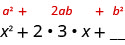
We now know .
Now, we just square the second term of the binomial to get the last term of the perfect square trinomial, so we square three to get the last term, nine.

We can now factor to

So, we found that adding nine to ‘completes the square,’ and we write it as .
Solve Quadratic Equations of the Form x2 + bx + c = 0 by completing the square
In solving equations, we must always do the same thing to both sides of the equation. This is true, of course, when we solve a quadratic equation by completing the square, too. When we add a term to one side of the equation to make a perfect square trinomial, we must also add the same term to the other side of the equation.
For example, if we start with the equation and we want to complete the square on the left, we will add nine to both sides of the equation.
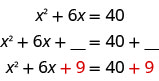
Then, we factor on the left and simplify on the right.
Now the equation is in the form to solve using the Square Root Property. Completing the square is a way to transform an equation into the form we need to be able to use the Square Root Property.
In the previous example, there was no real solution because was equal to a negative number.
We will start the next example by isolating the variable terms on the left side of the equation.
To solve the next equation, we must first collect all the variable terms to the left side of the equation. Then, we proceed as we did in the previous examples.
Notice that the left side of the next equation is in factored form. But the right side is not zero, so we cannot use the Zero Product Property. Instead, we multiply the factors and then put the equation into the standard form to solve by completing the square.
Solve Quadratic Equations of the form ax2 + bx + c = 0 by completing the square
The process of completing the square works best when the leading coefficient is one, so the left side of the equation is of the form . If the term has a coefficient, we take some preliminary steps to make the coefficient equal to one.
Sometimes the coefficient can be factored from all three terms of the trinomial. This will be our strategy in the next example.
To complete the square, the leading coefficient must be one. When the leading coefficient is not a factor of all the terms, we will divide both sides of the equation by the leading coefficient. This will give us a fraction for the second coefficient. We have already seen how to complete the square with fractions in this section.
Key Concepts
- Binomial Squares Pattern If are real numbers,


- Complete a Square
To complete the square of :- Identify , the coefficient of .
- Find , the number to complete the square.
- Add the to .
Practice Makes Perfect
Complete the Square of a Binomial Expression
In the following exercises, complete the square to make a perfect square trinomial. Then, write the result as a binomial squared.
Solve Quadratic Equations of the Form by Completing the Square
In the following exercises, solve by completing the square.
no real solution
no real solution
Solve Quadratic Equations of the Form by Completing the Square
In the following exercises, solve by completing the square.
Everyday Math
Rafi is designing a rectangular playground to have an area of 320 square feet. He wants one side of the playground to be four feet longer than the other side. Solve the equation for , the length of one side of the playground. What is the length of the other side?
16 feet, 20 feet
Yvette wants to put a square swimming pool in the corner of her backyard. She will have a 3 foot deck on the south side of the pool and a 9 foot deck on the west side of the pool. She has a total area of 1080 square feet for the pool and two decks. Solve the equation for , the length of a side of the pool.
Writing Exercises
Solve the equation ⓐ by using the Square Root Property and ⓑ by completing the square. ⓒ Which method do you prefer? Why?
ⓐ ⓑ ⓒ Answers will vary.
Solve the equation by completing the square and explain all your steps.
Self Check
ⓐ After completing the exercises, use this checklist to evaluate your mastery of the objectives of this section.
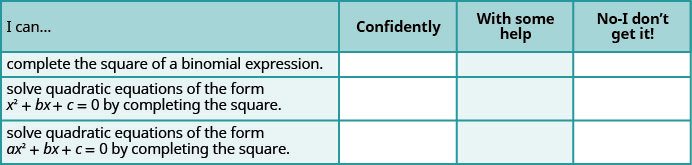
ⓑ After reviewing this checklist, what will you do to become confident for all objectives?