
3.2 Arithmetic and Geometric Sequences
We now turn to the question of finding closed formulas for particular types of sequences.
How do we know this? For the recursive definition, we need to specify . Then we need to express in terms of . If we call the first term , then . For the recurrence relation, by the definition of an arithmetic sequence, the difference between successive terms is some constant, say . So , or in other words,
.
To find a closed formula, first write out the sequence in general:
We see that to find the th term, we need to start with and then add a bunch of times. In fact, add it times. Thus .
What about sequences like ? This is not arithmetic because the difference between terms is not constant. However, the ratio between successive terms is constant. We call such sequences geometric.
The recursive definition for the geometric sequence with initial term and common ratio is . To get the next term we multiply the previous term by . We can find the closed formula like we did for the arithmetic progression. Write
We must multiply the first term by a number of times, times to be precise. We get .
In the examples and formulas above, we assumed that the initial term was . If your sequence starts with , you can easily find the term that would have been and use that in the formula. For example, if we want a formula for the sequence and insist that , then we can find (since the sequence is arithmetic with common difference 3, we have ). Then the closed formula will be .
Sums of Arithmetic and Geometric Sequences
Look at the sequence which starts . These are called the triangular numbers since they represent the number of dots in an equilateral triangle (think of how you arrange 10 bowling pins: a row of 4 plus a row of 3 plus a row of 2 and a row of 1).
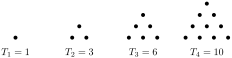
Is this sequence arithmetic? No, since and , so there is no common difference. Is the sequence geometric? No. but , so there is no common ratio. What to do?
Notice that the differences between terms do form an arithmetic sequence: . This means that the th term of the sequence is the sum of the first terms in the sequence . We say that is the sequence of partial sums of the sequence (partial sums because we are not taking the sum of all infinitely many terms).
This should become clearer if we write the triangular numbers like this:
.
If we know how to add up the terms of an arithmetic sequence, we could find a closed formula for a sequence whose differences are the terms of that arithmetic sequence. Consider how we could find the sum of the first 100 positive integers (that is, ). Instead of adding them in order, we regroup and add . The next pair to combine is . Then . Keep going. This gives 50 pairs which each add up to , so .1
In general, using this same sort of regrouping, we find that . Incidentally, this is exactly the same as , which makes sense if you think of the triangular numbers as counting the number of handshakes that take place at a party with people: the first person shakes hands, the next shakes an additional hands and so on.
The point of all of this is that some sequences, while not arithmetic or geometric, can be interpreted as the sequence of partial sums of arithmetic and geometric sequences. Luckily there are methods we can use to compute these sums quickly.
Summing Arithmetic Sequences: Reverse and Add
Here is a technique that allows us to quickly find the sum of an arithmetic sequence.
This will work for the sum of any arithmetic sequence. Call the sum . Reverse and add. This produces a single number added to itself many times. Find the number of times. Multiply. Divide by 2. Done.
Besides finding sums, we can use this technique to find closed formulas for sequences we recognize as sequences of partial sums.
Summing Geometric Sequences: Multiply, Shift and Subtract
To find the sum of a geometric sequence, we cannot just reverse and add. Do you see why? The reason we got the same term added to itself many times is because there was a constant difference. So as we added that difference in one direction, we subtracted the difference going the other way, leaving a constant total. For geometric sums, we have a different technique.
To better see what happened in the above example, try writing it this way:
Then divide both sides by and we have the same result for . The idea is, by multiplying the sum by the common ratio, each term becomes the next term. We shift over the sum to get the subtraction to mostly cancel out, leaving just the first term and new last term.
Even though this might seem like a new technique, you have probably used it before.
Is there a pair of integers such that is part of an arithmetic sequences and is part of a geometric sequence with all integers?
Consider the sequence (with ). By looking at the differences between terms, express the sequence as a sequence of partial sums. Then find a closed formula for the sequence by computing the th partial sum.
We have , , , , and so on. The terms in the sums are given by the arithmetic sequence . In other words, . To find the closed formula, we reverse and add. We get (we have there because there are terms in the sum for ).
Starting with any rectangle, we can create a new, larger rectangle by attaching a square to the longer side. For example, if we start with a rectangle, we would glue on a square, forming a rectangle:
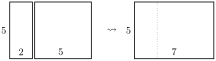
The next rectangle would be formed by attaching a square to the top or bottom of the rectangle.
- Create a sequence of rectangles using this rule starting with a rectangle. Then write out the sequence of perimeters for the rectangles (the first term of the sequence would be 6, since the perimeter of a rectangle is 6 - the next term would be 10).
- Repeat the above part this time starting with a rectangle.
- Find recursive formulas for each of the sequences of perimeters you found in parts (a) and (b). Don't forget to give the initial conditions as well.
- Are the sequences arithmetic? Geometric? If not, are they close to being either of these (i.e., are the differences or ratios almost constant)? Explain.
If you have enough toothpicks, you can make a large triangular grid. Below, are the triangular grids of size 1 and of size 2. The size 1 grid requires 3 toothpicks, the size 2 grid requires 9 toothpicks.


- Let be the number of toothpicks required to make a size triangular grid. Write out the first 5 terms of the sequence .
- Find a recursive definition for the sequence. Explain why you are correct.
- Is the sequence arithmetic or geometric? If not, is it the sequence of partial sums of an arithmetic or geometric sequence? Explain why your answer is correct.
- Use your results from part (c) to find a closed formula for the sequence. Show your work.
If you were to shade in a square on graph paper, you could do it the boring way (with sides parallel to the edge of the paper) or the interesting way, as illustrated below:


The interesting thing here, is that a square now has area 13. Our goal is the find a formula for the area of a (diagonal) square.
- Write out the first few terms of the sequence of areas (assume , , etc). Is the sequence arithmetic or geometric? If not, is it the sequence of partial sums of an arithmetic or geometric sequence? Explain why your answer is correct, referring to the diagonal squares.
- Use your results from part (a) to find a closed formula for the sequence. Show your work. Note, while there are lots of ways to find a closed formula here, you should use partial sums specifically.
- Find the closed formula in as many other interesting ways as you can.
Here is a surprising use of sequences to answer a counting question: How many license plates consist of 6 symbols, using only the three numerals 1, 2, and 3 and the four letters a, b, c, and d, so that no numeral appears after any letter? For example, “31ddac”, “123321”, and “ababab” are each acceptable license plates, but “13ba2c” is not.
- First answer this question by considering different cases: how many of the license plates contain no numerals? How many contain one numeral, etc.
- Now use the techniques of this section to show why the answer is .
Discrete Mathematics: An Open Introduction, 3rd edition, by Oscar Levin (discrete.openmathbooks.org), licensed under CC BY-SA 4.0; this adaptation is distributed under the same license. License: CC-BY-SA-4.0.