A sequence
is simply an ordered list of numbers.
For example, here is a sequence: 0, 1, 2, 3, 4, 5, ….
This is different from the set because,
while the sequence is a complete list of every element in the set of natural numbers,
in the sequence we very much care what order the numbers come in.
For this reason,
when we use variables to represent terms in a sequence they will look like this:
.
To refer to the entire sequence at once,
we will write or ,
or sometimes if we are being sloppy, just
(in which case we assume we start the sequence with ).
We might replace the with another letter,
and sometimes we omit , starting with ,
in which case we would use
to refer to the sequence as a whole.
The numbers in the subscripts are called indices
(the plural of index).
While we often just think of a sequence as an ordered list of numbers,
it is really a type of function.
Specifically, the sequence
is a function with domain where is the image of the natural number .
Later we will manipulate sequences in much the same way you have manipulated functions in algebra or calculus.
We can shift a sequence up or down,
add two sequences, or ask for the rate of change of a sequence.
These are done exactly as you would for functions.
That said, while keeping the rigorous mathematical definition in mind is helpful,
we often describe sequences by writing out the first few terms.
Given that no number of initial terms in a sequence is enough to say for certain which sequence we are dealing with,
we need to find another way to specify a sequence.
We consider two ways to do this:
It is easier to understand what is going on here with an example:
You might wonder why we would bother with recursive definitions for sequences.
After all, it is harder to find with a recursive definition than with a closed formula.
This is true,
but it is also harder to find a closed formula for a sequence than it is to find a recursive definition.
So to find a useful closed formula,
we might first find the recursive definition,
then use that to find the closed formula.
This is not to say that recursive definitions aren't useful in finding .
You can always calculate given a recursive definition,
it might just take a while.
Finding closed formulas,
or even recursive definitions,
for sequences is not trivial.
There is no one method for doing this.
Just as in evaluating integrals or solving differential equations,
it is useful to have a bag of tricks you can apply,
but sometimes there is no easy answer.
One useful method is to relate a given sequence to another sequence for which we already know the closed formula. To do this, we need a few “known sequences” to compare mystery sequences to. Here are a few that are good to know. We will verify the formulas for these in the coming sections.
Partial sums
Some sequences naturally arise as the sum of terms of another sequence.
Given any sequence , we can always form a new sequence by
.
Since the terms of are the sums of the initial
part of the sequence ways call the
sequence of partial sums of .
Soon we will see that it is sometimes possible to find a closed formula for from the closed formula for .
To simplify writing out these sums,
we will often use notation like .
This means add up the 's where changes from 1 to .
If we want to multiply the instead,
we could write .
For example, .
Consider the sequence that starts (i.e., the odd numbers in order).
Give a recursive definition and closed formula for the sequence.
Write out the sequence of partial sums of . Write down the recursive definition for and guess at the closed formula.
The recursive definition is with . A closed formula is .
The sequence of partial sums is . A recursive definition is (as always) which in this case is . It appears that the closed formula is
The Fibonacci sequence is
(where ).
Write out the first few terms of the sequence of partial sums:
, , ,…
Guess a formula for the sequence of partial sums expressed in terms of a single Fibonacci number. For example,
you might say ,
although that is definitely not correct.
.
.
Consider the three sequences below.
For each, find a recursive definition.
How are these sequences related?
.
.
.
The sequences all have the same recurrence relation:
(the same as the Fibonacci numbers).
The only difference is the initial conditions.
Write out the first few terms of the sequence given by ;
.
Then find a recursive definition for the sequence .
.
The recursive definition for is
with .
Write out the first few terms of the sequence given by .
Then find a closed formula for the sequence
(starting with )
.
Thus the sequence
has closed formula .
Show that is a solution to the recurrence relation .
What would the initial conditions need to be for this to be the closed formula for the sequence?
This closed formula would have
and .
Then we would have
.
So the closed formula agrees with the recurrence relation.
The closed formula has initial terms and .
Show that is also a solution to the recurrence relation .
What would the initial conditions need to be for this to be the closed formula for the sequence?
Find a closed formula for the sequence with recursive definition
with and .
You will want to write out the sequence, guess a closed formula, and then verify that you are correct.
Give two different recursive definitions for the sequence with closed formula . Prove you are correct.
At least one of the recursive definitions should makes use of two previous terms and no constants.
Write out the sequence, guess a recursive definition, and verify that the closed formula is a solution to that recursive definition.
Use summation () or product () notation to rewrite the following.
.
.
.
.
.
.
.
.
.
.
Expand the following sums and products.
That is, write them out the long way.
.
.
.
.
.
.
.
.
.
.
Suppose you draw lines in the plane so that every pair of lines cross (no lines are parallel) and no three lines cross at the same point. This will create some number of regions in the plane, including some unbounded regions. Call the number of regions . Find a recursive formula for the number of regions created by lines, and justify why your recursion is correct.
Try an example: when you draw the 4th line, it will cross three other lines, so will be divided into four segments, two of which are infinite. Each segment will divide a previous region into two.
A ternary string is a sequence of 0's, 1's and 2's. Just like a bit string, but with three symbols.
Let's call a ternary string good provided it never contains a 2 followed immediately by a 0. Let be the number of good strings of length . For example, , and (since of the 9 ternary strings of length 2, only one is not good).
Find, with justification, a recursive formula for , and use it to compute .
Consider three cases: the last digit is a 0, a 1, or a 2. Two of these should be easy to count, but strings ending in 0 cannot be proceeded by a 2, so require a little more work.
Consider bit strings with length and weight
(so strings of 0's and 1's, including 1's).
We know how to count the number of these for a fixed and .
Now, we will count the number of strings for which the sum
of the length and the weight is fixed.
For example,
let's count all the bit strings for which .
Find examples of these strings of different lengths.
What is the longest string possible?
What is the shortest?
How many strings are there of each of these lengths.
Use this to count the total number of strings
(with sum 11).
The other approach: Let vary.
How many strings have sum ?
How many have sum ?
And so on.
Find and explain a recurrence relation for the sequence which gives the number of strings with sum .
Describe what you have found above in terms of Pascal's Triangle.
What pattern have you discovered?
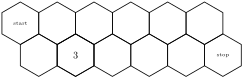
When bees play chess,
they use a hexagonal board like the one shown below.
The queen bee can move one space at a time either directly to the right or angled up-right or down-right
(but can never move leftwards).
How many different paths can the queen take from the top left hexagon to the bottom right hexagon?
Explain your answer, and this relates to the previous question.
(As an example,
there are three paths to get to the second hexagon on the bottom row.)
Think recursively, like you did in Pascal's triangle.
Let denote the number of ways to tile a chessboard using dominoes. Write out the first few terms of the sequence and then give a recursive definition. Explain why your recursive formula is correct.
There is only one way to tile a board, and two ways to tile a board (you can orient the dominoes in two ways). In general, consider the two ways the domino covering the top left corner could be oriented.
Discrete Mathematics: An Open Introduction, 3rd edition, by Oscar Levin (discrete.openmathbooks.org), licensed under CC BY-SA 4.0; this adaptation is distributed under the same license. License: CC-BY-SA-4.0.
These eBooks are a prerelease and are not yet certified conformant with WCAG 2.1 AA or ADA Title II. Every page is built against an automated accessibility gate, and the published editions will meet ADA Title II requirements when they release in late September 2026. If something is unusable, please tell us.