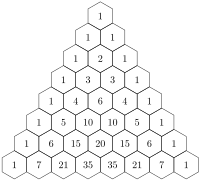
Have a look again at Pascal's triangle.
Forget for a moment where it comes from.
Just look at it as a mathematical object.
What do you notice?
There are lots of patterns hidden away in the triangle,
enough to fill a reasonably sized book.
Here are just a few of the most obvious ones:
The entries on the border of the triangle are all 1.
Any entry not on the border is the sum of the two entries above it.
The triangle is symmetric.
In any row, entries on the left side are mirrored on the right side.
The sum of all entries on a given row is a power of 2. (You should check this!)
We would like to state these observations in a more precise way,
and then prove that they are correct.
Now each entry in Pascal's triangle is in fact a binomial coefficient.
The 1 on the very top of the triangle is .
The next row
(which we will call row 1, even though it is not the top-most row)
consists of and .
Row 4 (the row 1, 4, 6, 4, 1) consists of the binomial coefficients
.
Given this description of the elements in Pascal's triangle,
we can rewrite the above observations as follows:
and .
.
.
.
Each of these is an example of a
binomial identity
: an identity (i.e., equation) involving binomial coefficients.
Our goal is to establish these identities.
We wish to prove that they hold for all values of and .
These proofs can be done in many ways.
One option would be to give algebraic proofs,
using the formula for :
.
Here's how you might do that for the second identity above.
This is certainly a valid proof,
but also is entirely useless.
Even if you understand the proof perfectly,
it does not tell you why the identity is true.
A better approach would be to explain what means
and then say why that is also what means.
Let's see how this works for the four identities we observed above.
Hopefully this gives some idea of how explanatory proofs of binomial identities can go.
It is worth pointing out that more traditional proofs can also be beautiful.1 For example,
consider the following rather slick proof of the last identity.
Expand the binomial :
.
Let and .
We get:
.
Of course this simplifies to:
.
Something fun to try: Let and .
Neat huh?
More Proofs
The explanatory proofs given in the above examples are typically called
combinatorial proofs.
In general, to give a combinatorial proof for a binomial identity,
say you do the following:
Find a counting problem you will be able to answer in two ways.
Explain why one answer to the counting problem is .
Explain why the other answer to the counting problem is .
Since both and are the answers to the same question,
we must have .
The tricky thing is coming up with the question.
This is not always obvious,
but it gets easier the more counting problems you solve.
You will start to recognize types of answers as the answers to types of questions.
More often what will happen is you will be solving a counting problem and happen to think up two different ways of finding the answer.
Now you have a binomial identity and the proof is right there.
The proof is the problem you just solved together with your two solutions.
For example, consider this counting question:
How many 10-letter words use exactly four A's, three B's, two C's and one D?
Let's try to solve this problem.
We have 10 spots for letters to go.
Four of those need to be A's.
We can pick the four A-spots in ways.
Now where can we put the B's?
Well there are only 6 spots left,
we need to pick of them.
This can be done in ways.
The two C's need to go in two of the 3 remaining spots,
so we have ways of doing that.
That leaves just one spot of the D, but we could write that 1 choice as .
Thus the answer is:
.
But why stop there?
We can find the answer another way too.
First let's decide where to put the one D: we have 10 spots,
we need to choose 1 of them, so this can be done in ways.
Next, choose one of the ways to place the two C's.
We now have spots left,
and three of them need to be filled with B's.
There are ways to do this.
Finally the A's can be placed in
(that is, only one)
ways.
So another answer to the question is
.
Interesting.
This gives us the binomial identity:
.
Here are a couple more binomial identities with combinatorial proofs.
Give a combinatorial proof of the identity .
Suppose you own fezzes and bow ties. Of course, and are both greater than 1.
How many combinations of fez and bow tie can you make? You can wear only one fez and one bow tie at a time. Explain.
Explain why the answer is also . (If this is what you claimed the answer was in part (a), try it again.)
Use your answers to parts (a) and (b) to give a combinatorial proof of the identity
.
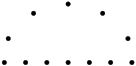
How many triangles can you draw using the dots below as vertices?
Find an expression for the answer which is the sum of three terms involving binomial coefficients.
Find an expression for the answer which is the difference of two binomial coefficients.
Generalize the above to state and prove a binomial identity using a combinatorial proof. Say you have points on the horizontal axis and points in the semi-circle.
There will be 185 triangles. But to find them …
How many vertices of the triangle can be on the horizontal axis?
Will any three dots work as the vertices?
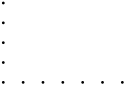
Consider all the triangles you can create using the points shown below as vertices.
Note, we are not allowing degenerate triangles
(ones with all three vertices on the same line)
but we do allow non-right triangles.
Find the number of triangles,
and explain why your answer is correct.
Find the number of triangles again, using a different method.
Explain why your new method works.
State a binomial identity that your two answers above establish
(that is, give the binomial identity that your two answers a proof for).
Then generalize this using 's and 's.
The answer is 120.
A woman is getting married.
She has 15 best friends but can only select 6 of them to be her bridesmaids,
one of which needs to be her maid of honor.
How many ways can she do this?
What if she first selects the 6 bridesmaids,
and then selects one of them to be the maid of honor?
What if she first selects her maid of honor,
and then 5 other bridesmaids?
Explain why .
She has ways to select the 6 bridesmaids,
and then for each way, has 6 choices for the maid of honor.
Thus she has choices.
She has 15 choices for who will be her maid of honor.
Then she needs to select 5 of the remaining 14 friends to be bridesmaids,
which she can do in ways.
Thus she has choices.
We have answered the question
(how many wedding parties can the bride choose from)
in two ways.
The first way gives the left-hand side of the identity and the second way gives the right-hand side of the identity.
Therefore the identity holds.
Consider the identity:
.
Is this true?
Try it for a few values of and .
Use the formula for to give an algebraic proof of the identity.
Give a combinatorial proof of this identity. Hint: What if some number of a group of people wanted to go to an escape room, and among those going, one needed to be the team captain?
Give an alternate proof by multiplying out and taking derivatives of both sides.
For the combinatorial proof: what if you don't yet know how many bridesmaids you will have?
Give a combinatorial proof for the identity .
Count handshakes.
Consider the bit strings in
(bit strings of length 6 and weight 2).
How many of those bit strings start with 1?
How many of those bit strings start with 01?
How many of those bit strings start with 001?
Are there any other strings we have not counted yet?
Which ones, and how many are there?
How many bit strings are there total in ?
What binomial identity have you just given a combinatorial proof for?
Let's count ternary digit strings,
that is, strings in which each digit can be 0, 1, or 2.
How many ternary digit strings contain exactly digits?
How many ternary digit strings contain exactly digits and 2's.
How many ternary digit strings contain exactly digits and 2's. (Hint:
where can you put the non-2 digit,
and then what could it be?)
How many ternary digit strings contain exactly digits and 2's. (Hint:
see previous hint)
How many ternary digit strings contain exactly digits and 2's.
How many ternary digit strings contain exactly digits and no 2's. (Hint:
what kind of a string is this?)
Use the above parts to give a combinatorial proof for the identity
.
How many ways are there to rearrange the letters in the word “rearrange”?
Answer this question in at least two different ways to establish a binomial identity.
Establish the identity below using a combinatorial proof.
In Example we established that the sum of any row in Pascal's triangle is a power of two. Specifically,
.
The argument given there used the counting question, “how many pizzas can you build using any number of different toppings?” To practice, give new proofs of this identity using different questions.
Use a question about counting subsets.
Use a question about counting bit strings.
Use a question about counting lattice paths.
For the lattice paths, think about what sort of paths would count. Not all the paths will end at the same point, but you could describe the set of end points as a line.
Discrete Mathematics: An Open Introduction, 3rd edition, by Oscar Levin (discrete.openmathbooks.org), licensed under CC BY-SA 4.0; this adaptation is distributed under the same license. License: CC-BY-SA-4.0.
These eBooks are a prerelease and are not yet certified conformant with WCAG 2.1 AA or ADA Title II. Every page is built against an automated accessibility gate, and the published editions will meet ADA Title II requirements when they release in late September 2026. If something is unusable, please tell us.